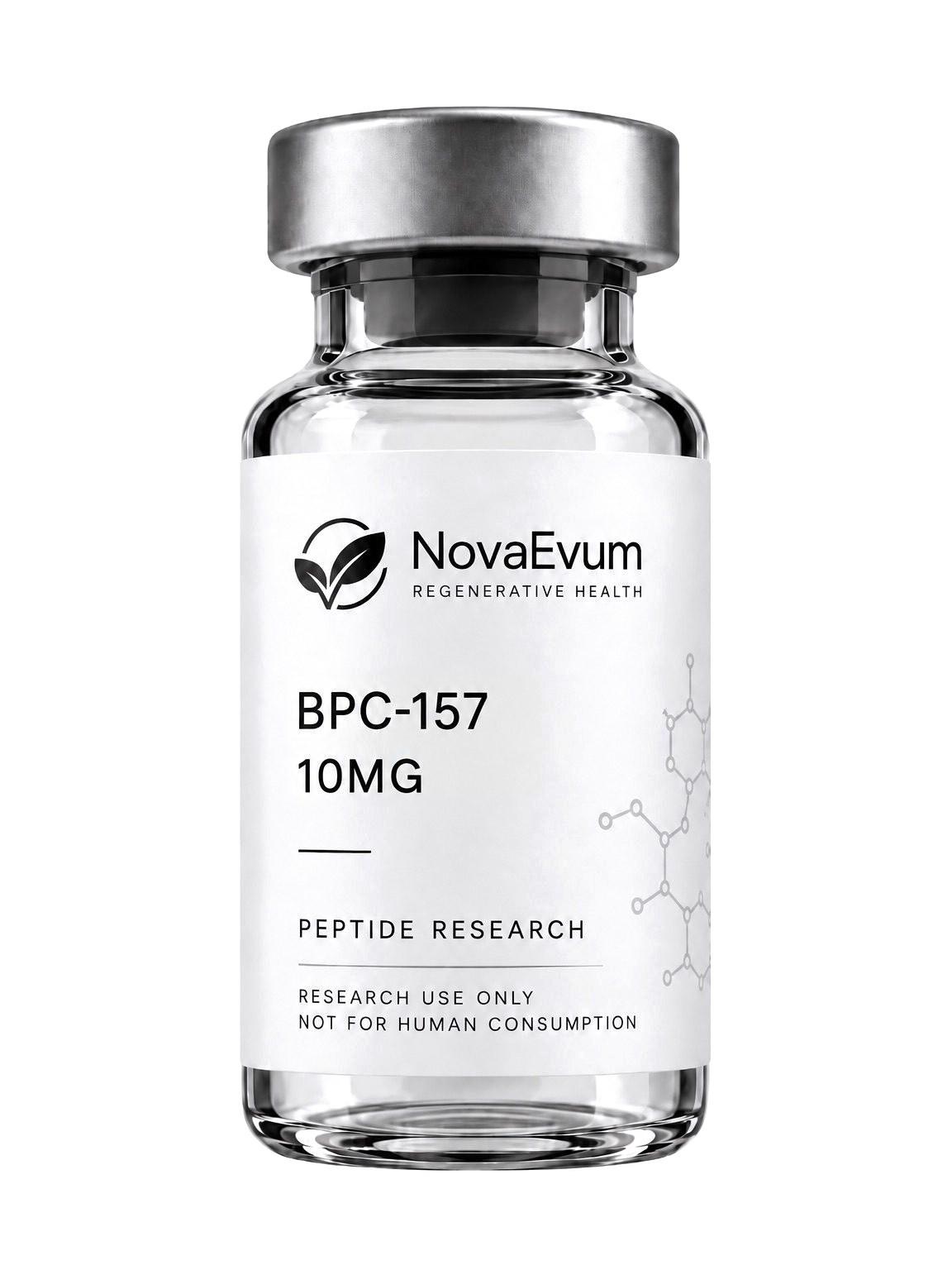
BPC-157 (BPC) research peptide, Canada
BPC · Body protection compound 157 · PL 14736 · Shipped across Canada
Each vial contains 10 mg of BPC-157.
BPC-157 is a synthetic fifteen-amino-acid sequence, described as derived from a protein found in gastric juice. Its literature is almost entirely rodent: tendon, ligament, muscle and gastrointestinal injury models, alongside work on nitric oxide and growth-factor signalling. Much of that body of work comes from a small number of research groups, which is a limitation worth knowing about. No controlled human trials have been published.
- Lyophilized powder, requires reconstitution
Price
$65.00 CAD
$6.50 / mg
In stock
- 24/7 customer support
- Lab tested purity & quality
- Free shipping on all orders




BPC-157 in Canada
Ships from Toronto to anywhere in Canada, priced in Canadian dollars, payable by Interac e-Transfer or card.
Specification
- CAS number
- 137525-51-0
- Molecular formula
- C62H98N16O22
- Molecular weight
- 1,419.5 g/mol
- Sequence
- GEPPPGKPADDAGLV
- Purity
- ≥ 99.56% by RP-HPLC
- Form
- Lyophilized powder
- Third-party assay
- Purity, fill and endotoxin
- Storage
- Refrigerated, 2-8 °C
- Lot
- NVE-2417-B
How it works
A literature that has not been reproduced widely is a different thing from one that has, and that is the first thing to know before reading any of this one. What follows is the rodent models the work used, and the pathway it is still arguing about.
Gastrointestinal models
Where it was characterised
The models it was first described in: gastric and intestinal lesions in rats, and work on the mucosal lining under various insults.
Tendon and ligament models
Connective tissue
Rodent injury models measuring cell outgrowth from tendon explants and the tensile properties of the tissue afterwards.
Nitric oxide signalling
Proposed pathway
Examined as a candidate mechanism, alongside growth-factor receptor expression. Proposed rather than established — the pathway is still what the animal work is arguing about.
Where the evidence stands
Preclinical. No controlled human trials have been published. Not approved as a medicine.
Laboratory results
- Purity+Fill+Endotoxin99.56% purity; endotoxin passFreedom Diagnostics · Jul 2026 · 10 mgOpen
- Purity+Fill98.690%Janoshik · Jul 2026 · 10 mgOpen
Opened as the laboratory issued them, unedited. Every certificate we publish
Research reading
New BPC-157 research
- Week of 9 November 2026Possibilities for Cytoprotective Liver Therapy, Stable Gastric Pentadecapeptide BPC 157, and Standard Agents-A Narrative ReviewPharmaceuticals (Basel) · 2026 Oct
- Week of 2 November 2026Investigational Peptides in Orthopaedic Practice: Evidence, Safety, and Patient Counseling for BPC-157, Thymosin Beta-4, and TB-500J Am Acad Orthop Surg · 2026 Oct 27
Research use only
Supplied as a laboratory research chemical. Not a drug, food or cosmetic, and not for human or veterinary use. No application guidance is provided or implied.
What BPC-157 is
BPC-157 is a synthetic peptide of fifteen amino acids. It was described in 1993 by Pavel Sikiric’s group in Zagreb as a fragment of a larger protein, of about 40 kDa, that the group isolated from gastric juice and named BPC, for “body protection compound”. The name reflects that group’s hypothesis about the stomach, not an established property of the peptide.
No receptor for BPC-157 has been identified. The papers describe interactions with the nitric oxide system, with growth-factor signalling and with blood-vessel formation in rat models, but none of these has been traced to a single molecular target, which is unusual for a compound with so many publications.
| Property | BPC-157 |
|---|---|
| Sequence | GEPPPGKPADDAGLV |
| Length | 15 amino acids (a pentadecapeptide) |
| Origin | A fragment of a gastric juice protein, made synthetically |
| Other names | PL 14736, Bepecin |
| Identified receptor | None |
BPC-157 research: what has been studied
Nearly all of the BPC-157 literature is rodent work, and much of it comes from the group that first described it. The table sets out the main lines and how far each one got.
The human record is thin: a small number of uncontrolled reports, including a retrospective series and a two-person safety pilot. There is no completed controlled trial in people, so nothing in the animal work can be read as a finding about humans.
| Research area | Typical models | Evidence stage |
|---|---|---|
| Stomach and intestine | Rat lesion, fistula and surgical models | Animal |
| Tendon, ligament, muscle and bone | Rat transection models; tendon cells | Animal and cell |
| Blood vessels | Rat vascular and angiogenesis models | Animal |
| Nervous system and behaviour | Rat models | Animal |
| People | Uncontrolled case series and a safety pilot | No controlled trial |
BPC-157 vs TB-500
The two are often sold together, and sometimes described as if they were one idea. They are unrelated molecules from different sources, with different literatures, and the evidence for one says nothing about the other.
| BPC-157 | TB-500 | |
|---|---|---|
| Source | Gastric juice protein fragment | Thymosin beta-4 fragment |
| Length | 15 amino acids | 7 amino acids |
| Known target | None identified | Actin, via the parent protein |
| Most of the research | Rodent, one main group | On the full parent protein |
How to read the BPC-157 literature
Three questions do most of the work. Was the study independent of the Zagreb group? What was the model, and was the endpoint histology, mechanics or behaviour? And was the result measured against a proper control, with blinding? Independent replication is sparse, and a literature in which one laboratory produced most of the findings is exactly where those questions matter.
Buying BPC-157 in Canada
NovaEvum ships BPC-157 from Toronto to every province and territory, in 10 mg and 10 mg + spray atomizer sizes, priced in Canadian dollars.
Orders placed before 2:00 PM ET on a working day are dispatched the same day by tracked express parcel, which reaches most of Canada in one to two working days and remote areas a little later. In the Greater Toronto Area, larger orders placed before the cutoff can be couriered the same evening; the threshold is on our shipping page. Shipping is free on every order.
Pay by Interac e-Transfer, which takes 10% off the goods, or by card. Because the order ships from inside Canada, it never crosses a border: there is no customs declaration and no import hold.
Storage and laboratory handling
The specification for BPC-157 is Refrigerated, 2-8 °C. Keep sealed vials refrigerated and away from light.
Lyophilised material tolerates ambient temperature in transit; put it back into cold storage on arrival. Let a cold vial reach room temperature before opening it, so moisture does not condense on the powder.
BPC-157 FAQ
Is BPC the same as BPC-157?
Usually, yes. “BPC” is shorthand for BPC-157, body protection compound 157: a synthetic 15-amino-acid peptide based on a sequence from a gastric protein, also listed under the code PL 14736.
What does BPC stand for?
Body protection compound: the name Pavel Sikiric’s group gave to a gastric juice protein of about 40 kDa in the early 1990s. The 157 identifies the fifteen-amino-acid fragment they characterised, and the compound sold today is a synthetic copy of that fragment.
Is BPC-157 a naturally occurring hormone?
No. Its discoverers isolated a larger gastric protein and characterised this fragment of it. BPC-157 itself is a synthetic fifteen-residue peptide, and no receptor for it has been identified.
Has BPC-157 been tested in controlled human trials?
No completed controlled trial has been published. The human record is a few uncontrolled reports; almost all of the literature is rodent work, much of it from one research group in Zagreb.
Which BPC-157 sizes are available?
10 mg and 10 mg + spray atomizer, as lyophilised powder. The size selector above shows the current price and stock for each.
How is BPC-157 shipped within Canada?
From Toronto by tracked express parcel, dispatched the same working day for orders before 2:00 PM ET. Most of Canada receives it in one to two working days. Shipping is free on every order.
How should BPC-157 be stored?
At Refrigerated, 2-8 °C, sealed and away from light. Return it to cold storage on arrival.
Can I see a certificate of analysis before ordering?
Yes. Every certificate published for this compound is linked under Laboratory results on this page, stating the laboratory, the date and the vial size it covers. For the certificate covering a specific lot, contact us before ordering.
Is BPC-157 for human use?
No. It is supplied as a laboratory research chemical: not a drug, food or cosmetic, and not for human or veterinary use. No application guidance is provided or implied.