
BPC-157
BPC-157 Stability After Reconstitution: The Chemistry and the Claims
SB
· 10 min read
A summary of published research, with citations. It states no amount, schedule or route, and makes no claim about what this compound does in a person. Supplied for laboratory research use only.
On this page · 7 sections
No validated shelf life for BPC-157 in solution has been published. The peptide is often described as stable in gastric juice, but that is a different question from how a solution behaves over weeks in a vial. Its sequence has no oxidation-prone residues; its vulnerable points are two adjacent aspartates, which can isomerise without changing mass, and a proline-rich stretch that can complicate chromatography. A "90-day" purity claim means little without the method, replicates and acceptance criteria behind it — and it says nothing about sterility.
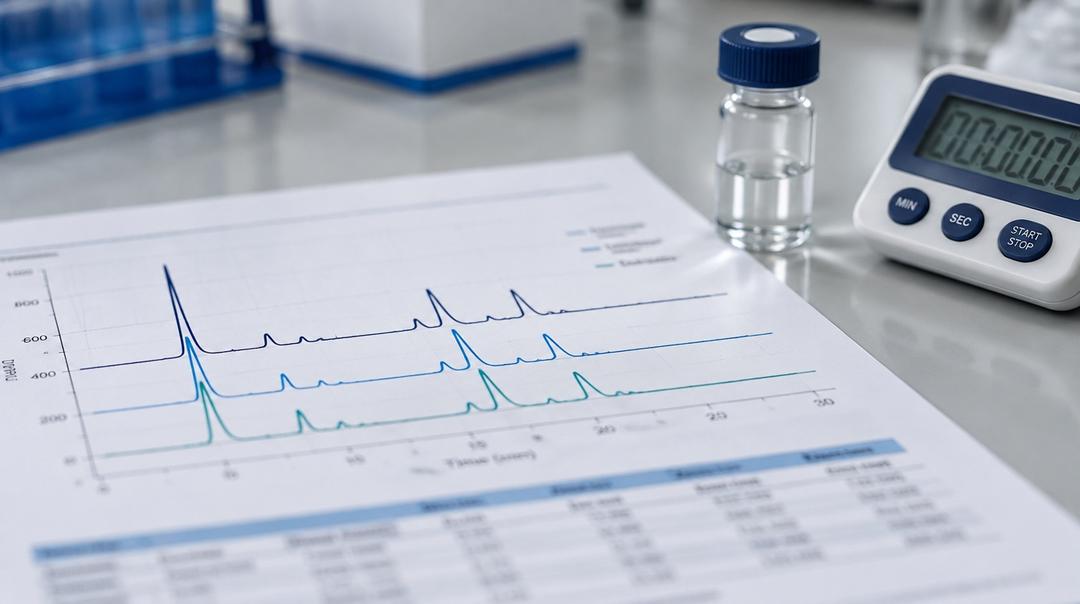
General peptide degradation chemistry is in lyophilised peptides and what degrades them. This page applies it to one fifteen-residue sequence, and to the kind of stability claim made about it most often.
Is BPC-157 really "stable"?
The word "stable" sits in the peptide's literature name — the group that first described it calls it the "stable gastric pentadecapeptide" — and their reviews state that it is native to, and stable in, human gastric juice (Sikiric and colleagues, PMID 38675421). An independent 2026 review of BPC-157 from a pharmaceutical-development perspective also describes unusual stability in gastric juice (Mateescu and colleagues, PMID 42198317).
Three things limit what that tells you about a solution in a vial.
It answers a different question. Resistance to acid and digestive enzymes over hours is not the same as resistance to slow chemical change over weeks at refrigerator temperature in a neutral or mildly acidic diluent. The reactions that matter in storage are not the ones gastric juice tests for.
"Stable" is context-specific even in the literature. In rats and dogs the intact peptide's elimination half-life in plasma was under 30 minutes, and it was rapidly broken down into small fragments and amino acids (He and colleagues, PMID 36588717). A molecule can be robust in one environment and short-lived in another.
Nobody has published the vial data. The same 2026 review found that no pharmaceutical-grade formulation of BPC-157 has been developed or validated, and that formal excipient-compatibility studies are lacking (Mateescu and colleagues, PMID 42198317). If there is no characterised formulation, there is no characterised solution stability either.
What in the BPC-157 sequence can degrade?
The sequence is fifteen residues:
G E P P P G K P A D D A G L V
What it lacks is as informative as what it contains.
| Feature | Positions | Stability consequence |
|---|---|---|
| Methionine, cysteine, tryptophan, tyrosine, histidine | none | The main oxidation-prone residues are absent |
| Asparagine, glutamine | none | No deamidation route |
| Aspartate–aspartate–alanine | 10, 11, 12 | Cyclic imide (succinimide) formation, leading to isoaspartate, racemisation or cleavage |
| Proline run (Pro-Pro-Pro) plus a fourth proline | 3, 4, 5, 8 | Cis–trans isomers that can broaden or split chromatographic peaks |
| Glutamate, aspartates versus a single lysine | 2, 10, 11 vs 7 | Net negative charge at neutral pH |
| Aromatic residues | none | Weak UV absorbance above about 250 nm |
That is close to the opposite of the profile of MOTS-c, which has two methionines and a tryptophan and a strong positive charge. For BPC-157, oxidation is a minor concern; aspartate chemistry and analytical blind spots are the major ones.
The aspartate problem: degradation that does not change the mass
Aspartate residues degrade through a cyclic imide intermediate. The side-chain carboxyl attacks the backbone, forming a five-membered succinimide ring, which then reopens either to the original aspartate or to isoaspartate — a residue whose backbone runs through the side chain instead — and can also racemise to the D-form (Geiger and Clarke, PMID 3805008).
In a model aspartate-containing hexapeptide, the outcome depended on pH: under strongly acidic conditions the main route was hydrolysis of the peptide bond after aspartate, at pH 4 to 5 isomerisation and cleavage ran side by side, and above pH 6 isomerisation to isoaspartate was the only product observed (Oliyai and Borchardt, PMID 8430066). In a follow-up comparing sequences, the rate of cyclic imide formation was most affected by the size of the residue on the C-terminal side of the aspartate (Oliyai and Borchardt, PMID 8058648). In BPC-157, aspartate 11 is followed by alanine, a small residue, so this is a site where the chemistry is plausible. How fast it proceeds in any given BPC-157 solution has not been published.
The analytical difficulty is that isoaspartate and D-aspartate products have exactly the same mass as the intact peptide. Mass spectrometry cannot see them by mass alone, and they can elute close to the main peak on reversed-phase HPLC. A method that has not been shown to resolve them will report an unchanged purity while the peptide isomerises. How the two main methods differ in what they can detect is in HPLC and LC-MS in peptide testing.
The solution's pH therefore matters, and the salt form affects it. Acetate and arginate salts of BPC-157 are compared in BPC-157 arginate vs acetate; neither has a published solution stability study.
Why BPC-157 chromatograms are easy to misread
Two features of this sequence make its chromatograms harder to interpret than many.
The proline run can produce extra peaks. The bond before each proline can sit in either the cis or the trans form, and interconversion can be slow on the timescale of a chromatographic run. In a proline-rich receptor peptide studied by HPLC and NMR, slow isomerisation of a single proline–proline bond generated two separate reversed-phase HPLC peaks (O'Neal and colleagues, PMID 8645165). BPC-157 has three consecutive prolines. Whether its conformers resolve depends on the column, temperature and mobile phase — but the possibility means a shoulder or doublet is not automatically an impurity, and a method that merges conformers into one broad peak may also hide a real degradant underneath.
Without aromatic residues, detection relies on low-wavelength UV. BPC-157 has no tryptophan or tyrosine, so it absorbs only weakly in the region often used for peptide concentration measurements, and HPLC detection relies on the peptide bond at around 210–220 nm. Many other substances absorb there too. Benzyl alcohol, the preservative in bacteriostatic water, absorbs strongly in the UV and will appear as its own peak; how that peak is identified and excluded from the purity calculation needs to be stated. Its limits as a preservative are discussed in bacteriostatic water and the 28-day rule.
How to read a "90-day stability" claim for BPC-157
A claim that a BPC-157 solution "held its purity for 90 days" is usually a handful of chromatograms. Whether it means anything depends on what sits behind it.
| What a credible claim would state | Why it matters for BPC-157 specifically |
|---|---|
| Exact solution composition, pH, salt form and container | Aspartate chemistry is pH-dependent; results do not transfer between formulations |
| Storage conditions, with temperature records | A refrigerator door and a monitored unit are not the same condition |
| Number of independent replicate preparations | One vial cannot separate degradation from variability |
| Evidence the method is stability-indicating | It must resolve isoaspartate, D-aspartate and cleavage products from intact peptide |
| Forced-degradation results | Deliberately stressing the peptide is how a method proves it can see degradants |
| Content against a reference standard, not only area per cent | Purity is a ratio; it cannot show loss of material |
| Handling of conformer peaks and diluent peaks | Proline isomers and benzyl alcohol both complicate the trace |
| Acceptance criteria fixed before testing | Otherwise "acceptable" is decided after seeing the data |
| Separate microbiological testing | Chromatography detects no organisms |
The general requirements — a method that separates all degradation products and establishes mass balance among them — are reviewed by Bakshi and Singh (PMID 12049968). A claim missing most of the table is an anecdote with a chromatogram attached.
Sterility is a separate question
However good the chemistry, a stability claim says nothing about whether a solution is sterile. Chemical stability is measured by chromatography; sterility is a property established by aseptic preparation and microbiological testing. A solution can be chemically pristine and contaminated, or chemically degraded and sterile. Neither measurement substitutes for the other, and a preservative in the diluent does not close the gap.
This page states no number of days as acceptable for a BPC-157 solution, because no published evidence supports one. The concentration calculator performs the only arithmetic this site supports — mass over volume. Background on what the research literature has examined is in BPC-157 musculoskeletal research.
Supplied here for laboratory use: BPC-157. The laboratory's certificate for each lot is linked from its product page. For laboratory research use only. Nothing here is medical, dosing, or therapeutic guidance.
Frequently asked questions
Does stability in gastric juice mean BPC-157 is stable in a vial? No. Gastric-juice stability concerns resistance to acid and digestive enzymes over hours. Storage stability concerns slow reactions, such as aspartate isomerisation, over weeks in a diluent. Those are different conditions and different chemistry. The same peptide was also cleared from plasma within about half an hour in animal studies, which shows how context-dependent "stable" is.
Can BPC-157 oxidise? Its sequence contains none of the residues most prone to oxidation — no methionine, cysteine, tryptophan, tyrosine or histidine. That removes the oxidation route that dominates for many peptides. It does not make BPC-157 chemically inert: its two adjacent aspartates can form isoaspartate and D-aspartate products, and peptide bonds next to aspartate can be cleaved, depending on pH.
Why might a BPC-157 chromatogram show two peaks? Possibly because of proline conformers rather than an impurity. BPC-157 has three consecutive prolines, and slow cis–trans switching at a proline–proline bond has been shown to produce two reversed-phase peaks in another proline-rich peptide. Distinguishing a conformer from a degradant needs method work, such as changing column temperature, or mass spectrometry.
Would LC-MS catch every form of BPC-157 degradation? No. Isoaspartate and D-aspartate products have the same mass as intact BPC-157, so mass alone cannot reveal them. They need chromatographic separation by a method shown to resolve them. LC-MS does readily detect cleavage fragments, which have different masses, so it is a useful complement to HPLC rather than a replacement.
How long is BPC-157 stable after reconstitution? That has not been established. No published study has measured BPC-157 solution stability with a validated stability-indicating method, replicates and pre-set acceptance criteria, and a 2026 review found no validated formulation at all. Specific day counts circulating online rest on less evidence than that, and none is endorsed here.
Selected Research References
- Mateescu DM, Gavrilescu DM, Constantinescu FE, et al. BPC-157 as an Investigational Peptide Therapeutic: Biopharmaceutical Challenges, Formulation Strategies, and Translational Development Barriers. Pharmaceutics. 2026;18(5):625. pubmed.ncbi.nlm.nih.gov/42198317
- Sikiric P, Boban Blagaic A, Strbe S, et al. The Stable Gastric Pentadecapeptide BPC 157 Pleiotropic Beneficial Activity and Its Possible Relations with Neurotransmitter Activity. Pharmaceuticals (Basel). 2024;17(4):461. pubmed.ncbi.nlm.nih.gov/38675421
- He L, Feng D, Guo H, et al. Pharmacokinetics, distribution, metabolism, and excretion of body-protective compound 157, a potential drug for treating various wounds, in rats and dogs. Frontiers in Pharmacology. 2022;13:1026182. pubmed.ncbi.nlm.nih.gov/36588717
- Geiger T, Clarke S. Deamidation, isomerization, and racemization at asparaginyl and aspartyl residues in peptides: succinimide-linked reactions that contribute to protein degradation. Journal of Biological Chemistry. 1987;262(2):785-794. pubmed.ncbi.nlm.nih.gov/3805008
- Oliyai C, Borchardt RT. Chemical pathways of peptide degradation. IV. Pathways, kinetics, and mechanism of degradation of an aspartyl residue in a model hexapeptide. Pharmaceutical Research. 1993;10(1):95-102. pubmed.ncbi.nlm.nih.gov/8430066
- Oliyai C, Borchardt RT. Chemical pathways of peptide degradation. VI. Effect of the primary sequence on the pathways of degradation of aspartyl residues in model hexapeptides. Pharmaceutical Research. 1994;11(5):751-758. pubmed.ncbi.nlm.nih.gov/8058648
- O'Neal KD, Chari MV, McDonald CH, et al. Multiple cis-trans conformers of the prolactin receptor proline-rich motif (PRM) peptide detected by reverse-phase HPLC, CD and NMR spectroscopy. Biochemical Journal. 1996;315(Pt 3):833-844. pubmed.ncbi.nlm.nih.gov/8645165
- Bakshi M, Singh S. Development of validated stability-indicating assay methods: critical review. Journal of Pharmaceutical and Biomedical Analysis. 2002;28(6):1011-1040. pubmed.ncbi.nlm.nih.gov/12049968
All products sold by NovaEvum are for research and laboratory use only. They are not intended for human or animal consumption, diagnosis, treatment, cure, or prevention of any disease.