
BPC-157
BPC-157 Arginate vs Acetate: Salt Forms, Claims and Research Limits
SB
· 7 min read
A summary of published research, with citations. It states no amount, schedule or route, and makes no claim about what this compound does in a person. Supplied for laboratory research use only.
On this page · 8 sections
Quick answer: "Acetate" and "arginate" describe what the BPC-157 peptide is paired with in the powder, not a different peptide. The fifteen-amino-acid sequence is the same in both. Acetate is the ordinary form a synthetic peptide is supplied in; arginate pairs it with the amino acid arginine and is marketed as more stable. A PubMed search for BPC-157 arginate or a BPC-157 arginine salt, run in October 2026, returned no records at all, so no published study compares the two.
That gap is the most important thing to know about this question. What follows explains what a salt form is, what it changes on a certificate of analysis, and what evidence a stability claim would actually need.
What a salt form is
BPC-157 carries charged groups: a lysine side chain and the free amino end are positive at neutral pH, and two aspartic acid side chains, a glutamic acid side chain and the carboxyl end are negative. A charged molecule in a dry powder is always paired with oppositely charged ions, called counterions, and which counterion is present depends on how the peptide was made and purified.
Synthetic peptides are built on a resin, cut from it with trifluoroacetic acid, and purified by reverse-phase HPLC in solvents that usually contain trifluoroacetic acid too. What comes off the column is therefore a trifluoroacetate (TFA) salt. Manufacturers commonly exchange that for acetate or chloride, and the peptide-chemistry literature has examined how completely each method removes TFA (PMID 17031869, PMID 18035848).
Why bother? Because the counterion is not always inert. Cornish and colleagues showed that trifluoroacetate, present as a contaminant in purified proteins, inhibited the proliferation of osteoblasts and chondrocytes in culture (PMID 10567002). For anyone running a cell assay, the salt form of a peptide can be a variable in the experiment.
Acetate and arginate, compared
| Acetate | Arginate | |
|---|---|---|
| Counterion | Acetate, from acetic acid | Arginine, a basic amino acid |
| Where it comes from | Standard exchange step after HPLC purification | A deliberate formulation choice |
| Peptide sequence | The same fifteen residues | The same fifteen residues |
| Published comparative data | None for BPC-157 | None for BPC-157 |
| Common marketing claim | None in particular | Greater stability, often in an acidic environment |
The phrase "stable gastric pentadecapeptide" in the literature can make the arginate claim sound established. It is not the same claim. Sikiric's group uses "stable" to describe the peptide itself, in the name they give it (PMID 21548867); it is not a statement about any salt form, and it is not evidence that one counterion outperforms another.
What a salt form changes on a certificate
This is where the difference becomes practical, because it changes what the numbers on a certificate of analysis mean.
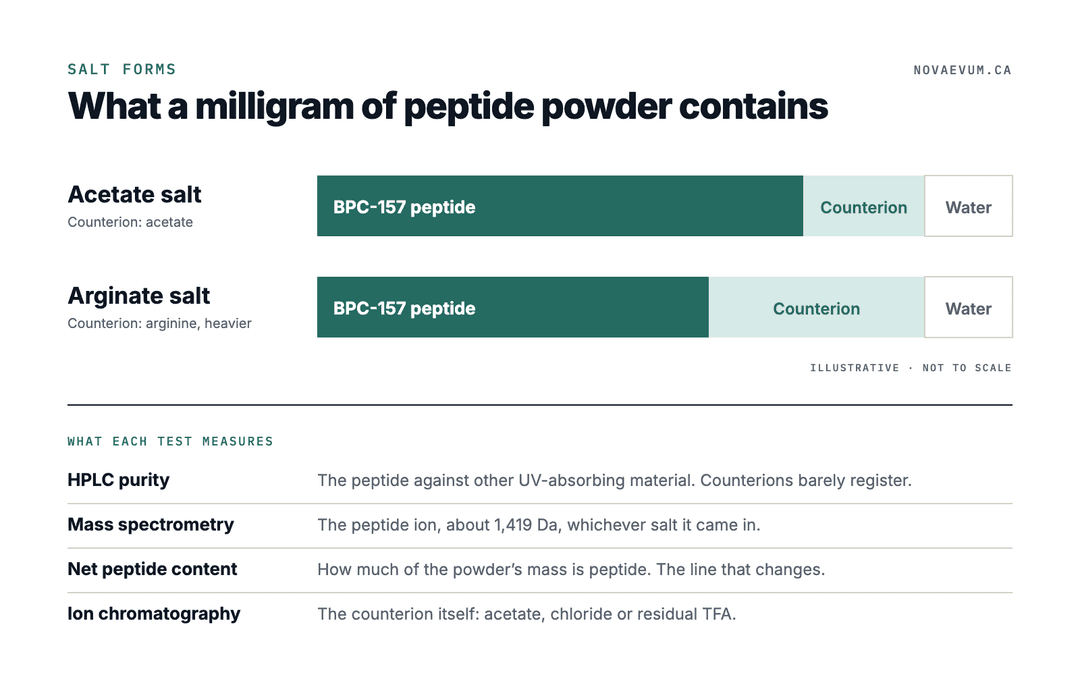
Purity by HPLC barely changes. HPLC purity reports what share of the UV-absorbing material in the sample is the target peptide. Acetate and arginine do not register as the peptide, so a well-made acetate lot and a well-made arginate lot can report similar purity. A high purity figure does not tell you which salt you have. HPLC vs LC-MS explains what each method can see.
Identity by mass spectrometry does not change. Mass spectrometry measures the peptide ion, about 1,419 Da for BPC-157, whichever counterion it was paired with in the vial. MS confirms the sequence; it does not confirm the salt.
Net peptide content changes. Counterions, and the water a lyophilised powder holds, have mass. Every milligram of powder is part peptide and part everything else. Arginine is a heavier counterion than acetate, so for the same weight of powder an arginate salt can contain less peptide. Net peptide content, measured by amino-acid analysis or by quantitative methods against a reference standard, is the figure that answers "how much BPC-157 is in this vial?", and it is often missing from certificates.
The counterion itself can be measured. Ion chromatography or similar methods can quantify acetate, chloride or residual TFA. A supplier claiming a specific salt form should be able to show that measurement.
What would establish a stability advantage
A real comparison of two salt forms looks like this:
- the same synthesis lot, split and converted to each salt, so the peptide is otherwise identical
- defined storage conditions, temperature and humidity, held and recorded
- several time points, not one
- a stability-indicating method, one shown to separate the intact peptide from its degradation products, rather than appearance or a single purity reading
- net peptide content and identity measured at each point
That is the standard pharmaceutical stability design, and the review by Manning and colleagues sets out the chemical and physical routes by which peptides and proteins degrade (PMID 20143256). For BPC-157, nothing like it has been published for either salt. A claim that arginate is "more stable" is, as of this writing, an assertion without a paper behind it.
Where the clinical evidence stops
Whatever the salt, the underlying question about BPC-157 is unchanged. Its literature is preclinical and concentrated in one research group (PMID 21548867), with a small retrospective case series (PMID 34324435) and a two-person pilot (PMID 40131143) as the only human reports, neither of them controlled. A 2025 systematic review sets out how limited that evidence is (PMID 40756949). A different counterion does not supply the trials that are missing.
You will also see "BPC-157 PDA" or similar abbreviations on some sites. These are not standard chemical names. If a supplier uses one, ask for the counterion by name and for the certificate that measures it.
Frequently asked questions
Is BPC-157 arginate a different peptide from BPC-157 acetate? No. The peptide sequence is identical; only the counterion paired with it in the powder differs.
Is arginate more stable? No published study shows it. A PubMed search in October 2026 found no record of a BPC-157 arginate salt, let alone a comparison with acetate.
Does acetate mean lower quality? No. Acetate is the standard form a purified synthetic peptide is supplied in. Counterion and purity are separate measurements.
What should a certificate show? Identity by mass spectrometry, purity by HPLC, and ideally net peptide content and the counterion. How to read a certificate of analysis walks through each section.
Supplied here for laboratory use: BPC-157. The laboratory's certificate for each lot is linked from its product page. For laboratory research use only.
Further reading
References
- Andrushchenko VV, Vogel HJ, Prenner EJ. Optimization of the Hydrochloric Acid Concentration Used for Trifluoroacetate Removal from Synthetic Peptides. Journal of Peptide Science. 2007;13(1):37-43. pubmed.ncbi.nlm.nih.gov/17031869
- Roux S, Zékri E, Rousseau B, Paternostre M, Cintrat JC, Fay N. Elimination and Exchange of Trifluoroacetate Counter-Ion from Cationic Peptides: A Critical Evaluation of Different Approaches. Journal of Peptide Science. 2008;14(3):354-359. pubmed.ncbi.nlm.nih.gov/18035848
- Cornish J, Callon KE, Lin CQ, et al. Trifluoroacetate, a Contaminant in Purified Proteins, Inhibits Proliferation of Osteoblasts and Chondrocytes. American Journal of Physiology. 1999;277(5):E779-E783. pubmed.ncbi.nlm.nih.gov/10567002
- Manning MC, Chou DK, Murphy BM, Payne RW, Katayama DS. Stability of Protein Pharmaceuticals: An Update. Pharmaceutical Research. 2010;27(4):544-575. pubmed.ncbi.nlm.nih.gov/20143256
- Sikiric P, Seiwerth S, Rucman R, et al. Stable Gastric Pentadecapeptide BPC 157: Novel Therapy in Gastrointestinal Tract. Current Pharmaceutical Design. 2011;17(16):1612-1632. pubmed.ncbi.nlm.nih.gov/21548867
- Lee E, Padgett B. Intra-Articular Injection of BPC 157 for Multiple Types of Knee Pain. Alternative Therapies in Health and Medicine. 2021;27(4):8-13. pubmed.ncbi.nlm.nih.gov/34324435
- Lee E, Burgess K. Safety of Intravenous Infusion of BPC157 in Humans: A Pilot Study. Alternative Therapies in Health and Medicine. 2025;31(5):20-24. pubmed.ncbi.nlm.nih.gov/40131143
- Vasireddi N, Hahamyan H, Salata MJ, et al. Emerging Use of BPC-157 in Orthopaedic Sports Medicine: A Systematic Review. HSS Journal. 2025;21(4):485-495. pubmed.ncbi.nlm.nih.gov/40756949
All products sold by NovaEvum are for research and laboratory use only. They are not intended for human or animal consumption, diagnosis, treatment, cure, or prevention of any disease.