
BPC-157
BPC-157 vs TB-500: two unrelated peptides that keep being sold together
SB
· 6 min read
A summary of published research, with citations. It states no amount, schedule or route, and makes no claim about what this compound does in a person. Supplied for laboratory research use only.
On this page · 7 sections
BPC-157 and TB-500 are paired so often — in blends, in stacks, in forum threads — that they are easy to think of as two versions of one idea. They are not. They come from different proteins, they are studied through different mechanisms, and the strongest papers usually cited for one say nothing about the other.
This page sets out what each molecule is, what its literature examined, and why the evidence for each has to be read on its own.
Two molecules, side by side
| BPC-157 | TB-500 | |
|---|---|---|
| What it is | A synthetic 15-amino-acid sequence | The N-acetylated 17-23 fragment of thymosin beta-4 (Ac-LKKTETQ) |
| Where it comes from | Described as a partial sequence of a protein found in gastric juice | Thymosin beta-4, a 43-residue actin-binding protein found in most cells |
| Main research framing | Tendon, ligament, muscle and gastrointestinal injury in rodents | Actin sequestration, cell migration and tissue repair, mostly through the full protein |
| Human data | A handful of small case series and pilot reports | None for the fragment |
| Regulatory status | Not approved anywhere | Not approved anywhere |
| Sport | Prohibited by WADA | Prohibited by WADA |
What TB-500 actually is
The name causes most of the confusion. "TB-500" is a trade name, not a pharmacological one, and the material sold under it is not thymosin beta-4. Esposito and colleagues, analysing TB-500 for doping control, identified it as the N-terminally acetylated 17-23 fragment of human thymosin beta-4 — seven amino acids out of forty-three (PMID 22962027).
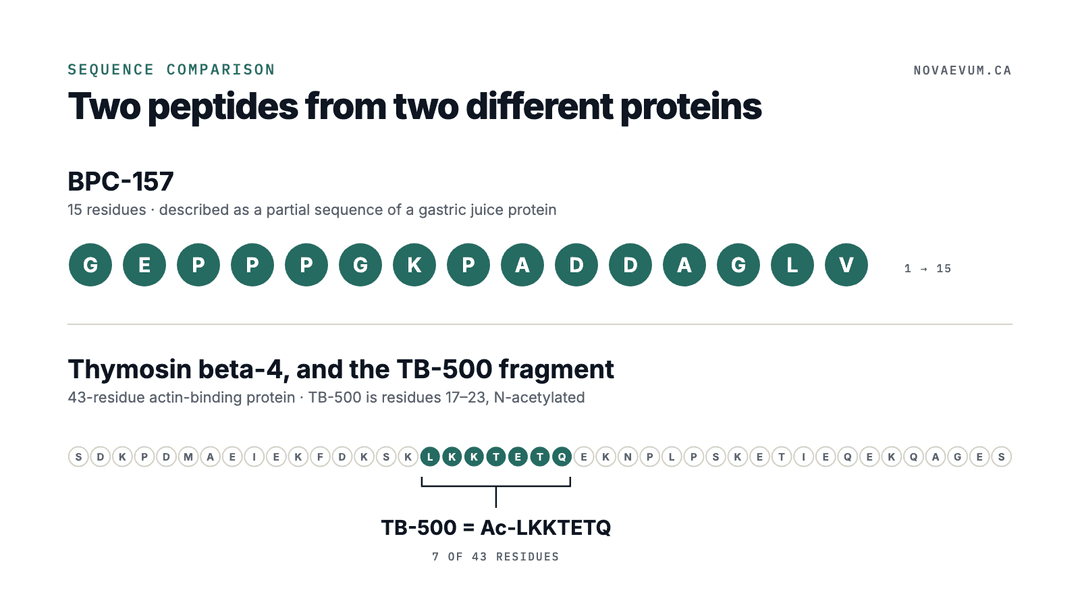
That matters because almost every well-known thymosin beta-4 paper used the full protein. Bock-Marquette and colleagues' cardiac work in mice (PMID 15565145), the actin-sequestering biology reviewed by Goldstein and colleagues (PMID 16099219), and the small phase 2 trials of thymosin beta-4 eye drops in dry eye (PMID 25826322) were all studies of the 43-residue protein. Whether the fragment reproduces any of it is a separate question, and it has barely been asked. The TB-500 cardiac research page goes through that gap in detail.
What the BPC-157 literature examined
BPC-157's literature is large, preclinical, and concentrated. Much of it comes from one research group in Zagreb, reviewed by Sikiric and colleagues (PMID 21548867). The musculoskeletal work includes tendon healing in rats (PMID 21030672), tendon-to-bone healing after Achilles detachment (PMID 16583442), and ligament healing (PMID 20225319). The BPC-157 musculoskeletal page covers those studies.
Human data is thin. Lee and Padgett reported a retrospective case series of knee-pain patients (PMID 34324435), and Lee and Burgess reported a two-person intravenous safety pilot (PMID 40131143). Neither is a controlled trial. Vasireddi and colleagues' 2025 systematic review from an orthopaedic sports-medicine perspective is a useful summary of how far the evidence actually goes (PMID 40756949).
Why they are sold together
The pairing comes from the market, not from the literature. Both are described in tissue-repair terms, they work through different proposed mechanisms, and so combining them reads as covering two bases. No published study has examined BPC-157 and TB-500 together. A blend is two compounds in one vial; it is not a third compound with its own evidence. Wolverine Stack vs GLOW explains why the total milligrams on a blend label also mislead.
Where the evidence stops
Neither is approved. Not by Health Canada, the FDA or the EMA, for any indication. In 2023 the FDA listed BPC-157 among bulk substances it considers to raise significant safety risks for pharmacy compounding.
Full-protein data is not fragment data. A thymosin beta-4 study is evidence about thymosin beta-4. It is not evidence about TB-500.
One group, mostly rodents. The BPC-157 literature is overwhelmingly animal work from a small number of laboratories, with little independent replication and no completed randomised human trial.
Both are prohibited in sport. Each appears on the World Anti-Doping Agency's prohibited list.
Common questions
Is TB-500 the same as thymosin beta-4? No. It is a seven-residue fragment of it, identified by doping-control analysis. Research on the full protein does not transfer automatically.
Which one has more research? BPC-157 has more papers, nearly all in animals. Thymosin beta-4, the full protein, has small human trials; TB-500 itself has none.
Do they work better together? No study has tested the combination, so there is no evidence either way.
BPC-157 and TB-500 are supplied here as BPC-157, TB-500, and together in the Wolverine Stack. Independently tested by HPLC; 100% synthetic. The laboratory's certificate for each lot is linked from its product page. For laboratory research use only.
References
- Esposito S, Deventer K, Goeman J, Van der Eycken J, Van Eenoo P. Synthesis and Characterization of the N-Terminal Acetylated 17-23 Fragment of Thymosin Beta 4 Identified in TB-500, a Product Suspected to Possess Doping Potential. Drug Testing and Analysis. 2012;4(9):733-738. pubmed.ncbi.nlm.nih.gov/22962027
- Bock-Marquette I, Saxena A, White MD, DiMaio JM, Srivastava D. Thymosin Beta-4 Activates Integrin-Linked Kinase and Promotes Cardiac Cell Migration, Survival and Cardiac Repair. Nature. 2004;432(7016):466-472. pubmed.ncbi.nlm.nih.gov/15565145
- Goldstein AL, Hannappel E, Kleinman HK. Thymosin Beta-4: Actin-Sequestering Protein Moonlights to Repair Injured Tissues. Trends in Molecular Medicine. 2005;11(9):421-429. pubmed.ncbi.nlm.nih.gov/16099219
- Sosne G, Dunn SP, Kim C. Thymosin β4 Significantly Improves Signs and Symptoms of Severe Dry Eye in a Phase 2 Randomized Trial. Cornea. 2015;34(5):491-496. pubmed.ncbi.nlm.nih.gov/25826322
- Sikiric P, Seiwerth S, Rucman R, et al. Stable Gastric Pentadecapeptide BPC 157: Novel Therapy in Gastrointestinal Tract. Current Pharmaceutical Design. 2011;17(16):1612-1632. pubmed.ncbi.nlm.nih.gov/21548867
- Chang CH, Tsai WC, Lin MS, Hsu YH, Pang JH. The Promoting Effect of Pentadecapeptide BPC 157 on Tendon Healing Involves Tendon Outgrowth, Cell Survival, and Cell Migration. Journal of Applied Physiology. 2011;110(3):774-780. pubmed.ncbi.nlm.nih.gov/21030672
- Krivic A, Anic T, Seiwerth S, Huljev D, Sikiric P. Achilles Detachment in Rat and Stable Gastric Pentadecapeptide BPC 157: Promoted Tendon-to-Bone Healing and Opposed Corticosteroid Aggravation. Journal of Orthopaedic Research. 2006;24(5):982-989. pubmed.ncbi.nlm.nih.gov/16583442
- Cerovecki T, Bojanic I, Brcic L, et al. Pentadecapeptide BPC 157 (PL 14736) Improves Ligament Healing in the Rat. Journal of Orthopaedic Research. 2010;28(9):1155-1161. pubmed.ncbi.nlm.nih.gov/20225319
- Lee E, Padgett B. Intra-Articular Injection of BPC 157 for Multiple Types of Knee Pain. Alternative Therapies in Health and Medicine. 2021;27(4):8-13. pubmed.ncbi.nlm.nih.gov/34324435
- Lee E, Burgess K. Safety of Intravenous Infusion of BPC157 in Humans: A Pilot Study. Alternative Therapies in Health and Medicine. 2025;31(5):20-24. pubmed.ncbi.nlm.nih.gov/40131143
- Vasireddi N, Hahamyan H, Salata MJ, et al. Emerging Use of BPC-157 in Orthopaedic Sports Medicine: A Systematic Review. HSS Journal. 2025;21(4):485-495. pubmed.ncbi.nlm.nih.gov/40756949
All products sold by NovaEvum are for research and laboratory use only. They are not intended for human or animal consumption, diagnosis, treatment, cure, or prevention of any disease.