
BPC-157
GHK-Cu vs BPC-157: Copper Peptide and Pentadecapeptide Research Compared
SB
· 8 min read
A summary of published research, with citations. It states no amount, schedule or route, and makes no claim about what this compound does in a person. Supplied for laboratory research use only.
On this page · 9 sections
Quick answer: GHK-Cu is a three-amino-acid peptide carrying a copper ion, first isolated from human plasma and now best known as a cosmetic ingredient. BPC-157 is a synthetic fifteen-amino-acid peptide based on a sequence from a gastric protein, studied almost entirely in rodents. They share a marketing vocabulary of "repair" and "recovery", and almost nothing else: different size, different chemistry, different research groups and different kinds of evidence.
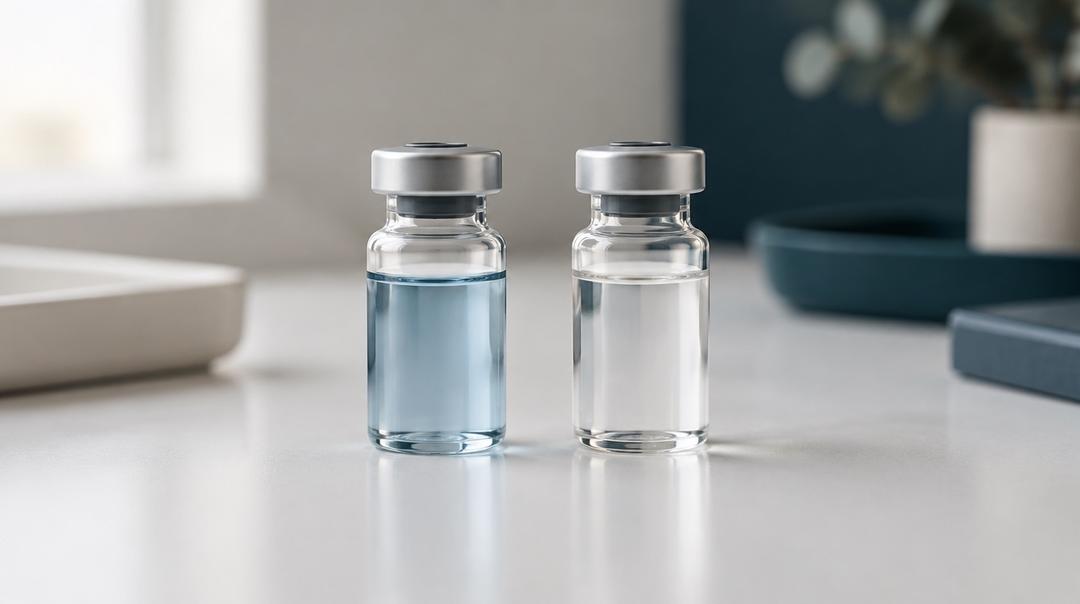
Both are among the most searched research peptides in Canada, and they are often sold side by side or in the same blend. This page sets out what each molecule is, what each literature actually examined, and why a finding about one says nothing about the other.
Two molecules, side by side
| GHK-Cu | BPC-157 | |
|---|---|---|
| Sequence | Gly-His-Lys, bound to Cu(II) | 15 residues: Gly-Glu-Pro-Pro-Pro-Gly-Lys-Pro-Ala-Asp-Asp-Ala-Gly-Leu-Val |
| Origin | Isolated from human plasma | Partial sequence of a protein described in gastric juice |
| Size | About 400 Da as the copper complex | About 1,419 Da |
| Main research models | Fibroblast cultures, skin and wound models, gene-expression studies | Rodent tendon, ligament, muscle and gastrointestinal injury models |
| Human data | Small studies of topical cosmetic preparations | A small case series and a two-person pilot; no controlled trial |
| Status | Not approved as a medicine; permitted as a topical cosmetic ingredient | Not approved anywhere; prohibited in sport by WADA |
What GHK-Cu is
GHK was identified by Loren Pickart in human plasma in the 1970s. Its defining chemistry is copper: the histidine and the free amino group of glycine form a tight binding site for Cu(II), and Pickart and Thaler reported in 1980 that the tripeptide circulates associated with copper and iron (PMID 6246126). "GHK-Cu" names that complex, and on a cosmetic label it appears as copper tripeptide-1.
The best-known experimental finding is from 1988. Maquart, Pickart and colleagues added the copper complex to cultured fibroblasts and measured collagen synthesis, which rose in those cultures (PMID 3169264). That paper is the foundation of nearly every later claim about GHK-Cu and skin, and it is a cell-culture result.
Later work widened the frame. Pickart's reviews describe GHK as a modulator of tissue remodelling (PMID 18644225), of multiple pathways in skin (PMID 26236730), and, drawing on gene-expression databases, of a large number of human genes (PMID 29986520). The gene-expression work is the most ambitious part of the literature and the most easily over-read: it describes which genes change in expression profiles associated with GHK, not what happens in a person.
What BPC-157 is
BPC stands for body protection compound. BPC-157 is a synthetic pentadecapeptide described as a partial sequence of a protein found in gastric juice, and it has been developed under the code PL 14736. Almost all of its literature comes from one research group in Zagreb, reviewed by Sikiric and colleagues (PMID 21548867).
The musculoskeletal studies are the ones most often cited: tendon outgrowth and cell migration in rat tendon models (PMID 21030672), tendon-to-bone healing after Achilles detachment in rats (PMID 16583442), and ligament healing in rats (PMID 20225319). A 2022 study by He and colleagues described the compound's pharmacokinetics, distribution and excretion in rats and dogs (PMID 36588717), one of the few papers from outside the Zagreb group.
Human data is thin. Lee and Padgett reported a retrospective case series in people with knee pain (PMID 34324435), and Lee and Burgess a two-person safety pilot (PMID 40131143). Neither is a controlled trial. Vasireddi and colleagues' 2025 systematic review, written from an orthopaedic sports-medicine perspective, is the clearest summary of how far the evidence goes (PMID 40756949). BPC-157 vs TB-500 covers the same literature from another angle.
Where the two literatures differ
The kind of model. GHK-Cu research is mostly cells and skin: cultured fibroblasts, extracellular-matrix measurements, topical preparations. BPC-157 research is mostly whole animals with an induced injury. A collagen measurement in a culture dish and a histology score on a rat tendon are different measurements, and neither predicts the other.
The kind of human evidence. What human data GHK-Cu has comes from cosmetic studies of creams and serums applied to skin, small and often industry-linked. BPC-157 has no controlled human study of any kind. "Has human data" means something different for each.
Who did the work. Both literatures are concentrated. GHK-Cu's runs largely through one investigator and his collaborators; BPC-157's through one Croatian group. Concentration is not a flaw in any single paper, but it means independent replication, the thing that turns a finding into a fact, is thin for both.
The chemistry. GHK-Cu's activity is tied to copper binding, so the copper content of a sample is part of its identity. BPC-157 has no metal; its identity is its fifteen-residue sequence. A certificate of analysis for each needs to confirm different things, which how to read a certificate of analysis explains.
Why they end up in the same vial
Blends such as KLOW put GHK-Cu and BPC-157 together with TB-500 and KPV. The logic is commercial: four compounds each described in "recovery" language, combined to sound like broader coverage. No published study has examined GHK-Cu and BPC-157 together, and a mixture of studied compounds is not itself a studied compound. Inside the KLOW blend takes each component in turn.
Where the evidence stops
Cells and rodents are not people. Both literatures are overwhelmingly preclinical. A result in fibroblasts or in a rat tendon is a fact about that model.
Topical is not systemic. GHK-Cu's cosmetic data concerns preparations applied to skin. It says nothing about lyophilised research material in any other context.
Neither is an approved medicine. GHK-Cu is permitted as a cosmetic ingredient, which is a different category with different rules. BPC-157 is approved nowhere, and the World Anti-Doping Agency prohibits it in sport.
Frequently asked questions
Are GHK-Cu and BPC-157 the same kind of peptide? No. GHK-Cu is a three-residue copper complex; BPC-157 is a fifteen-residue synthetic peptide with no metal. Their sizes, chemistry and research histories are different.
Which one has more research? BPC-157 has more papers, almost all in animals from one group. GHK-Cu has a longer history and some small human cosmetic studies, mostly topical.
Can a study of one support the other? No. Similar marketing language does not create shared evidence, and no study has examined them together.
Why is GHK-Cu blue? The colour comes from the copper(II) ion bound to the peptide. Colour indicates copper is present; it does not establish purity or the amount of peptide.
Supplied here for laboratory use: GHK-Cu and BPC-157. The laboratory's certificate for each lot is linked from its product page. For laboratory research use only.
Further reading
References
- Pickart L, Thaler MM. Growth-Modulating Tripeptide (Glycylhistidyllysine): Association with Copper and Iron in Plasma, and Stimulation of Adhesiveness and Growth of Hepatoma Cells in Culture by Tripeptide-Metal Ion Complexes. Journal of Cellular Physiology. 1980;102(2):129-139. pubmed.ncbi.nlm.nih.gov/6246126
- Maquart FX, Pickart L, Laurent M, Gillery P, Monboisse JC, Borel JP. Stimulation of Collagen Synthesis in Fibroblast Cultures by the Tripeptide-Copper Complex Glycyl-L-Histidyl-L-Lysine-Cu2+. FEBS Letters. 1988;238(2):343-346. pubmed.ncbi.nlm.nih.gov/3169264
- Pickart L. The Human Tri-Peptide GHK and Tissue Remodeling. Journal of Biomaterials Science, Polymer Edition. 2008;19(8):969-988. pubmed.ncbi.nlm.nih.gov/18644225
- Pickart L, Vasquez-Soltero JM, Margolina A. GHK Peptide as a Natural Modulator of Multiple Cellular Pathways in Skin Regeneration. BioMed Research International. 2015;2015:648108. pubmed.ncbi.nlm.nih.gov/26236730
- Pickart L, Margolina A. Regenerative and Protective Actions of the GHK-Cu Peptide in the Light of the New Gene Data. International Journal of Molecular Sciences. 2018;19(7):1987. pubmed.ncbi.nlm.nih.gov/29986520
- Sikiric P, Seiwerth S, Rucman R, et al. Stable Gastric Pentadecapeptide BPC 157: Novel Therapy in Gastrointestinal Tract. Current Pharmaceutical Design. 2011;17(16):1612-1632. pubmed.ncbi.nlm.nih.gov/21548867
- Chang CH, Tsai WC, Lin MS, Hsu YH, Pang JH. The Promoting Effect of Pentadecapeptide BPC 157 on Tendon Healing Involves Tendon Outgrowth, Cell Survival, and Cell Migration. Journal of Applied Physiology. 2011;110(3):774-780. pubmed.ncbi.nlm.nih.gov/21030672
- Krivic A, Anic T, Seiwerth S, Huljev D, Sikiric P. Achilles Detachment in Rat and Stable Gastric Pentadecapeptide BPC 157: Promoted Tendon-to-Bone Healing and Opposed Corticosteroid Aggravation. Journal of Orthopaedic Research. 2006;24(5):982-989. pubmed.ncbi.nlm.nih.gov/16583442
- Cerovecki T, Bojanic I, Brcic L, et al. Pentadecapeptide BPC 157 (PL 14736) Improves Ligament Healing in the Rat. Journal of Orthopaedic Research. 2010;28(9):1155-1161. pubmed.ncbi.nlm.nih.gov/20225319
- He L, Feng D, Guo H, et al. Pharmacokinetics, Distribution, Metabolism, and Excretion of Body-Protective Compound 157, a Potential Drug for Treating Various Wounds, in Rats and Dogs. Frontiers in Pharmacology. 2022;13:1026182. pubmed.ncbi.nlm.nih.gov/36588717
- Lee E, Padgett B. Intra-Articular Injection of BPC 157 for Multiple Types of Knee Pain. Alternative Therapies in Health and Medicine. 2021;27(4):8-13. pubmed.ncbi.nlm.nih.gov/34324435
- Lee E, Burgess K. Safety of Intravenous Infusion of BPC157 in Humans: A Pilot Study. Alternative Therapies in Health and Medicine. 2025;31(5):20-24. pubmed.ncbi.nlm.nih.gov/40131143
- Vasireddi N, Hahamyan H, Salata MJ, et al. Emerging Use of BPC-157 in Orthopaedic Sports Medicine: A Systematic Review. HSS Journal. 2025;21(4):485-495. pubmed.ncbi.nlm.nih.gov/40756949
All products sold by NovaEvum are for research and laboratory use only. They are not intended for human or animal consumption, diagnosis, treatment, cure, or prevention of any disease.