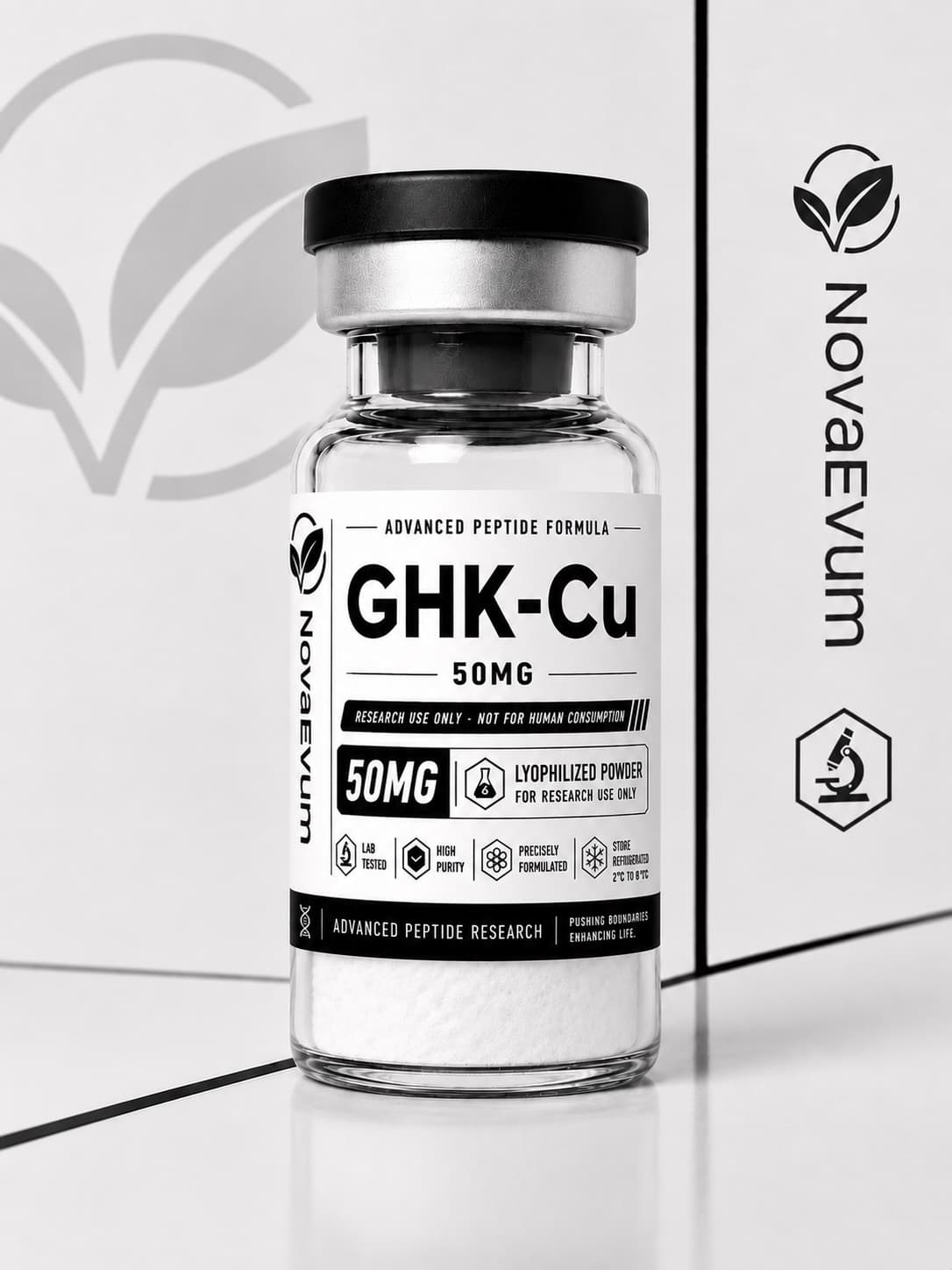
GHK-Cu
Copper tripeptide-1
Supplied in 50 mg and 100 mg vials.
GHK-Cu is a copper-binding tripeptide — glycine, histidine and lysine, carrying a copper(II) ion. It was first isolated from human plasma in the early 1970s, and it is one of the most heavily studied peptides in matrix biology: the published work on it runs to hundreds of papers concerning gene expression and the proteins of the extracellular matrix, collagen among them.
- Lyophilized powder, requires reconstitution
Price
$55.00 CAD
In stock
Produced & shipped in Canada
Specification
- CAS number
- 89030-95-5
- Molecular formula
- C14H24N6O4Cu
- Molecular weight
- 403.94 g/mol
- Sequence
- GHK
- Purity
- ≥ 99.5% by RP-HPLC
- Form
- Lyophilized powder
- Third-party assay
- Purity, fill and endotoxin
- Origin
- Canada
- Storage
- Refrigerated, 2-8 °C
- Lot
- NVE-2405-D
How it works
A literature that size is unusual for a molecule this small, and its first limit is where the work was done: nearly all of it is cell culture and animal models. An origin in human plasma in the early 1970s is a fact about where the molecule was found — not a statement about anybody’s own supply of it, and not a comparison with what a topical serum contains. The targets below divide into that preclinical work, the entity it was done on, and the point where the human literature stops being about material in a vial.
Extracellular matrix
Where most of the work is
Cell and animal studies of gene expression and of the matrix proteins — collagen and the glycosaminoglycans among them. This is the bulk of the literature. Firmness and fine lines are claims about appearance; they are not findings this page can carry.
Vessel formation
Angiogenesis models
Examined in cell and animal models of new blood-vessel formation, usually alongside the matrix work rather than on its own.
The copper
Part of the molecule
The copper(II) ion is bound into the peptide rather than added to it, and the literature takes the complex as the entity under study — findings about the tripeptide alone are not findings about this. Decades of papers on the complex are still papers, not a ranking of this vial.
The topical literature
Small cosmetic studies, not this vial
What human data exists was gathered on preparations applied to skin, which is a different literature from lyophilised research material in a vial. A finding about a cream is not a finding about this. The stage line below says how small that set is.
Where the evidence stands
Largely in-vitro and animal. The human studies are small and concern topical cosmetic preparations. Not approved as a medicine; permitted as a cosmetic ingredient. Permission as a cosmetic ingredient is not an indication for this vial.
Laboratory results
- Purity+Fill+Endotoxin99.81%Freedom Diagnostics · Jul 2026 · 50 mgOpen
- Purity+Fill99.54%Freedom Diagnostics · Jul 2026 · 50 mgOpen
- Purity+Fill+Endotoxin99.84% + <=0.05 EU/mLFreedom Diagnostics · Jul 2026 · 100 mgOpen
Opened as the laboratory issued them, unedited. Every certificate we publish
Research use only
Supplied as a laboratory research chemical. Not a drug, food or cosmetic, and not for human or veterinary use. No application guidance is provided or implied.