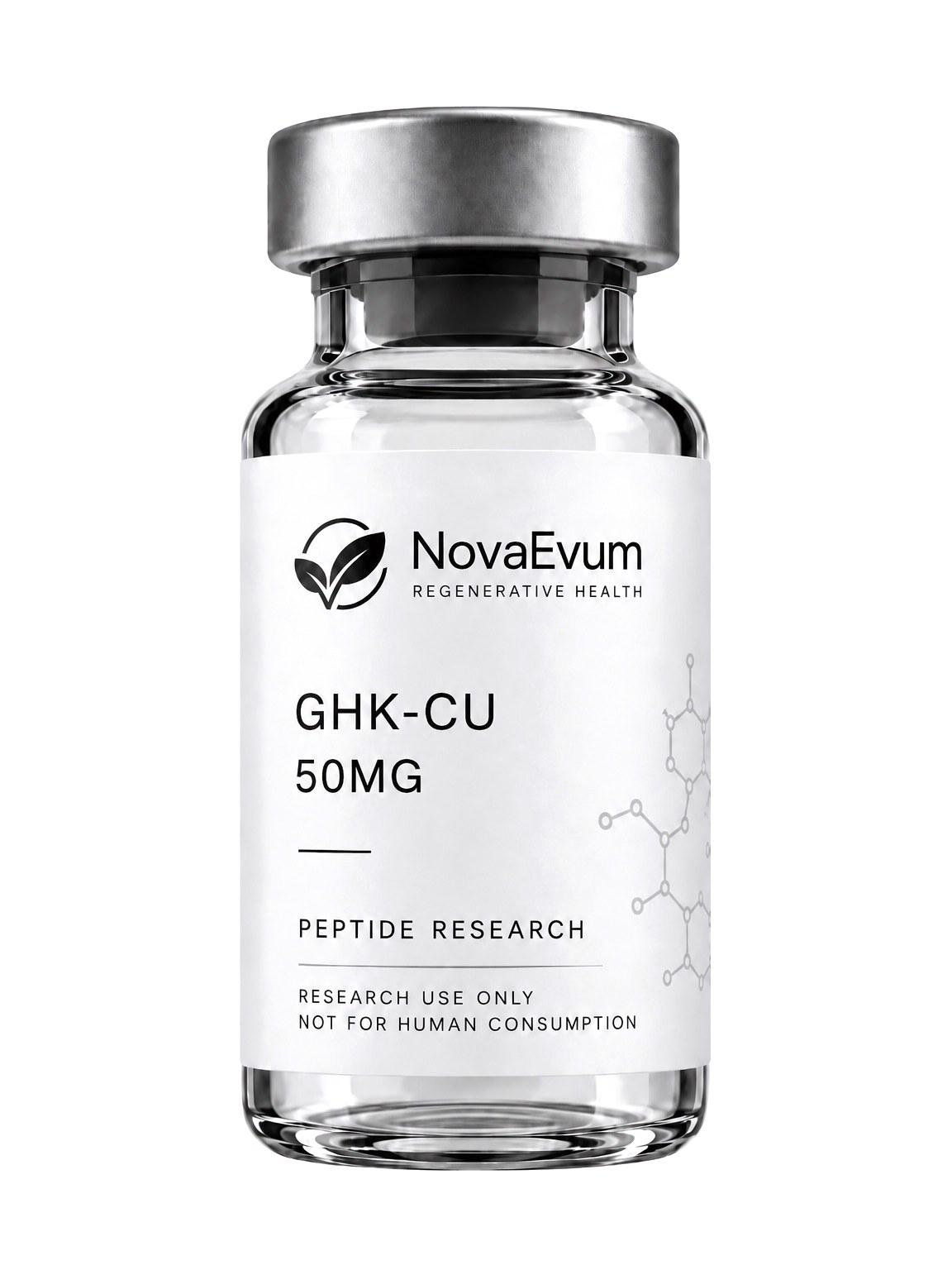
GHK-Cu copper peptide for research, Canada
Copper peptide · Copper tripeptide-1 · Shipped across Canada
Supplied in 50 mg and 100 mg vials.
GHK-Cu is a copper-binding tripeptide — glycine, histidine and lysine, carrying a copper(II) ion. It was first isolated from human plasma in the early 1970s, and it is one of the most heavily studied peptides in matrix biology: the published work on it runs to hundreds of papers concerning gene expression and the proteins of the extracellular matrix, collagen among them.
- Lyophilized powder, requires reconstitution
Price
$55.00 CAD
$1.10 / mg
In stock
- 24/7 customer support
- Lab tested purity & quality
- Free shipping on all orders




GHK-Cu in Canada
Ships from Toronto to anywhere in Canada, priced in Canadian dollars, payable by Interac e-Transfer or card.
Specification
- CAS number
- 89030-95-5
- Molecular formula
- C14H24N6O4Cu
- Molecular weight
- 403.94 g/mol
- Sequence
- GHK
- Purity
- ≥ 99.84% by RP-HPLC
- Form
- Lyophilized powder
- Third-party assay
- Purity, fill and endotoxin
- Storage
- Refrigerated, 2-8 °C
- Lot
- NVE-2405-D
How it works
A literature that size is unusual for a molecule this small, and its first limit is where the work was done: nearly all of it is cell culture and animal models. An origin in human plasma in the early 1970s is a fact about where the molecule was found — not a statement about anybody’s own supply of it, and not a comparison with what a topical serum contains. The targets below divide into that preclinical work, the entity it was done on, and the point where the human literature stops being about material in a vial.
Extracellular matrix
Where most of the work is
Cell and animal studies of gene expression and of the matrix proteins — collagen and the glycosaminoglycans among them. This is the bulk of the literature. Firmness and fine lines are claims about appearance; they are not findings this page can carry.
Vessel formation
Angiogenesis models
Examined in cell and animal models of new blood-vessel formation, usually alongside the matrix work rather than on its own.
The copper
Part of the molecule
The copper(II) ion is bound into the peptide rather than added to it, and the literature takes the complex as the entity under study — findings about the tripeptide alone are not findings about this. Decades of papers on the complex are still papers, not a ranking of this vial.
The topical literature
Small cosmetic studies, not this vial
What human data exists was gathered on preparations applied to skin, which is a different literature from lyophilised research material in a vial. A finding about a cream is not a finding about this. The stage line below says how small that set is.
Where the evidence stands
Largely in-vitro and animal. The human studies are small and concern topical cosmetic preparations. Not approved as a medicine; permitted as a cosmetic ingredient. Permission as a cosmetic ingredient is not an indication for this vial.
Laboratory results
- Purity+Fill+Endotoxin99.81%Freedom Diagnostics · Jul 2026 · 50 mgOpen
- Purity+Fill+Endotoxin99.84% + <=0.05 EU/mLFreedom Diagnostics · Jul 2026 · 100 mgOpen
Opened as the laboratory issued them, unedited. Every certificate we publish
Research reading
New GHK-Cu research
All weekly research newsResearch use only
Supplied as a laboratory research chemical. Not a drug, food or cosmetic, and not for human or veterinary use. No application guidance is provided or implied.
What GHK-Cu is
GHK-Cu is the tripeptide glycyl-histidyl-lysine bound to a copper(II) ion. GHK occurs naturally in human plasma: Loren Pickart and Marvin Thaler reported it in 1973 as a serum factor that prolonged the survival of liver cells in culture, and in 1980 they reported its affinity for copper.
The copper binding is the best-characterised thing about the molecule. In solution one peptide holds one copper ion, through the terminal amino group, an amide nitrogen and the histidine ring, and holds it tightly. Most of its biology was reported for the copper complex rather than for the free peptide, and the two are not interchangeable in an experiment.
| Property | GHK-Cu |
|---|---|
| Peptide | Glycyl-L-histidyl-L-lysine (Gly-His-Lys) |
| Metal | Copper(II), one per peptide |
| First reported | 1973, in human plasma |
| Other names | Copper tripeptide-1, copper peptide |
GHK-Cu research: what has been studied
GHK-Cu has a larger literature than most research peptides, spread across cell culture, animal wound models and small cosmetic studies of skin creams. The table sets out each line and how far it got.
One caution runs through all of it: many of the major reviews were written by the peptide’s discoverer, who also had a commercial interest in copper peptide skin care. That does not make the work wrong, but it is the reason independent studies matter more than the reviews.
| Research area | What was examined | Evidence stage |
|---|---|---|
| Collagen and matrix | Fibroblasts in culture | Cell |
| Wound models | Animal wounds | Animal |
| Skin appearance | Small studies of topical creams | Small human, cosmetic |
| Gene expression | Computational and cell data | Cell and computational |
| Hair follicles | Follicle culture, which in fact used AHK-Cu | Cell |
GHK-Cu vs AHK-Cu
Both are copper-binding tripeptides, and they differ by their first amino acid. The hair-follicle culture study often cited for GHK-Cu actually used AHK-Cu, which is one of the most common mix-ups in this area.
| GHK-Cu | AHK-Cu | |
|---|---|---|
| First amino acid | Glycine | Alanine |
| Occurs naturally | Yes, in plasma | No |
| Size of the literature | Large | Small |
Buying GHK-Cu in Canada
NovaEvum ships GHK-Cu from Toronto to every province and territory, in 50 mg and 100 mg sizes, priced in Canadian dollars.
Orders placed before 2:00 PM ET on a working day are dispatched the same day by tracked express parcel, which reaches most of Canada in one to two working days and remote areas a little later. In the Greater Toronto Area, larger orders placed before the cutoff can be couriered the same evening; the threshold is on our shipping page. Shipping is free on every order.
Pay by Interac e-Transfer, which takes 10% off the goods, or by card. Because the order ships from inside Canada, it never crosses a border: there is no customs declaration and no import hold.
Storage and laboratory handling
The specification for GHK-Cu is Refrigerated, 2-8 °C. Keep sealed vials refrigerated and away from light.
Lyophilised material tolerates ambient temperature in transit; put it back into cold storage on arrival. Let a cold vial reach room temperature before opening it, so moisture does not condense on the powder.
GHK-Cu FAQ
Is GHK-Cu the same as copper peptide?
GHK-Cu is the best-known copper peptide: the tripeptide glycyl-histidyl-lysine bound to a copper ion, listed on cosmetic labels as copper tripeptide-1. “Copper peptide” usually means it, but the term is not specific to one molecule.
What does GHK stand for?
The one-letter codes of its three amino acids: G for glycine, H for histidine and K for lysine. Cu is the chemical symbol for copper, so GHK-Cu names the tripeptide Gly-His-Lys with a copper(II) ion bound to it.
Who discovered GHK-Cu?
Loren Pickart and Marvin Thaler reported the tripeptide in human plasma in 1973, as a factor that prolonged the survival of liver cells in culture. Its affinity for copper was reported in 1980.
Is GHK-Cu the same as the copper peptide in skin care?
Usually the same molecule, listed on cosmetic labels as copper tripeptide-1, but sold under different rules. A skin-care product is regulated as a cosmetic; what is supplied here is lyophilised research material for laboratory use.
Which GHK-Cu sizes are available?
50 mg and 100 mg, as lyophilised powder. The size selector above shows the current price and stock for each.
How is GHK-Cu shipped within Canada?
From Toronto by tracked express parcel, dispatched the same working day for orders before 2:00 PM ET. Most of Canada receives it in one to two working days. Shipping is free on every order.
How should GHK-Cu be stored?
At Refrigerated, 2-8 °C, sealed and away from light. Return it to cold storage on arrival.
Can I see a certificate of analysis before ordering?
Yes. Every certificate published for this compound is linked under Laboratory results on this page, stating the laboratory, the date and the vial size it covers. For the certificate covering a specific lot, contact us before ordering.
Is GHK-Cu for human use?
No. It is supplied as a laboratory research chemical: not a drug, food or cosmetic, and not for human or veterinary use. No application guidance is provided or implied.