
Copper peptides
GHK-Cu and Hair: What the Copper Peptide Hair Follicle Research Shows
IM
· 9 min read
A summary of published research, with citations. It states no amount, schedule or route, and makes no claim about what this compound does in a person. Supplied for laboratory research use only.
On this page · 6 sections
The case for GHK-Cu and hair rests on a small, old and surprisingly indirect literature. Reviews by the peptide's discoverer state that it increases hair follicle size. The primary studies behind that are a 1991 mouse report, a rat study of a different copper-binding peptide, and a human follicle-culture study that used a related tripeptide, AHK-Cu, rather than GHK-Cu. Newer work is mouse formulation research and one small human trial of a GHK combination product. GHK-Cu is not an approved hair-loss treatment anywhere.
Why copper peptides were linked to hair in the first place
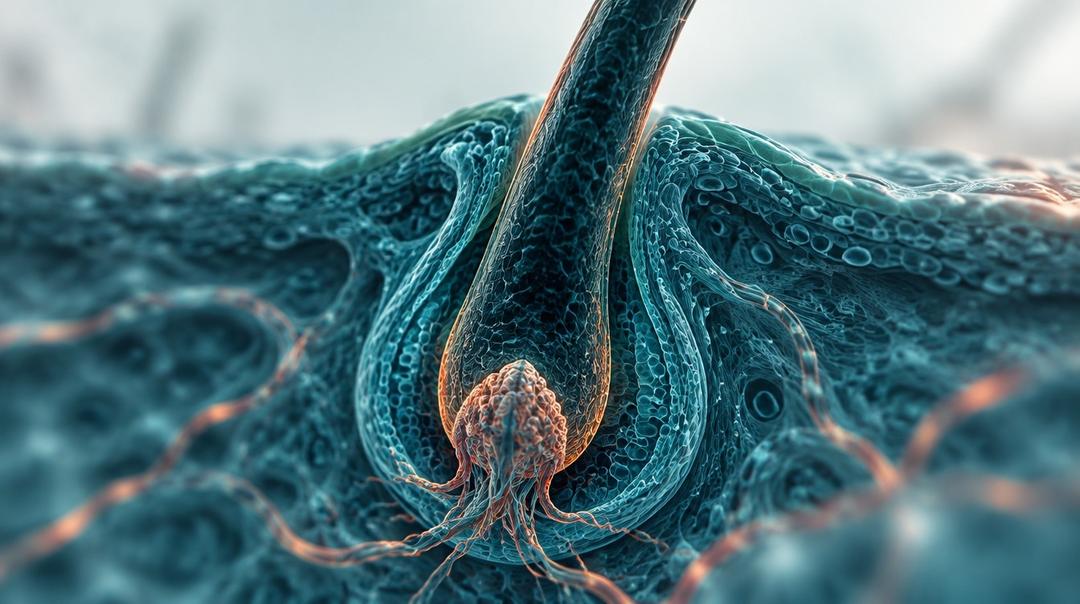
GHK, the tripeptide glycine-histidine-lysine, was isolated from human plasma in the 1970s by Loren Pickart. Its copper complex was studied first as a tissue-repair factor, a history covered in GHK-Cu and wound repair. Hair came later, by analogy. The hair follicle is a mini-organ that rebuilds itself through repeated cycles. Its pace is set by the dermal papilla, a cluster of specialised fibroblasts at its base. A compound reported to stimulate fibroblasts, blood-vessel growth and matrix production was an obvious candidate to test there.
Pickart's reviews carry the claim forward in general terms. His 2008 review lists "hair follicle size" among the processes GHK and GHK-Cu activate, and says GHK-Cu "improves hair transplant success" (PMID 18644225). His 2015 review describes accelerated wound healing of "hair follicles" among other tissues (PMID 26236730). These are summary sentences in reviews by the person who discovered the molecule. To know what they rest on, you have to find the primary papers.
The hair cycle, and what each kind of study can measure
| Stage or structure | What happens | What a study would measure |
|---|---|---|
| Anagen | Growth phase; the follicle is long and the shaft lengthens | Proportion of follicles in anagen; shaft elongation in culture |
| Catagen | Short regression phase; the lower follicle shrinks | Timing of entry into catagen |
| Telogen | Resting phase before the hair sheds | Proportion in telogen; shedding counts |
| Dermal papilla | Signalling centre that sets follicle size and cycle | Papilla-cell proliferation and survival in culture |
| Miniaturisation | In pattern hair loss, terminal follicles shrink towards vellus | Follicle diameter; terminal-to-vellus ratio; hair count in a fixed scalp area |
Culture work can measure the first column's cell behaviour. Animal work can measure cycling and follicle size. Only human trials can measure what someone asking about hair actually wants to know: hair count and thickness in a defined scalp area, over months, against a placebo.
The primary studies, one at a time
1991, mice. Trachy and colleagues published a short report titled "The hair follicle-stimulating properties of peptide copper complexes. Results in C3H mice" (PMID 1809108); Pickart and Uno are among its authors. It appeared in a conference volume and has no abstract in PubMed. The title names "peptide copper complexes" in the plural, not GHK-Cu specifically. Without the full text, we cannot say which complexes were tested or what was measured, and this article does not guess.
1993, rats and macaques. Uno and Kurata reviewed a decade of work on agents that affect hair growth. Their abstract reports that a copper-binding peptide coded PC1031 enlarged follicles on the backs of fuzzy rats, covering vellus follicles, with an effect similar to minoxidil (PMID 8326148). The abstract does not identify PC1031 as GHK-Cu. Its macaque experiments, the part of that paper on balding scalp, concern minoxidil, diazoxide and a 5α-reductase inhibitor, not the copper peptide.
2007, human follicles in culture. This is the paper most often cited as showing a copper peptide works on human hair. Pyo and colleagues kept human hair follicles alive outside the body and cultured dermal papilla cells. They reported that the copper complex lengthened follicles and increased papilla-cell proliferation. It also shifted apoptosis markers: a higher Bcl-2/Bax ratio and less cleaved caspase-3 and PARP. The reduction in apoptotic cells themselves was not statistically significant (PMID 17703734). The compound was AHK-Cu, alanine-histidine-lysine-copper, not GHK-Cu. It differs from GHK by one residue, and the result cannot simply be assigned to GHK-Cu.
2016, a human trial of a combination product. Lee and colleagues randomised 45 men with pattern hair loss to two strengths of a complex of 5-aminolevulinic acid and GHK peptide, or placebo, for six months. Hair counts rose more in both active groups than with placebo. The lower-strength group showed the larger increase, and hair length and thickness did not differ between groups (PMID 27489425). The abstract does not describe a copper complex. Because the product combined two active ingredients, the trial cannot attribute any effect to GHK.
2024, mice and delivery. Liu and colleagues designed an ionic-liquid microemulsion to carry GHK-Cu through skin. They reported roughly three-fold better local delivery, effects in mice, and activation of Wnt/β-catenin signalling and growth factors such as VEGF (PMID 38026438). This is formulation science. It shows the delivery problem is real enough that a whole vehicle had to be engineered to address it.
Where the evidence stops
No adequately powered human trial of GHK-Cu alone on hair has been published. A 2026 systematic evidence map reached the same conclusion about the wider GHK-Cu clinical literature. It found preclinical data consistent across repair and remodelling endpoints and clinical evidence that is sparse. It noted one 2026 split-face eyebrow study of 18 participants that reported positive cosmetic hair outcomes, without defining the copper peptide's chemical state or exposure (PMID 42797253).
The compound is often not the compound. That same review argues the field routinely blurs free GHK, GHK-Cu, other GHK-derived copper peptides and copper peptides unrelated to GHK, and should keep them apart. The hair literature shows the problem clearly: its most-cited human-tissue paper used AHK-Cu, and its one controlled human trial used a GHK combination with no stated copper.
Cosmetic is not research. Copper peptides appear in cosmetic hair and scalp products. A cosmetic listing permits an ingredient in a product. It is not a finding that the ingredient grows hair, and a result for a finished formulation belongs to that formulation. The research-use compound sold here is a lyophilised powder with no vehicle and no penetration work behind it. The same point is made for skin in GHK-Cu and photoageing, and the irritation and formulation side is in GHK-Cu irritation and formulation.
It is not an approved drug. GHK-Cu is not authorized by Health Canada, the FDA or the EMA for hair loss or anything else. Health Canada–authorized treatments for pattern hair loss exist, and GHK-Cu is not one of them.
Designing a question around it
If the question is whether GHK-Cu itself acts on the follicle, the published groundwork points to specific designs. Use human follicle organ culture or dermal papilla cells. Include GHK-Cu, metal-free GHK, AHK-Cu and a copper-salt control side by side, so the peptide, the metal and the specific sequence can be told apart. Measure shaft elongation, anagen duration and papilla-cell behaviour. For background on why a hair-count claim needs a placebo arm and months of follow-up, see how to read a peptide study. For a very different hair question, hair shedding reported in weight-loss drug trials, see GLP-1 drugs and hair loss in trials. How GHK-Cu compares with another repair peptide is in GHK-Cu vs BPC-157. Nothing here is medical, dosing, or therapeutic guidance.
Supplied here for laboratory use: GHK-Cu. The laboratory's certificate for each lot is linked from its product page. For laboratory research use only.
Frequently asked questions
Does GHK-Cu grow hair? That has not been shown in people. The supporting literature is a 1991 mouse report without an available abstract, a rat study of a different copper-binding peptide, a follicle-culture study using AHK-Cu, mouse formulation work, and a small trial of a GHK combination product. No adequately powered placebo-controlled human trial of GHK-Cu alone on hair has been published.
What is the difference between GHK-Cu and AHK-Cu? One amino acid. GHK-Cu is glycine-histidine-lysine bound to copper. AHK-Cu replaces the glycine with alanine. AHK-Cu is the compound in the 2007 human hair-follicle culture study often cited for copper peptides and hair. Because the two are different molecules, results for one cannot be assumed to hold for the other.
Why does the dermal papilla matter in this research? The dermal papilla is the cluster of specialised fibroblasts at the base of the follicle. It signals to the surrounding cells and helps set follicle size and the length of the growth phase. Copper peptides were reported to stimulate fibroblasts in wound research, so papilla cells were a natural place to test whether that extends to hair.
Is GHK-Cu in hair products the same as research GHK-Cu? The ingredient name may match, but the material is used differently. A cosmetic product is a finished formulation in a vehicle designed for skin, sold under cosmetic rules that permit an ingredient without establishing that it works. Research-grade GHK-Cu is a lyophilised powder for laboratory use, with no vehicle and no human-use approval.
Is GHK-Cu approved for hair loss in Canada? No. It is not authorized by Health Canada, the FDA or the EMA as a treatment for hair loss or any other condition. Material sold here is a research chemical for laboratory use only. Approved treatments for pattern hair loss exist, and a physician is the right source of advice about them.
Selected Research References
- Pickart L. The human tri-peptide GHK and tissue remodeling. J Biomater Sci Polym Ed. 2008;19(8):969-988. pubmed.ncbi.nlm.nih.gov/18644225
- Pickart L, Vasquez-Soltero JM, Margolina A. GHK peptide as a natural modulator of multiple cellular pathways in skin regeneration. Biomed Res Int. 2015;2015:648108. pubmed.ncbi.nlm.nih.gov/26236730
- Trachy RE, Fors TD, Pickart L, Uno H. The hair follicle-stimulating properties of peptide copper complexes. Results in C3H mice. Ann N Y Acad Sci. 1991;642:468-469. pubmed.ncbi.nlm.nih.gov/1809108
- Uno H, Kurata S. Chemical agents and peptides affect hair growth. J Invest Dermatol. 1993;101(1 Suppl):143S-147S. pubmed.ncbi.nlm.nih.gov/8326148
- Pyo HK, Yoo HG, Won CH, et al. The effect of tripeptide-copper complex on human hair growth in vitro. Arch Pharm Res. 2007;30(7):834-839. pubmed.ncbi.nlm.nih.gov/17703734
- Lee WJ, Sim HB, Jang YH, et al. Efficacy of a complex of 5-aminolevulinic acid and glycyl-histidyl-lysine peptide on hair growth. Ann Dermatol. 2016;28(4):438-443. pubmed.ncbi.nlm.nih.gov/27489425
- Liu T, Liu Y, Zhao X, et al. Thermodynamically stable ionic liquid microemulsions pioneer pathways for topical delivery and peptide application. Bioact Mater. 2024;32:502-513. pubmed.ncbi.nlm.nih.gov/38026438
- Mateescu DM, Gavrilescu DM, Mincioaga RI, et al. GHK-Cu as a bioactive metallopeptide and drug-delivery cargo: coordination chemistry, formulation science, therapeutic evidence, and a translational roadmap. Pharmaceutics. 2026;18(9). pubmed.ncbi.nlm.nih.gov/42797253
All products sold by NovaEvum are for research and laboratory use only. They are not intended for human or animal consumption, diagnosis, treatment, cure, or prevention of any disease.