
GLP-1 and metabolic
GLP-1 Hair Loss: What Tirzepatide and Semaglutide Trials Report
AM
· 9 min read
A summary of published research, with citations. It states no amount, schedule or route, and makes no claim about what this compound does in a person. Supplied for laboratory research use only.
On this page · 6 sections
Hair loss is a recorded adverse event in the weight-management trials of tirzepatide and semaglutide. The US labels report it in about 4–5% of tirzepatide-treated participants and 3.3% of semaglutide-treated participants, against roughly 1% on placebo. Women report it far more often than men, and both labels say the reports were associated with weight reduction. Telogen effluvium, the diffuse shedding that follows a physiological shock, is the leading explanation. No trial has shown that the drugs act on the follicle directly.
How often did hair loss occur in the trials?
The cleanest numbers come from the placebo-controlled trials that supported the obesity approvals, as summarised in section 6.1 of each drug's US prescribing information (the Zepbound and Wegovy labels, published on DailyMed). The trial papers themselves report weight change in their abstracts but leave hair loss to the supplementary adverse-event tables, so the labels are the most accessible source for the rate.
| Source | Population | Hair loss on drug | Hair loss on placebo |
|---|---|---|---|
| Zepbound (tirzepatide) US label, pool of two weight-management trials | Adults with obesity or overweight | 5%, 4% and 5% across the three dose groups | 1% |
| Same pool, split by sex | Same | 7.1% of women, 0.5% of men | 1.3% of women, 0% of men |
| Wegovy (semaglutide) US label, pool of three weight-management trials | Adults with obesity or overweight | 3.3% (4% of women, 0.9% of men) | 1% (2% of women, 0 men) |
| Wegovy label, pediatric trial | Adolescents with obesity | 4% | 0% |
| Wegovy label, trials of a higher maintenance dose | Adults with obesity | 5.8% higher dose, 3.3% standard dose (8.4% and 5.4% of women) | 1.0% |
Two things stand out. The absolute rates are low and the placebo rate is not zero, because hair shedding is common in the general population and people with obesity who are trying to lose weight are not a neutral baseline. And in every pool the excess sits almost entirely in women.
A meta-analysis by Cheng and colleagues pooled nine interventional studies, seven of them randomised, covering 4,114 people on a GLP-1 receptor agonist. Hair loss was more likely than on placebo (risk ratio 3.25, 95% CI 1.44 to 7.36), the association held when restricted to randomised trials in people with overweight or obesity (risk ratio 3.59, 2.10 to 6.12), and the single-arm event rate was 3.9%. A tripling sounds alarming until it is set against a placebo rate of about 1%: the absolute difference is a few percentage points.
Is hair loss linked to how much weight is lost?
Both labels state that hair loss reports "were associated with weight reduction". That is an observation, not a mechanism, but several lines of evidence point the same way.
The drugs that produce the most weight loss carry the most reports. In SURMOUNT-1, mean weight change at 72 weeks ranged from −15.0% to −20.9% across the tirzepatide doses studied, against −3.1% on placebo. In STEP 1, semaglutide produced a mean change of −14.9% at 68 weeks against −2.4%. Tirzepatide's slightly higher label rate fits its larger average weight loss.
Within semaglutide, the higher-dose trials summarised in the Wegovy label recorded more hair loss than the standard dose, alongside greater weight loss. A systematic review of 24 studies by Gupta and colleagues found that hair loss with semaglutide appeared dose-dependent, that tirzepatide was the agent most often linked to telogen effluvium, and that rapid weight loss "emerged as a potential contributor". A narrative review by Leite Júnior and colleagues reached a similar reading: female sex and weight reduction greater than 10% were the most consistent predictors.
The comparison that makes this plausible is bariatric surgery. A 2025 meta-analysis of 41 studies and 7,044 patients put the incidence of hair loss after metabolic and bariatric surgery at 47%, with higher rates after the procedures that cause more malabsorption. No drug acts on the follicle in those patients. What they share with people on incretin drugs is a large, fast fall in energy intake.
What is telogen effluvium, and why is it the leading explanation?
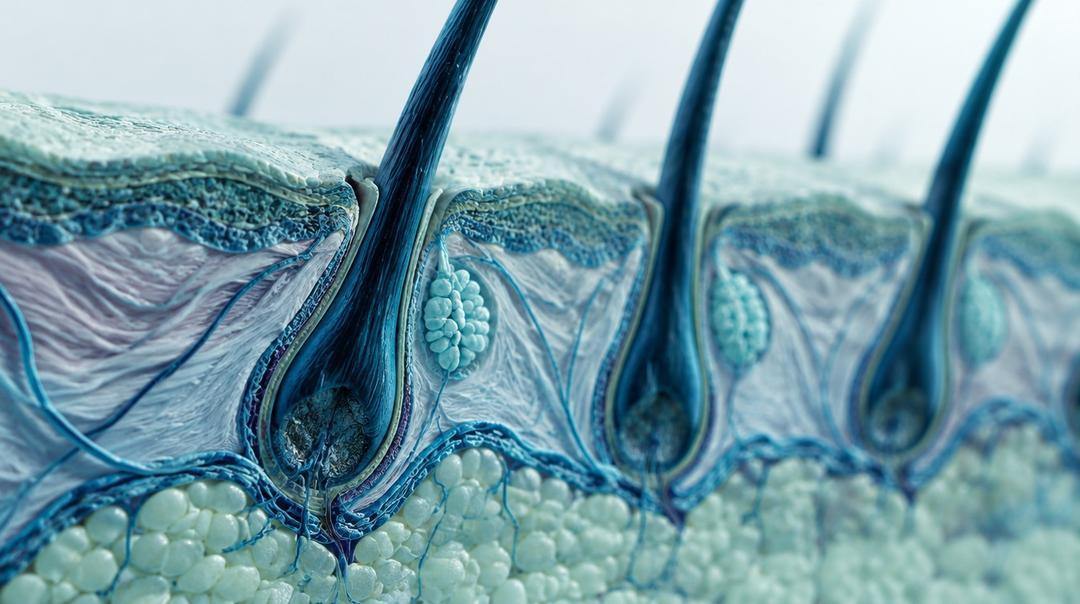
Every scalp hair cycles between a growing phase (anagen) and a resting phase (telogen), after which it sheds. Normally only a minority of follicles are resting at once. A physiological shock, such as surgery, severe illness, childbirth or a sharp drop in calorie and protein intake, can push a larger share of follicles into telogen at the same time. The result, some weeks to months later, is diffuse shedding across the whole scalp rather than bald patches. It is usually self-limiting once the trigger passes.
That pattern fits what the trials describe: diffuse, mostly mild, rarely treatment-limiting. In the tirzepatide pool, no tirzepatide-treated participant stopped treatment because of hair loss, while one placebo participant did.
The observational data add a subtype breakdown. A 2026 meta-analysis by Viquez Burboa and colleagues pooled 17 studies covering more than a million patient-exposures. The pooled odds ratio for any non-scarring alopecia was 1.40 (95% CI 1.33 to 1.48, three cohort studies). At 12 months the association was significant for telogen effluvium (adjusted odds ratio 1.76) and for androgenetic alopecia (1.64), but not for alopecia areata (1.08, 95% CI 0.87 to 1.34). An autoimmune pattern showing no signal while stress-related and pattern shedding do is what the weight-loss explanation would predict.
The same authors conclude that the effect is "primarily mediated by weight loss-induced micronutrient deficiency". Treat that as a hypothesis. Low protein, iron or zinc intake during rapid weight loss is a reasonable candidate, but none of the pooled studies randomised nutrition or measured it well enough to settle the question.
Why do women report more hair loss?
The sex gap is the most consistent finding in the data: 7.1% of women versus 0.5% of men on tirzepatide in the label pool, and 8.4% versus 0.2% in the higher-dose semaglutide trials. Placebo shows the same direction at a lower level.
Nobody has established why. Candidate explanations include a real biological difference in follicle sensitivity, the higher background rate of telogen effluvium and female-pattern thinning in women, and reporting: shedding in longer hair is more visible and more likely to be mentioned to an investigator. The trials enrolled more women than men, so the female estimates are also the more precise ones. Treat the gap as robust and its cause as open.
What the trial data cannot tell you
Mechanism. Adverse-event tables record what participants reported, coded into a preferred term. They do not include scalp examination, trichoscopy or biopsy, so "hair loss" in a label is not a diagnosis of telogen effluvium or anything else.
Direct drug effect versus weight-loss effect. To separate the two, you would need to compare people who lost the same amount of weight with and without the drug. No randomised trial was designed to do that, and observational analyses that adjust for weight loss inherit every weakness of observational data.
Duration and recovery. Trial follow-up was long enough to count events, not to track regrowth. Reviews describe the shedding as mostly transient, but that rests largely on clinical experience and case series.
Real-world frequency. Leite Júnior and colleagues note that reported prevalence ranges from 3–7% in controlled trials to over 70% in some real-world cohorts. That spread reflects how the question is asked. A self-report survey that asks "have you noticed more hair shedding?" captures far more than a trial in which participants volunteer symptoms. Neither number is wrong, but they measure different things. The guide to reading a study covers why self-selected samples inflate rates.
Other compounds. These figures belong to tirzepatide and semaglutide in the populations studied. They say nothing direct about retatrutide, whose larger average weight loss would predict more shedding if the weight-loss explanation holds, or about any material outside the trials. For how the receptor targets differ, see the GLP-1, GIP and glucagon receptor guide and the tirzepatide and retatrutide comparison.
Sudden, patchy, scarring or persistent hair loss is not the pattern described in these trials and needs a clinical assessment, not an assumption.
Frequently asked questions
How common is hair loss with tirzepatide compared with semaglutide? In the US labels, hair loss was reported in 4–5% of tirzepatide-treated participants and 3.3% of semaglutide-treated participants, against about 1% on placebo. The trials were separate, with different populations and durations, so the small difference between drugs is not a head-to-head finding. It is consistent with tirzepatide's larger average weight loss.
Is GLP-1 hair loss permanent? The pattern most often described is telogen effluvium, which is usually self-limiting once the trigger passes. But the trials did not follow participants long enough to document regrowth, and recovery data come mostly from clinical experience and case series. Persistent, patchy or scarring hair loss is a different presentation that the trial data do not describe.
Do the drugs damage hair follicles directly? That has not been shown. Both US labels associate the reports with weight reduction, bariatric surgery produces far higher rates with no drug involved, and observational data show no signal for alopecia areata. A direct follicular effect cannot be ruled out, because no trial compared people losing the same weight with and without the drug.
Why do surveys report much higher rates than the trials? Trials count adverse events that participants volunteer and investigators code. Surveys ask directly about shedding and recruit people already motivated to answer, which inflates rates. One review found estimates ranging from 3–7% in controlled trials to over 70% in some real-world cohorts. The two methods measure different things.
Does the label rate apply to other incretin compounds? No. The figures belong to tirzepatide and semaglutide in the trial populations that produced them. A compound with a different receptor profile, a different weight-loss trajectory or an unverified source has its own data or none. Extrapolating an adverse-event rate across molecules is the same error as extrapolating a benefit.
Supplied here for laboratory use: Tirzepatide. The laboratory's certificate for each lot is linked from its product page. For laboratory research use only.
Selected Research References
- Jastreboff AM, Aronne LJ, Ahmad NN, et al.; SURMOUNT-1 Investigators. Tirzepatide Once Weekly for the Treatment of Obesity. New England Journal of Medicine. 2022;387(3):205-216. pubmed.ncbi.nlm.nih.gov/35658024
- Wilding JPH, et al.; STEP 1 Study Group. Once-Weekly Semaglutide in Adults with Overweight or Obesity. New England Journal of Medicine. 2021;384:989-1002. pubmed.ncbi.nlm.nih.gov/33567185
- Cheng PL, et al. Glucagon-like peptide-1 receptor agonists and hair loss: A systematic review and meta-analysis. Diabetes Research and Clinical Practice. 2026;237:113333. pubmed.ncbi.nlm.nih.gov/42155605
- Viquez Burboa GU, Flores Guillén AR, Duardo González VS. GLP-1 Receptor Agonists and Alopecia: A Systematic Review and Meta-Analysis of Incidence, Risk, Subtypes, and Mechanisms. Skin Appendage Disorders. 2026. pubmed.ncbi.nlm.nih.gov/42621629
- Gupta AK, et al. GLP-1 therapies and hair loss: A systematic review of current evidence and implications for counseling. Science Progress. 2026;109(2):368504261444578. pubmed.ncbi.nlm.nih.gov/41998799
- Leite Júnior AC, et al. GLP-1 receptor agonists and hair loss: adverse effect, epiphenomenon, or therapeutic paradox? Acta Diabetologica. 2026. pubmed.ncbi.nlm.nih.gov/42873315
- Taghizadeh N, Salhab H, Alirezaei A, et al. Hair Loss and Metabolic and Bariatric Surgery: An Updated Systematic Review and Meta-analysis. Obesity Surgery. 2025;35(6):2370-2380. pubmed.ncbi.nlm.nih.gov/40388098
All products sold by NovaEvum are for research and laboratory use only. They are not intended for human or animal consumption, diagnosis, treatment, cure, or prevention of any disease.