
Copper peptides
What Is GHK-Cu? The Copper Peptide's Chemistry and Research
IM
· 10 min read
A summary of published research, with citations. It states no amount, schedule or route, and makes no claim about what this compound does in a person. Supplied for laboratory research use only.
On this page · 7 sections
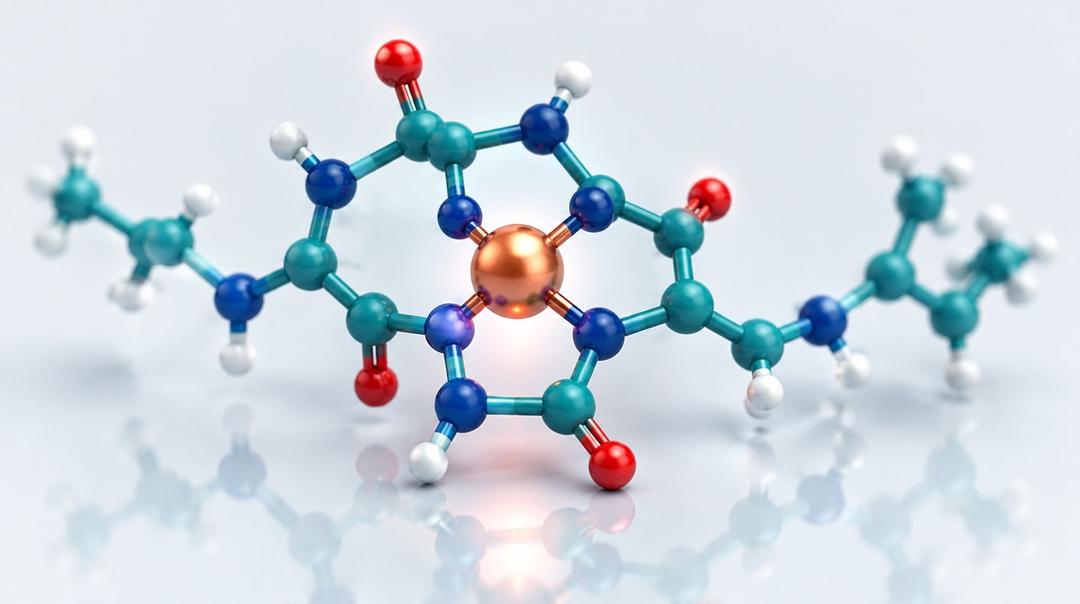
GHK-Cu is the tripeptide glycyl-histidyl-lysine (GHK) bound to a copper(II) ion. GHK occurs naturally in human plasma; Loren Pickart and Marvin Thaler reported it in 1973 as a serum factor that prolonged the survival of liver cells in culture. It binds copper very tightly, and most of its research, on fibroblasts, collagen and wound models, uses the copper complex. It is widely sold as a cosmetic ingredient. It is not an approved drug anywhere, and controlled human evidence for any medical use is lacking.
Where does GHK-Cu come from?
From a liver-cell experiment. In 1973 Pickart and Thaler reported a tripeptide in human serum that prolonged the survival of normal liver cells and stimulated the growth of liver tumour cells in culture (PMID 4349963). The same year, Pickart and colleagues showed that a synthetic version of the tripeptide had the same effects (PMID 4356974). It was Gly-His-Lys.
The copper came next. In 1980 Pickart and Thaler reported that GHK is complexed with copper and iron in plasma, binds a range of transition metals but not calcium, potassium or sodium, and stimulates cell adhesion and growth in culture at nanomolar concentrations when combined with copper or iron (PMID 6246126). From then on, the copper complex rather than the free peptide became the main object of study.
The step that pointed the field toward skin was a 1988 cell-culture paper. Maquart, Pickart and colleagues reported that GHK-Cu stimulated collagen synthesis by fibroblasts, starting at around 10⁻¹² to 10⁻¹¹ M and peaking at 10⁻⁹ M, without changing cell number (PMID 3169264). They also noted that the GHK sequence occurs within the α2 chain of type I collagen, and suggested that proteases at a wound might release it. That idea, of a repair signal freed from damaged matrix, still frames most of the research.
How does GHK hold copper?
This is the part most summaries skip, and it is the best-characterised thing about the molecule.
| Property | GHK-Cu |
|---|---|
| Peptide | Glycyl-L-histidyl-L-lysine (Gly-His-Lys) |
| Metal | Copper(II) |
| Stoichiometry in solution | 1:1 (one copper per peptide) |
| Copper ligands in solution | The terminal amino nitrogen, one amide nitrogen and the histidine imidazole nitrogen |
| Affinity | Conditional dissociation constant about 7 × 10⁻¹⁴ M at pH 7.4 |
| Solid state | Dimeric, with a carboxylate oxygen in the fourth position |
| Colour in solution | Blue, from the copper |
| Natural sources | Human plasma, saliva and urine |
Freedman and colleagues used EPR and related spectroscopy to show that, at neutral pH, GHK forms a mononuclear 1:1 copper(II) complex with copper held by two or three nitrogen atoms, one of them in the histidine ring (PMID 6291585). Hureau and colleagues later combined X-ray and solution methods and confirmed three nitrogen ligands in solution: the terminal amine, a deprotonated amide and the imidazole. In the crystal the complex is dimeric, and its copper exchanges quickly between peptides, unlike the related plasma copper site DAHK (PMID 21780203).
The binding is very tight. Trapaidze and colleagues measured a conditional dissociation constant of about 7 × 10⁻¹⁴ M for GHK at pH 7.4 by isothermal titration calorimetry (PMID 21898044). That is strong enough to compete with albumin, the main copper carrier in blood. Lau and Sarkar found that at equal concentrations of albumin and GHK, about 42% of the copper went to the peptide. At physiological concentrations, though, only about 6% of plasma copper was associated with small molecules (PMID 7340824). Bossak-Ahmad and colleagues later showed that GHK-Cu and albumin form ternary complexes, which may help shuttle exchangeable copper in blood (PMID 34730942).
Two practical points follow. GHK-Cu is a coordination complex, not a peptide with copper sprinkled on. And because copper exchanges readily, what a solution contains depends on what else is in it: other amino acids, buffers or proteins can take part in the binding.
What has GHK-Cu been studied in, and how far did each line get?
| Research area | What was examined | Evidence stage | Deep-dive |
|---|---|---|---|
| Collagen and matrix synthesis | Fibroblasts in culture | Cell | wound repair |
| Wound repair | Animal wound models; reviews by the discoverer | Animal | wound repair |
| Photoageing | Mostly reviews and cosmetic studies | Cell and cosmetic | photoageing |
| Hair follicles | Rodent studies and follicle culture, some using a different copper peptide | Animal and cell | hair follicle research |
| Gene expression | Computational screening; lung fibroblasts from people with COPD | Cell | This page |
| Skin after laser resurfacing | Randomised study, 13 patients completed | Small human | This page |
Gene expression. The most cited modern result came from outside the copper-peptide field. Campbell and colleagues profiled gene expression in lung tissue with varying emphysema and used the Connectivity Map, a database of drug-induced expression changes, to look for compounds that reverse the signature. GHK came out as one. In fibroblasts from COPD lungs, GHK restored the cells' ability to contract and remodel collagen gels, much as TGF-β did (PMID 22937864). That is a cell result, and the authors called for further studies. Reviews by Pickart's group go much further, describing GHK as able to "reset" thousands of genes (PMID 26236730). The primary data do not support so broad a claim.
Human data. Controlled human studies are scarce. In a randomised study after carbon dioxide laser resurfacing, completed by 13 patients, Miller and colleagues found no significant difference in redness, wrinkles or overall skin quality on objective or blinded assessment between skin-care regimens with and without GHK-Cu. Only patient satisfaction differed (PMID 16847171).
Why is GHK-Cu both a cosmetic and a research peptide?
Because the two are regulated differently and answer different questions.
As a cosmetic ingredient, a copper peptide in a skin-care product is sold on appearance claims. Cosmetic rules do not require the kind of randomised evidence a drug needs, and much of the claimed benefit comes from reviews written by researchers with a commercial interest. Pickart, the discoverer, co-authored most of the major reviews from a skin-care company (PMID 26236730, PMID 29986520). That does not make the reviews wrong, but it is a reason to go back to the primary studies they cite. The hair follicle article shows how far some of those claims drift from the papers behind them.
As a research reagent, GHK-Cu is a defined copper complex used to study matrix biology, copper transport and gene expression. That research needs to know the copper content, the counterion and the pH, all of which affect what the solution does. Why some formulations sting or irritate is examined in GHK-Cu irritation and formulation.
What is GHK-Cu's regulatory status?
- Not an approved drug. No approval from Health Canada, the FDA or the EMA for any medical indication.
- Cosmetic ingredient. Used in skin-care products, which are regulated as cosmetics, not drugs.
- US compounding. The FDA lists GHK-Cu, for some routes of administration, among bulk substances nominated for compounding that may present significant safety risks. It cites possible immunogenicity from aggregation and impurities, and limited human safety data.
- Canada. Research material sold here is a chemical for laboratory use only, not a cosmetic or drug product.
What is GHK-Cu commonly confused with?
AHK-Cu. A related copper tripeptide, alanyl-histidyl-lysine. The human follicle-culture study often cited for GHK-Cu and hair actually used AHK-Cu (PMID 17703734).
Free GHK. The peptide without copper. Much of the biology was reported for the copper complex, and the two are not interchangeable in an experiment.
BPC-157. Both are marketed for "repair", but they differ in size, chemistry and evidence; see GHK-Cu vs BPC-157 and what is BPC-157.
A blend component with its own evidence. GHK-Cu is the third component of GLOW and one of four in KLOW; see Wolverine Stack vs GLOW and inside the KLOW blend. The other components are introduced in what is TB-500 and what is KPV peptide.
Nothing here is medical, dosing, or therapeutic guidance.
Supplied here for laboratory use: GHK-Cu. The laboratory's certificate for each lot is linked from its product page. For laboratory research use only.
Frequently asked questions
What does GHK stand for? The one-letter codes of its three amino acids: G for glycine, H for histidine and K for lysine. "Cu" is the chemical symbol for copper. GHK-Cu therefore names the tripeptide Gly-His-Lys with a copper(II) ion bound to it, the form in which most of its biology has been studied since the early 1980s.
Who discovered GHK-Cu? Loren Pickart and Marvin Thaler reported the tripeptide in 1973 as a factor in human serum that prolonged the survival of liver cells in culture. A synthetic version was shown to behave the same way that year. In 1980 they reported that it carries copper and iron in plasma, and the copper complex became the focus of later work.
Why is GHK-Cu blue? Because of the copper(II) ion. Copper(II) complexes with nitrogen ligands absorb red and orange light and so look blue in solution. In GHK-Cu, copper is held by the peptide's terminal amino group, an amide nitrogen and the histidine ring. A colourless solution sold as GHK-Cu would suggest little or no copper is present.
Does GHK decline with age? Reviews by Pickart's group state that GHK is present in human plasma, saliva and urine and that its level declines with age. That is a statement about the endogenous peptide. It does not show that adding GHK-Cu to a system restores anything, and no controlled human study has tested that idea.
Is there good human evidence for GHK-Cu? Not for any medical use. Most of the evidence is cell culture and animal work, much of it from the discoverer's group. A randomised study after laser skin resurfacing, completed by 13 patients, found no objective difference with GHK-Cu products, only higher patient satisfaction. Cosmetic marketing claims are not evidence of a drug effect.
Selected Research References
- Pickart L, Thaler MM. Tripeptide in human serum which prolongs survival of normal liver cells and stimulates growth in neoplastic liver. Nature New Biology. 1973;243(124):85-87. pubmed.ncbi.nlm.nih.gov/4349963
- Pickart L, Thaler MM. Growth-modulating tripeptide (glycylhistidyllysine): association with copper and iron in plasma, and stimulation of adhesiveness and growth of hepatoma cells in culture by tripeptide-metal ion complexes. Journal of Cellular Physiology. 1980;102(2):129-139. pubmed.ncbi.nlm.nih.gov/6246126
- Maquart FX, Pickart L, Laurent M, et al. Stimulation of collagen synthesis in fibroblast cultures by the tripeptide-copper complex glycyl-L-histidyl-L-lysine-Cu2+. FEBS Letters. 1988;238(2):343-346. pubmed.ncbi.nlm.nih.gov/3169264
- Freedman JH, Pickart L, Weinstein B, et al. Structure of the glycyl-L-histidyl-L-lysine--copper(II) complex in solution. Biochemistry. 1982;21(19):4540-4544. pubmed.ncbi.nlm.nih.gov/6291585
- Lau SJ, Sarkar B. The interaction of copper(II) and glycyl-L-histidyl-L-lysine, a growth-modulating tripeptide from plasma. Biochemical Journal. 1981;199(3):649-656. pubmed.ncbi.nlm.nih.gov/7340824
- Hureau C, Eury H, Guillot R, et al. X-ray and solution structures of Cu(II) GHK and Cu(II) DAHK complexes: influence on their redox properties. Chemistry: A European Journal. 2011;17(36):10151-10160. pubmed.ncbi.nlm.nih.gov/21780203
- Trapaidze A, Hureau C, Bal W, et al. Thermodynamic study of Cu2+ binding to the DAHK and GHK peptides by isothermal titration calorimetry (ITC) with the weaker competitor glycine. Journal of Biological Inorganic Chemistry. 2012;17(1):37-47. pubmed.ncbi.nlm.nih.gov/21898044
- Campbell JD, McDonough JE, Zeskind JE, et al. A gene expression signature of emphysema-related lung destruction and its reversal by the tripeptide GHK. Genome Medicine. 2012;4(8):67. pubmed.ncbi.nlm.nih.gov/22937864
- Miller TR, Wagner JD, Baack BR, Eisbach KJ. Effects of topical copper tripeptide complex on CO2 laser-resurfaced skin. Archives of Facial Plastic Surgery. 2006;8(4):252-259. pubmed.ncbi.nlm.nih.gov/16847171
- Pickart L, Vasquez-Soltero JM, Margolina A. GHK Peptide as a Natural Modulator of Multiple Cellular Pathways in Skin Regeneration. BioMed Research International. 2015;2015:648108. pubmed.ncbi.nlm.nih.gov/26236730
All products sold by NovaEvum are for research and laboratory use only. They are not intended for human or animal consumption, diagnosis, treatment, cure, or prevention of any disease.