
A summary of published research, with citations. It states no amount, schedule or route, and makes no claim about what this compound does in a person. Supplied for laboratory research use only.
On this page · 9 sections
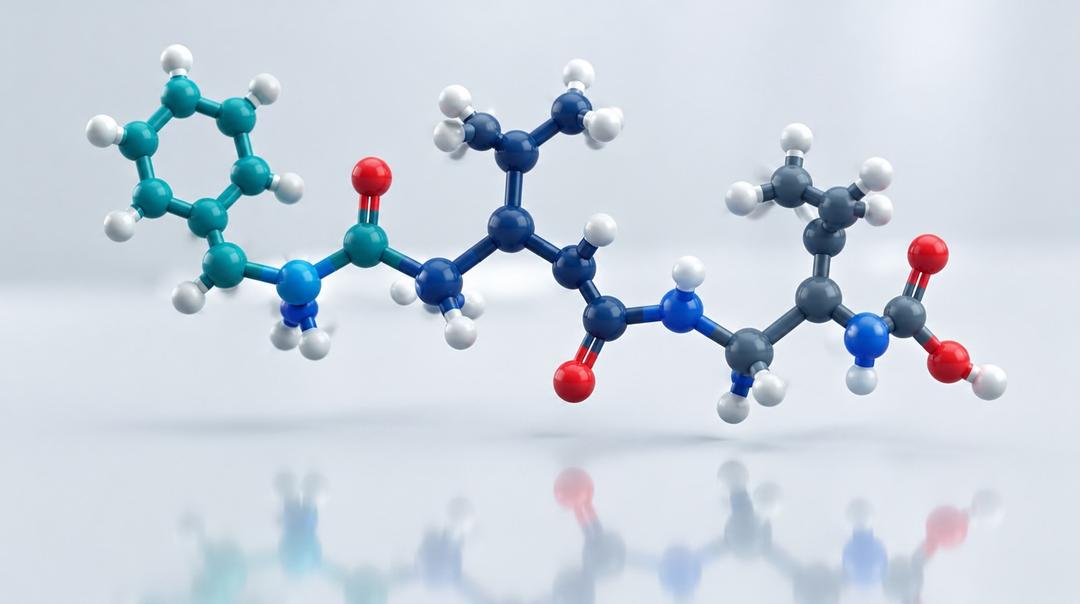
KPV is a tripeptide, lysine-proline-valine, that forms the last three residues of α-melanocyte-stimulating hormone (α-MSH), a thirteen-residue melanocortin hormone. Hiltz and Lipton reported in 1989 that the fragment on its own reduced inflammation in a mouse ear-swelling model. Since then KPV has been studied in cell culture and in mouse colitis models, where it is reported to enter cells through the PepT1 transporter. It has never been tested in a human trial and is not approved anywhere.
Where does KPV come from?
From the far end of a hormone. α-MSH is cut from a larger precursor, pro-opiomelanocortin, and its full sequence is SYSMEHFRWGKPV (PMID 10670585). Its best-known job is in pigmentation, through the melanocortin-1 receptor on melanocytes, but it also has anti-inflammatory and fever-reducing actions in experimental systems.
In the 1980s, Lipton's group was studying α-MSH as an antipyretic and had come to think that the fever-reducing "message" sat in its C-terminal tripeptide. In 1989 Hiltz and Lipton tested whether that tripeptide, α-MSH(11-13), also had general anti-inflammatory activity. In mice whose ears were made to swell with the chemical irritant picryl chloride, it reduced the swelling in a dose-related way, in a comparison with saline and a corticosteroid (PMID 2550304). The authors suggested that peptide drugs based on the tripeptide might one day be developed.
There was a practical reason for interest. A 2008 review by Brzoska and colleagues pointed out that the pigmentary effect of α-MSH is an obstacle to using the full hormone against inflammation, and that KPV keeps anti-inflammatory activity without the pigmentary action (PMID 18612139). A three-residue peptide is also cheap and straightforward to make.
What is KPV, chemically?
| Property | KPV |
|---|---|
| Sequence | Lys-Pro-Val (KPV) |
| Length | 3 amino acids |
| Source sequence | Residues 11 to 13 of α-MSH (SYSMEHFRWGKPV) |
| Parent hormone family | Melanocortins, derived from pro-opiomelanocortin |
| Proposed entry into gut cells | The di- and tripeptide transporter PepT1 |
| Related but different molecule | KdPT (Lys-D-Pro-Thr), which reached a phase 2a trial |
| Human trials of KPV | None |
At three residues, KPV is about as small as a peptide gets. That changes how it can reach its targets. Dipeptides and tripeptides from digested protein are absorbed by dedicated transporters, and that route is central to the best-known KPV paper.
How is KPV proposed to work?
Two explanations exist, and they are not fully reconciled.
Through melanocortin receptors. Because α-MSH acts on melanocortin receptors, the obvious assumption is that its tripeptide does too. The evidence is mixed. Elliott and colleagues found that neither α-MSH nor KPV raised cyclic AMP, the classic melanocortin second messenger, in human keratinocytes. Both did trigger calcium signals under specific conditions, and both raised intracellular calcium in cells engineered to express the MC1 receptor (PMID 15102092). That suggests KPV can signal through MC1R in some settings, but not by the textbook route.
Inside the cell, after transport. Dalmasso and colleagues showed that KPV is carried into intestinal epithelial cells and immune cells by PepT1, a transporter normally found in the small intestine and induced in the colon during inflammatory bowel disease. Once inside, nanomolar concentrations inhibited NF-κB and MAP kinase signalling and reduced the release of pro-inflammatory cytokines (PMID 18061177). On this account KPV does not need a surface receptor at all. It only needs to get in, and inflamed colon makes more of the transporter that lets it.
These are not exclusive. A tripeptide could act on a receptor in skin and through transport in gut. But it means "KPV works through melanocortin receptors" and "KPV works through PepT1" are both partial statements, each backed by a small number of papers. How receptor claims of this kind are tested is explained in how peptide receptors work.
What has KPV been studied in, and how far did each line get?
| Research area | Models | Evidence stage | Deep-dive |
|---|---|---|---|
| Inflammation (original finding) | Mouse ear swelling | Animal | This page |
| Colitis | DSS- and TNBS-induced colitis in mice; intestinal cell lines | Animal and cell | KPV and colitis |
| Targeted delivery to the colon | Nanoparticle formulations in mouse colitis | Animal | This page |
| Antimicrobial activity | Staphylococcus aureus and Candida albicans in culture | Cell (in vitro) | This page |
| Skin cells | Human keratinocytes in culture | Cell | This page |
| Airway inflammation | Mostly studies of the parent hormone, α-MSH | Indirect | KPV and airway research |
| People | None | — | — |
The colitis work is the core. Beyond the PepT1 paper, Xiao and colleagues loaded KPV into hyaluronic-acid-coated nanoparticles designed to reach colonic epithelial cells and macrophages. In a mouse model of ulcerative colitis, the targeted formulation reduced mucosal damage and TNF-α expression more than an untargeted one (PMID 28143741). That is a drug-delivery result: it shows that where the tripeptide ends up matters, not that the free peptide behaves the same way.
The antimicrobial finding is easy to overlook. Cutuli and colleagues reported that α-MSH and KPV both inhibited S. aureus colony formation and reduced the viability of C. albicans in culture, at concentrations including the picomolar range (PMID 10670585). It is a single in vitro study, but it gives KPV a second, unrelated line of research.
The airway thread is the weakest. Most of what is cited for KPV and asthma is research on α-MSH, not on the tripeptide, which is the subject of the airway deep-dive.
Has KPV been tested in humans?
No. There is no registered or published clinical trial of KPV itself. Searching ClinicalTrials.gov for KPV in October 2026 returned no studies.
The FDA reaches the same conclusion from the regulatory side. KPV appears on its list of bulk substances nominated for compounding that may present significant safety risks, and the agency states it has not identified any human exposure data on drug products containing KPV by any route.
Why is KdPT not the same as KPV?
This is the most consequential confusion in the KPV literature. KdPT (sometimes written K(D)PT) is Lys-D-Pro-Thr, described in the literature as an interleukin-1β analogue (PMID 10081976). Brzoska's review calls it a derivative of KPV that corresponds to residues 193 to 195 of interleukin-1β, not to α-MSH (PMID 18612139). It has a D-amino acid and a different third residue.
KdPT went further than KPV ever has. In a randomised, double-blind phase 2a trial, Kucharzik and colleagues added it to existing treatment in patients with mild-to-moderate ulcerative colitis. All doses were well tolerated. The pooled KdPT group met the primary endpoint only after additional analyses, against a very high placebo response, and the authors called it a preliminary trial (PMID 28092306).
That trial is sometimes cited as human evidence for KPV. It is not. It is evidence about a different tripeptide, and a modest, preliminary piece of evidence at that.
What is KPV's regulatory status?
- Not approved anywhere. No approval from Health Canada, the FDA or the EMA for any indication.
- No clinical programme. No completed or registered human trial of KPV.
- US compounding. Listed by the FDA among bulk substances that may present significant safety risks in compounding, with no human exposure data identified.
- Canada. Not an authorised drug. Sold here as a research chemical for laboratory use only.
What else is KPV confused with?
α-MSH and melanotan. KPV is a fragment of α-MSH, but it lacks the pigmentary action of the hormone and of synthetic melanocortin agonists.
BPC-157. Both are studied in colitis models, through different proposed mechanisms; see KPV vs BPC-157 and what is BPC-157.
A blend component with its own evidence. KPV is the fourth component of the KLOW blend, alongside BPC-157, TB-500 and GHK-Cu; see inside the KLOW blend. No published study has tested that combination. The other components are introduced in what is TB-500 and what is GHK-Cu.
Nothing here is medical, dosing, or therapeutic guidance.
Supplied here for laboratory use: KPV. The laboratory's certificate for each lot is linked from its product page. For laboratory research use only.
Frequently asked questions
What does KPV stand for? The single-letter codes for its three amino acids: K for lysine, P for proline and V for valine. Together they are residues 11 to 13 of α-melanocyte-stimulating hormone. KPV is not an acronym for a brand or a development code, which is why the same name appears across unrelated suppliers and papers.
Is KPV a melanocortin agonist? Partly, and under specific conditions. One study found KPV raised calcium in cells engineered to express the MC1 receptor but did not raise cyclic AMP in human keratinocytes. The best-known colitis work instead proposes that it enters cells through the PepT1 transporter and acts inside them. Neither mechanism has been shown to explain all its reported effects.
Does KPV cause tanning like α-MSH? A 2008 review describes KPV as keeping the anti-inflammatory activity of α-MSH without its pigmentary action, and that lack of pigmentary effect is the main reason researchers turned to the tripeptide. No human study has examined KPV for any endpoint, pigmentation included, so this rests on laboratory work.
Is there any human data on KPV? None for KPV itself. The FDA states it has identified no human exposure data on KPV drug products. A phase 2a trial in ulcerative colitis tested KdPT, a different tripeptide with a D-proline and a threonine, and its authors described it as preliminary. It should not be read as KPV evidence.
Why does PepT1 matter for KPV? PepT1 is a transporter for di- and tripeptides, normally found in the small intestine and induced in the colon during inflammatory bowel disease. If KPV acts after being carried into cells by PepT1, inflamed colon is a place where it can get in more readily. That is the logic of the mouse colitis research.
Selected Research References
- Hiltz ME, Lipton JM. Antiinflammatory activity of a COOH-terminal fragment of the neuropeptide alpha-MSH. FASEB Journal. 1989;3(11):2282-2284. pubmed.ncbi.nlm.nih.gov/2550304
- Brzoska T, Luger TA, Maaser C, et al. Alpha-melanocyte-stimulating hormone and related tripeptides: biochemistry, antiinflammatory and protective effects in vitro and in vivo, and future perspectives for the treatment of immune-mediated inflammatory diseases. Endocrine Reviews. 2008;29(5):581-602. pubmed.ncbi.nlm.nih.gov/18612139
- Dalmasso G, Charrier-Hisamuddin L, Nguyen HT, et al. PepT1-mediated tripeptide KPV uptake reduces intestinal inflammation. Gastroenterology. 2008;134(1):166-178. pubmed.ncbi.nlm.nih.gov/18061177
- Elliott RJ, Szabo M, Wagner MJ, et al. alpha-Melanocyte-stimulating hormone, MSH 11-13 KPV and adrenocorticotropic hormone signalling in human keratinocyte cells. Journal of Investigative Dermatology. 2004;122(4):1010-1019. pubmed.ncbi.nlm.nih.gov/15102092
- Cutuli M, Cristiani S, Lipton JM, Catania A. Antimicrobial effects of alpha-MSH peptides. Journal of Leukocyte Biology. 2000;67(2):233-239. pubmed.ncbi.nlm.nih.gov/10670585
- Xiao B, Xu Z, Viennois E, et al. Orally Targeted Delivery of Tripeptide KPV via Hyaluronic Acid-Functionalized Nanoparticles Efficiently Alleviates Ulcerative Colitis. Molecular Therapy. 2017;25(7):1628-1640. pubmed.ncbi.nlm.nih.gov/28143741
- Kucharzik T, Lemmnitz G, Abels C, et al. Tripeptide K(D)PT Is Well Tolerated in Mild-to-moderate Ulcerative Colitis: Results from a Randomized Multicenter Study. Inflammatory Bowel Diseases. 2017;23(2):261-271. pubmed.ncbi.nlm.nih.gov/28092306
All products sold by NovaEvum are for research and laboratory use only. They are not intended for human or animal consumption, diagnosis, treatment, cure, or prevention of any disease.