
Copper peptides
GHK-Cu and the Future of Regenerative Skincare: What's Next in 2027?
IM
· 5 min read
A summary of published research, with citations. It states no amount, schedule or route, and makes no claim about what this compound does in a person. Supplied for laboratory research use only.
On this page · 8 sections
Skincare has entered an era in which molecular biology and cosmetic formulation science are increasingly connected. Among the ingredients receiving continued research attention is GHK-Cu, a copper-binding tripeptide studied for its interactions with skin biology and tissue remodelling.
GHK-Cu is not a new discovery, but advances in analytical chemistry, formulation technology and biological research have created new ways to investigate it.
What is GHK-Cu?
GHK-Cu is the tripeptide glycyl-L-histidyl-L-lysine bound to a copper ion. It belongs to a broader group of copper-binding peptides studied for their relationship with biological signalling and extracellular matrix processes.
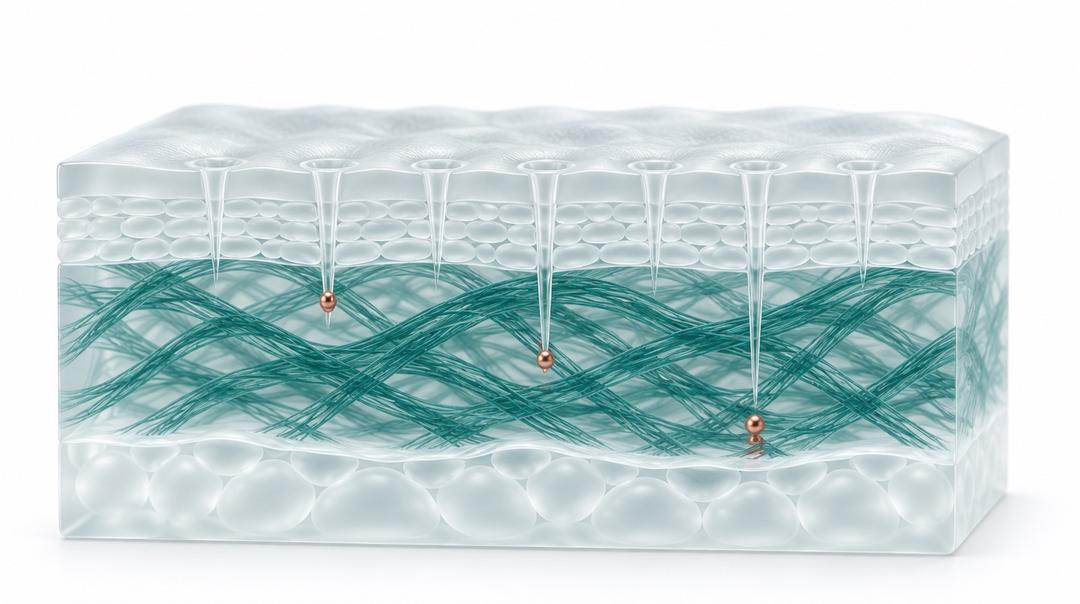
The extracellular matrix is part of the structural environment around cells. In skin it includes proteins such as collagen and elastin, which contribute to the skin's organization and mechanical properties. Laboratory studies have investigated how GHK-Cu influences fibroblast activity and matrix remodelling. Activity in a laboratory system is not the same as demonstrated clinical efficacy in people. The compound is covered in what GHK-Cu is.
Copper peptides and collagen research
Collagen is a structural protein found throughout the body. In skin it contributes to strength, organization and tissue integrity, and changes in its structure and turnover with age affect the skin's appearance and mechanical properties.
GHK-Cu has been investigated in experimental systems involving collagen-related pathways and tissue repair, and some small cosmetic studies have examined copper-peptide formulations for changes in skin appearance. The human literature remains limited. A 2026 evidence-mapping review found the preclinical data consistent but the clinical evidence sparse: historical cosmetic reports are small or incompletely characterized, a 13-participant study after CO2 laser resurfacing was negative on its objective endpoints, and a registered phase 2 wound study had no results yet (Mateescu and colleagues, 2026). Many older studies do not characterize the product well enough to isolate the effect of chemically defined GHK-Cu, which is why researchers increasingly stress standardized formulations and controlled trials. The photoageing work is covered in GHK-Cu photoageing research.
AHK-Cu and the wider copper peptide family
AHK-Cu is another copper-binding peptide with a different amino acid sequence. Although both bind copper, AHK-Cu should not be treated as interchangeable with GHK-Cu: a different sequence can change molecular structure, chemical stability and biological interactions.
Research on copper peptides and hair biology has raised interest in how those differences affect cellular responses. Strong conclusions would need well-characterized formulations and meaningful human outcomes. More is in what AHK-Cu is and GHK-Cu and the hair follicle.
The next frontier: better delivery systems
Researchers are studying hydrogels, advanced topical formulations, microneedle-assisted delivery, encapsulation and controlled-release materials. These bear on a basic problem in peptide formulation: a molecule can be active in a laboratory system without reaching its intended target when applied to intact skin.
A 2026 systematic review found that microneedle delivery has markedly increased GHK-Cu skin uptake in laboratory and pig-skin models, but that no adequately powered randomized human trial of microneedle-delivered GHK-Cu had been published (Najafi and colleagues, 2026). Better stability, transport and exposure could make clinical studies more informative. Microneedling and other methods that break the skin barrier also need their own independent safety evaluation.
Why formulation quality matters
The concentration printed on a label does not fully describe how a peptide formulation will behave. Identity, the stability of the copper complex, the surrounding ingredients, pH, storage conditions and degradation all matter, and two formulations with the same nominal amount of GHK-Cu may behave differently. The 2026 review above argues that the field's main obstacle is less biological plausibility than pharmaceutical definition: what copper species is actually present, how much copper is free, and whether intact GHK-Cu is what gets released. Formulation problems are covered in GHK-Cu irritation and formulation.
What will define GHK-Cu research in 2027?
Three questions could shape the year. Can researchers produce stronger human evidence? Can formulation science improve consistency? Can delivery technology improve performance safely? Larger controlled studies, better chemical characterization and carefully validated delivery systems would strengthen the field's scientific foundation.
The future of copper peptides will depend as much on formulation science and clinical validation as on the biological properties of the peptides themselves.
Looking ahead
GHK-Cu sits at the intersection of peptide chemistry, skin biology and formulation science. Its long history of experimental work is a foundation for research, but more rigorous human evidence is needed.
The next generation of regenerative skincare may be defined not by adding more active ingredients, but by understanding how to deliver well-characterized molecules effectively and consistently.
Supplied here for laboratory use: GHK-Cu and AHK-Cu. For laboratory research use only.
Nothing here is medical, cosmetic, dosing or therapeutic guidance.
Selected Research References
- Mateescu DM, Gavrilescu DM, Mincioaga RI, et al. GHK-Cu as a Bioactive Metallopeptide and Drug-Delivery Cargo: Coordination Chemistry, Formulation Science, Therapeutic Evidence, and a Translational Roadmap. Pharmaceutics. 2026;18(9). pubmed.ncbi.nlm.nih.gov/42797253
- Najafi N, Maatouk H, Vardanyan KG, Vartanian KB, Agrawal DK. A Systematic Review of the Mechanisms and Therapeutic Applications of GHK-Cu (Glycyl-L-Histidyl-L-Lysine-Copper Complex) in Topical Microneedle Delivery: A Case for Expanded Clinical Trials. Archives of Internal Medicine Research. 2026;9(3):269-293. pubmed.ncbi.nlm.nih.gov/42787770
Further reading
All products sold by NovaEvum are for research and laboratory use only. They are not intended for human or animal consumption, diagnosis, treatment, cure, or prevention of any disease.