
A summary of published research, with citations. It states no amount, schedule or route, and makes no claim about what this compound does in a person. Supplied for laboratory research use only.
On this page · 7 sections
Tesamorelin is a synthetic analogue of growth hormone-releasing hormone (GHRH): the full 44-residue human hormone with a trans-3-hexenoyl group attached to its first amino acid. That change slows its breakdown, and it prompts the pituitary to release the body's own growth hormone. Developed in Montreal by Theratechnologies as TH9507, it is approved as Egrifta in the United States (2010) and Canada (2014) for excess abdominal fat in adults with HIV. It holds no approval for anything else, anywhere.
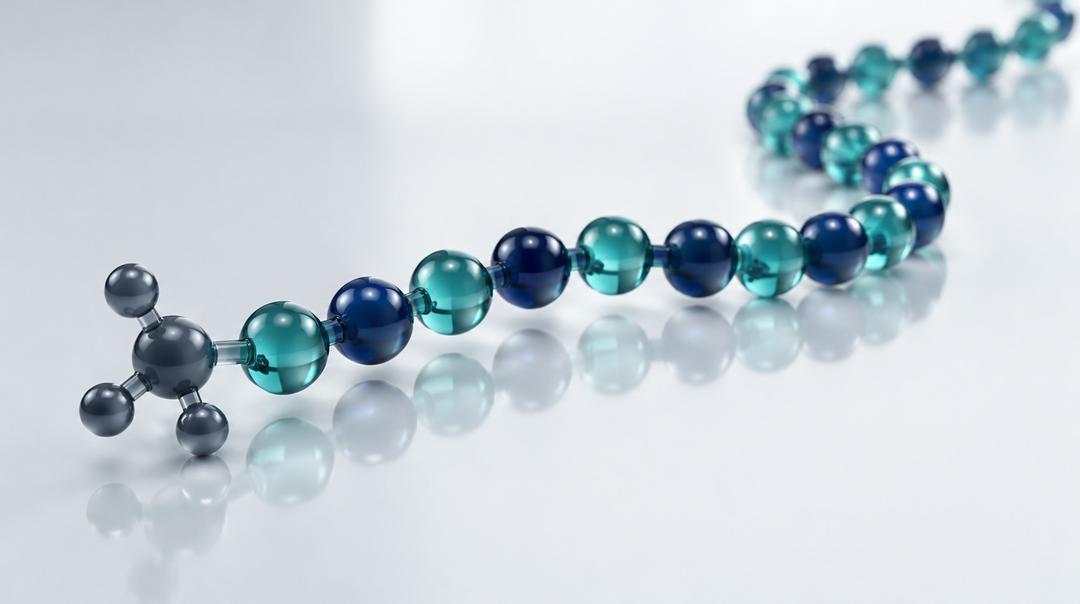
What is tesamorelin, chemically?
It is native human GHRH with one addition. Ferdinandi and colleagues describe TH9507 as human GHRH(1-44)-NH2 "minimally modified" by a trans-3-hexenoyl group on tyrosine 1 (PMID 17214611). Everything after that first residue is the natural hormone's sequence.
| Property | Tesamorelin |
|---|---|
| Structure | Human GHRH(1-44)-NH2 with an N-terminal trans-3-hexenoyl group |
| Development code | TH9507 |
| Developer | Theratechnologies, Montreal |
| CAS number (PubChem) | 218949-48-5 |
| Molecular formula (PubChem) | C221H366N72O67S |
| Molecular weight (PubChem) | About 5,136 g/mol |
| Class | GHRH-receptor agonist (a releasing-hormone analogue, not growth hormone) |
| Evidence stage | Human: phase 3 trials and later randomised trials, mostly in adults with HIV |
| Regulatory status | Approved as Egrifta for one indication in the US and Canada; nothing else |
That makes tesamorelin the largest molecule among the common growth hormone secretagogues, and the closest to the natural hormone. Sermorelin keeps only the first 29 residues and adds nothing. CJC-1295 keeps 29 residues with four substitutions, and in its original form adds an albumin-binding linker. The three are compared in sermorelin vs tesamorelin and what is CJC-1295.
How does tesamorelin work?
Native GHRH is inactivated within minutes, mainly by dipeptidyl peptidase-4, which cuts off its first two residues. The hexenoyl cap blocks that. In the non-clinical package, TH9507 resisted the enzyme, degraded more slowly than native GHRH in rat, dog and human plasma, and stayed in circulation longer; its apparent elimination half-life in dogs was 21 to 45 minutes (PMID 17214611). Growth hormone and IGF-I rose in pigs, rats and dogs.
Once it reaches the pituitary it does what GHRH does: it binds the GHRH receptor on growth hormone-producing cells, the cells release growth hormone, and IGF-I rises downstream. It does not act at the ghrelin receptor, which is where ipamorelin works. Where both families sit is mapped in growth hormone secretagogues explained.
The same non-clinical paper records the downside of the mechanism. Dogs exposed for up to four months showed a more pronounced anabolic effect and reversible adverse findings in liver and kidney, anaemia and organ-weight changes, which the authors attributed to sustained supraphysiological growth hormone and IGF-I. A drug that raises IGF-I carries the risks of raised IGF-I.
What were the trials that led to approval?
Two phase 3 trials in adults with HIV who had accumulated abdominal fat on antiretroviral therapy. In the first, 412 patients, 86% of them men, were randomised to tesamorelin or placebo for 26 weeks. Visceral fat on CT fell by 15.2% with tesamorelin and rose by 5.0% with placebo; IGF-I rose by 81%, triglycerides fell, and glycaemic measures did not differ. More patients on tesamorelin withdrew because of an adverse event (PMID 18057338). Pooled across both trials, 806 patients, the treatment effect on visceral fat was −15.4% at 26 weeks, with fat under the abdominal skin essentially unchanged (PMID 20554713).
The detail that matters most for reading the whole programme came from the extension. Patients who stopped had their visceral fat come back (PMID 21668043). The full trial record, responder analyses and the liver-fat studies are in the tesamorelin visceral fat trials, and are not repeated here. Why a CT measurement of fat is a surrogate rather than a clinical outcome is explained in surrogate endpoints explained.
What else has tesamorelin been studied for?
Outside the approved indication, the record is smaller, mixed, and in one case not about HIV at all.
Cognition in older adults. Baker and colleagues randomised 152 adults aged 55 to 87, 66 with mild cognitive impairment, to tesamorelin or placebo for 20 weeks (PMID 22869065). The intent-to-treat analysis reported a favourable effect on a cognitive composite (P = .03), driven mainly by executive function. IGF-I rose by 117% and body fat fell by 7.4%. Adverse events, mostly mild, were reported by 68% on tesamorelin and 36% on placebo. It is a single trial with a composite cognitive endpoint, and its authors called for longer studies.
Cognition in HIV. Ellis and colleagues randomised 73 people with HIV and abdominal obesity to tesamorelin or standard care for six months (PMID 39813152). Waist circumference fell more with tesamorelin, but the difference in neurocognitive performance between groups was not significant (P = .673). The trial was open-label, had no placebo arm, and the authors describe it as underpowered.
Liver fat in HIV. A 61-person randomised trial reported a reduction in liver fat fraction with no difference in glucose control (PMID 31611038). Liver disease is not an approved indication anywhere.
Abandoned directions. ClinicalTrials.gov lists a Theratechnologies phase 2 trial in chronic obstructive pulmonary disease (NCT01388920), terminated on what the registry calls a non-safety-related corporate decision.
Is tesamorelin approved in Canada?
Yes, as one product for one indication. The FDA approved Egrifta in 2010 (Traynor, 2010). In Canada, Theratechnologies announced a Notice of Compliance from Health Canada in April 2014, after an earlier negative decision was reconsidered; the Canadian authorisation covers excess visceral fat in adults with HIV. We could not reach Health Canada's database to re-confirm the listing on the day this was written, so current marketing status, including which presentations remain active, should be checked in the Drug Product Database.
What the approval covers matters as much as that it exists. It belongs to a manufactured medicine, made to an approved dossier, prescribed for adults with HIV. It does not extend to people without HIV, to any other use, or to material sold under the same name outside the medicine supply chain. Sourcing research tesamorelin in Canada sets out why research material inherits none of it. GHRH and its analogues are also a named class on the World Anti-Doping Agency's prohibited list.
What is tesamorelin commonly confused with?
Growth hormone. Tesamorelin contains none. It needs a working pituitary to have any effect, which is a basic difference from recombinant growth hormone.
Sermorelin and CJC-1295. Same receptor, different molecules: sermorelin is the short native fragment, CJC-1295 a substituted short fragment. Tesamorelin is the only one of the three with a current approval.
Ipamorelin. A ghrelin-receptor agonist with no approval anywhere, often listed beside tesamorelin as if the two were interchangeable. The difference in receptor and evidence is set out in tesamorelin vs ipamorelin.
A weight-loss drug. The trials measured visceral fat in one population. Body weight was not the primary endpoint, and no approval covers weight management.
Supplied here for laboratory use: Tesamorelin. The laboratory's certificate for each lot is linked from its product page. For laboratory research use only.
The trial results above describe the licensed or investigational product in the people enrolled. They are not evidence about any laboratory reagent. Nothing here is medical, dosing, or therapeutic guidance.
Frequently asked questions
Is tesamorelin a peptide or a hormone? Both, in a sense. It is a synthetic peptide whose sequence is the natural 44-residue human GHRH, with one chemical group added at the start to slow its breakdown. It acts like the natural releasing hormone, not like growth hormone, so its effect depends on the pituitary responding to it.
What does the hexenoyl group do? It caps the first amino acid. Native GHRH is inactivated when dipeptidyl peptidase-4 removes its first two residues. In Theratechnologies' non-clinical work, the capped peptide resisted that enzyme and degraded more slowly in rat, dog and human plasma, which is what made a full-length GHRH practical to develop as a drug.
Has tesamorelin been tested in people without HIV? Yes, in smaller studies. The largest published is a 152-person randomised trial in older adults with and without mild cognitive impairment, which reported a favourable effect on a cognitive composite. That trial is not an approval, and none of the indications studied outside HIV has been authorised anywhere.
Is research tesamorelin the same as Egrifta? The sequence is the same; the product is not. Egrifta is a licensed medicine manufactured under pharmaceutical controls and prescribed for one indication. Research material is a laboratory chemical with no approval, no prescribing information and no clinical evidence base of its own, and it is not for human use.
Selected Research References
- Ferdinandi ES, Brazeau P, High K, et al. Non-clinical pharmacology and safety evaluation of TH9507, a human growth hormone-releasing factor analogue. Basic & Clinical Pharmacology & Toxicology. 2007;100(1):49-58. pubmed.ncbi.nlm.nih.gov/17214611
- Falutz J, Allas S, Blot K, et al. Metabolic effects of a growth hormone-releasing factor in patients with HIV. New England Journal of Medicine. 2007;357(23):2359-2370. pubmed.ncbi.nlm.nih.gov/18057338
- Falutz J, Mamputu JC, Potvin D, et al. Effects of tesamorelin (TH9507), a growth hormone-releasing factor analog, in human immunodeficiency virus-infected patients with excess abdominal fat: a pooled analysis of two multicenter, double-blind placebo-controlled phase 3 trials with safety extension data. Journal of Clinical Endocrinology & Metabolism. 2010;95(9):4291-4304. pubmed.ncbi.nlm.nih.gov/20554713
- Traynor K. FDA approves tesamorelin for HIV-related lipodystrophy. American Journal of Health-System Pharmacy. 2010;67(24):2082. pubmed.ncbi.nlm.nih.gov/21115997
- Dhillon S. Tesamorelin: a review of its use in the management of HIV-associated lipodystrophy. Drugs. 2011;71(8):1071-1091. pubmed.ncbi.nlm.nih.gov/21668043
- Baker LD, Barsness SM, Borson S, et al. Effects of growth hormone-releasing hormone on cognitive function in adults with mild cognitive impairment and healthy older adults: results of a controlled trial. Archives of Neurology. 2012;69(11):1420-1429. pubmed.ncbi.nlm.nih.gov/22869065
- Stanley TL, Fourman LT, Feldpausch MN, et al. Effects of tesamorelin on non-alcoholic fatty liver disease in HIV: a randomised, double-blind, multicentre trial. Lancet HIV. 2019;6(12):e821-e830. pubmed.ncbi.nlm.nih.gov/31611038
- Ellis RJ, Vaida F, Hu K, et al. Effects of tesamorelin on neurocognitive impairment in persons with HIV and abdominal obesity. Journal of Infectious Diseases. 2025;231(5):1230-1238. pubmed.ncbi.nlm.nih.gov/39813152
All products sold by NovaEvum are for research and laboratory use only. They are not intended for human or animal consumption, diagnosis, treatment, cure, or prevention of any disease.