
Tesamorelin
Tesamorelin vs Ipamorelin: Two Receptors, Two Evidence Bases
EC
· 9 min read
A summary of published research, with citations. It states no amount, schedule or route, and makes no claim about what this compound does in a person. Supplied for laboratory research use only.
On this page · 8 sections
Tesamorelin and ipamorelin both lead to growth hormone release, but through different receptors. Tesamorelin is a modified 44-residue growth hormone-releasing hormone (GHRH) analogue acting at the GHRH receptor; it is approved as Egrifta for excess visceral fat in adults with HIV, on the basis of two phase 3 trials. Ipamorelin is a five-residue agonist of the ghrelin receptor (GHS-R1a); its human record is one pharmacokinetic study in healthy men and one negative phase 2 trial, and it is approved nowhere.
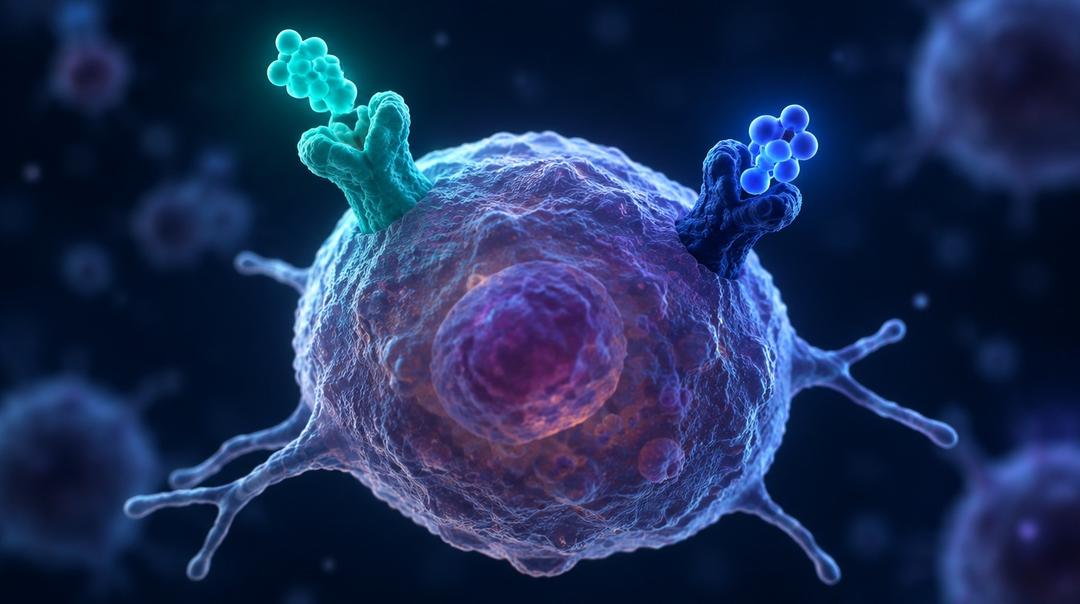
Which receptor does each one act on?
The pituitary somatotroph, the cell that makes growth hormone, carries two receptors that matter here.
The GHRH receptor responds to the hypothalamic hormone GHRH. Tesamorelin is human GHRH(1-44) with a trans-3-hexenoyl group added to its first residue; in plasma studies that modification made it resistant to dipeptidyl peptidase-4, the enzyme that inactivates native GHRH (Ferdinandi and colleagues, PMID 17214611).
The ghrelin receptor, also called the growth hormone secretagogue receptor, responds to the gut hormone ghrelin and to a family of synthetic growth hormone-releasing peptides. Ipamorelin, Aib-His-D-2-Nal-D-Phe-Lys-NH2, came out of a chemistry programme built on that family. In pharmacological profiling with receptor antagonists, it released growth hormone through the GHRP-type receptor, not the GHRH receptor (Raun and colleagues, PMID 9849822).
Same cell, different doors. The growth hormone secretagogues guide maps both pathways, and the ghrelin receptor explainer covers the second in detail. That is why the two names often appear together, and why results for one say nothing about the other. The receptor logic is set out in CJC-1295 and ipamorelin.
Side by side
| Tesamorelin | Ipamorelin | |
|---|---|---|
| Identity | GHRH(1-44)-NH2 with N-terminal trans-3-hexenoyl group; 44 residues | Aib-His-D-2-Nal-D-Phe-Lys-NH2; 5 residues, including non-natural amino acids |
| Class | GHRH analogue | Ghrelin-receptor (GHS-R1a) agonist; growth hormone secretagogue |
| Mechanism | GHRH receptor on pituitary somatotrophs | Ghrelin receptor on somatotrophs and elsewhere, including the gut |
| Evidence stage | Human: phase 3 trials in adults with HIV; smaller later trials | Human: one pharmacokinetic study; one phase 2 trial that missed its endpoint. Otherwise cell and animal work |
| Regulatory status | Approved as Egrifta (United States; Canada since 2014) for one indication | Approved nowhere; development did not reach registration |
| What was measured | Visceral fat by CT, lipids, IGF-I, liver fat | Growth hormone release and selectivity; time to tolerating a meal after bowel surgery |
What did ipamorelin's founding studies show?
The defining paper is about selectivity. In rat pituitary cells, ipamorelin released growth hormone with potency and efficacy similar to GHRP-6. In anaesthetised rats and conscious swine its potency was also comparable. The point that made it notable came from the swine: GHRP-6 and GHRP-2 raised ACTH and cortisol, while ipamorelin did not raise either beyond the levels seen with GHRH, even at amounts far above those needed for growth hormone release. None of the secretagogues tested changed FSH, LH, prolactin or TSH (Raun and colleagues, PMID 9849822).
That is a finding about hormone specificity in pigs. It is not a safety result in people, and "selective" should not be read as "without effects". The ipamorelin selectivity article explains why selectivity depends on the assay.
What human data exist for ipamorelin?
Two studies.
Gobburu and colleagues studied ipamorelin at five escalating exposure levels in healthy men, eight per level. The terminal half-life was about two hours. Each exposure produced a single episode of growth hormone release, peaking at 0.67 hours and then falling to negligible levels, and variability between individuals was larger for the hormone response than for the drug concentrations (PMID 10496658). That is pharmacokinetic and pharmacodynamic modelling in 40 healthy men, and it measured hormone levels only.
The second is the one clinical efficacy test the compound received. Beck and colleagues ran a multicentre, double-blind, placebo-controlled phase 2 trial in 114 adults recovering from bowel resection, testing whether ghrelin-receptor stimulation would shorten postoperative ileus. Median time to the first tolerated solid meal was 25.3 hours with ipamorelin and 32.6 hours with placebo, a difference that was not statistically significant (p = 0.15). Adverse events occurred in 87.5% and 94.8% of patients respectively, and the authors concluded there were no significant differences in the key or secondary efficacy analyses (PMID 25331030).
So ipamorelin's only efficacy trial in people was about gut motility, not growth hormone, and it did not meet its endpoint. Nothing in the published human record covers body composition, ageing or any long-term outcome. The somatopause article covers why the ageing argument rests on general growth hormone biology, not on ipamorelin data.
What did the tesamorelin trials show?
Tesamorelin's record is larger and narrower. Its trials enrolled adults with HIV on antiretroviral therapy who had accumulated abdominal fat.
In the first phase 3 trial, 412 patients were randomised to tesamorelin or placebo for 26 weeks. Visceral fat on CT fell by 15.2% against a 5.0% rise on placebo, IGF-I rose by 81.0%, triglycerides fell, and glycaemic measures did not differ. More patients on tesamorelin withdrew because of an adverse event (Falutz and colleagues, PMID 18057338). Pooling both phase 3 trials, 806 patients in all, gave a treatment effect on visceral fat of −15.4% at 26 weeks, with the fat layer under the abdominal skin essentially unchanged; the reduction was maintained to week 52 in those who continued (PMID 20554713).
A later, smaller trial randomised 61 people with HIV and fatty liver to tesamorelin or placebo for 12 months and found a 37% relative reduction in liver fat fraction, with no difference in fasting glucose or HbA1c (Stanley and colleagues, PMID 31611038).
These are randomised, placebo-controlled results, which is more than ipamorelin has. They are also results in one population for imaging and laboratory endpoints. They do not describe people without HIV, and none of them is an outcome trial counting heart attacks or deaths.
Can the two be compared on effect?
No, for a simple reason: they have never been measured against each other, and they have hardly been measured on the same thing. Tesamorelin's trials measured fat compartments in adults with HIV. Ipamorelin's human studies measured hormone release in healthy men and recovery time after surgery. There is no shared population, endpoint or comparator.
What can be compared is the shape of the evidence. Tesamorelin has a registered indication backed by phase 3 data. Ipamorelin has elegant early pharmacology and a clinical programme that stopped after a negative phase 2 trial. A pharmacokinetic half-life of about two hours for ipamorelin and a plasma half-life of tens of minutes reported for tesamorelin in dogs are not comparable either, being different species, methods and measures. For a GHRH-to-GHRH comparison, see sermorelin vs tesamorelin.
Where does each stand on regulation?
Tesamorelin is approved as Egrifta for excess visceral fat in adults with HIV; Health Canada issued its Notice of Compliance in 2014, and current status is listed in the Drug Product Database. That approval belongs to the licensed product and its indication. It does not cover laboratory material, as the tesamorelin sourcing guide explains.
Ipamorelin is not approved by Health Canada, the FDA or the EMA for any use. Both GHRH analogues and growth hormone secretagogues are named classes on the World Anti-Doping Agency's prohibited list.
Supplied here for laboratory use: Tesamorelin and Ipamorelin. The laboratory's certificate for each lot is linked from its product page. For laboratory research use only.
The trial results above describe the products tested, in the people enrolled. They are not evidence about any laboratory reagent. Nothing here is medical, dosing, or therapeutic guidance.
Frequently asked questions
Do tesamorelin and ipamorelin act on the same receptor? No. Tesamorelin acts at the GHRH receptor, the target of the hypothalamic releasing hormone. Ipamorelin acts at the ghrelin receptor, also called the growth hormone secretagogue receptor. Both receptors sit on the pituitary cells that make growth hormone, which is why both compounds can release it, but they are separate signalling pathways.
Has ipamorelin ever been tested for body composition in people? Not in any published trial. Its human record is a pharmacokinetic study in 40 healthy men, which measured drug and growth hormone levels, and a phase 2 trial after bowel surgery, which measured time to tolerating a meal and found no significant difference from placebo. Body-composition claims rest on general growth hormone biology.
Why does ipamorelin's selectivity matter? Earlier growth hormone-releasing peptides also raised ACTH and cortisol. In the founding swine study, ipamorelin released growth hormone without raising those hormones beyond the levels seen with GHRH. That makes it a cleaner research tool for some questions. It is a statement about hormone specificity in an animal model, not about safety in people.
Is tesamorelin approved for weight loss? No. Egrifta's approval covers excess visceral abdominal fat in adults with HIV, the population its phase 3 trials enrolled. It is not an approval for general weight management, for people without HIV, or for any material sold outside the licensed medicine supply chain.
Selected Research References
- Raun K, Hansen BS, Johansen NL, et al. Ipamorelin, the first selective growth hormone secretagogue. European Journal of Endocrinology. 1998;139(5):552-561. pubmed.ncbi.nlm.nih.gov/9849822
- Gobburu JV, Agersø H, Jusko WJ, Ynddal L. Pharmacokinetic-pharmacodynamic modeling of ipamorelin, a growth hormone releasing peptide, in human volunteers. Pharmaceutical Research. 1999;16(9):1412-1416. pubmed.ncbi.nlm.nih.gov/10496658
- Beck DE, Sweeney WB, McCarter MD; Ipamorelin 201 Study Group. Prospective, randomized, controlled, proof-of-concept study of the Ghrelin mimetic ipamorelin for the management of postoperative ileus in bowel resection patients. International Journal of Colorectal Disease. 2014;29(12):1527-1534. pubmed.ncbi.nlm.nih.gov/25331030
- Ferdinandi ES, Brazeau P, High K, et al. Non-clinical pharmacology and safety evaluation of TH9507, a human growth hormone-releasing factor analogue. Basic & Clinical Pharmacology & Toxicology. 2007;100(1):49-58. pubmed.ncbi.nlm.nih.gov/17214611
- Falutz J, Allas S, Blot K, et al. Metabolic effects of a growth hormone-releasing factor in patients with HIV. New England Journal of Medicine. 2007;357(23):2359-2370. pubmed.ncbi.nlm.nih.gov/18057338
- Falutz J, Mamputu JC, Potvin D, et al. Effects of tesamorelin (TH9507), a growth hormone-releasing factor analog, in human immunodeficiency virus-infected patients with excess abdominal fat: a pooled analysis of two multicenter, double-blind placebo-controlled phase 3 trials with safety extension data. Journal of Clinical Endocrinology and Metabolism. 2010;95(9):4291-4304. pubmed.ncbi.nlm.nih.gov/20554713
- Stanley TL, Fourman LT, Feldpausch MN, et al. Effects of tesamorelin on non-alcoholic fatty liver disease in HIV: a randomised, double-blind, multicentre trial. Lancet HIV. 2019;6(12):e821-e830. pubmed.ncbi.nlm.nih.gov/31611038
All products sold by NovaEvum are for research and laboratory use only. They are not intended for human or animal consumption, diagnosis, treatment, cure, or prevention of any disease.