
A summary of published research, with citations. It states no amount, schedule or route, and makes no claim about what this compound does in a person. Supplied for laboratory research use only.
On this page · 7 sections
Sermorelin and tesamorelin both act at the growth hormone-releasing hormone (GHRH) receptor, but they are different molecules with different histories. Sermorelin is GHRH(1-29), the shortest fully active fragment; it was marketed as Geref for children with growth hormone deficiency and discontinued in 2008. Tesamorelin is the full 44-residue hormone with a trans-3-hexenoyl group added to its first residue; it is approved as Egrifta, for excess visceral fat in adults with HIV. Neither has been compared with the other in a trial.
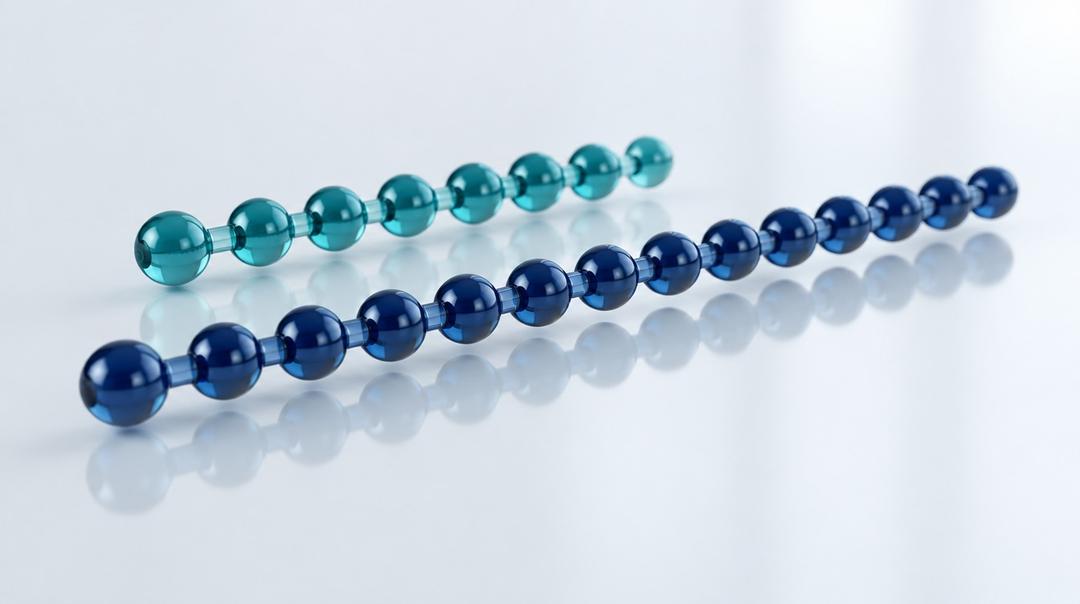
What are sermorelin and tesamorelin, structurally?
Native GHRH is a 44-amino-acid hypothalamic hormone that prompts the pituitary to release growth hormone. Its activity sits at the N-terminal end, and the two drugs exploit that fact in opposite ways.
Sermorelin keeps only the first 29 residues, amidated at the C-terminus. A review of its clinical use describes it as the shortest synthetic peptide with the full biological activity of GHRH (Prakash and Goa, PMID 18031173). It inherits the native hormone's weakness: rapid cleavage in circulation, with a half-life measured in minutes.
Tesamorelin keeps all 44 residues and modifies the very first one. Theratechnologies' non-clinical paper describes it as human GHRH(1-44)-NH2 "minimally modified" by a trans-3-hexenoyl group on the N-terminal tyrosine. In plasma from rats, dogs and people, that change slowed degradation and made the peptide resistant to dipeptidyl peptidase-4, the enzyme that inactivates native GHRH (Ferdinandi and colleagues, PMID 17214611).
So the comparison is not a short version against a long version of the same thing. One is a truncated natural sequence; the other is a full sequence engineered to survive longer. The wider family, including CJC-1295, is laid out in the sermorelin and GHRH pathway article and in sermorelin vs CJC-1295.
Side by side
| Sermorelin | Tesamorelin | |
|---|---|---|
| Identity | GHRH(1-29)-NH2 | GHRH(1-44)-NH2 with N-terminal trans-3-hexenoyl group |
| Class | GHRH receptor agonist (releasing hormone, not growth hormone) | GHRH receptor agonist (releasing hormone, not growth hormone) |
| Mechanism | Prompts pituitary release of the body's own growth hormone | The same, with resistance to dipeptidyl peptidase-4 cleavage |
| Evidence stage | Human: paediatric diagnostic and treatment studies; small adult studies | Human: two phase 3 trials and a liver-fat trial in adults with HIV |
| Regulatory status | Marketed as Geref (Serono); discontinued 2008; not currently marketed | Approved as Egrifta in the United States and, since 2014, in Canada, for one indication |
| What was measured | Growth hormone responses, height velocity, IGF-I | Visceral fat by CT, lipids, IGF-I, liver fat |
| In this catalog | No | Yes, as laboratory material |
What was sermorelin approved for, and why was it withdrawn?
Sermorelin's clinical record sits almost entirely in children. Prakash and Goa reviewed two uses: a provocative test of pituitary growth hormone secretion, and treatment of prepubertal children with idiopathic growth hormone deficiency. In the treatment studies, height velocity rose and was sustained over 12 months, with data in a few children extending to 36 months. The review also notes what was missing: effect on final adult height had not been established, and the increases in height velocity were smaller than those seen with recombinant growth hormone (PMID 18031173).
That comparison is the context for what happened next. Serono discontinued the Geref presentations in 2008. A notice later published by the US Food and Drug Administration recorded its determination that Geref was not withdrawn from sale for reasons of safety or effectiveness. Discontinuation for commercial reasons is a different event from a safety withdrawal, and it is also not an approval that carries on after the product has gone. The Geref history article covers what that distinction does and does not prove.
Adult work is thin. Vittone and colleagues gave GHRH(1-29) to 11 healthy men aged 64 to 76 for six weeks. Mean nocturnal growth hormone release and peak amplitude rose; IGF-I did not change; two of six strength measures and one endurance test changed, while body composition, muscle histology, glucose handling and lipids did not (PMID 9005976). Eleven men, no placebo group, and a hormone endpoint that did not carry through to IGF-I: that is a pilot result, and it describes that small group.
What did the tesamorelin trials measure?
Tesamorelin's evidence comes from a defined population: adults with HIV on antiretroviral therapy who had accumulated abdominal fat. The tesamorelin visceral fat trials article goes through them in more depth.
In the first phase 3 trial, 412 patients (86% men) were randomised to tesamorelin or placebo for 26 weeks. Visceral adipose tissue on CT, the primary endpoint, fell by 15.2% with tesamorelin and rose by 5.0% with placebo. Triglycerides and the total-to-HDL cholesterol ratio moved in the same direction, IGF-I rose by 81.0%, and glycaemic measures did not differ. Adverse events overall were similar, but more patients on tesamorelin withdrew because of one (Falutz and colleagues, PMID 18057338).
A pooled analysis of both phase 3 trials, covering 806 randomised patients, put the treatment effect on visceral fat at −15.4% at 26 weeks, with no significant change in the fat layer under the skin of the abdomen. Patients who continued to week 52 maintained the reduction (Falutz and colleagues, PMID 20554713). A review of the programme adds the finding that matters most for reading it: when treatment stopped during the extension, visceral fat re-accumulated (Dhillon, PMID 21668043).
A later trial asked a different question. Stanley and colleagues randomised 61 people with HIV and a hepatic fat fraction of at least 5% to tesamorelin or placebo for 12 months. The absolute difference in liver fat fraction was −4.1 percentage points, a 37% relative reduction, and fasting glucose and HbA1c did not differ between groups (PMID 31611038). That is a small trial with an imaging and histology endpoint, not an outcome trial.
Why can't the two literatures be compared directly?
Because they were never measured on the same people or the same endpoints. Sermorelin's data are mostly height velocity and growth hormone responses in children, plus a handful of small adult studies of hormone levels. Tesamorelin's are CT-measured fat compartments and lipids in adults with HIV-associated fat accumulation. No trial has randomised anyone to one against the other.
Even the shared endpoint, IGF-I, does not line up. It rose markedly in the tesamorelin trials and did not change in the Vittone sermorelin pilot, but the two studies differed in population, duration, size and design. The study design guide explains why numbers from separate trials are not a comparison.
What can be compared honestly is regulatory position and evidence depth. Tesamorelin holds a current approval for one indication in one population. Sermorelin held an approval for a paediatric indication and no longer does.
What does each approval cover, and what doesn't it?
Egrifta's approval covers the licensed product, made to its dossier, for excess visceral fat in adults with HIV. Health Canada's Notice of Compliance came in 2014, and current status can be checked in the Drug Product Database. It does not extend to weight management in general, to people without HIV, or to material sold under the same name outside the medicine supply chain. The tesamorelin sourcing guide sets out why research-grade material inherits none of that approval.
Geref's approval was for a paediatric diagnostic use and for idiopathic growth hormone deficiency in children. It never covered adults, and it ended with the product's withdrawal.
Both are prohibited in sport: GHRH and its analogues are a named class on the World Anti-Doping Agency's list. For how GHRH analogues differ from compounds acting at the ghrelin receptor, see tesamorelin vs ipamorelin.
Supplied here for laboratory use: Tesamorelin. The laboratory's certificate for each lot is linked from its product page. For laboratory research use only.
NovaEvum does not carry sermorelin. The trial results above describe licensed or investigational products in the people enrolled; they are not evidence about any laboratory reagent. Nothing here is medical, dosing, or therapeutic guidance.
Frequently asked questions
Is tesamorelin just a longer sermorelin? No. Sermorelin is the first 29 residues of GHRH with nothing added. Tesamorelin is all 44 residues with a trans-3-hexenoyl group attached to the first amino acid, a change that slowed its breakdown by dipeptidyl peptidase-4 in plasma studies. Both act at the same receptor, but the molecules and their pharmacology differ.
Was sermorelin withdrawn for safety reasons? No. The manufacturer discontinued Geref in 2008, and a later notice from the US Food and Drug Administration recorded that it was not withdrawn for reasons of safety or effectiveness. That finding does not make sermorelin a currently approved medicine anywhere, and its approval never extended beyond children.
Has any trial compared sermorelin and tesamorelin? No. Sermorelin was studied mostly in children with growth hormone deficiency, measuring growth and hormone responses. Tesamorelin was studied in adults with HIV and abdominal fat accumulation, measuring visceral fat by CT. Different populations, endpoints and decades mean the results cannot be ranked against each other.
Did tesamorelin's effect on visceral fat persist after treatment stopped? In the phase 3 extension, patients who continued treatment to week 52 maintained the reduction, while those switched to placebo saw visceral fat re-accumulate. That observation applies to adults with HIV-associated fat accumulation in those trials and says nothing about other populations.
Selected Research References
- Prakash A, Goa KL. Sermorelin: a review of its use in the diagnosis and treatment of children with idiopathic growth hormone deficiency. BioDrugs. 1999;12(2):139-157. pubmed.ncbi.nlm.nih.gov/18031173
- Vittone J, Blackman MR, Busby-Whitehead J, et al. Effects of single nightly injections of growth hormone-releasing hormone (GHRH 1-29) in healthy elderly men. Metabolism. 1997;46(1):89-96. pubmed.ncbi.nlm.nih.gov/9005976
- Ferdinandi ES, Brazeau P, High K, et al. Non-clinical pharmacology and safety evaluation of TH9507, a human growth hormone-releasing factor analogue. Basic & Clinical Pharmacology & Toxicology. 2007;100(1):49-58. pubmed.ncbi.nlm.nih.gov/17214611
- Falutz J, Allas S, Blot K, et al. Metabolic effects of a growth hormone-releasing factor in patients with HIV. New England Journal of Medicine. 2007;357(23):2359-2370. pubmed.ncbi.nlm.nih.gov/18057338
- Falutz J, Mamputu JC, Potvin D, et al. Effects of tesamorelin (TH9507), a growth hormone-releasing factor analog, in human immunodeficiency virus-infected patients with excess abdominal fat: a pooled analysis of two multicenter, double-blind placebo-controlled phase 3 trials with safety extension data. Journal of Clinical Endocrinology and Metabolism. 2010;95(9):4291-4304. pubmed.ncbi.nlm.nih.gov/20554713
- Dhillon S. Tesamorelin: a review of its use in the management of HIV-associated lipodystrophy. Drugs. 2011;71(8):1071-1091. pubmed.ncbi.nlm.nih.gov/21668043
- Stanley TL, Fourman LT, Feldpausch MN, et al. Effects of tesamorelin on non-alcoholic fatty liver disease in HIV: a randomised, double-blind, multicentre trial. Lancet HIV. 2019;6(12):e821-e830. pubmed.ncbi.nlm.nih.gov/31611038
All products sold by NovaEvum are for research and laboratory use only. They are not intended for human or animal consumption, diagnosis, treatment, cure, or prevention of any disease.