
Tesamorelin
Tesamorelin research: the visceral fat trials, the liver fat trial, and what was approved
EC
· 9 min read
A summary of published research, with citations. It states no amount, schedule or route, and makes no claim about what this compound does in a person. Supplied for laboratory research use only.
On this page · 9 sections
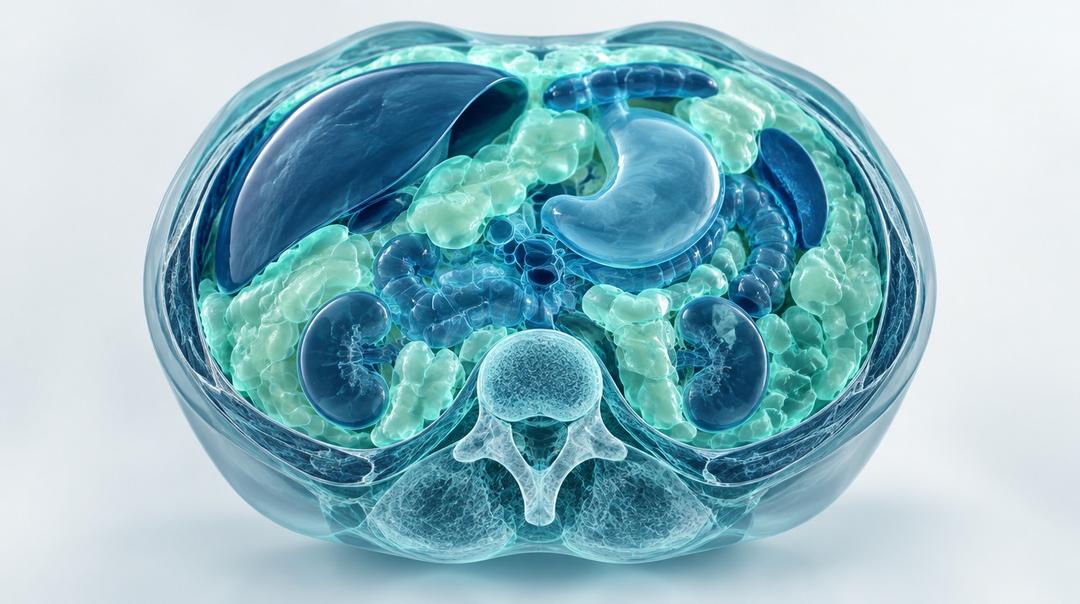
Tesamorelin research centres on one population: adults with HIV who accumulated abdominal visceral fat on antiretroviral therapy. Two phase 3 trials, first reported by Falutz and colleagues in 2007, measured a reduction in visceral fat by CT against placebo, and the gain was lost when patients switched to placebo. Later trials examined liver fat. Tesamorelin is approved as Egrifta by the FDA (2010) and Health Canada (2014) for that one indication, and nowhere for anything else.
What tesamorelin is
Tesamorelin is the full 44-residue growth hormone-releasing hormone with a trans-3-hexenoyl group attached at the N-terminus. The modification protects the molecule from the enzymatic cleavage that clears native GHRH within minutes. It acts at the GHRH receptor on the pituitary, prompting the body's own growth hormone release, and IGF-I rises downstream. It does not act at the ghrelin receptor. Where it sits among the other secretagogues, and which of them are approved for anything, is set out in growth hormone secretagogues explained; its structural relatives are covered in sermorelin and the GHRH pathway, and the GHRH analogue it is most often confused with in the CJC-1295 and ipamorelin guide.
Why HIV-associated abdominal fat
Through the late 1990s and 2000s, many people on antiretroviral therapy developed changes in body fat distribution, including accumulation of visceral adipose tissue, the fat inside the abdominal cavity around the organs. Visceral fat is associated with cardiovascular and metabolic risk, and it is measurable with precision by a single CT slice at the lumbar spine. Growth hormone secretion is also reduced in people with excess visceral fat. The research programme rested on that combination: a clinically relevant fat depot, a precise imaging endpoint, and a reason to think the growth hormone axis was involved.
The first phase 3 trial
Falutz and colleagues randomised 412 patients with HIV and abdominal fat accumulation, 86% of them men, to tesamorelin or placebo for 26 weeks (PMID 18057338). The primary endpoint was percent change in visceral adipose tissue by CT.
Visceral fat fell by 15.2% in the tesamorelin group and rose by 5.0% in the placebo group. Triglycerides fell and the total-to-HDL cholesterol ratio improved relative to placebo. IGF-I rose by 81% with tesamorelin and fell by 5% with placebo. No significant differences were seen in glycaemic measures. Adverse events overall did not differ significantly between groups, but more patients in the tesamorelin group withdrew because of one.
The second trial, and what happened on stopping
The second phase 3 trial enrolled 404 patients over 12 months in two phases (PMID 20101189). In the first six months, patients were randomised two to one to tesamorelin or placebo. At six months, those on tesamorelin were randomised again, either to continue or to switch to placebo, under continued blinding.
Visceral fat fell by 10.9% with tesamorelin over the first six months against 0.6% with placebo, with improvements in waist circumference and waist-hip ratio and no change in limb fat or in the fat layer beneath the abdominal skin. Patients who continued for 12 months showed about an 18% reduction. The finding that matters most for reading the whole literature is in the extension: in patients switched from tesamorelin to placebo, the initial reduction in visceral fat was rapidly lost.
That is a direct, blinded, randomised demonstration that the measured effect depended on continued exposure in this population. It is also why the approval describes a reduction in excess visceral fat rather than anything permanent.
Responders and non-responders
The FDA defined a "responder" in advance as a patient with at least an 8% reduction in visceral fat. Stanley and colleagues used that definition across both phase 3 trials and compared responders with non-responders among 402 patients initially given tesamorelin (PMID 22495074). Responders had greater reductions in triglycerides and preserved glucose control over 52 weeks, while non-responders showed small rises in fasting glucose and HbA1c. Changes in lipids and glucose tracked the percentage change in visceral fat.
These were post hoc comparisons inside trial arms, so they describe associations, not effects caused by the responder status. They do, however, show that the population-average result conceals a real spread, and that the metabolic picture differed by how much visceral fat a patient lost.
The liver fat trials
Visceral fat and liver fat travel together, which made the liver the obvious next question.
A first look, 2014. Stanley and colleagues randomised 50 antiretroviral-treated adults with abdominal fat accumulation to tesamorelin or placebo for six months, with visceral fat and liver fat as co-primary endpoints (PMID 25038357). Tesamorelin reduced visceral fat and produced what the authors called modest reductions in liver fat, a net treatment effect of 2.9 percentage points in lipid-to-water ratio. Fasting glucose rose at two weeks in the tesamorelin group, but the difference was not significant over six months. The authors described it as a preliminary study.
The NAFLD trial, 2019. The larger question was whether tesamorelin affects non-alcoholic fatty liver disease in people with HIV. Stanley and colleagues ran a randomised, double-blind, placebo-controlled trial at two US sites in people with HIV and a hepatic fat fraction of at least 5% by proton magnetic resonance spectroscopy (PMID 31611038). Sixty-one were enrolled; the primary endpoint was change in hepatic fat fraction over 12 months, and the primary safety endpoint was glucose.
| Measure | Result reported |
|---|---|
| Hepatic fat fraction, absolute difference vs placebo | −4.1 percentage points (95% CI −7.6 to −0.7) |
| Relative reduction from baseline | −37% (95% CI −67 to −7) |
| Below 5% hepatic fat at 12 months | 35% with tesamorelin, 4% with placebo |
| Fasting glucose and HbA1c at 12 months | Not different between groups |
The authors' interpretation was that tesamorelin "might be beneficial" in people with HIV and NAFLD, and that longer studies would be needed to determine its effect on liver histology. That wording is the correct ceiling: a liver fat fraction is an imaging biomarker, a small single trial is a signal, and the question that matters clinically, whether fibrosis and liver outcomes change, was not settled by it.
A secondary analysis of the phase 3 data also linked visceral fat reduction with tesamorelin to lower liver enzymes in patients whose baseline ALT or AST was raised (Fourman and colleagues, PMID 28832410). That is another association within a trial, not a liver trial.
Approval history
| Jurisdiction | Status |
|---|---|
| United States | Approved by the FDA in November 2010 as Egrifta, to reduce excess abdominal fat in adults with HIV and lipodystrophy |
| Canada | Health Canada issued a Notice of Compliance for Egrifta in April 2014, for excess visceral adipose tissue in treatment-experienced adults with HIV, after an earlier negative decision was reconsidered |
| Indication outside HIV | None, in any jurisdiction we could find |
| Liver disease | Not an approved indication anywhere |
| Research-grade material | Not a medicine and not Egrifta |
The Canadian label states that it is not indicated for weight loss management. Health Canada's Drug Product Database is the authoritative record of current Canadian authorisation and product status, and the product monograph sets out the label in full.
The gap between the trial record and the approval is the useful thing to notice. The trials were run in people with HIV on antiretroviral therapy, with excess abdominal fat measured by CT. The liver work was run in the same population. Nothing in either establishes what tesamorelin does in anyone else, and the extension data show the measured change did not persist after stopping.
What this page does not cover
Sourcing, certificates of analysis and how to read a chromatogram are covered in sourcing research tesamorelin in Canada. Why a single trial with a biomarker endpoint is a signal rather than a conclusion is covered in how to read a peptide study.
Supplied here for laboratory use: Tesamorelin. The laboratory's certificate for each lot is linked from its product page. For laboratory research use only.
Tesamorelin is also prohibited in sport as a GHRH analogue on the World Anti-Doping Agency's list. Nothing here is medical, dosing, or therapeutic guidance.
Frequently asked questions
What did the tesamorelin phase 3 trials measure? The primary endpoint in both was visceral adipose tissue by CT, in adults with HIV and abdominal fat accumulation on antiretroviral therapy. Secondary endpoints included triglycerides, cholesterol ratios, IGF-I, glucose measures and body image ratings. The first trial reported a 15.2% fall in visceral fat with tesamorelin against a 5.0% rise with placebo over 26 weeks.
What happened when tesamorelin was stopped in the trials? In the second phase 3 trial, patients who had received tesamorelin for six months were randomised, still blinded, to continue or switch to placebo. Those switched to placebo rapidly lost the initial reduction in visceral fat. Those who continued showed about an 18% reduction at 12 months.
Is tesamorelin approved for fatty liver disease? No. A 61-person randomised trial in people with HIV and NAFLD reported a reduction in hepatic fat fraction against placebo, and the authors called for longer studies of liver histology. Liver disease is not an approved indication in any jurisdiction we could find.
Is tesamorelin approved in Canada? Yes, as one product for one indication. Health Canada issued a Notice of Compliance for Egrifta in April 2014, for excess visceral fat in treatment-experienced adults with HIV. That authorisation belongs to the manufactured medicine and does not extend to research-grade tesamorelin.
Did tesamorelin affect blood sugar in the trials? The phase 3 trials reported no significant differences in glycaemic measures between groups overall. The 2014 liver study saw fasting glucose rise at two weeks, not significant over six months. Responder analyses found glucose control preserved in responders and slightly worse in non-responders.
Selected Research References
- Falutz J, Allas S, Blot K, et al. Metabolic effects of a growth hormone-releasing factor in patients with HIV. New England Journal of Medicine. 2007;357(23):2359-2370. pubmed.ncbi.nlm.nih.gov/18057338
- Falutz J, Potvin D, Mamputu JC, et al. Effects of tesamorelin, a growth hormone-releasing factor, in HIV-infected patients with abdominal fat accumulation: a randomized placebo-controlled trial with a safety extension. Journal of Acquired Immune Deficiency Syndromes. 2010;53(3):311-322. pubmed.ncbi.nlm.nih.gov/20101189
- Stanley TL, Falutz J, Marsolais C, et al. Reduction in visceral adiposity is associated with an improved metabolic profile in HIV-infected patients receiving tesamorelin. Clinical Infectious Diseases. 2012;54(11):1642-1651. pubmed.ncbi.nlm.nih.gov/22495074
- Stanley TL, Feldpausch MN, Oh J, et al. Effect of tesamorelin on visceral fat and liver fat in HIV-infected patients with abdominal fat accumulation: a randomized clinical trial. JAMA. 2014;312(4):380-389. pubmed.ncbi.nlm.nih.gov/25038357
- Stanley TL, Fourman LT, Feldpausch MN, et al. Effects of tesamorelin on non-alcoholic fatty liver disease in HIV: a randomised, double-blind, multicentre trial. Lancet HIV. 2019;6(12):e821-e830. pubmed.ncbi.nlm.nih.gov/31611038
- Fourman LT, Czerwonka N, Feldpausch MN, et al. Visceral fat reduction with tesamorelin is associated with improved liver enzymes in HIV. AIDS. 2017;31(16):2253-2259. pubmed.ncbi.nlm.nih.gov/28832410
All products sold by NovaEvum are for research and laboratory use only. They are not intended for human or animal consumption, diagnosis, treatment, cure, or prevention of any disease.