
Growth hormone peptides
Growth hormone secretagogues explained: GHRH analogues, ghrelin agonists and what is approved
EC
· 11 min read
A summary of published research, with citations. It states no amount, schedule or route, and makes no claim about what this compound does in a person. Supplied for laboratory research use only.
On this page · 7 sections
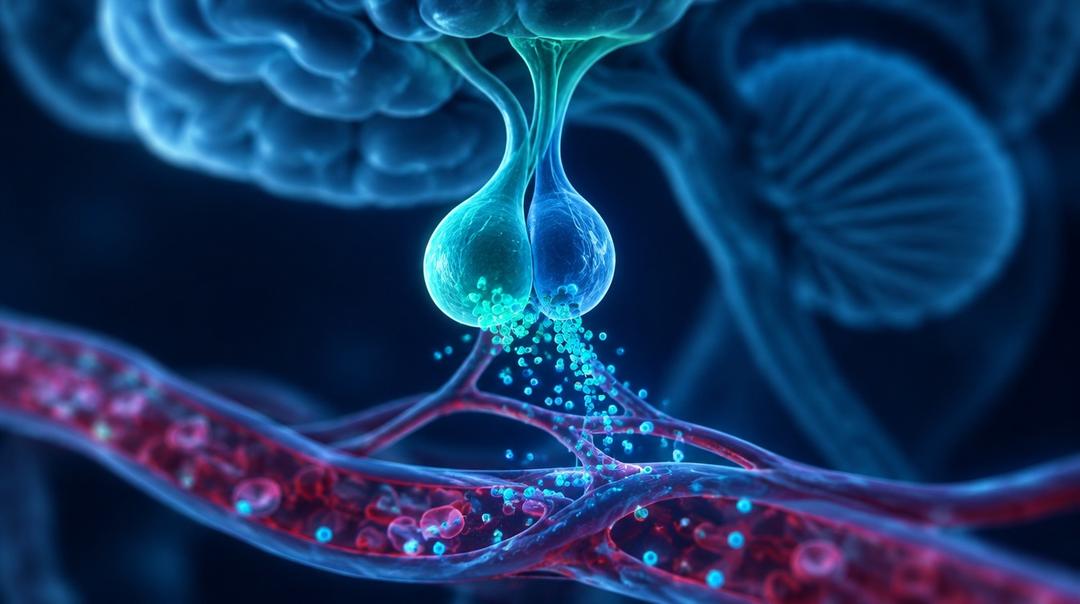
A growth hormone secretagogue is any compound that makes the pituitary release its own growth hormone rather than supplying the hormone itself. They fall into two families that act at different receptors: GHRH analogues (sermorelin, CJC-1295, tesamorelin) at the GHRH receptor, and ghrelin-receptor agonists (GHRP-6, GHRP-2, hexarelin, ipamorelin, ibutamoren, macimorelin, anamorelin) at the growth hormone secretagogue receptor. Only a handful hold an approval, each for one narrow use, and most are investigational research compounds.
Why two receptors, and why it matters
The somatotroph cells of the anterior pituitary carry two separate receptors that both end in growth hormone release.
The first is the GHRH receptor. Its natural ligand is growth hormone-releasing hormone, made in the hypothalamus and carried a short distance to the pituitary. It was the expected pathway and was characterised first.
The second was found backwards. In the late 1970s and 1980s, Cyril Bowers and colleagues built small synthetic peptides — the growth hormone-releasing peptides, or GHRPs — that released growth hormone through a mechanism that was plainly not the GHRH receptor. Bowers reviewed that chemistry and argued that it pointed to an undiscovered natural hormone (PMID 9893708). In 1996 Howard and colleagues at Merck cloned the receptor these synthetic compounds acted on, in pituitary and hypothalamus of swine and humans (PMID 8688086). The ligand followed in 1999, when Kojima and colleagues purified a 28-residue acylated peptide from rat stomach and named it ghrelin (PMID 10604470). The receptor is now called the growth hormone secretagogue receptor, GHS-R1a, or simply the ghrelin receptor.
That history explains why older papers use "growth hormone secretagogue" to mean the ghrelin-receptor family specifically. Current usage covers both.
It also explains the most common error in writing about these compounds. A GHRH analogue and a ghrelin-receptor agonist are not stronger and weaker versions of one drug. They engage different receptors with different distributions outside the pituitary, and the ghrelin receptor in particular is expressed in the hypothalamus and the gut, which is why appetite and gastric motility turn up in its literature and not in the GHRH literature.
The GHRH analogue family
| Molecule | What it is | Furthest evidence stage | Regulatory status |
|---|---|---|---|
| Sermorelin | GHRH(1-29)-NH2, the shortest fully active fragment | Human; was an approved medicine | Marketed in the US as Geref, then discontinued by its manufacturer. Not a current medicine |
| CJC-1295 with DAC | Modified GRF(1-29) with an albumin-binding linker | Small human pharmacology studies | Approved nowhere |
| CJC-1295 without DAC (modified GRF 1-29) | The same substitutions, no linker | Little published work of its own | Approved nowhere |
| Tesamorelin | Full GHRH(1-44) with an N-terminal trans-3-hexenoyl group | Phase 3 | Approved as Egrifta by the FDA (2010) and Health Canada (2014), for excess visceral fat in adults with HIV |
The engineering story is one of keeping the activity and losing the short life. Native GHRH and sermorelin are cleaved in minutes; sermorelin and the GHRH pathway traces the family from that 29-residue fragment. CJC-1295 with DAC was designed by ConjuChem to bind covalently to circulating albumin (PMID 15817669), and Teichman and colleagues reported an estimated half-life of roughly six to eight days in healthy adults, with growth hormone and IGF-I raised for days after a single administration (PMID 16352683). Ionescu and Frohman then asked whether continuous stimulation would flatten the normal pulsatile pattern and reported that pulse frequency and magnitude were unaltered, while trough levels rose (PMID 17018654). Those papers describe the DAC version only. Sermorelin vs CJC-1295 and the CJC-1295 and ipamorelin guide cover why the version usually sold as "CJC-1295" has almost none of that literature behind it.
Tesamorelin is the only member with a current approval. Its registration rests on two phase 3 trials in HIV-associated abdominal fat accumulation, the first published by Falutz and colleagues in 2007 (PMID 18057338). Tesamorelin research: the visceral fat and liver fat trials goes through what those trials measured and what happened when the drug was stopped.
The ghrelin-receptor family
| Molecule | What it is | Furthest evidence stage | Regulatory status |
|---|---|---|---|
| GHRP-6 | Synthetic hexapeptide, one of the original Bowers compounds | Human pharmacology | Approved nowhere |
| GHRP-2 (pralmorelin) | Hexapeptide "super-analogue" of GHRP-6 | Human; clinical diagnostic use in Japan | Used in Japan as a GH stimulation test; no Canadian, US or EU approval found |
| Hexarelin | Hexapeptide analogue of GHRP-6 | Human pharmacology | Approved nowhere |
| Ipamorelin | Pentapeptide, Novo Nordisk | Phase 2 (postoperative ileus) | Approved nowhere |
| Ibutamoren (MK-677) | Non-peptide small molecule, Merck | Two-year randomised trial in older adults | Approved nowhere |
| Macimorelin | Non-peptide small molecule | Phase 3, diagnostic | Approved by the FDA in 2017 as Macrilen, as a diagnostic test for adult GH deficiency |
| Anamorelin | Non-peptide small molecule | Phase 3 | Approved in Japan in 2020 for cancer cachexia; not approved in Europe |
The original GHRPs. GHRP-6, GHRP-2 and hexarelin are potent growth hormone releasers, and their selectivity is the recurring problem. In healthy young adults, Arvat and colleagues found that GHRP-2 and hexarelin raised prolactin, ACTH and cortisol as well as growth hormone, with the ACTH and cortisol response comparable to that from corticotropin-releasing hormone (PMID 9285939). Centrally administered GHRP-6 also stimulated eating in rats (PMID 8614257). GHRP-2 has one clinical niche: in Japan it is used as a stimulation test for growth hormone deficiency, which Suzuki and colleagues describe as widely used there (PMID 35795807). That is a diagnostic in one country, not a therapeutic approval, and outside it these compounds are research tools.
Ipamorelin. Raun and colleagues described it in 1998 as the first selective growth hormone secretagogue: in swine, it released growth hormone with a potency and efficacy similar to GHRP-6 but did not raise ACTH or cortisol above the levels seen after GHRH, even far above the effective amount (PMID 9849822). Ipamorelin vs GHRP-6 and GHRP-2 sets out exactly which species each of those comparisons was made in, which matters more than the headline.
Ibutamoren (MK-677). A non-peptide agonist, and the compound in this family with the longest controlled human study. Nass and colleagues randomised 65 healthy adults aged 60 to 81 to MK-677 or placebo for up to two years (PMID 18981485). Growth hormone and IGF-I rose into the young-adult range and fat-free mass increased relative to placebo, but strength and function did not change. Fasting glucose rose, insulin sensitivity fell, cortisol rose, and increased appetite was the most frequent adverse effect. It reports the trade-offs alongside the marker. MK-677 is approved nowhere.
Macimorelin. The one ghrelin-receptor agonist the FDA has approved, and its approval is diagnostic rather than therapeutic. Garcia and colleagues compared a single macimorelin stimulation test with the insulin tolerance test in adults with high, intermediate or low likelihood of GH deficiency and matched controls, reporting sensitivity of 87% and specificity of 96% at the prespecified cut-off (PMID 29860473). The test asks whether a pituitary can release growth hormone when provoked; it is not a treatment. A Canadian authorisation for macimorelin could not be confirmed for this page, and Health Canada's Drug Product Database is the place to check.
Anamorelin. Approved in Japan in December 2020 for cachexia in non-small cell lung, gastric, pancreatic and colorectal cancer, and not approved in Europe (Wakabayashi and colleagues, PMID 33382205). Its endpoints were lean body mass and appetite in people with cancer, which is a long way from anything a research catalogue is about.
Pulsatility: the argument both families are judged by
Growth hormone is released in pulses, mostly at night, and a large part of the interest in secretagogues comes from the idea that they work through that physiology rather than replacing it. Recombinant growth hormone delivers a level; a secretagogue asks the pituitary to respond, and the pituitary's feedback loops, including IGF-I and somatostatin, still apply.
That is a real pharmacological distinction, and it is regularly stretched into a safety claim it does not support. Feedback being intact does not make an exposure harmless, and the MK-677 trial shows a ghrelin-receptor agonist moving glucose, insulin sensitivity and cortisol over months even with pulsatile secretion preserved. The CJC-1295 pulsatility finding was made in healthy men over a short window. Neither result says what sustained exposure does over years, because no study of that length exists for any research compound in this family. Why a marker measured in a few healthy volunteers is a narrow result is the subject of how to read a peptide study.
Which are in this catalogue
NovaEvum supplies three of the eleven molecules above as research chemicals: ipamorelin, CJC-1295 and tesamorelin. The other eight are not sold here. Research-grade tesamorelin is not Egrifta: the approval belongs to a manufactured medicine with a label and a prescriber, and none of it transfers to a vial supplied for laboratory work.
Supplied here for laboratory use: Ipamorelin, CJC-1295 and Tesamorelin. The laboratory's certificate for each lot is linked from its product page. For laboratory research use only.
Where the evidence stops
Hormone release is an endpoint, not an outcome. Almost every paper on this page measures growth hormone, IGF-I or a related marker. The two exceptions with clinical endpoints, tesamorelin's visceral fat trials and the MK-677 body composition trial, were run in defined populations and do not generalise beyond them.
Approval is narrow everywhere it exists. Tesamorelin for one population, macimorelin as a diagnostic, anamorelin in one country for cachexia, sermorelin historically for children. None of these approvals extends to the research compounds in the same family.
Canada's position is specific. Health Canada's April 2026 public advisory on unauthorized peptides sold online names CJC-1295 and ipamorelin among its examples. They are sold here strictly as laboratory reagents, not for human use.
It is prohibited in sport. GHRH analogues and growth hormone secretagogues are named categories on the World Anti-Doping Agency's prohibited list. Nothing here is medical, dosing, or therapeutic guidance.
Frequently asked questions
What is the difference between a GHRH analogue and a GHRP? They act at different receptors on the same pituitary cells. A GHRH analogue mimics growth hormone-releasing hormone at the GHRH receptor; a GHRP acts at the ghrelin receptor, which is also expressed in the hypothalamus and gut. That second distribution is why appetite, cortisol and gastric motility appear in the GHRP literature and not in the GHRH literature.
Is any growth hormone secretagogue approved in Canada? Tesamorelin received a Health Canada Notice of Compliance as Egrifta in 2014, for excess visceral fat in adults with HIV. That is one product for one indication. The research compounds in both families have no Canadian authorisation, and two of them are named in Health Canada's 2026 advisory on unauthorized peptides.
Is MK-677 a peptide? No. Ibutamoren is a non-peptide small molecule that acts at the ghrelin receptor, which is why it is grouped with the secretagogues despite its different chemistry. Its main human trial, in healthy older adults, reported raised growth hormone and fat-free mass alongside higher fasting glucose, lower insulin sensitivity and no change in strength or function.
Do secretagogues preserve natural pulsatility? The published work suggests the pulsatile pattern can persist. The CJC-1295 study reported unaltered pulse frequency with raised trough levels, and the MK-677 trial described enhanced pulsatile secretion. Neither finding is a safety result, and neither covers long-term exposure.
Why is macimorelin approved when the others are not? Because its sponsor asked a narrow question and answered it: can a single stimulation test identify adult growth hormone deficiency as well as the insulin tolerance test? A diagnostic approval of that kind says nothing about therapeutic use of any secretagogue.
Selected Research References
- Bowers CY. Growth hormone-releasing peptide (GHRP). Cellular and Molecular Life Sciences. 1998;54(12):1316-1329. pubmed.ncbi.nlm.nih.gov/9893708
- Howard AD, Feighner SD, Cully DF, et al. A receptor in pituitary and hypothalamus that functions in growth hormone release. Science. 1996;273(5277):974-977. pubmed.ncbi.nlm.nih.gov/8688086
- Kojima M, Hosoda H, Date Y, et al. Ghrelin is a growth-hormone-releasing acylated peptide from stomach. Nature. 1999;402(6762):656-660. pubmed.ncbi.nlm.nih.gov/10604470
- Raun K, Hansen BS, Johansen NL, et al. Ipamorelin, the first selective growth hormone secretagogue. European Journal of Endocrinology. 1998;139(5):552-561. pubmed.ncbi.nlm.nih.gov/9849822
- Arvat E, di Vito L, Maccagno B, et al. Effects of GHRP-2 and hexarelin, two synthetic GH-releasing peptides, on GH, prolactin, ACTH and cortisol levels in man. Comparison with the effects of GHRH, TRH and hCRH. Peptides. 1997;18(6):885-891. pubmed.ncbi.nlm.nih.gov/9285939
- Teichman SL, Neale A, Lawrence B, et al. Prolonged stimulation of growth hormone (GH) and insulin-like growth factor I secretion by CJC-1295, a long-acting analog of GH-releasing hormone, in healthy adults. Journal of Clinical Endocrinology & Metabolism. 2006;91(3):799-805. pubmed.ncbi.nlm.nih.gov/16352683
- Ionescu M, Frohman LA. Pulsatile secretion of growth hormone (GH) persists during continuous stimulation by CJC-1295, a long-acting GH-releasing hormone analog. Journal of Clinical Endocrinology & Metabolism. 2006;91(12):4792-4797. pubmed.ncbi.nlm.nih.gov/17018654
- Nass R, Pezzoli SS, Oliveri MC, et al. Effects of an oral ghrelin mimetic on body composition and clinical outcomes in healthy older adults: a randomized trial. Annals of Internal Medicine. 2008;149(9):601-611. pubmed.ncbi.nlm.nih.gov/18981485
- Garcia JM, Biller BMK, Korbonits M, et al. Macimorelin as a diagnostic test for adult GH deficiency. Journal of Clinical Endocrinology & Metabolism. 2018;103(8):3083-3093. pubmed.ncbi.nlm.nih.gov/29860473
- Wakabayashi H, Arai H, Inui A. The regulatory approval of anamorelin for treatment of cachexia in patients with non-small cell lung cancer, gastric cancer, pancreatic cancer, and colorectal cancer in Japan: facts and numbers. Journal of Cachexia, Sarcopenia and Muscle. 2021;12(1):14-16. pubmed.ncbi.nlm.nih.gov/33382205
All products sold by NovaEvum are for research and laboratory use only. They are not intended for human or animal consumption, diagnosis, treatment, cure, or prevention of any disease.