
Growth hormone peptides
Ghrelin receptor (GHSR1a) explained: discovery, constant signalling and the compounds studied at it
EC
· 11 min read
A summary of published research, with citations. It states no amount, schedule or route, and makes no claim about what this compound does in a person. Supplied for laboratory research use only.
On this page · 8 sections
- What is the ghrelin receptor?
- How was the receptor found before its hormone?
- Why does the ghrelin receptor signal with nothing bound?
- Where is GHSR1a expressed?
- Which research compounds act at the ghrelin receptor?
- Why compounds at one receptor behave differently
- What a ghrelin-receptor result does and does not tell you
- Frequently asked questions
The ghrelin receptor, formally the growth hormone secretagogue receptor type 1a (GHSR1a), is a G protein-coupled receptor found mainly in the pituitary and hypothalamus. It was cloned in 1996 as the target of synthetic growth-hormone-releasing molecules, three years before its natural hormone, ghrelin, was identified. It is unusual in signalling strongly even when nothing is bound. GHRP-6, GHRP-2, ipamorelin, ibutamoren (MK-677), macimorelin and anamorelin all act at it, and they differ widely in evidence and regulatory status.
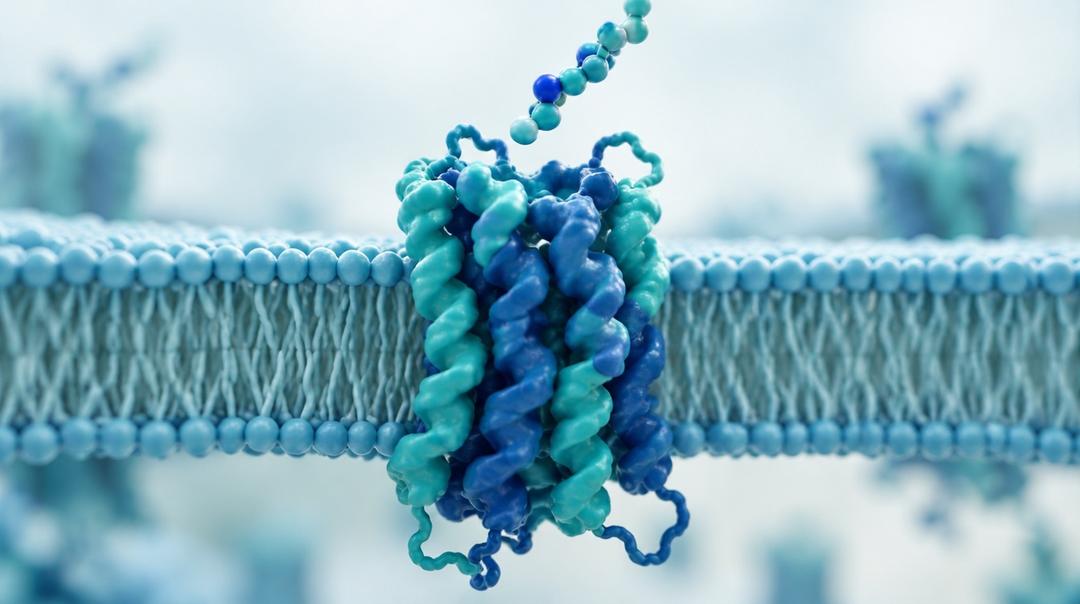
What is the ghrelin receptor?
GHSR1a is a seven-transmembrane receptor of the kind described in how peptide receptor signalling is studied. When activated it couples mainly to the Gq family of G proteins, so the classic laboratory readout is inositol phosphate turnover or intracellular calcium rather than cyclic AMP.
The same gene also produces a second transcript, GHSR1b. It is a truncated form that does not respond to ghrelin, and it turns up in far more tissues than the functional receptor does. Papers that measure "GHSR expression" without separating the two forms are measuring something harder to interpret than they appear to be.
The receptor sits on one of two routes by which the pituitary is told to release growth hormone. The other route is the GHRH receptor, the target of sermorelin, CJC-1295 and tesamorelin. How the two families compare is covered in growth hormone secretagogues explained. This page is only about the ghrelin-receptor side.
How was the receptor found before its hormone?
The order of discovery is backwards, and it explains the receptor's old name.
1984: a synthetic hexapeptide. Bowers and colleagues described a synthetic six-residue peptide that released growth hormone by acting directly on the pituitary (PMID 6714155). This line of work produced the growth hormone-releasing peptides, GHRP-6 among them, and later non-peptide molecules with the same activity. Nobody knew what receptor they acted on.
1996: the receptor is cloned. A Merck team led by Howard cloned a G protein-coupled receptor from the pituitary and the arcuate and ventromedial hypothalamus of pigs and humans, and showed that it was the target of these synthetic secretagogues (PMID 8688086). Their abstract ends by saying the result "supports the notion that the GHSs mimic an undiscovered hormone." A receptor named after the drugs that bind it, with no known natural ligand, is called an orphan receptor.
1999: the hormone is found. Kojima and colleagues purified the natural ligand from rat stomach (PMID 10604470). It was a 28-amino-acid peptide carrying an n-octanoyl fatty-acid group on its third residue, serine 3, and that modification was essential for activity. They named it ghrelin, from a Proto-Indo-European root meaning "grow". Human ghrelin differs from the rat sequence at two positions.
That fatty-acid group is very rare among peptide hormones. In 2008 the enzyme that attaches it was identified as ghrelin O-acyltransferase, or GOAT (PMID 18267071). It matters in the laboratory because only acylated ghrelin activates GHSR1a. An assay that does not tell acyl-ghrelin from des-acyl ghrelin measures a mixture of active and inactive hormone.
Why does the ghrelin receptor signal with nothing bound?
Most receptors sit close to silent until a ligand arrives. GHSR1a does not.
Holst and colleagues expressed the receptor in two standard cell lines and found strong signalling with no ligand present (PMID 12907757). Ghrelin and the synthetic secretagogues pushed the signal higher. A compound long described as a weak ghrelin antagonist turned out to be a potent full inverse agonist: it lowered the receptor's activity to the level of cells that had no receptor at all. The closely related motilin receptor, used as a control, showed no constitutive activity. Unstimulated GHSR1a signalled about as strongly as the motilin receptor did when fully activated.
For a long time, constant signalling of this kind could have been a quirk of cells engineered to make too much receptor. Pantel and colleagues gave it clinical weight in 2006 (PMID 16511605). They found a GHSR mutation that ran with short stature in two unrelated families. The mutant receptor still responded to ghrelin, but its constitutive activity was selectively lost. The authors described it as the first functionally significant GHSR mutation reported, and it suggests the ligand-free signal does physiological work in humans.
Constant signalling changes what a compound acting at this receptor can do. An agonist adds to a signal that is already there. An inverse agonist removes some of it. A neutral antagonist blocks ghrelin and leaves the baseline alone. Those are three different experiments, and calling a compound simply an "antagonist" here leaves out the part that matters.
Where is GHSR1a expressed?
Gnanapavan and colleagues measured the messenger RNA of ghrelin and of both receptor forms across human tissues (PMID 12050285):
| Transcript | Where it was found |
|---|---|
| GHSR1a, the functional receptor | Mainly pituitary; much lower levels in thyroid, pancreas, spleen, myocardium and adrenal gland |
| GHSR1b, the non-functional form | Widespread across every tissue studied |
| Ghrelin | Stomach and gut, and also every other tissue studied |
The cloning paper had already located the receptor in the arcuate and ventromedial hypothalamus (PMID 8688086), where signals about energy balance and growth hormone release are combined.
Two cautions apply. These are mRNA measurements, and mRNA does not tell you how much receptor protein reaches the cell surface. And finding ghrelin in a tissue does not show that it acts there, because the hormone is everywhere and the functional receptor is not. The authors themselves called the significance of ghrelin's wide distribution undetermined.
Which research compounds act at the ghrelin receptor?
Peptides and non-peptides alike have been developed against GHSR1a. Recent cryo-electron microscopy showed macimorelin and anamorelin sitting in a two-part binding pocket divided by a conserved salt bridge, and identified the residues behind anamorelin's higher affinity (PMID 40542284). The table sets out each compound's evidence and status. A compound with a regulatory approval is approved for that use only.
| Compound | Type | How far the evidence goes | Regulatory status |
|---|---|---|---|
| GHRP-6 | Synthetic hexapeptide | Animal and human pharmacology | Approved nowhere |
| GHRP-2 | Synthetic peptide | Human pharmacology | Used as a diagnostic stimulation test in Japan; no Canadian, US or EU approval found |
| Ipamorelin | Synthetic pentapeptide | Rat and swine pharmacology; small human studies | Approved nowhere |
| Ibutamoren (MK-677) | Non-peptide | Randomised trials in older adults (PMID 18981485) | Approved nowhere |
| Macimorelin | Non-peptide | Diagnostic accuracy studies | Approved in the United States as a test for adult growth hormone deficiency; Canadian authorisation not confirmed |
| Anamorelin | Non-peptide | Phase 3 trials in cancer cachexia | Approved in Japan; not approved in Canada, the US or the EU as far as could be found |
Ipamorelin. Raun and colleagues at Novo Nordisk described ipamorelin in 1998 as "the first selective growth hormone secretagogue" (PMID 9849822). In swine, GHRP-6 and GHRP-2 raised ACTH and cortisol along with growth hormone. Ipamorelin did not raise them beyond what GHRH did, even at more than 200 times the amount needed for half its maximal growth-hormone response. That is a selectivity result from one species, and ipamorelin vs GHRP-6 and GHRP-2 goes through exactly what it covers and what it does not.
Anamorelin. In two phase 3 trials, ROMANA 1 and ROMANA 2, in people with advanced non-small-cell lung cancer and cachexia, anamorelin increased lean body mass against placebo but did not change handgrip strength, the other co-primary endpoint (PMID 26906526). Japan approved it on 22 January 2021 for cancer cachexia in non-small-cell lung, gastric, pancreatic and colorectal cancer (PMID 37389636). The same review reports cardiac adverse reactions, including arrhythmias, in case reports.
Macimorelin reached approval through a different door. It is a diagnostic: a single exposure followed by growth hormone measurement, used to test whether the pituitary can respond. Its approval says nothing about sustained exposure.
Why compounds at one receptor behave differently
If every compound in the table binds the same receptor, why are their profiles so different? Several reasons stack up. Agonists differ in efficacy, so some produce a full response and some only part of one. They differ in which signalling pathway they favour, the biased agonism described in how peptide receptors work. They differ in how long they last in the body and which tissues they reach. And some, like GHRP-6 in Raun's swine data, show effects such as ACTH release that ipamorelin did not show, without the field having settled on one explanation.
Constitutive activity adds one more variable. On a receptor that is already partly switched on, a weak partial agonist and a strong one can look more alike in one tissue than in another, depending on how much receptor that tissue carries.
What a ghrelin-receptor result does and does not tell you
A compound that activates GHSR1a in a cell assay has shown that it can engage the receptor. It has not shown that growth hormone rises in an animal, that the rise follows a normal pulsatile pattern, or that anything downstream changes. Anamorelin is the clearest warning. It is an approved drug with phase 3 data, and its two co-primary endpoints split: lean mass moved and grip strength did not. A receptor's activity, a hormone level and a functional outcome are three separate measurements, and the evidence for one does not carry over to the next. How to read a peptide study sets out why.
Nothing here is medical, dosing, or therapeutic guidance. For the other receptor families covered in this series, see melanocortin receptors explained and amylin receptors explained.
Supplied here for laboratory use: Ipamorelin. The laboratory's certificate for each lot is linked from its product page. For laboratory research use only.
Frequently asked questions
Is the ghrelin receptor the same as the growth hormone secretagogue receptor? Yes. GHSR1a is the formal name, and it comes from the receptor being cloned as the target of synthetic secretagogues in 1996, before ghrelin was known. After ghrelin was identified in 1999 the two names came to be used for the same receptor. GHSR1b, made from the same gene, is a truncated form that does not respond to ghrelin.
What does constitutive activity mean for this receptor? It means GHSR1a signals with no ligand bound. Holst and colleagues measured strong ligand-free signalling in cell lines, and a family with short stature carried a mutation that removed this baseline signal while leaving the ghrelin response intact. So the baseline appears to matter in humans, not only in engineered cells.
Why does ghrelin need a fatty acid to work? The octanoyl group on serine 3 is required for ghrelin to activate GHSR1a. Kojima's original paper showed that the activity depended on it. Des-acyl ghrelin, which lacks the group, circulates too, so assays that do not separate the two forms report a mixture of active and inactive hormone.
Are any ghrelin-receptor agonists approved? Some are, for narrow uses. Macimorelin is approved in the United States as a diagnostic test for adult growth hormone deficiency, and anamorelin is approved in Japan for cancer cachexia in four tumour types. GHRP-2 is used as a diagnostic test in Japan. Ipamorelin, GHRP-6 and ibutamoren are approved nowhere.
Does ipamorelin act at a different receptor from GHRP-6? No. Raun and colleagues showed that ipamorelin releases growth hormone through the same GHRP-type receptor as GHRP-6. What differed in their swine experiments was the hormone profile: GHRP-6 and GHRP-2 raised ACTH and cortisol, and ipamorelin did not. Same receptor, different downstream signature.
Selected Research References
- Bowers CY, Momany FA, Reynolds GA, Hong A. On the in vitro and in vivo activity of a new synthetic hexapeptide that acts on the pituitary to specifically release growth hormone. Endocrinology. 1984;114:1537-1545. pubmed.ncbi.nlm.nih.gov/6714155
- Howard AD, Feighner SD, Cully DF, et al. A receptor in pituitary and hypothalamus that functions in growth hormone release. Science. 1996;273:974-977. pubmed.ncbi.nlm.nih.gov/8688086
- Kojima M, Hosoda H, Date Y, Nakazato M, Matsuo H, Kangawa K. Ghrelin is a growth-hormone-releasing acylated peptide from stomach. Nature. 1999;402:656-660. pubmed.ncbi.nlm.nih.gov/10604470
- Holst B, Cygankiewicz A, Jensen TH, Ankersen M, Schwartz TW. High constitutive signaling of the ghrelin receptor--identification of a potent inverse agonist. Molecular Endocrinology. 2003;17:2201-2210. pubmed.ncbi.nlm.nih.gov/12907757
- Pantel J, Legendre M, Cabrol S, et al. Loss of constitutive activity of the growth hormone secretagogue receptor in familial short stature. Journal of Clinical Investigation. 2006;116:760-768. pubmed.ncbi.nlm.nih.gov/16511605
- Gnanapavan S, Kola B, Bustin SA, et al. The tissue distribution of the mRNA of ghrelin and subtypes of its receptor, GHS-R, in humans. Journal of Clinical Endocrinology & Metabolism. 2002;87:2988. pubmed.ncbi.nlm.nih.gov/12050285
- Raun K, Hansen BS, Johansen NL, et al. Ipamorelin, the first selective growth hormone secretagogue. European Journal of Endocrinology. 1998;139:552-561. pubmed.ncbi.nlm.nih.gov/9849822
- Temel JS, Abernethy AP, Currow DC, et al. Anamorelin in patients with non-small-cell lung cancer and cachexia (ROMANA 1 and ROMANA 2): results from two randomised, double-blind, phase 3 trials. Lancet Oncology. 2016;17:519-531. pubmed.ncbi.nlm.nih.gov/26906526
- Wakabayashi H, Arai H, Inui A. Anamorelin in Japanese patients with cancer cachexia: an update. Current Opinion in Supportive and Palliative Care. 2023;17:162-167. pubmed.ncbi.nlm.nih.gov/37389636
- Wang RL, Sun J, Liu H, et al. Molecular recognition of two approved drugs Macimorelin and Anamorelin by the growth hormone secretagogue receptor. Acta Pharmacologica Sinica. 2025;46:2998-3008. pubmed.ncbi.nlm.nih.gov/40542284
All products sold by NovaEvum are for research and laboratory use only. They are not intended for human or animal consumption, diagnosis, treatment, cure, or prevention of any disease.