
PT-141 and melanocortins
Melanocortin receptors explained: MC1R to MC5R, POMC peptides and the drugs built on them
EC
· 10 min read
A summary of published research, with citations. It states no amount, schedule or route, and makes no claim about what this compound does in a person. Supplied for laboratory research use only.
On this page · 7 sections
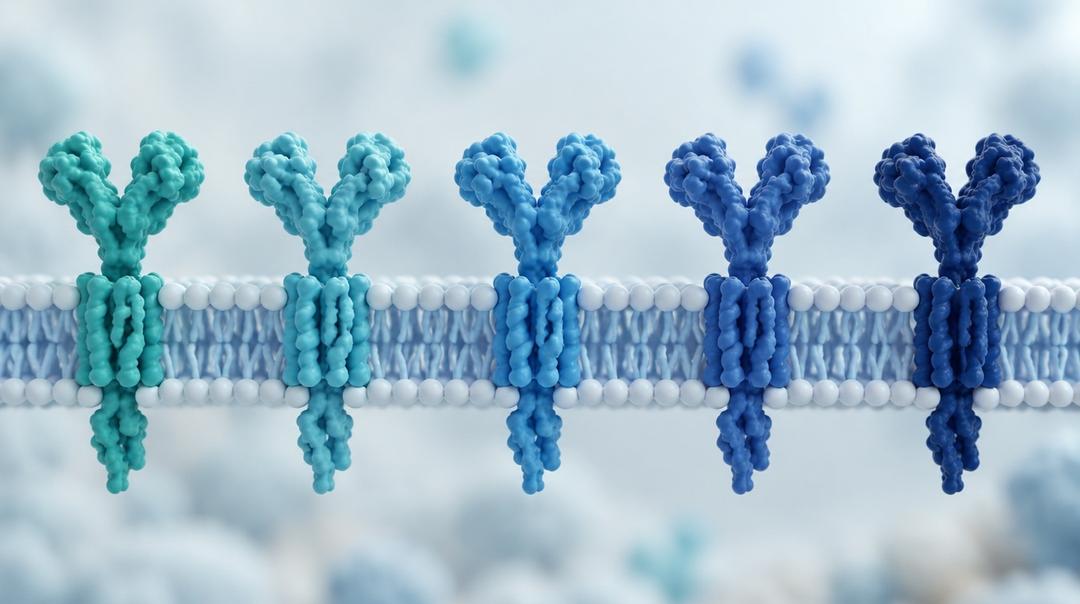
The melanocortin receptors are five G protein-coupled receptors, MC1R to MC5R, that respond to peptides cut from one precursor protein, pro-opiomelanocortin (POMC). MC1R is best known for skin and hair pigmentation, MC2R is the adrenal ACTH receptor, MC3R and MC4R are central receptors linked to energy balance, and MC5R works in exocrine glands. Approved drugs act at this family: afamelanotide, bremelanotide (PT-141) and setmelanotide. The same is true of unapproved research compounds such as Melanotan II and the tripeptide KPV.
What are melanocortins?
"Melanocortin" is the family name for the peptides made when POMC is cut into pieces. Krude and colleagues summarised the pieces when they described the first human POMC defects: sequential cleavage of the precursor yields adrenocorticotrophin (ACTH), the alpha, beta and gamma melanocyte-stimulating hormones (α-, β- and γ-MSH), and also beta-endorphin, which acts at opioid receptors rather than melanocortin receptors (PMID 9620771).
ACTH and α-MSH share a core sequence. That shared core explains why one family of receptors can respond to all of them with different preferences, and why so many synthetic analogues are built around it.
The family also has natural antagonists, which is unusual among hormone systems. Agouti protein, a pigmentation factor in skin, and the related agouti-related peptide in the brain both oppose melanocortin signalling. Huszar and colleagues framed the obesity of the agouti mouse as chronic antagonism of MC4R (PMID 9019399). A receptor family with endogenous agonists and endogenous antagonists is one where the balance between the two carries much of the signal.
How were the receptors found?
In 1992 Mountjoy and colleagues cloned the mouse and human MSH receptors and a human ACTH receptor, and recognised them as a new subfamily of G protein-coupled receptors (PMID 1325670). Over the following years the family was completed at five. Each receptor was then given its role in the research literature mainly through gene-knockout mice and rare human mutations, which is why so much of the table below is anchored in genetics rather than pharmacology.
What does each melanocortin receptor do?
| Receptor | Main natural ligand(s) | Where it is studied | What the genetic evidence points to |
|---|---|---|---|
| MC1R | α-MSH, ACTH | Melanocytes; immune cells | Pigment type: MC1R variants were found in over 80% of people with red hair or fair skin that tans poorly (PMID 7581459) |
| MC2R | ACTH only | Adrenal cortex | Cortisol production. Needs the accessory protein MRAP to reach the cell surface (PMID 15654338) |
| MC3R | γ-MSH and others | Brain and periphery | Energy partitioning: knockout mice had about 50 to 60% more fat without being clearly overweight (PMID 10965927) |
| MC4R | α-MSH; opposed by agouti-related peptide | Brain | Food intake and body weight: knockout mice develop obesity with overeating (PMID 9019399); a frameshift mutation tracked with inherited human obesity (PMID 9771698) |
| MC5R | α-MSH | Exocrine glands | Sebaceous and other gland secretion: knockout mice had defective water repulsion and thermoregulation from reduced sebaceous lipids (PMID 9413988) |
Three points from that table are easy to miss.
MC2R is the outlier. It responds to ACTH and essentially nothing else, and it cannot work alone. Metherell and colleagues found that people with familial glucocorticoid deficiency who had normal MC2R genes carried mutations in a small partner protein, MRAP, which helps move the receptor from inside the cell to its surface (PMID 15654338). An MC2R expressed without MRAP in a test cell is not a working ACTH receptor, so assay design matters a great deal here.
MC3R and MC4R are not interchangeable. Both are central receptors in energy balance, yet their knockouts look different. Butler and colleagues report that MC4R-null mice eat more and grow larger, while MC3R-null mice show an "exclusively metabolic syndrome": more fat mass, a shift in fuel use and less running-wheel activity, without overeating (PMID 10965927).
The human genetics agrees with the mice for MC4R. Krude's two patients with POMC mutations had severe early-onset obesity, adrenal insufficiency and red hair, which is one precursor failing at three receptors at once (PMID 9620771). Yeo and colleagues tied an MC4R frameshift mutation to dominantly inherited obesity (PMID 9771698). This is why MC4R became a drug target. Agreement between mouse and human genetics is uncommon.
Which approved drugs act at melanocortin receptors?
Three melanocortin peptides were approved by the US FDA within two years. Sweeney and colleagues, from the laboratory that produced several of the knockouts above, record bremelanotide and afamelanotide in 2019 and setmelanotide in 2020 (PMID 37365323).
| Drug | Receptor emphasis | Approved use (United States) | Evidence base |
|---|---|---|---|
| Afamelanotide | MC1R (α-MSH analogue) | Phototoxicity in erythropoietic protoporphyria | Two randomised trials (PMID 26132941); approved in the European Union before the US (PMID 28003770) |
| Bremelanotide (PT-141) | Non-selective melanocortin agonist | Hypoactive sexual desire disorder in premenopausal women | Two phase 3 RECONNECT trials (PMID 31599840) |
| Setmelanotide | MC4R agonist | Obesity from specific genetic defects in the MC4R pathway | Single-arm phase 3 trials in POMC and LEPR deficiency (PMID 33137293) |
A Canadian authorisation for any of the three could not be confirmed for this page. The Drug Product Database is the place to check. Each approval covers a defined formulation for a defined population and nothing beyond it.
What the trials measured. In the afamelanotide trials, the primary endpoint was hours of direct sunlight without pain. In the US study the median was 69.4 hours against 40.8 on placebo (PMID 26132941). In the RECONNECT trials of bremelanotide, 1,267 women were randomised. Desire and distress scores moved against placebo, and nausea, flushing and headache each occurred in 10% or more of participants (PMID 31599840). In setmelanotide's trials, 8 of 10 participants with POMC deficiency and 5 of 11 with LEPR deficiency lost at least 10% of body weight at about a year. Hyperpigmentation was reported in all ten POMC participants (PMID 33137293).
That last finding shows how the family works. Setmelanotide is designed as an MC4R agonist, yet darker skin appeared in every POMC participant, which is the kind of effect expected when MC1R is also engaged. Selectivity within this family is a matter of degree.
Where do PT-141, Melanotan II and KPV fit?
PT-141 and Melanotan II are closely related cyclic peptides. Bremelanotide is the approved form of PT-141. Melanotan II is approved nowhere, for any use. Their receptor profiles and the safety record that separates them are covered in PT-141 vs Melanotan II, and the approved product's evidence in PT-141 research. The difference between Vyleesi as a medicine and PT-141 as a research chemical is the point those pages make.
KPV is the three C-terminal residues of α-MSH, lysine-proline-valine, written α-MSH(11-13). It is a fragment, not an analogue built to hit a receptor, and its mechanism is not settled. Kannengiesser and colleagues found it active in two mouse colitis models, and it worked even in mice whose MC1R did not function. They concluded the effects were "at least partially independent of MC1R signaling" (PMID 18092346). Dalmasso and colleagues proposed a different route, uptake into intestinal cells through the peptide transporter PepT1 (PMID 18061177). So KPV belongs in a melanocortin article because of where it comes from, not because a melanocortin receptor has been shown to explain its effects. The animal work is set out in KPV and inflammatory bowel disease research. KPV is approved nowhere, and its evidence is cell and animal work.
Reading melanocortin research
Ask which receptor was measured. α-MSH acts at four of the five receptors. A paper that reports an "α-MSH-like" effect without receptor-selective tools, or without knockout controls like the MC1R-deficient mice in the KPV study, has not identified which receptor produced the effect.
Ask whether the assay can support the receptor. MC2R without MRAP, or MC4R studied without its endogenous antagonist present, are experiments set up differently from the body. Background on the assays themselves is in how peptide receptors work.
Keep the approved and the unapproved apart. Three approved drugs show that melanocortin agonists can pass regulatory review for narrow indications. That says nothing about an unapproved analogue or a fragment.
Nothing here is medical, dosing, or therapeutic guidance. For other receptor systems in this series, see the ghrelin receptor explained and the HPG axis and kisspeptin.
Supplied here for laboratory use: PT-141 and KPV. The laboratory's certificate for each lot is linked from its product page. For laboratory research use only.
Frequently asked questions
How many melanocortin receptors are there? Five, named MC1R to MC5R. All are G protein-coupled receptors that respond to peptides from the POMC precursor. MC1R is linked to pigmentation, MC2R to adrenal cortisol production, MC3R and MC4R to energy balance in the brain, and MC5R to exocrine gland secretion. MC2R responds only to ACTH and needs the partner protein MRAP.
Why does MC4R get so much attention? Because the mouse and human genetics agree. Mice lacking MC4R become obese and overeat, and an MC4R mutation was linked to inherited human obesity in 1998. That agreement made it a drug target, and setmelanotide, an MC4R agonist, was approved in the United States in 2020 for obesity caused by specific genetic defects in the pathway.
Is KPV a melanocortin receptor agonist? That has not been established. KPV is a fragment of α-MSH, but in one mouse colitis study it remained active in animals with non-functional MC1R, and the authors described its effects as partly independent of MC1R. Another group proposed uptake through the PepT1 transporter. Its evidence is cell and animal work, and it is approved nowhere.
Why did setmelanotide trial participants develop darker skin? Hyperpigmentation was reported in all ten participants in the POMC-deficiency trial. Setmelanotide is designed for MC4R, and darker skin is what you would expect if MC1R, the pigmentation receptor, is also engaged. It shows that selectivity within this receptor family is relative, even for an approved, targeted drug.
Selected Research References
- Mountjoy KG, Robbins LS, Mortrud MT, Cone RD. The cloning of a family of genes that encode the melanocortin receptors. Science. 1992;257:1248-1251. pubmed.ncbi.nlm.nih.gov/1325670
- Krude H, Biebermann H, Luck W, Horn R, Brabant G, Grüters A. Severe early-onset obesity, adrenal insufficiency and red hair pigmentation caused by POMC mutations in humans. Nature Genetics. 1998;19:155-157. pubmed.ncbi.nlm.nih.gov/9620771
- Huszar D, Lynch CA, Fairchild-Huntress V, et al. Targeted disruption of the melanocortin-4 receptor results in obesity in mice. Cell. 1997;88:131-141. pubmed.ncbi.nlm.nih.gov/9019399
- Valverde P, Healy E, Jackson I, Rees JL, Thody AJ. Variants of the melanocyte-stimulating hormone receptor gene are associated with red hair and fair skin in humans. Nature Genetics. 1995;11:328-330. pubmed.ncbi.nlm.nih.gov/7581459
- Metherell LA, Chapple JP, Cooray S, et al. Mutations in MRAP, encoding a new interacting partner of the ACTH receptor, cause familial glucocorticoid deficiency type 2. Nature Genetics. 2005;37:166-170. pubmed.ncbi.nlm.nih.gov/15654338
- Butler AA, Kesterson RA, Khong K, et al. A unique metabolic syndrome causes obesity in the melanocortin-3 receptor-deficient mouse. Endocrinology. 2000;141:3518-3521. pubmed.ncbi.nlm.nih.gov/10965927
- Sweeney P, Gimenez LE, Hernandez CC, Cone RD. Targeting the central melanocortin system for the treatment of metabolic disorders. Nature Reviews Endocrinology. 2023;19:507-519. pubmed.ncbi.nlm.nih.gov/37365323
- Clément K, van den Akker E, Argente J, et al. Efficacy and safety of setmelanotide, an MC4R agonist, in individuals with severe obesity due to LEPR or POMC deficiency: single-arm, open-label, multicentre, phase 3 trials. Lancet Diabetes & Endocrinology. 2020;8:960-970. pubmed.ncbi.nlm.nih.gov/33137293
- Langendonk JG, Balwani M, Anderson KE, et al. Afamelanotide for Erythropoietic Protoporphyria. New England Journal of Medicine. 2015;373:48-59. pubmed.ncbi.nlm.nih.gov/26132941
- Kannengiesser K, Maaser C, Heidemann J, et al. Melanocortin-derived tripeptide KPV has anti-inflammatory potential in murine models of inflammatory bowel disease. Inflammatory Bowel Diseases. 2008;14:324-331. pubmed.ncbi.nlm.nih.gov/18092346
All products sold by NovaEvum are for research and laboratory use only. They are not intended for human or animal consumption, diagnosis, treatment, cure, or prevention of any disease.