
PT-141 and melanocortins
PT-141 vs Melanotan II: one atom apart, one approved, one under a Health Canada warning
EC
· 9 min read
A summary of published research, with citations. It states no amount, schedule or route, and makes no claim about what this compound does in a person. Supplied for laboratory research use only.
On this page · 8 sections
PT-141 (bremelanotide) and Melanotan II are cyclic heptapeptide analogues of alpha-MSH that differ only at the C-terminus: Melanotan II ends in an amide, bremelanotide in a free carboxylic acid, which is why bremelanotide is often described as its metabolite. Both act at several melanocortin receptors. Bremelanotide was approved by the FDA in 2019 for one indication in premenopausal women. Melanotan II is approved nowhere and is named in Health Canada's 2026 advisory on unauthorized peptides.
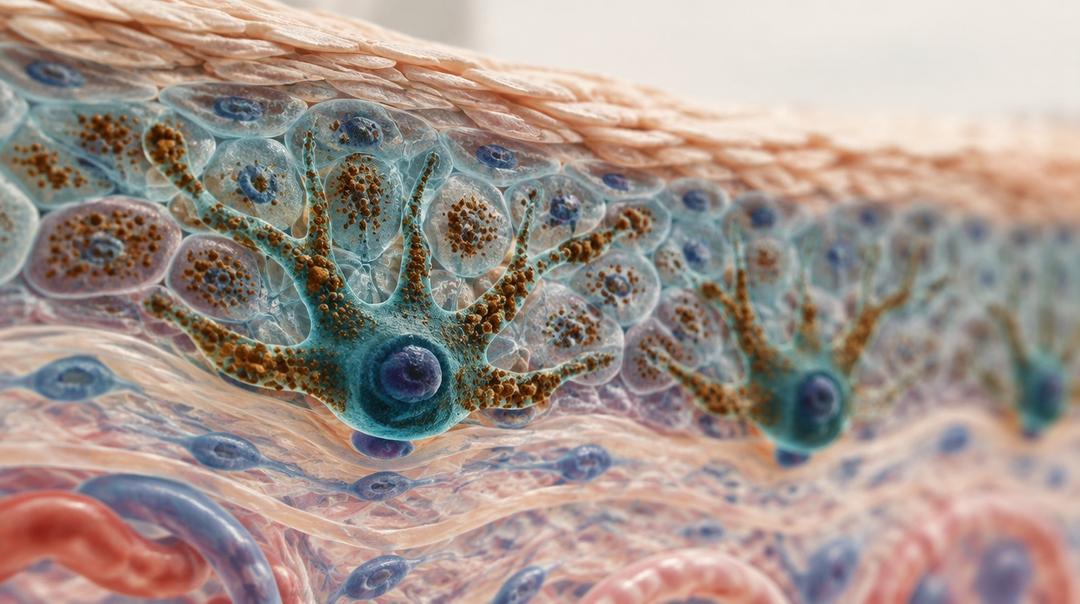
The structural relationship
Melanotan II came out of a group in Tucson, Arizona, that included Victor Hruby and Mac Hadley, working on synthetic melanotropins as tanning agents. Dorr and colleagues described it in its first human study as a lactam-bridged cyclic heptapeptide analogue of alpha-MSH, with the structure Ac-Nle-cyclo[Asp-His-D-Phe-Arg-Trp-Lys]-NH2, and "superpotent melanotropic activity" in vitro (PMID 8637402).
Bremelanotide has the same ring and the same sequence, with one change at the very end: the C-terminal amide becomes a carboxylic acid. In molecular terms that swaps an NH2 group for an OH. The formulas show it — C50H69N15O9 for Melanotan II, C50H68N14O10 for bremelanotide — and the molecular weights differ by about one dalton. Hydrolysis of a C-terminal amide to the acid is a plausible metabolic step, which is the basis for the common description of bremelanotide as a Melanotan II metabolite. Palatin Technologies developed it from there.
A one-atom difference sounds trivial. In receptor pharmacology it often is not, and the two compounds went on to have entirely different development histories, safety records and legal positions.
Receptor profiles
There are five melanocortin receptors. MC1R on melanocytes drives pigmentation. MC2R is the ACTH receptor in the adrenal gland. MC3R and MC4R are expressed mainly in the brain, MC4R being the one most studied in energy balance and sexual function. MC5R is found in exocrine glands.
Melanotan II is broadly non-selective. Schiöth and colleagues tested it on cells expressing human MC1, MC3, MC4 and MC5 receptors and found the cyclic lactam analogues, Melanotan II among them, had high affinity across the set (PMID 9357059). Its action at MC1R is why it tans; its action at central receptors is why its first human study reported spontaneous erections, yawning and stretching alongside pigmentation.
Bremelanotide's development framed it as a central agonist. Molinoff and colleagues described PT-141 as an agonist at melanocortin receptors including MC3R and MC4R, expressed primarily in the central nervous system (PMID 12851303). That framing does not mean it has no MC1R activity. The bremelanotide safety record includes focal hyperpigmentation, which is what MC1R activation would predict.
| Melanotan II | PT-141 (bremelanotide) | |
|---|---|---|
| Structure | Ac-Nle-cyclo[Asp-His-D-Phe-Arg-Trp-Lys]-NH2 | Same ring and sequence, C-terminal free acid |
| Receptors | High affinity across MC1R, MC3R, MC4R and MC5R | Described as an MC3R/MC4R agonist; pigmentation reported in trials |
| Developed as | A tanning agent, later explored in erectile dysfunction | A treatment for sexual dysfunction |
| Largest controlled human data | Small pilot and crossover studies in the 1990s | Two phase 3 trials, about 1,250 women in the double-blind phase |
| FDA | Not approved | Approved in 2019 as Vyleesi, for acquired, generalised hypoactive sexual desire disorder in premenopausal women |
| Canada | Not authorised; named in Health Canada's April 2026 advisory | No Canadian marketing authorisation found |
What the Melanotan II human record contains
It is small and old.
Dorr's pilot phase 1 study enrolled a small number of healthy male volunteers in a single-blind, alternating design (PMID 8637402). The investigators reported mild nausea at most levels, somnolence and fatigue at the highest level in one subject, a stretching and yawning complex that accompanied spontaneous erections, and increased pigmentation in two subjects a week after the study ended.
Wessells and colleagues then ran a double-blind, placebo-controlled crossover study in ten men with psychogenic erectile dysfunction, with erections monitored by RigiScan (PMID 9679884). Eight of ten developed clinically apparent erections with Melanotan II. Nausea, stretching and yawning, and decreased appetite were more frequent than with placebo.
That is close to the whole controlled clinical record. Melanotan II was never taken through a registration programme. Its later history is mostly in dermatology journals, as case reports from people using unlicensed product to tan.
What the bremelanotide record contains
The opposite: a full development programme. Palatin first studied PT-141 in healthy men and men with erectile dysfunction (Diamond and colleagues, PMID 14963471), a programme that did not reach approval, and then moved to women with low sexual desire. The two RECONNECT phase 3 trials, registered on ClinicalTrials.gov as NCT02333071 and NCT02338960, randomised premenopausal women with hypoactive sexual desire disorder and measured validated desire and distress scores (Kingsberg and colleagues, PMID 31599840).
Clayton and colleagues summarised safety across the development programme: 3,500 subjects in 43 completed studies (PMID 35147466). In the integrated double-blind phase 3 data, nausea occurred in 40.0% of the bremelanotide group against 1.3% with placebo, flushing in 20.3% against 1.3%, and headache in 11.3% against 1.9%. Nausea was the commonest reason for stopping. Small, transient blood-pressure increases were seen on ambulatory monitoring. Focal hyperpigmentation was rare under the labelled conditions of use but occurred in more than a third of subjects in a study of extended consecutive exposure. A review of the approval described the efficacy as statistically significant but possibly modest in clinical terms (Mayer and Lynch, PMID 31893927).
PT-141 and the melanocortin receptors goes through that clinical record in order and what the approval does and does not cover.
The safety signal specific to Melanotan II
Because Melanotan II acts strongly at MC1R and has been sold widely without a licence for tanning, dermatologists have reported what they see. Habbema and colleagues reviewed the risks of unregulated alpha-MSH analogue use: changes in existing moles, newly emerging and dysplastic naevi, and four case reports of melanoma arising from existing moles during or shortly after use (PMID 28266027). They were explicit that conclusive evidence of a causal link is lacking, and that several national health organisations had issued warnings. Hjuler and Lorentzen described a 20-year-old woman with melanoma diagnosed three months after a short course of unlicensed Melanotan II combined with sunbed use (PMID 24355990).
Case reports cannot establish causation, and many of the people in them also used sunbeds; how to read a peptide study sets out why an uncontrolled report sits at the bottom of the evidence hierarchy. What they show is that the compound's main receptor target is the one that governs melanocytes, and that nobody has studied its long-term effect on them in a controlled way.
Health Canada's position
On 9 April 2026, Health Canada issued a public advisory warning against unauthorized peptides bought online, listing Melanotan I and II among its named examples and stating that peptides in Canada are generally regulated as prescription drugs. Earlier advisories about seized products from individual Canadian sellers also listed Melanotan II. The advisories are on Health Canada's recalls and safety alerts site. Authorised drugs carry an eight-digit Drug Identification Number, which can be checked in the Drug Product Database.
Bremelanotide does not appear in that advisory, and it also has no Canadian marketing authorisation that we could find. Melanotan II in Canada and peptides and Canadian law cover the regulatory framework in more detail.
What a one-atom difference does and does not mean
It does not mean the two compounds share a safety profile, and it does not mean bremelanotide's approval says anything about Melanotan II. For another pair where one peptide length has a clinical literature the other lacks, see kisspeptin-10 vs kisspeptin-54. The approval rests on trials of one specified product in one population. Melanotan II was never tested in that way.
It also does not mean research-grade PT-141 is Vyleesi. The approved medicine is a formulation with a label, warnings and a prescriber. NovaEvum supplies PT-141 as a laboratory reagent and does not sell Melanotan II.
Supplied here for laboratory use: PT-141. The laboratory's certificate for each lot is linked from its product page. For laboratory research use only.
Nothing here is medical, dosing, or therapeutic guidance.
Frequently asked questions
Is PT-141 made from Melanotan II? Bremelanotide has the same cyclic sequence as Melanotan II with one change: a C-terminal carboxylic acid in place of an amide. Because that hydrolysis is a plausible metabolic step, bremelanotide is commonly described as a Melanotan II metabolite. It is manufactured as its own molecule, not produced from Melanotan II.
Does PT-141 cause tanning like Melanotan II? Bremelanotide's development framed it as a central MC3R/MC4R agonist, but focal hyperpigmentation appears in its safety record. Clayton and colleagues reported it as rare under labelled conditions and present in more than a third of subjects after extended consecutive exposure. Melanotan II was developed specifically as a tanning agent.
Is Melanotan II legal in Canada? It has no Canadian authorisation, and Health Canada's April 2026 advisory on unauthorized peptides names Melanotan I and II. Health Canada states that peptides are generally regulated as prescription drugs. NovaEvum does not sell Melanotan II.
Is bremelanotide approved in Canada? No Canadian marketing authorisation for bremelanotide was found. Its approval is from the FDA, in 2019, as Vyleesi for acquired, generalised hypoactive sexual desire disorder in premenopausal women. Health Canada's Drug Product Database is the authoritative place to confirm current status.
Has Melanotan II been linked to melanoma? There are case reports of melanoma arising during or after unlicensed use, and a 2017 review counted four. The reviewers stated that conclusive evidence of a causal link is lacking, partly because many users also tanned. No controlled long-term study of Melanotan II and melanocytes exists.
Selected Research References
- Dorr RT, Lines R, Levine N, et al. Evaluation of melanotan-II, a superpotent cyclic melanotropic peptide in a pilot phase-I clinical study. Life Sciences. 1996;58(20):1777-1784. pubmed.ncbi.nlm.nih.gov/8637402
- Wessells H, Fuciarelli K, Hansen J, et al. Synthetic melanotropic peptide initiates erections in men with psychogenic erectile dysfunction: double-blind, placebo controlled crossover study. Journal of Urology. 1998;160(2):389-393. pubmed.ncbi.nlm.nih.gov/9679884
- Molinoff PB, Shadiack AM, Earle D, Diamond LE, Quon CY. PT-141: a melanocortin agonist for the treatment of sexual dysfunction. Annals of the New York Academy of Sciences. 2003;994:96-102. pubmed.ncbi.nlm.nih.gov/12851303
- Diamond LE, Earle DC, Rosen RC, Willett MS, Molinoff PB. Double-blind, placebo-controlled evaluation of the safety, pharmacokinetic properties and pharmacodynamic effects of intranasal PT-141, a melanocortin receptor agonist, in healthy males and patients with mild-to-moderate erectile dysfunction. International Journal of Impotence Research. 2004;16(1):51-59. pubmed.ncbi.nlm.nih.gov/14963471
- Kingsberg SA, Clayton AH, Portman D, et al. Bremelanotide for the treatment of hypoactive sexual desire disorder: two randomized phase 3 trials. Obstetrics & Gynecology. 2019;134(5):899-908. pubmed.ncbi.nlm.nih.gov/31599840
- Clayton AH, Kingsberg SA, Portman D, et al. Safety profile of bremelanotide across the clinical development program. Journal of Women's Health. 2022;31(2):171-182. pubmed.ncbi.nlm.nih.gov/35147466
- Mayer D, Lynch SE. Bremelanotide: new drug approved for treating hypoactive sexual desire disorder. Annals of Pharmacotherapy. 2020;54(7):684-690. pubmed.ncbi.nlm.nih.gov/31893927
- Habbema L, Halk AB, Neumann M, Bergman W. Risks of unregulated use of alpha-melanocyte-stimulating hormone analogues: a review. International Journal of Dermatology. 2017;56(10):975-980. pubmed.ncbi.nlm.nih.gov/28266027
- Hjuler KF, Lorentzen HF. Melanoma associated with the use of melanotan-II. Dermatology. 2014;228(1):34-36. pubmed.ncbi.nlm.nih.gov/24355990
All products sold by NovaEvum are for research and laboratory use only. They are not intended for human or animal consumption, diagnosis, treatment, cure, or prevention of any disease.