
Kisspeptin-10
Kisspeptin-10 vs kisspeptin-54: same receptor, different lengths, different literatures
EC
· 9 min read
A summary of published research, with citations. It states no amount, schedule or route, and makes no claim about what this compound does in a person. Supplied for laboratory research use only.
On this page · 9 sections
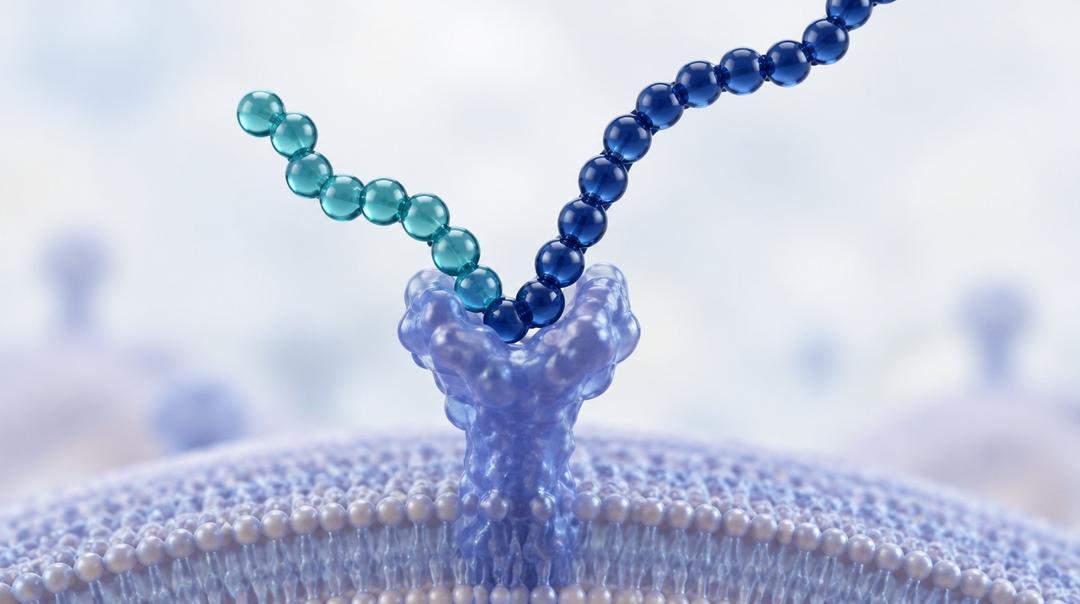
Kisspeptin-10 and kisspeptin-54 are two products of the same KISS1 gene and act at the same receptor, KISS1R. Kisspeptin-10 is the C-terminal decapeptide; kisspeptin-54 is the long form and the major circulating form in humans. In mice the long form lasted about eight times longer in blood, and in healthy men the two produced similar gonadotropin rises when given under identical conditions. The IVF oocyte-maturation trials used kisspeptin-54. Neither is approved anywhere.
Where the two peptides come from
In 2001 two groups independently found the natural ligand of an orphan receptor then called GPR54. Kotani and colleagues isolated peptides of 54, 14 and 13 amino acids from human placenta, all sharing an RF-amide C-terminus and all derived from the product of KISS1, a gene previously known as a metastasis suppressor in melanoma cells. They named them kisspeptins (PMID 11457843). Ohtaki and colleagues, working at Takeda, isolated the 54-residue amidated peptide from the same tissue and named it metastin (PMID 11385580).
The shared feature is the end of the molecule. All the natural kisspeptins share the same C-terminal ten residues, and that decapeptide is enough to bind and activate the receptor. Kisspeptin-10 is that minimal active fragment, which is why it is sometimes written as metastin 45-54: residues 45 to 54 of the long form. Kisspeptin-54 is the full-length processed peptide.
The receptor's importance was established by human genetics two years later, when loss-of-function mutations in GPR54 were shown to cause failure to enter puberty. Kisspeptin-10: what the human neuroendocrine literature measured covers that genetic foundation and the Imperial College group behind most of the human work. This page is about the two forms, side by side.
The comparison in one table
| Kisspeptin-10 | Kisspeptin-54 | |
|---|---|---|
| Length | 10 amino acids | 54 amino acids |
| Relationship | C-terminal fragment (metastin 45-54) | Full processed peptide; major circulating form in humans |
| Receptor | KISS1R | KISS1R |
| Plasma half-life | About 4 minutes in mice | About 32 minutes in mice; 27.6 minutes measured in men |
| Human studies | Gonadotropin responses in men and women; sexual dimorphism; short and 12-day exposure in men | Gonadotropin responses in men and women; desensitisation in hypothalamic amenorrhoea; IVF oocyte maturation |
| Furthest clinical stage | Physiological studies in volunteers | Phase 2 trials as an IVF trigger |
| Regulatory status | Approved nowhere | Approved nowhere |
Half-life, and why it is not the whole difference
The first human study of kisspeptin used the long form. Dhillo and colleagues gave kisspeptin-54 to healthy men, measured LH, FSH and testosterone, and calculated a plasma half-life of 27.6 minutes (PMID 16174713).
The cleanest comparison of the two forms' kinetics is in mice. d'Anglemont de Tassigny and colleagues measured a blood half-life of about 32 minutes for kisspeptin-54 and about 4 minutes for kisspeptin-10, and found that kisspeptin-54 sustained LH release far longer after a single administration (PMID 28464043). The interesting part is what happened when they tried to compensate. Giving kisspeptin-10 repeatedly to match the exposure did not reproduce the sustained LH rise, and when they looked for activation of GnRH neurones behind the blood-brain barrier, only kisspeptin-54 produced it. Their reading was that the long form may cross the barrier more readily, so the difference is not just clearance.
That is a mouse result. It is a good reason not to treat the two peptides as one compound at two durations, and it is not a measurement of what happens in people.
Head to head in healthy men
Only one study we found compared the two forms directly in humans. Jayasena and colleagues gave healthy men vehicle, kisspeptin-10, kisspeptin-54 or GnRH under identical conditions on separate days, five men per group, and sampled LH and FSH throughout (PMID 26089302).
At the levels tested, the two kisspeptins produced similar gonadotropin secretion. GnRH, which acts directly on the pituitary, was more potent than either: LH and FSH were roughly three times higher than with kisspeptin-10 and twice as high as with kisspeptin-54. The authors noted that rodent work had suggested kisspeptin-54 was the more potent form, that this had not previously been tested in humans, and that their own study was small.
So in healthy men, under one set of conditions, the potency gap that rodent work predicted did not show clearly. That is a narrow result from fifteen men, and it is the direct human comparison that exists.
Women, and the menstrual cycle
Both forms have been studied in women, and the response depends on cycle phase in a way that differs between the two sets of results.
For kisspeptin-54, Dhillo and colleagues reported that LH rose against saline in every phase, most in the preovulatory phase and least in the follicular phase (PMID 17635940).
For kisspeptin-10, the picture in the follicular phase was starker. Jayasena and colleagues found that kisspeptin-10 raised LH and FSH in healthy men, but in women in the follicular phase produced no change in gonadotropins even at the highest levels tested, while women in the preovulatory phase did respond (PMID 21976724). They called it sexual dimorphism. Chan and colleagues, using the same decapeptide sequence, found immediate LH pulses in all luteal-phase and preovulatory women but unambiguous responses in only half of early follicular women (PMID 22577171).
Whether the follicular-phase difference reflects the peptide or the study conditions is not resolved by these papers. What they do establish is that a kisspeptin-10 result in men does not predict a result in women, and that a kisspeptin-54 result in women does not predict a kisspeptin-10 one.
Sustained exposure: desensitisation and its limits
The most important constraint on any KISS1R agonist is what happens with continued exposure.
With kisspeptin-54, Jayasena and colleagues studied women with hypothalamic amenorrhoea over two weeks (PMID 19820030). The first exposure produced large LH and FSH rises. By the end of the study the responses were much smaller, while the women remained responsive to GnRH. Repeated exposure produced desensitisation.
With kisspeptin-10, Yeung and colleagues reported in 2026 that continuous exposure over five days in healthy men left gonadotropins no different from vehicle, though testosterone stayed raised, whereas intermittent exposure over twelve days sustained gonadotropin rises (PMID 42549827). Read together, the two studies suggest the pattern of exposure matters as much as the form of the peptide. They were run in different populations with different designs, so they do not support a direct comparison of desensitisation between the two forms.
The IVF trials used kisspeptin-54
The clinical application kisspeptin got closest to is triggering final oocyte maturation in IVF. Every trial in this line used the long form.
Jayasena and colleagues gave a single exposure of kisspeptin-54 to 53 women undergoing IVF after standard ovarian stimulation (PMID 25036713). Egg maturation was observed at every level tested, embryos were transferred in 92% of women, and biochemical and clinical pregnancy rates were 40% and 23%. Abbara and colleagues then ran a randomised phase 2 trial in 60 women at high risk of ovarian hyperstimulation syndrome, the complication the approach is meant to avoid (PMID 26192876). Oocyte maturation occurred in 95% of women, and no woman developed moderate, severe or critical hyperstimulation syndrome.
These are phase 2 results from one centre. They are about kisspeptin-54 in women undergoing IVF, and they are not evidence about kisspeptin-10. The industry programme that followed used a different, longer-acting agonist, MVT-602, as the kisspeptin-10 research page describes.
Regulatory position
Neither peptide is approved by Health Canada, the FDA or the EMA, for any indication. Both are investigational, and peptides and Canadian law explains what that means for material sold as a research chemical. NovaEvum supplies kisspeptin-10 as a laboratory reagent and does not sell kisspeptin-54.
For another central reproductive-signalling compound where an approved medicine sits next to a research chemical, see PT-141 vs Melanotan II. For how small physiological studies like these should be weighed, see how to read a peptide study. For how receptor activation is measured at the bench, see how peptide receptors work.
Supplied here for laboratory use: Kisspeptin-10. The laboratory's certificate for each lot is linked from its product page. For laboratory research use only.
Nothing here is medical, dosing, or therapeutic guidance.
Frequently asked questions
Do kisspeptin-10 and kisspeptin-54 act on different receptors? No. Both activate KISS1R, formerly GPR54. They share the same C-terminal ten residues, which is the part that binds the receptor. They differ in length, in how long they last in circulation, and possibly in how readily they reach GnRH neurones behind the blood-brain barrier, which mouse work suggests.
Is kisspeptin-54 more potent than kisspeptin-10? Rodent studies suggested so. The one direct human comparison found, in healthy men, reported similar gonadotropin secretion from the two forms at the levels tested, with GnRH more potent than either. That study had five men per group, so it narrows the question without closing it.
Why did the IVF trials use kisspeptin-54? It is the major circulating form in humans and has the longer half-life, which suits a single exposure intended to produce an LH surge. The trials reported oocyte maturation and no moderate or severe hyperstimulation syndrome in high-risk women. None of that work used kisspeptin-10.
Does kisspeptin-10 work in women? In the studies found, kisspeptin-10 raised gonadotropins in men and in women in the preovulatory phase, but not reliably in the early follicular phase. One study reported no change in follicular-phase women at the highest levels tested; another reported clear responses in about half.
Are either of these approved drugs? No. Neither kisspeptin-10 nor kisspeptin-54 is approved by any regulator for any indication. The IVF work reached phase 2. Kisspeptin-10 is sold here as a laboratory research reagent only.
Selected Research References
- Kotani M, Detheux M, Vandenbogaerde A, et al. The metastasis suppressor gene KiSS-1 encodes kisspeptins, the natural ligands of the orphan G protein-coupled receptor GPR54. Journal of Biological Chemistry. 2001;276(37):34631-34636. pubmed.ncbi.nlm.nih.gov/11457843
- Ohtaki T, Shintani Y, Honda S, et al. Metastasis suppressor gene KiSS-1 encodes peptide ligand of a G-protein-coupled receptor. Nature. 2001;411(6837):613-617. pubmed.ncbi.nlm.nih.gov/11385580
- Dhillo WS, Chaudhri OB, Patterson M, et al. Kisspeptin-54 stimulates the hypothalamic-pituitary gonadal axis in human males. Journal of Clinical Endocrinology & Metabolism. 2005;90(12):6609-6615. pubmed.ncbi.nlm.nih.gov/16174713
- Dhillo WS, Chaudhri OB, Thompson EL, et al. Kisspeptin-54 stimulates gonadotropin release most potently during the preovulatory phase of the menstrual cycle in women. Journal of Clinical Endocrinology & Metabolism. 2007;92(10):3958-3966. pubmed.ncbi.nlm.nih.gov/17635940
- Jayasena CN, Nijher GM, Comninos AN, et al. The effects of kisspeptin-10 on reproductive hormone release show sexual dimorphism in humans. Journal of Clinical Endocrinology & Metabolism. 2011;96(12):E1963-E1972. pubmed.ncbi.nlm.nih.gov/21976724
- Chan YM, Butler JP, Sidhoum VF, Pinnell NE, Seminara SB. Kisspeptin administration to women: a window into endogenous kisspeptin secretion and GnRH responsiveness across the menstrual cycle. Journal of Clinical Endocrinology & Metabolism. 2012;97(8):E1458-E1467. pubmed.ncbi.nlm.nih.gov/22577171
- Jayasena CN, Abbara A, Narayanaswamy S, et al. Direct comparison of the effects of intravenous kisspeptin-10, kisspeptin-54 and GnRH on gonadotrophin secretion in healthy men. Human Reproduction. 2015;30(8):1934-1941. pubmed.ncbi.nlm.nih.gov/26089302
- Jayasena CN, Abbara A, Comninos AN, et al. Kisspeptin-54 triggers egg maturation in women undergoing in vitro fertilization. Journal of Clinical Investigation. 2014;124(8):3667-3677. pubmed.ncbi.nlm.nih.gov/25036713
- Abbara A, Jayasena CN, Christopoulos G, et al. Efficacy of kisspeptin-54 to trigger oocyte maturation in women at high risk of ovarian hyperstimulation syndrome (OHSS) during in vitro fertilization (IVF) therapy. Journal of Clinical Endocrinology & Metabolism. 2015;100(9):3322-3331. pubmed.ncbi.nlm.nih.gov/26192876
All products sold by NovaEvum are for research and laboratory use only. They are not intended for human or animal consumption, diagnosis, treatment, cure, or prevention of any disease.