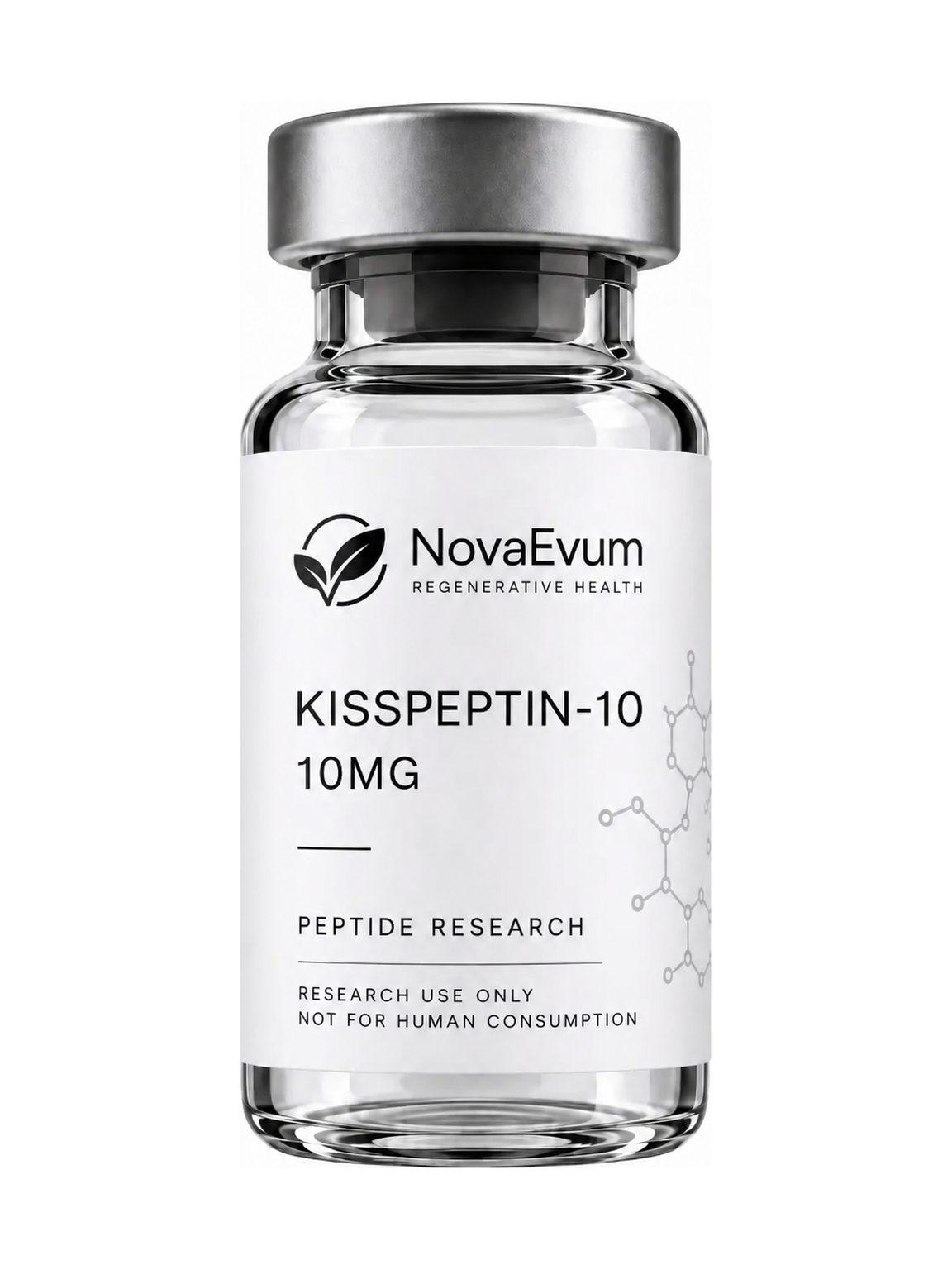
Kisspeptin-10 (KP-10) research peptide, Canada
Metastin 45-54 · KP-10 · Shipped across Canada
Each vial contains 10 mg of Kisspeptin-10.
Kisspeptin-10 is a ten-amino-acid C-terminal fragment of kisspeptin, the endogenous ligand at the KISS1R receptor. What the reproductive-endocrinology literature examines, how far it got, and whether any regulator has approved it are set out under How it works below.
- Lyophilized powder, requires reconstitution
Price
$80.00 CAD
$8.00 / mg
In stock
- 24/7 customer support
- Lab tested purity & quality
- Free shipping on all orders




Kisspeptin-10 in Canada
Ships from Toronto to anywhere in Canada, priced in Canadian dollars, payable by Interac e-Transfer or card.
Specification
- CAS number
- 374675-21-5
- Molecular formula
- C63H83N17O14
- Molecular weight
- 1,302.45 g/mol
- Sequence
- YNWNSFGLRF
- Purity
- ≥ 99.85% by RP-HPLC
- Form
- Lyophilized powder
- Third-party assay
- Purity and fill
- Storage
- -20 °C, protected from light
- Lot
- NVE-2452-A
How it works
What makes this fragment worth studying is where it sits in a chain rather than what it sits on: it acts upstream of the hormone that drives the reproductive axis rather than on the axis itself, so the literature is about a signal and its timing.
KISS1R
The receptor
The receptor kisspeptin binds, and the site this ten-residue C-terminal fragment is characterised at. Binding at a receptor is what that work established, and it is a fact about the molecule rather than about anybody.
Upstream of GnRH
Its position in the axis
Reproductive endocrinology has investigated it as a signal upstream of gonadotropin-releasing hormone. Sitting upstream of a hormone is a fact about a pathway, and it is the fact the rest of this literature is built on.
Pituitary gonadotropin secretion
What the human studies measured
Human experimental studies have measured the pituitary gonadotropins — luteinising hormone and follicle-stimulating hormone — in blood. That measurement is the endpoint of that work, and a hormone in a blood sample is not a clinical result.
Puberty-timing models
The animal literature
Used in animal models as a research tool for probing when puberty begins. A tool for asking a question in an animal is not a finding about a person, and this is the larger half of the literature by volume.
Where the evidence stands
Human experimental studies exist, mostly small and short, alongside a larger animal literature. No phase 3 programme has reported. Not approved by any regulator, in any jurisdiction, for any indication.
Laboratory results
- Purity+Fill99.50%Freedom Diagnostics · Jul 2026 · 10 mgOpen
- Purity+Fill99.851%Janoshik · Aug 2026 · 10 mgOpen
Opened as the laboratory issued them, unedited. Every certificate we publish
Research reading
- The HPG axis and kisspeptin explained: GnRH pulses, LH and FSH, and the receptor that starts puberty10 min
- Kisspeptin-10 vs kisspeptin-54: same receptor, different lengths, different literatures9 min
- What Is Kisspeptin-10? The Decapeptide, Its Receptor and the Human Studies9 min
- Kisspeptin-10: what the human neuroendocrine literature measured7 min
New Kisspeptin-10 research
All weekly research newsResearch use only
Supplied as a laboratory research chemical. Not a drug, food or cosmetic, and not for human or veterinary use. No application guidance is provided or implied.
What kisspeptin-10 is
Kisspeptin-10 is the last ten amino acids of kisspeptin, a family of peptides cut from one precursor made by the KISS1 gene. It is the shortest form with full activity at the kisspeptin receptor, KISS1R, which is why so much of the laboratory work uses it.
The gene was described first, in 1996, as a suppressor of metastasis in melanoma. In 2001 two groups found that its peptides are the natural ligands of an orphan receptor then called GPR54, and one of them named the peptide metastin. In 2003 two more groups found that people without a working GPR54 do not go through puberty, which placed kisspeptin upstream of gonadotropin-releasing hormone (GnRH) in the reproductive axis.
| Property | Kisspeptin-10 |
|---|---|
| Class | Endogenous peptide fragment |
| Length | Ten amino acids |
| Also called | KP-10, metastin 45-54 |
| Receptor | KISS1R, formerly GPR54 |
| Gene | KISS1 |
| Longer forms | Kisspeptin-54, -14 and -13, all sharing its sequence at their end |
| Stage | Human physiology studies; no phase 3 programme |
References
- Lee et al., Journal of the National Cancer Institute, 1996. PMID 8944003
- Ohtaki et al., Nature, 2001. PMID 11385580
- Kotani et al., Journal of Biological Chemistry, 2001. PMID 11457843
- de Roux et al., PNAS, 2003. PMID 12944565
- Seminara et al., New England Journal of Medicine, 2003. PMID 14573733
Kisspeptin-10 vs kisspeptin-54
The two forms most studied in people are kisspeptin-10 and kisspeptin-54. Kisspeptin-10 is the end of kisspeptin-54, so both carry the part that binds the receptor. Rodent work suggested the longer form was the more potent; the one direct comparison in people, in healthy men in 2015, found the two similar at the amounts tested, and both short of GnRH itself.
The literatures have diverged since. Kisspeptin-54 went on to trials in egg maturation during IVF; kisspeptin-10 has stayed mostly in physiology studies of how the axis responds. A synthetic receptor agonist, MVT-602, has been examined in early-phase trials of its own.
| Kisspeptin-10 | Kisspeptin-54 | |
|---|---|---|
| Length | Ten amino acids | 54 amino acids |
| Relationship | The receptor-binding end | The full-length form, containing it |
| Human work | Physiology studies in men and women | Physiology studies, and IVF trials |
References
- Jayasena et al., Human Reproduction, 2015. PMID 26089302
Kisspeptin-10 research: published studies
The human studies are small, mostly run by a handful of groups, and designed to measure how the reproductive hormones respond, chiefly luteinising hormone (LH), follicle-stimulating hormone (FSH) and testosterone. They are physiology, not trials of a medicine, and none of them used the research material sold here.
We do not quote study figures on this page. A result belongs to the study that produced it, under that study’s conditions, and the papers themselves, linked below, are the place to read it.
| Study | What it examined | Journal |
|---|---|---|
| Lee et al., 1996 | KISS1 identified as a melanoma metastasis-suppressor gene | J Natl Cancer Inst |
| Ohtaki et al., 2001 | The KISS1 peptide identified as the GPR54 ligand, named metastin | Nature |
| Kotani et al., 2001 | Kisspeptins identified as the natural GPR54 ligands | J Biol Chem |
| de Roux et al., 2003 | Loss of GPR54 function in hypogonadotropic hypogonadism | PNAS |
| Seminara et al., 2003 | GPR54 as a regulator of puberty | N Engl J Med |
| Dhillo et al., 2005 | Kisspeptin-54 and the reproductive axis in men | J Clin Endocrinol Metab |
| George et al., 2011 | The first human kisspeptin-10 study: LH secretion in men | J Clin Endocrinol Metab |
| Jayasena et al., 2011 | Kisspeptin-10 in men and women: the difference between the sexes | J Clin Endocrinol Metab |
| Jayasena et al., 2014 | Kisspeptin-54 and egg maturation in IVF | J Clin Invest |
| Jayasena et al., 2015 | Kisspeptin-10, kisspeptin-54 and GnRH compared in men | Hum Reprod |
| Abbara et al., 2023 | The synthetic agonist MVT-602, phase 1 and 2a | Fertil Steril |
| Yeung et al., 2026 | Kisspeptin-10 over 12 days in healthy men | Eur J Endocrinol |
References
- Dhillo et al., Journal of Clinical Endocrinology and Metabolism, 2005. PMID 16174713
- George et al., Journal of Clinical Endocrinology and Metabolism, 2011. PMID 21632807
- Jayasena et al., Journal of Clinical Endocrinology and Metabolism, 2011. PMID 21976724
- Jayasena et al., Journal of Clinical Investigation, 2014. PMID 25036713
- Abbara et al., Fertility and Sterility, 2023. PMID 37925096
- Yeung et al., European Journal of Endocrinology, 2026. PMID 42549827
How this Kisspeptin-10 is tested
Two questions matter about any vial of research peptide: is it the molecule on the label, and what else is in it. They are answered by different tests, and a certificate is only as useful as knowing which of the two it covers.
High-performance liquid chromatography (HPLC) answers the second. It separates the contents of a sample and reports how much of what it detects is the main component. That figure belongs to the lot that was tested, which is why it is stated on each certificate and not here.
Mass spectrometry answers the first. It measures the mass of the molecule, which for Kisspeptin-10 should match a molecular weight of about 1,302.45. HPLC alone does not establish identity; a certificate that reports a mass result does.
Every certificate published for this compound is linked under Laboratory results above, with the laboratory, the test date and the vial size it covers. Read each for which tests it reports.
Buying Kisspeptin-10 in Canada
NovaEvum ships Kisspeptin-10 from Toronto to every province and territory, in a 10 mg size, priced in Canadian dollars.
Orders placed before 2:00 PM ET on a working day are dispatched the same day by tracked express parcel, which reaches most of Canada in one to two working days and remote areas a little later. In the Greater Toronto Area, larger orders placed before the cutoff can be couriered the same evening; the threshold is on our shipping page. Shipping is free on every order.
Pay by Interac e-Transfer, which takes 10% off the goods, or by card. Because the order ships from inside Canada, it never crosses a border: there is no customs declaration and no import hold.
Storage and laboratory handling
The specification for Kisspeptin-10 is -20 °C, protected from light. Keep sealed vials frozen and away from light.
Lyophilised material tolerates ambient temperature in transit; put it back into cold storage on arrival. Let a cold vial reach room temperature before opening it, so moisture does not condense on the powder.
Kisspeptin-10 FAQ
- Is KP-10 the same as kisspeptin-10?
- Yes. KP-10 is kisspeptin-10, the ten-amino-acid form of kisspeptin, also called metastin 45-54. It acts at the kisspeptin receptor, KISS1R.
- What is the difference between kisspeptin-10 and kisspeptin-54?
- Length. Kisspeptin-54 is the full 54-amino-acid form; kisspeptin-10 is its last ten amino acids, the part that binds the receptor. The one direct comparison in people found them similar at the amounts tested.
- What is KISS1R, or GPR54?
- The receptor kisspeptins act at. It was an orphan receptor, called GPR54, until 2001, when kisspeptins were identified as its natural ligands; it was then renamed KISS1R.
- What is metastin?
- Another name for kisspeptin, from one of the two 2001 papers that identified it, reflecting the gene’s first description as a suppressor of metastasis. Kisspeptin-10 is metastin 45-54.
- Why is it called kisspeptin?
- The KISS1 gene was discovered in Hershey, Pennsylvania, and named after the town’s best-known chocolate. The peptides took their name from the gene.
- Which Kisspeptin-10 sizes are available?
- One size, 10 mg, as lyophilised powder. The size selector above shows the current price and stock for each.
- How is Kisspeptin-10 shipped within Canada?
- From Toronto by tracked express parcel, dispatched the same working day for orders before 2:00 PM ET. Most of Canada receives it in one to two working days. Shipping is free on every order.
- How should Kisspeptin-10 be stored?
- At -20 °C, protected from light, sealed and away from light. Return it to cold storage on arrival.
- Can I see a certificate of analysis before ordering?
- Yes. Every certificate published for this compound is linked under Laboratory results on this page, stating the laboratory, the date and the vial size it covers. For the certificate covering a specific lot, contact us before ordering.
- Is Kisspeptin-10 for human use?
- No. It is supplied as a laboratory research chemical: not a drug, food or cosmetic, and not for human or veterinary use. No application guidance is provided or implied.