
Kisspeptin-10
The HPG axis and kisspeptin explained: GnRH pulses, LH and FSH, and the receptor that starts puberty
EC
· 10 min read
A summary of published research, with citations. It states no amount, schedule or route, and makes no claim about what this compound does in a person. Supplied for laboratory research use only.
On this page · 8 sections
The hypothalamic–pituitary–gonadal (HPG) axis is a three-level hormonal chain. The hypothalamus releases gonadotropin-releasing hormone (GnRH) in pulses, the pituitary answers with luteinising hormone (LH) and follicle-stimulating hormone (FSH), and the gonads respond with sex steroids that feed back on both levels above. Kisspeptin, acting at the receptor KISS1R (once called GPR54), sits above GnRH. In 2003 two groups found that people lacking a working kisspeptin receptor do not go through puberty. That discovery is why kisspeptin-10 and kisspeptin-54 are studied as tools for probing the axis.
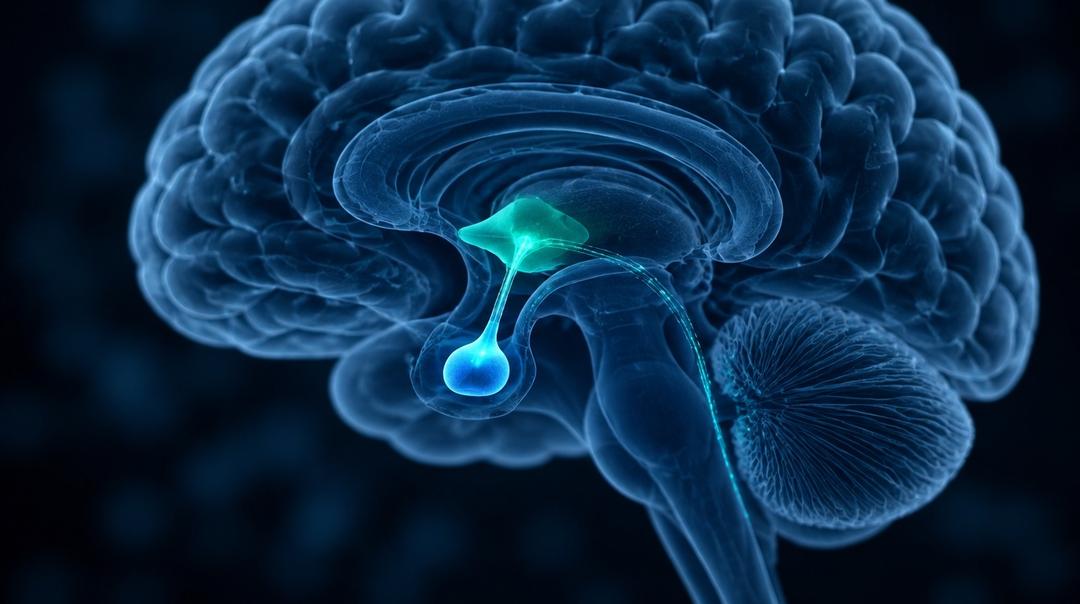
What is the HPG axis?
Each level of the axis is a gland that releases a hormone to act on the next level:
| Level | Signal released | Acts on | What it controls |
|---|---|---|---|
| Hypothalamic kisspeptin neurons | Kisspeptin | GnRH neurons, through KISS1R | Whether and how often GnRH is released |
| Hypothalamus | GnRH, in pulses | Pituitary gonadotroph cells | LH and FSH release |
| Anterior pituitary | LH and FSH | Testes or ovaries | Sex-steroid production and gamete development |
| Gonads | Testosterone, oestradiol, progesterone and others | Hypothalamus and pituitary | Negative feedback, and positive feedback at the mid-cycle surge |
Feedback is what turns the chain into a loop. Rising sex steroids normally slow the levels above them. That is why measuring one hormone alone is hard to interpret. A low testosterone with high LH points to a problem in the gonad. A low testosterone with low or "normal" LH points upward, to the pituitary or hypothalamus.
Why does GnRH have to be pulsed?
The most important fact about the axis is that the pituitary responds to a pattern of GnRH, not to an amount.
Knobil's group showed it directly in rhesus monkeys whose hypothalamic lesions had stopped gonadotropin release. A constant supply of GnRH failed to restore sustained LH and FSH secretion. The same hormone given intermittently, at the animals' natural pulse frequency, did restore it. Switching animals from the intermittent to the constant pattern then produced what the authors called "desensitization" or "down regulation" of the pituitary response (Belchetz and colleagues, PMID 100883). The effect depended on the pattern of exposure "rather than to the amounts of this hormone."
This principle runs through everything that follows. A constant GnRH signal shuts the axis down, and a pulsed one keeps it running. The same applies to agonists acting further up the chain, which is why sustained exposure appears as a recurring problem in kisspeptin research. The general receptor mechanisms of desensitisation are covered in how peptide receptor signalling is studied.
What do LH pulses look like in people?
Because GnRH is released into a small portal blood system between the hypothalamus and pituitary, it cannot practically be sampled in people. LH, released in step with it, is the readout.
Santen and Bardin set out the method in 1973. They sampled blood frequently and quantified each LH pulse's amplitude, frequency and shape. In normal men and in women in the follicular phase they found pulse amplitudes of 39–179% from trough to peak, at 2.7–3.9 pulses per six hours (PMID 4729055). Their practical finding still governs how the axis is measured. A single LH sample carried 95% confidence limits of plus or minus 50–90%, and multiple samples over six hours narrowed that to plus or minus 12%. Some patients with abnormal LH secretion had single values that fell in the "normal range."
Filicori and colleagues then mapped the pattern across the menstrual cycle in 51 ovulatory cycles, sampling every ten minutes for 20–24 hours (PMID 3084534). The interval between LH pulses shortened from 94 minutes in the early follicular phase to 71 minutes in the late follicular phase, and lengthened through the luteal phase. Pulse frequency slowed during sleep at some cycle stages, and FSH pulses moved with LH pulses in 82% of studies.
What this means for reading research:
- A single LH or FSH value is a snapshot of a moving signal. Without frequent sampling, a change in pulse frequency cannot be told apart from a change in pulse size, or from chance timing.
- Sex and cycle phase change the baseline. A result in men, or in one phase of the cycle, cannot be assumed to hold in another.
- Pulse detection is itself an analysis choice. Pulses are identified by algorithms, and different algorithms can count differently, which is why Filicori's group ran two.
How was kisspeptin found to sit above GnRH?
The discovery came in an unexpected order, through cancer research, an orphan receptor and finally clinical genetics.
1996: a metastasis gene. Lee and colleagues isolated a cDNA they named KiSS-1 from melanoma cells whose ability to spread had been suppressed. Its expression was highest in placenta, and it was proposed as a metastasis-suppressor gene (PMID 8944003). Reproduction was not mentioned.
2001: the ligand of an orphan receptor. Kotani and colleagues purified peptides of 54, 14 and 13 amino acids from human placenta, all made from the KiSS-1 protein. They named them kisspeptins and showed that they activated GPR54, an orphan G protein-coupled receptor, at low nanomolar affinities (PMID 11457843). Ohtaki and colleagues reported the same pairing that year (PMID 11385580).
2003: puberty. Two groups found the reproductive role at nearly the same time. De Roux and colleagues studied a consanguineous family with five siblings who had isolated hypogonadotropic hypogonadism, meaning absent LH and FSH secretion and no pubertal development. All carried a homozygous 155-nucleotide deletion in GPR54 (PMID 12944565). Seminara and colleagues found GPR54 mutations in an affected family and an unrelated patient, and showed that mice lacking Gpr54 had hypogonadotropic hypogonadism while still responding to GnRH given to them (PMID 14573733). The axis below the receptor worked. The signal from above was missing.
2012: the ligand itself. Mutations in the ligand took longer to find. Topaloglu and colleagues described an inactivating KISS1 mutation in a large consanguineous family with failed pubertal progression (PMID 22335740). That made the case from both sides, since losing either the receptor or the peptide stops puberty.
What generates the pulse?
If GnRH must pulse, something has to set the rhythm. The leading account is a population of arcuate-nucleus neurons that make three signals: kisspeptin, neurokinin B and dynorphin. They are called KNDy neurons. In the original model, neurokinin B synchronises the population to fire together, dynorphin stops it, and each burst releases kisspeptin onto GnRH neurons. Moore and colleagues review evidence that this population is both necessary and sufficient for pulsatility, along with revisions such as the role of glutamate in synchronising the network and species differences in how dynorphin acts (PMID 38170643). Topaloglu's 2012 paper notes that mutations in neurokinin B and its receptor also cause pubertal failure (PMID 22335740).
On this view, kisspeptin is the output of the pulse generator rather than a hormone that simply raises LH. That is why kisspeptin research reports its results in terms of pulse frequency and amplitude, not just peak values.
What kisspeptin studies measure
When kisspeptin is given in human studies, the endpoints are almost always gonadotropins. George and colleagues reported that kisspeptin-10 raised serum LH in healthy men and increased LH pulse frequency, measured with deconvolution analysis of frequently sampled blood (PMID 21632807). That is a measurement of the axis being driven. It is not a fertility or hormonal outcome in anyone outside the study.
How the two common forms compare in half-life, potency and response across the menstrual cycle is set out in kisspeptin-10 vs kisspeptin-54, and the full human record for kisspeptin-10 in kisspeptin-10 research. Kisspeptin-10 and kisspeptin-54 are approved nowhere, for any use. Their evidence consists of human physiology studies and clinical research such as IVF trials (PMID 36147569), with no marketing authorisation.
Reading HPG-axis research
Look for the sampling design. A study that took one blood sample per condition cannot say anything about pulsatility, however it is written up.
Look for the duration. The Belchetz experiment is the reason. An acute rise in LH and a sustained one are different results, and sustained exposure to an agonist can reverse the direction of effect.
Look for who was studied. Healthy men, women at a defined cycle phase, and people with a specific diagnosis are three different populations. The broader point about populations and endpoints is in how to read a peptide study.
Nothing here is medical, dosing, or therapeutic guidance. For other receptor systems in this series, see melanocortin receptors explained and BDNF explained.
Supplied here for laboratory use: Kisspeptin-10. The laboratory's certificate for each lot is linked from its product page. For laboratory research use only.
Frequently asked questions
What does the HPG axis stand for? Hypothalamic–pituitary–gonadal axis. The hypothalamus releases GnRH, the pituitary responds with LH and FSH, and the testes or ovaries respond with sex steroids that feed back on the levels above. Kisspeptin neurons in the hypothalamus sit above GnRH and are now considered part of the axis's control system.
Why is GnRH released in pulses? Because the pituitary only keeps responding to an intermittent signal. In monkeys with hypothalamic lesions, a constant GnRH supply failed to restore LH and FSH secretion, while pulses at the natural frequency restored it, and switching from pulses to a constant supply desensitised the pituitary. The pattern, not the amount, carries the information.
How was kisspeptin linked to puberty? In 2003 two research groups independently found that loss-of-function mutations in GPR54, the kisspeptin receptor, cause hypogonadotropic hypogonadism, a failure to enter puberty. Mice lacking the receptor still responded to GnRH, which placed the defect above GnRH. A mutation in the kisspeptin gene itself was described in a family in 2012.
Why isn't one LH blood test enough? LH is released in pulses, so a single sample catches it at an arbitrary point in a rising or falling signal. Santen and Bardin found that one sample carried confidence limits of plus or minus 50–90%, narrowing to about 12% with multiple samples over six hours. Research on pulsatility needs frequent sampling, often every ten minutes.
Selected Research References
- Belchetz PE, Plant TM, Nakai Y, Keogh EJ, Knobil E. Hypophysial responses to continuous and intermittent delivery of hypopthalamic gonadotropin-releasing hormone. Science. 1978;202:631-633. pubmed.ncbi.nlm.nih.gov/100883
- Santen RJ, Bardin CW. Episodic luteinizing hormone secretion in man. Pulse analysis, clinical interpretation, physiologic mechanisms. Journal of Clinical Investigation. 1973;52:2617-2628. pubmed.ncbi.nlm.nih.gov/4729055
- Filicori M, Santoro N, Merriam GR, Crowley WF Jr. Characterization of the physiological pattern of episodic gonadotropin secretion throughout the human menstrual cycle. Journal of Clinical Endocrinology & Metabolism. 1986;62:1136-1144. pubmed.ncbi.nlm.nih.gov/3084534
- Lee JH, Miele ME, Hicks DJ, et al. KiSS-1, a novel human malignant melanoma metastasis-suppressor gene. Journal of the National Cancer Institute. 1996;88:1731-1737. pubmed.ncbi.nlm.nih.gov/8944003
- Kotani M, Detheux M, Vandenbogaerde A, et al. The metastasis suppressor gene KiSS-1 encodes kisspeptins, the natural ligands of the orphan G protein-coupled receptor GPR54. Journal of Biological Chemistry. 2001;276:34631-34636. pubmed.ncbi.nlm.nih.gov/11457843
- de Roux N, Genin E, Carel JC, Matsuda F, Chaussain JL, Milgrom E. Hypogonadotropic hypogonadism due to loss of function of the KiSS1-derived peptide receptor GPR54. Proceedings of the National Academy of Sciences of the USA. 2003;100:10972-10976. pubmed.ncbi.nlm.nih.gov/12944565
- Seminara SB, Messager S, Chatzidaki EE, et al. The GPR54 gene as a regulator of puberty. New England Journal of Medicine. 2003;349:1614-1627. pubmed.ncbi.nlm.nih.gov/14573733
- Topaloglu AK, Tello JA, Kotan LD, et al. Inactivating KISS1 mutation and hypogonadotropic hypogonadism. New England Journal of Medicine. 2012;366:629-635. pubmed.ncbi.nlm.nih.gov/22335740
- Moore AM, Novak AG, Lehman MN. KNDy Neurons of the Hypothalamus and Their Role in GnRH Pulse Generation: an Update. Endocrinology. 2023;165. pubmed.ncbi.nlm.nih.gov/38170643
- George JT, Veldhuis JD, Roseweir AK, et al. Kisspeptin-10 is a potent stimulator of LH and increases pulse frequency in men. Journal of Clinical Endocrinology & Metabolism. 2011;96:E1228-E1236. pubmed.ncbi.nlm.nih.gov/21632807
All products sold by NovaEvum are for research and laboratory use only. They are not intended for human or animal consumption, diagnosis, treatment, cure, or prevention of any disease.