
PT-141 and melanocortins
What Is PT-141? Bremelanotide, Vyleesi and the Melanocortin Record
EC
· 8 min read
A summary of published research, with citations. It states no amount, schedule or route, and makes no claim about what this compound does in a person. Supplied for laboratory research use only.
On this page · 6 sections
PT-141 is the development code for bremelanotide, a synthetic cyclic seven-residue analogue of alpha-melanocyte-stimulating hormone (alpha-MSH). It activates melanocortin receptors in the brain, chiefly MC4R and MC3R. Developed by Palatin Technologies, it was approved by the US FDA in 2019 as Vyleesi for acquired, generalised hypoactive sexual desire disorder in premenopausal women. That is its only approval. We found no Canadian authorisation, and it is a close chemical relative of the unapproved Melanotan II.
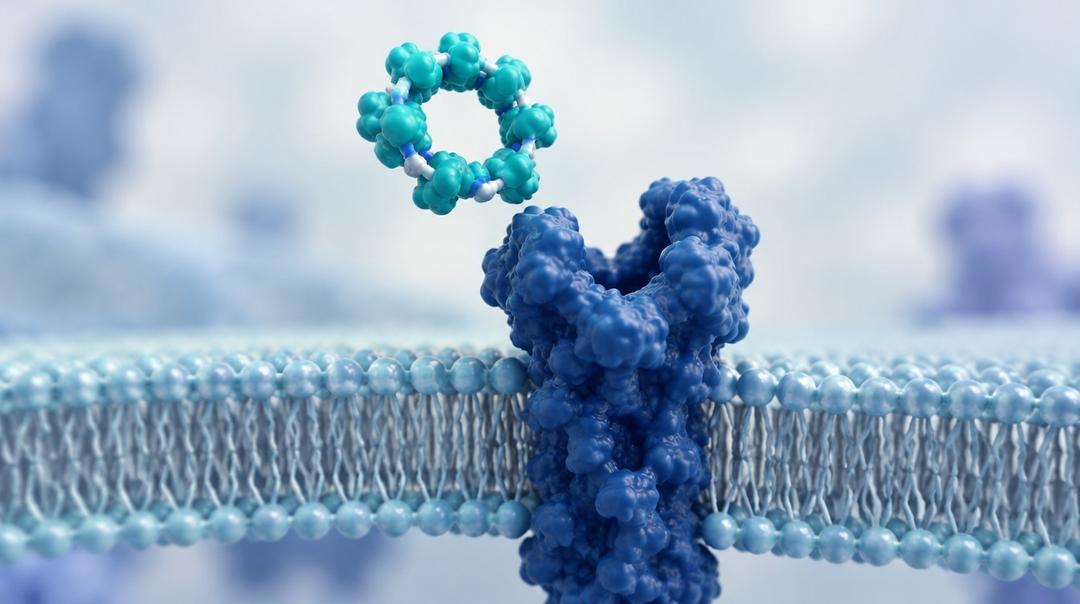
What is PT-141, chemically?
A ring of six residues with a capped tail. The sequence is Ac-Nle-cyclo[Asp-His-D-Phe-Arg-Trp-Lys]-OH: an acetylated norleucine, then a ring closed by a lactam bond between the side chains of aspartic acid and lysine, ending in a free carboxylic acid. Inside the ring is His-D-Phe-Arg-Trp, a version of the His-Phe-Arg-Trp core shared by the natural melanocortin peptides. A D-amino acid and a ring are two standard ways of making a peptide harder for enzymes to digest; why rings behave that way is explained in cyclic peptides explained.
| Property | PT-141 (bremelanotide) |
|---|---|
| Sequence | Ac-Nle-cyclo[Asp-His-D-Phe-Arg-Trp-Lys]-OH |
| CAS number (PubChem) | 189691-06-3 |
| Molecular formula (PubChem) | C50H68N14O10 |
| Molecular weight (PubChem) | About 1,025 g/mol |
| Brand name | Vyleesi (United States) |
| Class | Melanocortin receptor agonist; alpha-MSH analogue |
| Evidence stage | Human: two phase 3 trials, a programme of about 3,500 participants |
| Regulatory status | FDA-approved for one indication in 2019; no Canadian authorisation found |
The nearest relative is Melanotan II. PubChem gives its formula as C50H69N15O9, which is PT-141's formula with the C-terminal acid replaced by an amide. The two are often treated as interchangeable. They are not, either in regulatory position or in the safety record each carries; the comparison is set out in PT-141 vs Melanotan II.
How does PT-141 work?
It acts in the brain, not on blood vessels. That is the basic difference from erectile dysfunction drugs such as sildenafil, which act on smooth muscle in the penis.
Molinoff and colleagues describe PT-141 as an agonist at melanocortin receptors including MC3R and MC4R, which are expressed mainly in the central nervous system (PMID 12851303). In rats, giving it activated neurons in the hypothalamus, measured by c-Fos staining, in the same region that tracer studies connect to the penis. The case for MC4R specifically came partly from Merck: Van der Ploeg and colleagues showed that a selective MC4R agonist augmented erectile responses in normal mice but not in mice lacking the receptor, and that copulatory behaviour was reduced in mice without MC4R (PMID 12172010).
The finding that redirected development came from female rats. Pfaus and colleagues reported that PT-141 increased solicitational behaviour, the appetitive part of sexual behaviour, without changing lordosis, pacing, general motor activity or the reward value of sex (PMID 15226502). A drug that acted on desire rather than on a reflex was something the field had not seen in that model, and it is the line of evidence the eventual approval descends from.
The five melanocortin receptors, and what else acts at them, are mapped in melanocortin receptors explained.
What was PT-141 studied for?
Male erectile dysfunction, first. Early studies in healthy men and men with erectile dysfunction reported a rapid rise in erectile activity across the doses studied (PMID 12851303). That programme did not lead to an approval.
Female sexual desire, then. Two identical phase 3 trials, RECONNECT (NCT02333071 and NCT02338960), randomised 1,267 premenopausal women with hypoactive sexual desire disorder to bremelanotide or placebo for 24 weeks (PMID 31599840). Women on bremelanotide had statistically significant increases in the desire score of the Female Sexual Function Index and reductions in distress about low desire, compared with placebo. Nausea, flushing and headache were more common with the drug.
The size of the effect deserves the same attention as its significance. On the integrated analysis, the desire score rose by 0.35 points more than placebo on its scale. A review written after approval concluded that the trials met statistical significance but that "the clinical benefit may only be modest" (PMID 31893927). How a statistically significant result can still be small is the subject of how to read a peptide study.
Safety across the programme. A pooled review covered about 3,500 participants in 43 completed studies (PMID 35147466). In the double-blind phase 3 data, nausea affected 40.0% on bremelanotide against 1.3% on placebo, flushing 20.3% against 1.3%, and headache 11.3% against 1.9%; nausea was the most common reason for stopping. Blood pressure rose slightly and transiently. Focal skin darkening was rare under label conditions but affected more than a third of participants in a study of prolonged exposure on consecutive days, which fits the role of the melanocortin system in pigmentation.
Other directions. ClinicalTrials.gov lists a completed phase 3 bridging trial in Korea (NCT04943068), a completed phase 2b study in diabetic kidney disease (NCT05709444), and a Palatin phase 2 study combining bremelanotide with tirzepatide in obesity (NCT06565611), registered as active but not recruiting. None of these is an approval, and we found no peer-reviewed results for the last two.
The clinical record in order, and the preclinical work behind it, is in PT-141 and the melanocortin receptors.
Is PT-141 approved in Canada?
No Canadian authorisation was found. Bremelanotide's approval is from the FDA, in 2019, as Vyleesi, for acquired, generalised hypoactive sexual desire disorder in premenopausal women (PMID 31429064). Palatin sponsored the phase 3 trials and licensed North American rights to AMAG Pharmaceuticals, which filed the application. We found no EMA approval either. Health Canada's Drug Product Database is the authoritative place to confirm current status.
Bremelanotide is not among the examples named in Health Canada's April 2026 advisory on unauthorized peptides, which does name Melanotan I and II. That is not an authorisation: the advisory says many other unauthorized peptides exist and should be avoided. The Canadian picture for the related compound is in Melanotan II in Canada.
What is PT-141 commonly confused with?
Melanotan II. One chemical group apart, with an approval on one side and none on the other.
Erectile dysfunction drugs. PT-141 acts on brain receptors, not on the vascular pathway that sildenafil targets.
Alpha-MSH itself. The natural hormone is a linear peptide. PT-141 is a cyclic, modified analogue of it, and results for one do not describe the other.
Kisspeptin. Another peptide studied in sexual and reproductive signalling, but it acts at a different receptor, KISS1R, above the hormone axis that controls the gonads, and holds no approval; see what is kisspeptin-10.
Supplied here for laboratory use: PT-141. The laboratory's certificate for each lot is linked from its product page. For laboratory research use only.
The trial results above describe Vyleesi, a licensed medicine, in the women enrolled. They are not evidence about any laboratory reagent. Nothing here is medical, dosing, or therapeutic guidance.
Frequently asked questions
Are PT-141 and bremelanotide the same thing? They name the same molecule. PT-141 was Palatin Technologies' development code; bremelanotide is the international nonproprietary name; Vyleesi is the brand of the approved US product. Research material labelled PT-141 shares the sequence but is not Vyleesi, which is a manufactured medicine approved for one indication.
Which receptor does PT-141 act on? It is an agonist at several melanocortin receptors, with MC4R and MC3R the ones most associated with its central effects. MC4R is expressed in the hypothalamus and spinal pathways linked to sexual function. The skin darkening reported with prolonged exposure fits the melanocortin system's role in pigmentation.
How big was the effect in the phase 3 trials? Statistically significant but modest. In the integrated RECONNECT analysis, the desire score rose by 0.35 points more than with placebo, and distress about low desire fell by 0.33 points more. A post-approval review judged the clinical benefit may only be modest, while nausea affected about four in ten women on the drug.
Why was PT-141 first studied in men? Early work grew out of the observation that melanocortin agonists produced erections in animals, and a 1998 crossover study reported the same for Melanotan II in men with psychogenic erectile dysfunction (PMID 9679884). PT-141's first human studies measured erectile activity. The programme later shifted to women after rat experiments showed it affected appetitive sexual behaviour, and the approval came from the women's trials.
Selected Research References
- Molinoff PB, Shadiack AM, Earle D, Diamond LE, Quon CY. PT-141: a melanocortin agonist for the treatment of sexual dysfunction. Annals of the New York Academy of Sciences. 2003;994:96-102. pubmed.ncbi.nlm.nih.gov/12851303
- Van der Ploeg LH, Martin WJ, Howard AD, et al. A role for the melanocortin 4 receptor in sexual function. Proceedings of the National Academy of Sciences of the USA. 2002;99(17):11381-11386. pubmed.ncbi.nlm.nih.gov/12172010
- Pfaus JG, Shadiack A, Van Soest T, Tse M, Molinoff P. Selective facilitation of sexual solicitation in the female rat by a melanocortin receptor agonist. Proceedings of the National Academy of Sciences of the USA. 2004;101(27):10201-10204. pubmed.ncbi.nlm.nih.gov/15226502
- Kingsberg SA, Clayton AH, Portman D, et al. Bremelanotide for the treatment of hypoactive sexual desire disorder: two randomized phase 3 trials. Obstetrics & Gynecology. 2019;134(5):899-908. pubmed.ncbi.nlm.nih.gov/31599840
- Dhillon S, Keam SJ. Bremelanotide: first approval. Drugs. 2019;79(14):1599-1606. pubmed.ncbi.nlm.nih.gov/31429064
- Mayer D, Lynch SE. Bremelanotide: new drug approved for treating hypoactive sexual desire disorder. Annals of Pharmacotherapy. 2020;54(7):684-690. pubmed.ncbi.nlm.nih.gov/31893927
- Wessells H, Fuciarelli K, Hansen J, et al. Synthetic melanotropic peptide initiates erections in men with psychogenic erectile dysfunction: double-blind, placebo controlled crossover study. Journal of Urology. 1998;160(2):389-393. pubmed.ncbi.nlm.nih.gov/9679884
- Clayton AH, Kingsberg SA, Portman D, et al. Safety profile of bremelanotide across the clinical development program. Journal of Women's Health. 2022;31(2):171-182. pubmed.ncbi.nlm.nih.gov/35147466
All products sold by NovaEvum are for research and laboratory use only. They are not intended for human or animal consumption, diagnosis, treatment, cure, or prevention of any disease.