
GLP-1 and metabolic
Amylin receptors explained: the calcitonin receptor, RAMPs and AMY1 to AMY3
AM
· 9 min read
A summary of published research, with citations. It states no amount, schedule or route, and makes no claim about what this compound does in a person. Supplied for laboratory research use only.
On this page · 9 sections
- What is amylin?
- How do RAMPs create a receptor?
- AMY1, AMY2 and AMY3 at a glance
- Why AMY1 overlaps with migraine pharmacology
- What does the receptor structure show?
- Which compounds act at amylin receptors?
- Why selectivity in this family is hard to read
- How amylin sits beside the incretins
- Frequently asked questions
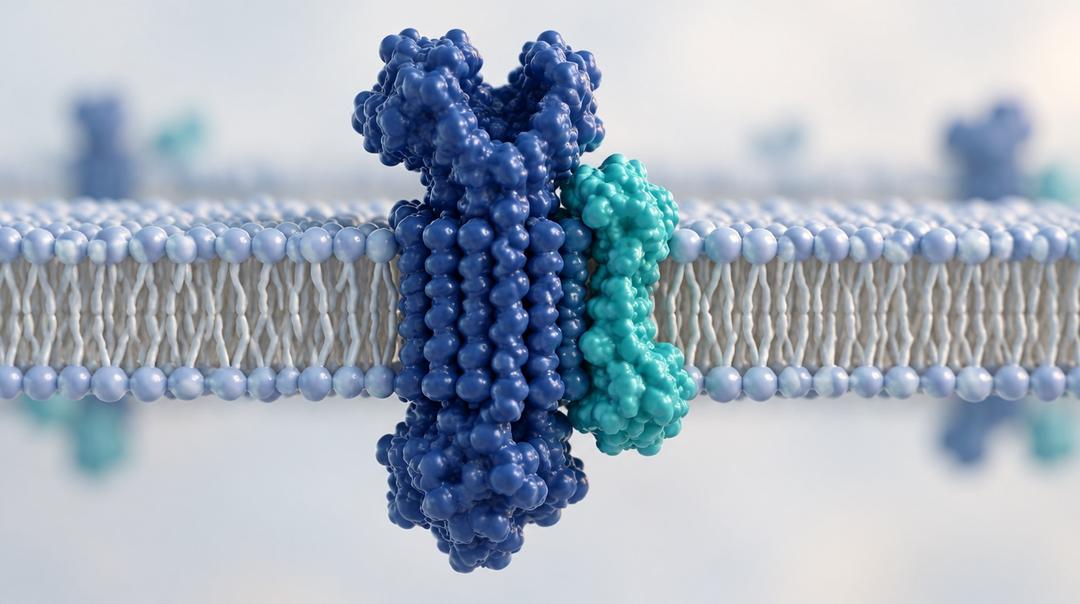
An amylin receptor is not a single protein. It forms when the calcitonin receptor, a G protein-coupled receptor, pairs with one of three receptor activity-modifying proteins, RAMP1, RAMP2 or RAMP3. The pairs are named AMY1, AMY2 and AMY3. The calcitonin receptor on its own is a fourth, related target. Whether a compound engages all of these or favours one is what separates the amylin analogues now in development. Pramlintide is approved in the United States, while cagrilintide and eloralintide remain investigational.
What is amylin?
Amylin is a 37-amino-acid peptide hormone made by the insulin-producing beta cells of the pancreas. It was first characterised from an unusual source. Cooper and colleagues purified it from the amyloid deposits in the pancreases of people with type 2 diabetes and found it was 46% identical to calcitonin gene-related peptide (CGRP), which suggested an evolutionary relationship (PMID 3317417). That relationship is the key to its receptors.
Amylin's tendency to form amyloid fibrils is also why native human amylin has never been a practical drug. The analogue chemistry that grew out of that problem, from pramlintide to cagrilintide, is covered in cagrilintide and amylin. This page is about the receptor end.
How do RAMPs create a receptor?
RAMPs were discovered through a different receptor. In 1998 McLatchie and colleagues showed that one seven-transmembrane protein, the calcitonin-receptor-like receptor (CLR), could act as either a CGRP receptor or an adrenomedullin receptor, depending on which small single-pass partner protein was present. They called these partners receptor-activity-modifying proteins. RAMPs were needed to carry CLR to the cell surface, and RAMP1 produced a CGRP receptor while RAMP2 produced an adrenomedullin receptor (PMID 9620797).
The next year Christopoulos and colleagues asked whether RAMPs did the same to the calcitonin receptor (PMID 10385705). When they put RAMP1 or RAMP3 into cells alongside the human calcitonin receptor, specific amylin binding appeared. RAMP2, in their system, did not significantly increase it. The two new receptors behaved differently:
- The RAMP1-derived receptor bound salmon calcitonin most tightly, then rat amylin and human CGRP, and human calcitonin only weakly.
- The RAMP3-derived receptor bound amylin and the calcitonins similarly, but CGRP was markedly less effective at it.
Their conclusion still frames the field: the phenotype of a cell is "likely to be dynamic," depending on how much receptor and which RAMPs it makes.
AMY1, AMY2 and AMY3 at a glance
The International Union of Basic and Clinical Pharmacology now sets out the whole calcitonin family as two receptors and three RAMPs (Hay and colleagues, PMID 29059473):
| Receptor | Built from | Natural peptides it responds to |
|---|---|---|
| Calcitonin receptor (CTR) | CTR alone | Calcitonin |
| AMY1 | CTR + RAMP1 | Amylin and CGRP |
| AMY2 | CTR + RAMP2 | Amylin |
| AMY3 | CTR + RAMP3 | Amylin |
| CGRP receptor | CLR + RAMP1 | CGRP |
| AM1 and AM2 receptors | CLR + RAMP2 or RAMP3 | Adrenomedullin |
The same review is frank about how hard it is to study these receptors in vivo. The only antagonists widely available are peptides with limited selectivity. Tissues that make CTR-RAMP complexes probably also make free CTR. And CTR has splice variants that differ between species. Together, these mean a tissue's response to amylin cannot easily be assigned to one receptor.
Why AMY1 overlaps with migraine pharmacology
AMY1 and the CGRP receptor share RAMP1, and CGRP can act at both. Garelja and colleagues reviewed the receptor-blocking migraine drugs that target CGRP signalling. These drugs are most potent at the CGRP receptor but can also antagonise AMY1. The data needed to define their selectivity are incomplete, and what AMY1 antagonism means clinically is unknown (PMID 34076887). The practical point for reading research is that a CGRP-receptor tool is not automatically clean of amylin-receptor effects, and the reverse is also true.
What does the receptor structure show?
In 2022 Cao and colleagues solved cryo-electron microscopy structures of all three active amylin receptors bound to amylin. They also solved AMY1 and AMY2 bound to calcitonins, and the calcitonin receptor alone with each peptide (PMID 35324283). Amylin adopted a similar conformation at every amylin receptor. That conformation was constrained by the RAMP and by an ordered middle section of the peptide that the authors called the "bypass motif". When calcitonin-based peptides bound the same amylin receptors, they did so differently, in a way that resembled their binding at the calcitonin receptor.
The authors' conclusion matters for drug design. Activating an amylin receptor with a calcitonin-like peptide is a different molecular event from activating it with an amylin-like peptide. "Amylin agonist" covers more than one mechanism.
Which compounds act at amylin receptors?
| Compound | Receptor profile | Evidence stage | Regulatory status |
|---|---|---|---|
| Pramlintide | Amylin analogue | Approved medicine; a year-long randomised trial in type 1 diabetes (PMID 15498087) | Approved in the United States as an adjunct to insulin in insulin-requiring diabetes (PMID 29059473); Canadian authorisation not confirmed |
| Salmon calcitonin | Binds CTR and AMY1 with high affinity (PMID 10385705) | Long-used reference ligand in receptor studies | Discussed here only as a laboratory tool |
| Cagrilintide | Acts at amylin and calcitonin receptors; described as non-selective (PMID 41109426) | Phase 2 alone; phase 3 with semaglutide | Investigational; not approved as a stand-alone medicine |
| Eloralintide | AMY1-preferring in human receptor assays | Phase 1 and phase 2 | Investigational; approved nowhere |
Cagrilintide was developed by Novo Nordisk as a stable, lipidated, long-acting amylin analogue (PMID 34288673). The paper describing it emphasises stability and duration more than receptor selectivity. Its phase 3 programme paired it with semaglutide, covered in the REDEFINE trials.
Eloralintide was designed from the start around selectivity. In Briere and colleagues' discovery paper, it activated human AMY1 12-fold more potently than the calcitonin receptor and 11-fold more potently than AMY3 (PMID 41109426). In rat receptors the pattern was different: AMY1 and AMY3 were both activated more potently than the calcitonin receptor. In lean rats it produced significantly less conditioned taste avoidance, a rodent stand-in for nausea, than cagrilintide. The clinical results are in eloralintide's phase 2 data.
Why selectivity in this family is hard to read
Species change the answer. Eloralintide's human selectivity did not carry over intact to rat receptors. A rodent result for an "AMY1-selective" compound may therefore be a result at a different mix of receptors from the one the name implies.
The cell decides the receptor. Because a receptor is built from CTR plus whichever RAMP the cell makes, the same compound can meet a different receptor population in a different tissue. A selectivity ratio measured in engineered cell lines describes those cells.
Fold-selectivity is not exclusivity. A 12-fold preference still means the compound acts at the other receptors at higher concentrations. Whether that matters depends on exposure, which receptor assays do not measure. More on reading potency figures is in how peptide receptors work.
Taste avoidance is a proxy. A lower rodent taste-avoidance score is a measured behaviour in rats, not a demonstration of better tolerability in people. Only the human trials can test that.
How amylin sits beside the incretins
Amylin receptors are a separate system from the GLP-1, GIP and glucagon receptors that tirzepatide and retatrutide target. They are a different receptor class with a different natural hormone, from a different cell type. The reason amylin analogues are paired with GLP-1 agonists in trials is that the two act through different pathways. The incretin side is set out in how GLP-1, GIP and glucagon receptors differ. For other receptor systems in this series, see the ghrelin receptor explained and melanocortin receptors explained.
NovaEvum does not carry cagrilintide, eloralintide or pramlintide. Nothing here is medical, dosing, or therapeutic guidance.
Frequently asked questions
Is there one amylin receptor? No. There is no single amylin receptor gene. Amylin receptors form when the calcitonin receptor pairs with RAMP1, RAMP2 or RAMP3, giving AMY1, AMY2 and AMY3. The calcitonin receptor on its own responds to calcitonin. Which receptors a cell carries depends on which RAMPs it makes, so different tissues can respond to amylin through different combinations.
What does a RAMP actually do? RAMPs are small proteins that cross the membrane once and partner with a larger receptor. In the original 1998 work they were needed to move the CGRP-family receptor to the cell surface, and the RAMP chosen decided which peptide the receptor preferred. With the calcitonin receptor, RAMP1 or RAMP3 turned it into a receptor with high affinity for amylin.
Why does CGRP act at an amylin receptor? AMY1 is built with RAMP1, the same partner that makes the CGRP receptor, and amylin and CGRP are related peptides. In the 1999 study the RAMP1-based amylin receptor bound CGRP with moderate affinity. That overlap is why migraine drugs aimed at CGRP receptors have been examined for AMY1 activity too.
What makes eloralintide "selective"? In human receptor assays it activated AMY1 about 12-fold more potently than the calcitonin receptor and 11-fold more than AMY3. In rat receptors the pattern differed. Cagrilintide, by comparison, is described as acting at amylin and calcitonin receptors without that preference. Both compounds remain investigational.
Selected Research References
- Cooper GJ, Willis AC, Clark A, Turner RC, Sim RB, Reid KB. Purification and characterization of a peptide from amyloid-rich pancreases of type 2 diabetic patients. Proceedings of the National Academy of Sciences of the USA. 1987;84:8628-8632. pubmed.ncbi.nlm.nih.gov/3317417
- McLatchie LM, Fraser NJ, Main MJ, et al. RAMPs regulate the transport and ligand specificity of the calcitonin-receptor-like receptor. Nature. 1998;393:333-339. pubmed.ncbi.nlm.nih.gov/9620797
- Christopoulos G, Perry KJ, Morfis M, et al. Multiple amylin receptors arise from receptor activity-modifying protein interaction with the calcitonin receptor gene product. Molecular Pharmacology. 1999;56:235-242. pubmed.ncbi.nlm.nih.gov/10385705
- Hay DL, Garelja ML, Poyner DR, Walker CS. Update on the pharmacology of calcitonin/CGRP family of peptides: IUPHAR Review 25. British Journal of Pharmacology. 2018;175:3-17. pubmed.ncbi.nlm.nih.gov/29059473
- Cao J, Belousoff MJ, Liang YL, et al. A structural basis for amylin receptor phenotype. Science. 2022;375:eabm9609. pubmed.ncbi.nlm.nih.gov/35324283
- Garelja ML, Walker CS, Hay DL. CGRP receptor antagonists for migraine. Are they also AMY1 receptor antagonists? British Journal of Pharmacology. 2022;179:454-459. pubmed.ncbi.nlm.nih.gov/34076887
- Kruse T, Hansen JL, Dahl K, et al. Development of Cagrilintide, a Long-Acting Amylin Analogue. Journal of Medicinal Chemistry. 2021;64:11183-11194. pubmed.ncbi.nlm.nih.gov/34288673
- Briere DA, Qu H, Lansu K, et al. Eloralintide (LY3841136), a novel amylin receptor agonist for the treatment of obesity: From discovery to clinical proof of concept. Molecular Metabolism. 2025;102:102271. pubmed.ncbi.nlm.nih.gov/41109426
- Ratner RE, Dickey R, Fineman M, et al. Amylin replacement with pramlintide as an adjunct to insulin therapy improves long-term glycaemic and weight control in Type 1 diabetes mellitus: a 1-year, randomized controlled trial. Diabetic Medicine. 2004;21:1204-1212. pubmed.ncbi.nlm.nih.gov/15498087
All products sold by NovaEvum are for research and laboratory use only. They are not intended for human or animal consumption, diagnosis, treatment, cure, or prevention of any disease.