
GLP-1 and metabolic
CagriSema Results: What the REDEFINE and REIMAGINE Trials Showed
AM
· 9 min read
A summary of published research, with citations. It states no amount, schedule or route, and makes no claim about what this compound does in a person. Supplied for laboratory research use only.
On this page · 9 sections
CagriSema is Novo Nordisk's combination of cagrilintide, an amylin analogue, with semaglutide, a GLP-1 receptor agonist. In REDEFINE 1, in 3,417 adults with obesity and no diabetes, mean weight change at 68 weeks was −20.4% against −3.0% on placebo. In REDEFINE 2, in 1,206 adults with obesity and type 2 diabetes, it was −13.7% against −3.4%. Gastrointestinal events affected 72.5% to 79.6% of CagriSema recipients. CagriSema is investigational; its head-to-head trials against tirzepatide have not yet published.
What is CagriSema?
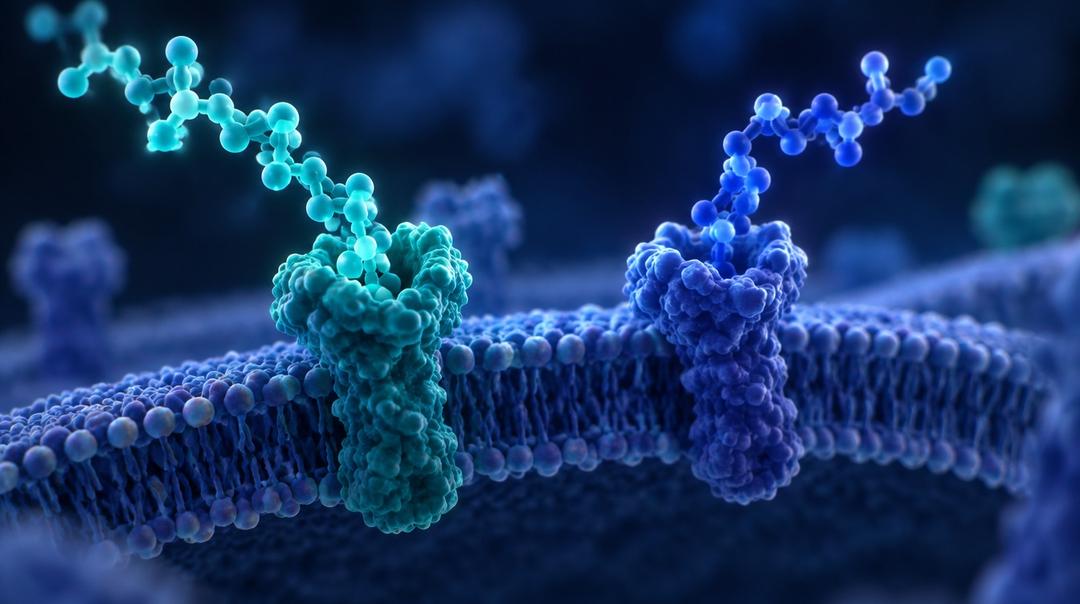
CagriSema is two separate peptides given together. It is not a single molecule. Semaglutide acts at the GLP-1 receptor, described in the receptor guide. Cagrilintide is a long-acting analogue of amylin, a pancreatic hormone released alongside insulin, and acts at amylin and calcitonin receptors, a different receptor family entirely. The cagrilintide article covers amylin biology, the receptor partnership behind it, and cagrilintide's own phase 1 and 2 trials.
The rationale is that two pathways which reduce food intake by different routes might add together. That is a hypothesis to be tested, and the useful trials are the ones that test it: those with single-component arms, where the combination is compared with each drug alone.
What did REDEFINE 1 test and find?
REDEFINE 1 was a phase 3a, 68-week, double-blind trial in adults without diabetes who had a BMI of 30 or more, or 27 or more with an obesity-related complication. It randomised 3,417 participants in a 21:3:3:7 ratio: 2,108 to CagriSema, 302 to semaglutide alone, 302 to cagrilintide alone and 705 to placebo. All groups also received lifestyle intervention. The coprimary endpoints were percent change in body weight and the share reaching at least 5% reduction, both for CagriSema against placebo. Results were analysed with a treatment-policy estimand, which counts everyone randomised regardless of whether they stayed on treatment.
Mean weight change was −20.4% with CagriSema and −3.0% with placebo, an estimated difference of −17.3 percentage points (95% CI −18.1 to −16.6). CagriSema recipients were more likely to reach every threshold tested, up to 30% weight reduction.
Look at the design, though, using the questions in the study design guide. The primary comparison is against placebo, not against semaglutide. The single-component arms were small by design, about 9% of participants each, and the abstract does not report their results. So the abstract alone cannot tell you how much cagrilintide added over semaglutide in this trial. That is the most important question about a combination product, and it has to be answered from the full paper or from pooled analyses.
What did REDEFINE 2 test and find?
REDEFINE 2 enrolled adults with type 2 diabetes, a BMI of 27 or more and HbA1c of 7% to 10%, in 12 countries. It randomised 1,206 participants 3:1 to CagriSema or placebo for 68 weeks, with lifestyle intervention. There were no single-component arms.
Mean weight change was −13.7% with CagriSema against −3.4% on placebo, a difference of −10.4 percentage points (95% CI −11.2 to −9.5). By the end, 73.5% of CagriSema recipients had an HbA1c of 6.5% or less, against 15.9% on placebo. As with other incretin drugs, weight reduction in people with diabetes was smaller than in people without.
What did the REIMAGINE diabetes trials add?
REIMAGINE is CagriSema's phase 3 programme in type 2 diabetes, with HbA1c as the primary endpoint.
REIMAGINE 1 randomised 189 people with early type 2 diabetes managed by diet and exercise alone, for 40 weeks. Using an efficacy estimand, HbA1c fell by 1.8 percentage points at the higher dose level and 1.5 at the lower, against 0.1 on placebo. Weight fell by 13.8% and 11.8% against 1.4%.
REIMAGINE 2 is the trial that tests the combination against its parts. It randomised 2,713 people with type 2 diabetes on metformin, with or without an SGLT2 inhibitor, in 30 countries, for 68 weeks. Arms included CagriSema at two dose levels, semaglutide alone at two levels, cagrilintide alone and placebo. The primary endpoint was HbA1c with CagriSema against semaglutide at the matching level. HbA1c fell by 1.91 percentage points with CagriSema and 1.75 with semaglutide, a difference of −0.16 points (95% CI −0.27 to −0.05). The difference was statistically significant and small in absolute terms. Adverse events were reported by 86.9% on CagriSema, 81.2% on semaglutide, 82.2% on cagrilintide and 70.5% on placebo.
| Trial | Population | Comparator | Duration | Primary result |
|---|---|---|---|---|
| REDEFINE 1 | Obesity, no diabetes; 3,417 | Placebo (plus single-component arms) | 68 weeks | Weight −20.4% vs −3.0% |
| REDEFINE 2 | Obesity with type 2 diabetes; 1,206 | Placebo | 68 weeks | Weight −13.7% vs −3.4% |
| REIMAGINE 1 | Early type 2 diabetes; 189 | Placebo | 40 weeks | HbA1c −1.8 vs −0.1 points |
| REIMAGINE 2 | Type 2 diabetes on metformin; 2,713 | Semaglutide, cagrilintide, placebo | 68 weeks | HbA1c −1.91 vs −1.75 points against semaglutide |
How much does cagrilintide add to semaglutide?
A 2026 meta-analysis by Rasool and colleagues pooled five trials, with 4,746 participants, that compared CagriSema with semaglutide alone or with placebo. Against semaglutide alone, CagriSema produced a further 6.89 percentage points of weight reduction (95% CI −8.70 to −5.06), and participants were about twice as likely to reach 20% weight reduction. The authors found no meaningful additional glycaemic benefit: the HbA1c difference was −0.07 points, with an interval inside their prespecified minimal important difference. That fits REIMAGINE 2, where the HbA1c gain was statistically clear but small.
So the current answer is that, in pooled data, adding cagrilintide makes a substantial difference to weight and very little to glucose. The meta-analysis authors also note that long-term durability, cardiovascular outcomes and body composition remain undetermined.
How well tolerated is CagriSema?
Gastrointestinal events dominated, as with every GLP-1-based drug. In REDEFINE 1 they affected 79.6% of CagriSema recipients against 39.9% on placebo: nausea, vomiting, diarrhoea, constipation or abdominal pain, mainly transient and mild to moderate. In REDEFINE 2, the figures were 72.5% against 34.4%.
Against semaglutide alone, the meta-analysis found gastrointestinal events were not significantly more frequent (RR 1.09, 95% CI 0.97 to 1.21). Local reactions at the administration site were about three times as frequent (RR 3.14). The authors judged the evidence insufficient to say whether serious adverse events or neoplasms differ. In other words, most of the gastrointestinal burden comes from the semaglutide component.
What has not been reported yet?
Head-to-head against tirzepatide. ClinicalTrials.gov lists a completed phase 3 trial comparing CagriSema with tirzepatide in obesity (NCT06131437), and two in type 2 diabetes (NCT06221969 and REIMAGINE 5, NCT06534411). No peer-reviewed results for any of them were found on PubMed by October 2026. Until they publish, setting CagriSema's numbers beside tirzepatide's means comparing across trials, a trap explained in the tirzepatide vs semaglutide article.
Cardiovascular outcomes. REDEFINE 3 has randomised 7,076 adults with established cardiovascular disease, 61% of them with type 2 diabetes, to CagriSema or placebo (NCT05669755). Its primary safety objective is noninferiority on major adverse cardiovascular events. The registry lists primary completion in 2027.
Body composition and long-term maintenance. The share of weight lost as lean mass is not reported in the REDEFINE abstracts. GLP-1 muscle loss and lean mass covers what other incretin substudies found. Registered long-term trials (NCT06780449, NCT07011667) have not reported.
Is CagriSema approved?
This article could not confirm any regulatory authorisation for CagriSema. In papers published as recently as mid-2026, its investigators still describe it as a potential therapy. Cagrilintide alone is not approved as a medicine anywhere. Semaglutide alone is authorised in Canada as Ozempic and Wegovy; why that authorisation attaches to a product rather than a molecule is covered in generic semaglutide in Canada. Health Canada's Drug Product Database is where any Canadian authorisation would appear, and regulatory positions in this field move quickly. The newer, selective amylin agonist in the same space is covered in eloralintide's phase 2 data, and the wider cross-class comparison in tirzepatide vs eloralintide vs mazdutide.
NovaEvum does not carry cagrilintide or semaglutide. The comparator in the head-to-head trials, tirzepatide, is supplied here as a laboratory reagent only. It is not the licensed medicine, and no trial result here describes it. Nothing here is medical, dosing, or therapeutic guidance.
Frequently asked questions
How much weight did people lose on CagriSema? In REDEFINE 1, adults with obesity and no diabetes had mean weight change of −20.4% at 68 weeks against −3.0% on placebo, counting everyone randomised. In REDEFINE 2, adults with obesity and type 2 diabetes had −13.7% against −3.4%. Results from different populations should not be averaged together.
Is CagriSema better than semaglutide alone? For weight, pooled trials suggest yes: a meta-analysis found about 6.9 percentage points more weight reduction than semaglutide alone. For blood glucose, the gain was small. In REIMAGINE 2, HbA1c fell 0.16 points more than with semaglutide, and the meta-analysis found no meaningful glycaemic difference overall.
Has CagriSema been compared with tirzepatide? Trials have been run but not published. ClinicalTrials.gov lists a completed head-to-head obesity trial and two type 2 diabetes trials comparing CagriSema with tirzepatide. No peer-reviewed results had appeared on PubMed by October 2026, so no reliable comparison can be made yet.
What are the side effects of CagriSema? Mainly gastrointestinal: nausea, vomiting, diarrhoea, constipation and abdominal pain, affecting about three-quarters of CagriSema recipients in REDEFINE 1 and 2. Most were transient and mild to moderate. Against semaglutide alone, gastrointestinal events were not clearly more frequent, but local administration-site reactions were about three times as common.
Is CagriSema approved in Canada? No Canadian authorisation could be confirmed for this article. Semaglutide alone is authorised in Canada, but CagriSema is a distinct combination product that needs its own review, and cagrilintide alone is approved nowhere. Health Canada's Drug Product Database is the place to check current status.
Selected Research References
- Garvey WT, Blüher M, Osorto Contreras CK, et al.; REDEFINE 1 Study Group. Coadministered Cagrilintide and Semaglutide in Adults with Overweight or Obesity. New England Journal of Medicine. 2025;393(7):635-647. pubmed.ncbi.nlm.nih.gov/40544433
- Davies MJ, Bajaj HS, Broholm C, et al.; REDEFINE 2 Study Group. Cagrilintide-Semaglutide in Adults with Overweight or Obesity and Type 2 Diabetes. New England Journal of Medicine. 2025;393(7):648-659. pubmed.ncbi.nlm.nih.gov/40544432
- Aroda VR, Buzzetti R, Dalskov SM, et al. Efficacy and safety of once-weekly cagrilintide-semaglutide (CagriSema) in adults with type 2 diabetes inadequately controlled on diet and exercise (REIMAGINE 1): a randomised, double-blind, placebo-controlled, phase 3a study. The Lancet Diabetes & Endocrinology. 2026;14(8):649-661. pubmed.ncbi.nlm.nih.gov/42251860
- Buse JB, Bajaj HS, Dalskov SM, et al.; REIMAGINE 2 study group. Cagrilintide-semaglutide (CagriSema) versus semaglutide or cagrilintide in people with type 2 diabetes (REIMAGINE 2): a double-blind, randomised, controlled, phase 3 study. The Lancet Diabetes & Endocrinology. 2026;14(8):662-677. pubmed.ncbi.nlm.nih.gov/42251859
- Rasool ZK, Shah R, Batool AEZ, et al. CagriSema versus Semaglutide 2.4 mg monotherapy for weight management in adults with overweight or obesity, with or without type 2 diabetes: a systematic review, meta-analysis, and trial sequential analysis. Frontiers in Endocrinology. 2026;17:1903335. pubmed.ncbi.nlm.nih.gov/42890523
- Cavender MA, Jastreboff AM, Cheng AYY, et al. Design and baseline characteristics of the CagriSema cardiovascular outcomes trial (REDEFINE 3). American Heart Journal. 2026:107626. pubmed.ncbi.nlm.nih.gov/42838477
All products sold by NovaEvum are for research and laboratory use only. They are not intended for human or animal consumption, diagnosis, treatment, cure, or prevention of any disease.