
Growth hormone peptides
What Is CJC-1295? DAC, No DAC and Which Molecule the Papers Studied
EC
· 9 min read
A summary of published research, with citations. It states no amount, schedule or route, and makes no claim about what this compound does in a person. Supplied for laboratory research use only.
On this page · 7 sections
CJC-1295 is a synthetic analogue of growth hormone-releasing hormone (GHRH), built from its first 29 amino acids with four substitutions. The name covers two molecules. ConjuChem's original CJC-1295 carries a reactive linker, the "DAC", that binds it to blood albumin, giving a half-life of about a week in people. The version usually sold as CJC-1295 lacks that linker and lasts minutes. Every published human study used the DAC form. Neither form is approved anywhere.
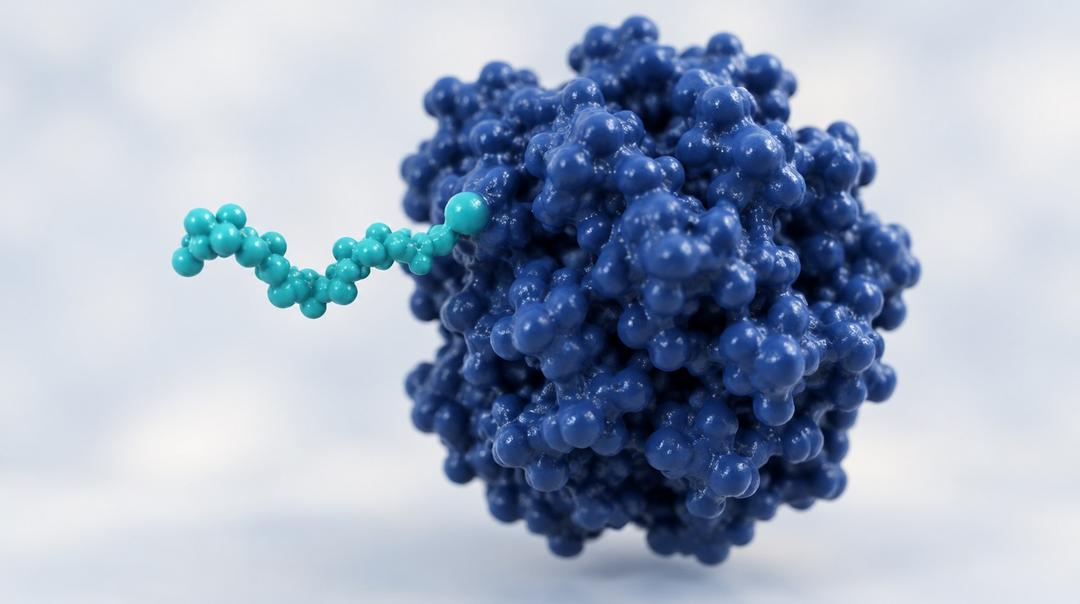
Why does the name cover two molecules?
Because the research-chemical market kept the name after removing the part that defined it. ConjuChem, a Montreal company, designed CJC-1295 as a bioconjugate. Jetté and colleagues describe it as a tetrasubstituted form of GRF(1-29) with an added lysine at the C-terminus carrying a maleimidopropionamide group (PMID 15817669). In circulation that group bonds covalently to the free thiol on cysteine 34 of serum albumin, so the peptide rides on a large, long-lived carrier protein instead of being cleared within minutes.
The same 29-residue backbone without the extra lysine and its reactive group is what most suppliers sell under the name. It is also called "CJC-1295 without DAC" or "modified GRF(1-29)". It is a stabilised GHRH fragment with a short half-life, and it was never the subject of ConjuChem's clinical programme.
| CJC-1295 with DAC | CJC-1295 without DAC (modified GRF 1-29) | |
|---|---|---|
| Length | 29 residues plus a modified C-terminal lysine | 29 residues, C-terminal amide |
| Albumin-binding linker | Yes, maleimidopropionamide on the added lysine | No |
| Molecular formula (PubChem) | C165H269N47O46 | C152H252N44O42 |
| Molecular weight (PubChem) | About 3,647 g/mol | About 3,368 g/mol |
| CAS number (PubChem) | 446262-90-4 | 863288-34-0 |
| Half-life reported | 5.8 to 8.1 days in healthy adults | Not established in a published human study |
| Human studies | Yes, from ConjuChem's programme | None found |
| Regulatory status | Approved nowhere | Approved nowhere |
The two molecules differ by roughly 280 mass units, which mass spectrometry separates without difficulty. That makes the table a practical tool: a certificate whose measured mass sits near 3,368 describes the no-DAC peptide, whatever the label says. Both CAS numbers appear against the bare name "CJC-1295" in public chemical databases, so a CAS number on its own does not settle which molecule is meant. How to read the rest of a certificate is in what a certificate of analysis establishes.
What are the four substitutions?
Comparing the published sequence with sermorelin, which is native GHRH(1-29), gives four changes: D-alanine at position 2, glutamine at 8, alanine at 15 and leucine at 27. The position-2 change sits at the bond between residues 2 and 3, which dipeptidyl peptidase-4 cuts to inactivate native GHRH, and Jetté and colleagues report that their conjugates were more stable against that enzyme. Alanine at 15 and leucine at 27 were already part of an analogue series that Upjohn chemists built in the early 1990s while stabilising GRF against the same enzyme (Kubiak and colleagues, PMID 8464043).
Those four changes are common to both forms. The DAC is the only structural difference between them, and it is responsible for the entire long-acting pharmacology. Sermorelin, the unmodified fragment that once held an approval, is compared with both in sermorelin vs CJC-1295, and the wider GHRH family is covered in sermorelin and the GHRH pathway.
How is CJC-1295 thought to work?
Both forms are GHRH-receptor agonists. They act on the pituitary cells that make growth hormone, prompting release of the body's own hormone, and IGF-I rises downstream, mostly from the liver. They do not act at the ghrelin receptor, which is where ipamorelin works. The two-receptor map is in growth hormone secretagogues explained.
The difference between the forms is not strength but exposure. A peptide that lasts minutes produces a brief pulse of receptor activation. A peptide carried on albumin for days keeps the receptor stimulated continuously. Those are different pharmacological situations, and the question of what continuous stimulation does to the normally pulsatile pattern of growth hormone secretion is exactly what one of the human studies set out to test.
What did the research on CJC-1295 examine?
Animal work, DAC form. In rats, the DAC conjugate was detectable in plasma beyond 72 hours, with an immunoreactive band at the size of albumin appearing within 15 minutes and persisting beyond 24 hours. Over a two-hour window, it produced four times the growth hormone exposure of unmodified GRF(1-29) (PMID 15817669). In mice lacking the GHRH gene, CJC-1295 normalised growth when given often enough, and less frequent exposure did not fully do so (Alba and colleagues, 2006).
Human work, DAC form. Teichman and colleagues ran two randomised, placebo-controlled, double-blind, ascending-exposure trials in healthy adults aged 21 to 61, lasting 28 and 49 days (PMID 16352683). After a single administration, mean growth hormone rose 2- to 10-fold for six days or more and IGF-I rose 1.5- to 3-fold for 9 to 11 days. The estimated half-life was 5.8 to 8.1 days, and no serious adverse reactions were reported.
Ionescu and Frohman then sampled growth hormone every 20 minutes overnight in healthy young men before and one week after a single administration (PMID 17018654). Pulse frequency and size were unchanged. What rose was the trough: basal growth hormone between pulses went up 7.5-fold, mean growth hormone by 46% and IGF-I by 45%, and the IGF-I rise did not correlate with any single measure of growth hormone secretion. A proteomic study from the same programme looked for new serum markers in 11 men after exposure (PMID 19386527).
ConjuChem's next step was a phase 2 trial in people with HIV and visceral fat accumulation, registered as NCT00267527. It started in December 2005 and is listed as terminated in September 2006. The registry gives no reason, and we found no published results. The GHRH analogue that did complete a programme in that population was tesamorelin; see what is tesamorelin.
Human work, no-DAC form. None that we could find. Claims about it borrow the DAC papers, which describe a molecule engineered to circulate for days.
Forensic work. The name also has a doping-control literature. In 2009 the Norwegian doping control laboratory analysed a seized preparation and found a 29-residue peptide with a C-terminal amide, consistent with the peptide then marketed as CJC-1295 (PMID 21204297). A 29-residue amidated peptide is the no-DAC shape, which is an early documented case of the name being attached to the short-acting molecule.
Is CJC-1295 approved anywhere?
No, in either form. ConjuChem's programme did not reach registration, and neither molecule has authorisation from Health Canada, the FDA or the EMA. Health Canada's public advisory of 9 April 2026 on unauthorized peptides bought online names CJC-1295 among its examples. GHRH and its analogues are a named class on the World Anti-Doping Agency's prohibited list; see peptides banned in sport.
What is CJC-1295 commonly confused with?
Its other form. The central confusion. A half-life of days and a half-life of minutes are not two strengths of one drug.
Ipamorelin. Usually paired with CJC-1295, but it acts at the ghrelin receptor, not the GHRH receptor. No published study has examined the combination. The pairing is discussed in CJC-1295 and ipamorelin.
Sermorelin and tesamorelin. Both GHRH-receptor agonists, both different molecules: sermorelin is the unmodified 29-residue fragment, tesamorelin is the full 44-residue hormone with a modified first residue.
Growth hormone. CJC-1295 is a releasing-hormone analogue. It depends on a working pituitary and contains no growth hormone.
Supplied here for laboratory use: CJC-1295 / Ipamorelin Blend. The laboratory's certificate for each lot is linked from its product page. For laboratory research use only.
The catalogue lists the CJC-1295 in that blend as the no-DAC form, which is the form the published human studies did not use. The results above describe the compound in the animals and people studied, not any laboratory reagent. Nothing here is medical, dosing, or therapeutic guidance.
Frequently asked questions
What is the DAC in CJC-1295? It is the label used for the reactive maleimidopropionamide group that ConjuChem attached to an added lysine at the peptide's end. In the blood that group bonds covalently to albumin, so the peptide circulates for days rather than minutes. Without it, the remaining molecule is a stabilised GRF(1-29) fragment with none of that long-acting pharmacology.
Is modified GRF(1-29) the same as CJC-1295? It is the same backbone as CJC-1295, with the same four amino-acid substitutions, but without the albumin-binding group. Suppliers sell it as "CJC-1295 without DAC". ConjuChem's clinical papers describe the DAC version, and their half-life and hormone data do not apply to the shorter-acting molecule.
How long does CJC-1295 last in the body? For the DAC form, Teichman and colleagues estimated a half-life of 5.8 to 8.1 days in healthy adults, with growth hormone raised for six days or more after one administration. No published human study reports a half-life for the no-DAC form. Native GHRH's short half-life is the limitation the DAC was designed to overcome.
Why did ConjuChem stop developing CJC-1295? The public record does not say. Its phase 2 trial in HIV-associated visceral fat is listed on ClinicalTrials.gov as terminated in 2006, with no reason given and no results posted. We found no peer-reviewed publication explaining the decision, so any specific explanation would be speculation.
Can a certificate tell me which CJC-1295 I have? Yes, if it includes mass spectrometry. The DAC form weighs about 3,647 and the no-DAC form about 3,368 mass units, a gap a mass spectrometer resolves easily. A purity figure from chromatography alone cannot tell the two apart, because it measures how much of one thing is present, not which thing it is.
Selected Research References
- Jetté L, Léger R, Thibaudeau K, et al. Human growth hormone-releasing factor (hGRF)1-29-albumin bioconjugates activate the GRF receptor on the anterior pituitary in rats: identification of CJC-1295 as a long-lasting GRF analog. Endocrinology. 2005;146(7):3052-3058. pubmed.ncbi.nlm.nih.gov/15817669
- Teichman SL, Neale A, Lawrence B, et al. Prolonged stimulation of growth hormone (GH) and insulin-like growth factor I secretion by CJC-1295, a long-acting analog of GH-releasing hormone, in healthy adults. Journal of Clinical Endocrinology & Metabolism. 2006;91(3):799-805. pubmed.ncbi.nlm.nih.gov/16352683
- Ionescu M, Frohman LA. Pulsatile secretion of growth hormone (GH) persists during continuous stimulation by CJC-1295, a long-acting GH-releasing hormone analog. Journal of Clinical Endocrinology & Metabolism. 2006;91(12):4792-4797. pubmed.ncbi.nlm.nih.gov/17018654
- Alba M, Fintini D, Sagazio A, et al. Once-daily administration of CJC-1295, a long-acting growth hormone-releasing hormone (GHRH) analog, normalizes growth in the GHRH knockout mouse. American Journal of Physiology: Endocrinology and Metabolism. 2006;291(6):E1290-E1294. pubmed.ncbi.nlm.nih.gov/16822960
- Sackmann-Sala L, Ding J, Frohman LA, Kopchick JJ. Activation of the GH/IGF-1 axis by CJC-1295, a long-acting GHRH analog, results in serum protein profile changes in normal adult subjects. Growth Hormone & IGF Research. 2009;19(6):471-477. pubmed.ncbi.nlm.nih.gov/19386527
- Kubiak TM, Friedman AR, Martin RA, et al. Position 2 and position 2/Ala15-substituted analogs of bovine growth hormone-releasing factor (bGRF) with enhanced metabolic stability and improved in vivo bioactivity. Journal of Medicinal Chemistry. 1993;36(7):888-897. pubmed.ncbi.nlm.nih.gov/8464043
- Henninge J, Pepaj M, Hullstein I, Hemmersbach P. Identification of CJC-1295, a growth-hormone-releasing peptide, in an unknown pharmaceutical preparation. Drug Testing and Analysis. 2010;2(11-12):647-650. pubmed.ncbi.nlm.nih.gov/21204297
All products sold by NovaEvum are for research and laboratory use only. They are not intended for human or animal consumption, diagnosis, treatment, cure, or prevention of any disease.