
A summary of published research, with citations. It states no amount, schedule or route, and makes no claim about what this compound does in a person. Supplied for laboratory research use only.
On this page · 13 sections
- Understanding mitochondrial function
- What are mitochondrial-derived peptides?
- MOTS-c: a peptide encoded by mitochondrial DNA
- October 2026: a new MOTS-c research direction
- Understanding SS-31
- Why cardiolipin matters
- SS-31 and Barth syndrome
- October 2026: developments in mitochondrial medicine
- MOTS-c versus SS-31
- The NovaEvum perspective
- Future directions in mitochondrial research
- Frequently asked questions
- Further reading
Mitochondria are among the most studied organelles in modern cell biology. Long known for producing the cell's energy, they are now recognized as part of a wider network of metabolic and signalling processes: they shape how cells respond to stress, take part in metabolic regulation, and interact with pathways involved in tissue function and disease. As that picture has grown, so has interest in molecules tied to mitochondrial signalling and membrane function. Two prominent examples are MOTS-c and SS-31, also known as elamipretide. Both appear in the mitochondrial literature, but they are different in structure, in mechanism and in how far their evidence has come, and publications from October 2026 show how varied the field has become.
Understanding mitochondrial function
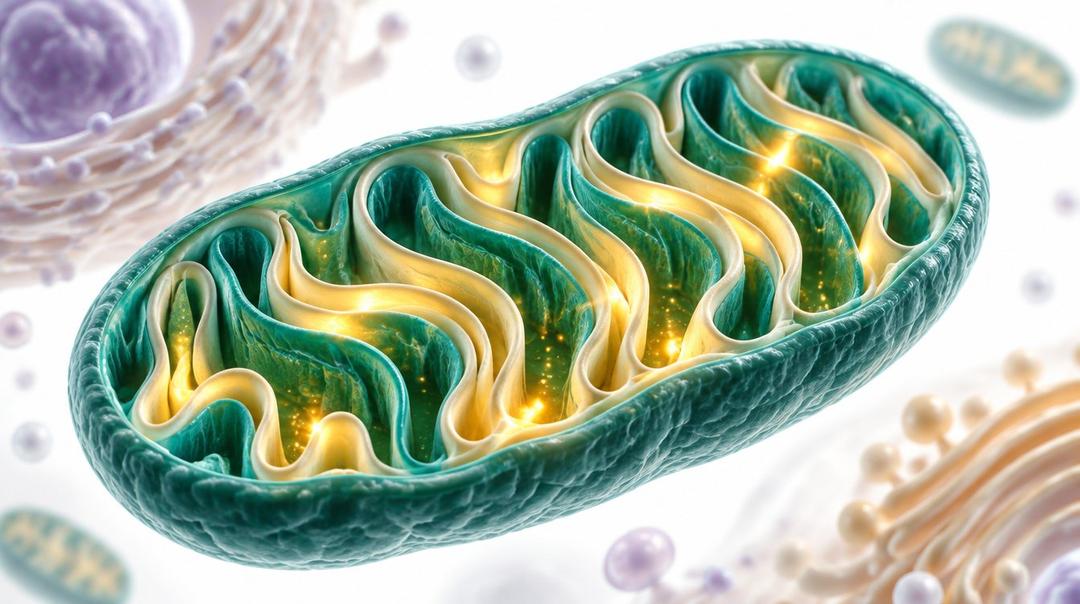
Mitochondria have two membranes. The outer membrane separates the organelle from the cytoplasm; the inner membrane holds the protein complexes of oxidative phosphorylation and folds into cristae, which multiply the surface available for energy conversion. Mitochondria also carry a small genome of their own, separate from the DNA in the nucleus.
Their role extends well beyond making ATP. Mitochondrial activity connects with cell signalling, reactive oxygen species, calcium handling and the pathways of programmed cell death, which is why mitochondrial biology bears on so many areas of biomedical research.
What are mitochondrial-derived peptides?
Mitochondrial-derived peptides are small peptides encoded by sequences within mitochondrial DNA. Their discovery added a new dimension to how scientists think about the mitochondrial genome: not only as instructions for the energy machinery, but as a possible source of signals. MOTS-c is the best-known example.
MOTS-c: a peptide encoded by mitochondrial DNA
MOTS-c is a 16-amino-acid peptide encoded within the mitochondrial gene for 12S ribosomal RNA, an unusual origin for a signalling peptide, most of which are encoded in the nucleus. Researchers have studied it in relation to metabolic signalling and how cells respond to physiological stress, including exercise.
The strength of that evidence varies a great deal by model. Most of the mechanistic work is in cells and animals, and those findings cannot by themselves establish effects in people. The compound is covered in depth in what MOTS-c is.
October 2026: a new MOTS-c research direction
On October 14, 2026, Wang and colleagues published a study in Frontiers in Immunology on chronic radiation proctitis, a scarring injury of the rectum after radiotherapy (PMID 42952740). Working in a mouse model, they combined bulk and single-cell gene-expression profiling with machine learning to map which cells drive the fibrosis, and identified a macrophage population marked by the gene Ms4a6c that was associated with pro-fibrotic signalling. Similar macrophages showed the same association in data from liver cirrhosis and lung fibrosis.
The MOTS-c part came at the end, and it was entirely computational: molecular docking and dynamics simulations ranked MOTS-c as a top candidate predicted to bind the Ms4a6c protein. That extends discussion of MOTS-c into a new context, but a simulation of binding does not show that MOTS-c binds, acts on fibrosis, or does anything in an animal or a person. The authors themselves describe it as pending experimental validation, which is the necessary next step.
Understanding SS-31
SS-31, also called elamipretide, is a four-amino-acid peptide studied for its interaction with mitochondrial membranes. Its history differs from that of MOTS-c: rather than a signal encoded by mitochondrial DNA, it is a synthetic molecule designed to reach the inner mitochondrial membrane, where much of its proposed activity centres on a lipid called cardiolipin. Its background is in what SS-31 is.
Why cardiolipin matters
Cardiolipin is a lipid with an unusual four-tailed structure, found almost only in the inner mitochondrial membrane. It helps organize that membrane and supports the protein complexes of energy metabolism, which makes it central to mitochondrial research.

Altered cardiolipin is linked to certain mitochondrial disorders, the clearest being Barth syndrome, a rare inherited condition caused by changes in the TAFAZZIN gene that disturb how cardiolipin is remodelled. Studying Barth syndrome has helped researchers understand how membrane organization affects cells and tissues. More on the lipid itself is in cardiolipin explained.
SS-31 and Barth syndrome
Elamipretide has been developed clinically for Barth syndrome, and in September 2025 the US Food and Drug Administration granted it accelerated approval for that disease, the first therapy for Barth syndrome and the first approved drug targeted at mitochondria.
Accelerated approval rests on an early measure that is expected to predict real benefit, and it comes with a requirement to confirm that benefit in a further trial. It applies to one specific condition. It does not establish benefits for unrelated conditions or for general "anti-ageing" uses, and it is not a Canadian authorization.
October 2026: developments in mitochondrial medicine
On October 19, 2026, the Journal of Developmental Biology published a report by Marjoram from the 2026 Barth Syndrome Foundation International Scientific, Medical and Family Conference, held in Florida in July, the first since elamipretide's approval (PMID 42924728). Sessions covered new cardiolipin biology, ABHD18 as a potential target for correcting the cardiolipin defect, gene therapy and enzyme replacement approaches, elamipretide's post-approval programme including its confirmatory trial, and the natural history of the condition.
It shows how mitochondrial research joins basic molecular biology with focused clinical work on a single disease. As a conference report it summarizes developments and priorities; it is not a new efficacy trial.
MOTS-c versus SS-31
| Characteristic | MOTS-c | SS-31 (elamipretide) |
|---|---|---|
| Structure | 16-amino-acid peptide | Four-amino-acid peptide |
| Origin | Encoded in mitochondrial DNA | Synthetic, designed |
| Research focus | Metabolic and cellular signalling | Inner-membrane and cardiolipin biology |
| Evidence base | Mostly cell and animal work | Includes disease-specific clinical trials |
| Regulatory context | Investigational | US accelerated approval for Barth syndrome only |
Molecules discussed in the same field are not interchangeable. A fuller comparison is in MOTS-c vs SS-31.
The NovaEvum perspective
Mitochondrial research is moving from a narrow focus on energy toward a broader understanding of cell communication and membrane organization. MOTS-c and SS-31 represent two different approaches: one examines signals carried in mitochondrial genetic information, the other the structure of the mitochondrial membrane. What interests us most is how these separate lines of work add up to a fuller picture of the organelle, and how clearly the field keeps mechanism, preclinical findings and clinical evidence apart.
Future directions in mitochondrial research
Advanced imaging, structural biology, molecular assays and carefully designed clinical studies will keep adding to this field. Not every promising mechanism will become a therapy; the increasing precision of the work is valuable in its own right for understanding basic cell biology.
Supplied here for laboratory use: MOTS-c and SS-31. For laboratory research use only.
Experimental findings do not establish clinical effects or general longevity benefits. Nothing here is medical, dosing, or therapeutic guidance.
Frequently asked questions
What is MOTS-c? A 16-amino-acid peptide encoded in mitochondrial DNA, studied in relation to metabolic and cellular signalling.
What is SS-31? SS-31, also called elamipretide, is a four-amino-acid peptide studied for its interactions with the inner mitochondrial membrane.
Are MOTS-c and SS-31 the same? No. They differ in structure, origin, proposed mechanism, research history and clinical evidence.
Has SS-31 been approved for medical use? Elamipretide received US accelerated approval for Barth syndrome in September 2025. That approval covers one rare disease; it does not establish any general benefit, and it is not a Canadian authorization.
Does MOTS-c extend human lifespan? There is no clinical evidence that it does.
Why is mitochondrial research important? Mitochondria take part in energy metabolism, signalling, stress responses and many processes involved in health and disease.
Selected Research References
- Wang P, Tao W, Wen H, et al. Integrative transcriptomic and computational analysis associates Ms4a6c+ macrophages with fibrosis in radiation proctitis and computationally nominates MOTS-c as a candidate modulator. Frontiers in Immunology. 2026;17:1907084. pubmed.ncbi.nlm.nih.gov/42952740
- Marjoram L. Report from the 2026 Barth Syndrome Foundation International Scientific, Medical & Family Conference: Advances in Barth Syndrome Research, Therapy Development, and Clinical Care. Journal of Developmental Biology. 2026;14(4):45. pubmed.ncbi.nlm.nih.gov/42924728
Further reading
All products sold by NovaEvum are for research and laboratory use only. They are not intended for human or animal consumption, diagnosis, treatment, cure, or prevention of any disease.