
MOTS-c
MOTS-c vs SS-31: Two Mitochondrial Peptides That Are Nothing Alike
JH
· 9 min read
A summary of published research, with citations. It states no amount, schedule or route, and makes no claim about what this compound does in a person. Supplied for laboratory research use only.
On this page · 7 sections
MOTS-c and SS-31 are both called "mitochondrial peptides", and that is where the resemblance ends. MOTS-c is a 16-residue peptide encoded by the mitochondrial genome itself. It is thought to act as a signal from the mitochondrion to the rest of the cell, and its evidence is cell, mouse and human observational work. SS-31 (elamipretide) is a synthetic four-residue peptide that people designed. It binds cardiolipin inside the mitochondrial membrane. It has been through randomised human trials and holds one US accelerated approval. Neither is authorized by Health Canada.
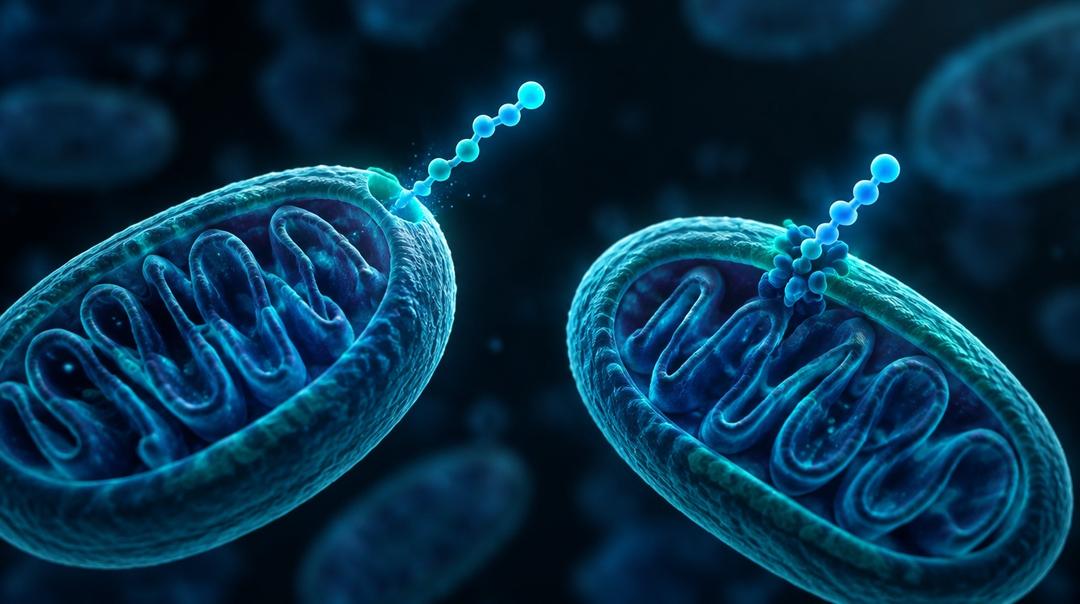
Why "mitochondrial peptide" means two different things
The phrase gets used in two unrelated senses, and the confusion explains most of what gets written comparing these two compounds.
In the first sense, a mitochondrial peptide is one made from mitochondrial DNA. Mitochondria carry their own small circular genome. Short open reading frames inside it turned out to encode a few peptides, humanin first and MOTS-c second. These are often called mitochondrial-derived peptides. The interest is that the organelle seems to send signals outward, using peptides written into its own genes.
In the second sense, a mitochondrial peptide is one aimed at mitochondria. SS-31 is not encoded anywhere in any genome. It was built in a laboratory from an opioid-peptide starting point, and it carries two residues that ordinary proteins do not contain. It is "mitochondrial" because of where it accumulates, not where it comes from.
So one is a product of the mitochondrion and the other is a drug sent to it. Questions about one rarely transfer to the other.
Side by side
| MOTS-c | SS-31 (elamipretide) | |
|---|---|---|
| Length | 16 amino acids | 4 amino acids |
| Origin | Encoded in the mitochondrial 12S rRNA gene; found in the body | Synthetic; contains D-arginine and 2',6'-dimethyltyrosine |
| Discovered / described | 2015, Cohen laboratory | 2004 as mitochondria-targeted, Szeto and Schiller laboratories |
| Proposed site of action | Skeletal muscle signalling; folate cycle and AMPK; binds and activates CK2 in muscle | Inner mitochondrial membrane; binds cardiolipin, alters membrane surface charge |
| Kind of mechanism | Signalling: changes what the cell does | Structural: stabilises the membrane the respiratory chain sits in |
| Most advanced evidence | Mouse studies; human genetics and biomarker measurement | Randomised phase 2 and phase 3 human trials |
| Controlled human trial results | None published | Several; most missed their primary endpoints |
| Regulatory status | Not approved anywhere | US accelerated approval, September 2025, for Barth syndrome only; not authorized in Canada |
How each one is thought to work
MOTS-c. Lee and colleagues found a short open reading frame inside the mitochondrial 12S rRNA gene encoding a 16-residue peptide. They reported that its primary target organ appears to be skeletal muscle. Its cellular actions inhibit the folate cycle and the purine synthesis tied to it, which leads to activation of AMPK, the kinase that senses cellular energy status. In mice, treatment prevented diet-induced and age-dependent insulin resistance and diet-induced obesity (PMID 25738459). For years no direct target was known. In 2024 Kumagai and colleagues reported that MOTS-c binds casein kinase 2 (CK2) directly, and that CK2 activity was needed for its effects on muscle in mice (PMID 39559755). The full account of that literature is in MOTS-c: a peptide encoded by the mitochondrial genome.
SS-31. The evidence points to a lipid rather than a protein target. Birk and colleagues showed high-affinity binding to cardiolipin, the phospholipid that shapes the cristae and anchors the electron-transport complexes. The complex also inhibited the peroxidase activity of cytochrome c, which otherwise damages cardiolipin during ischaemia (PMID 23813215). Later biophysical work found that SS-31 changes the surface electrostatics of mitochondrial membranes. The authors propose that this charge-tuning is a key part of its action (PMID 32273339). The structure and naming are covered in what is SS-31.
The practical difference is direction. MOTS-c is proposed to change the cell's metabolic programme from the inside: a signal goes out and the cell responds. SS-31 is proposed to keep an existing structure working, so the respiratory chain runs efficiently where it already is. One is a message and the other is a repair to the scaffolding. Neither framing is proven in a person, but they predict different things. They would show up in different tissues, on different timescales, with different biomarkers.
How far has the evidence for each one got?
This is where the two compounds diverge most, and where a lot of comparison writing goes wrong. It treats a mouse result for one and a phase 3 result for the other as if they were the same kind of fact.
MOTS-c has no published controlled human trial. The human data are observational. Exercise raises MOTS-c levels in muscle and blood (PMID 33473109), and a variant in its reading frame, found in East Asian populations, has been associated with muscle-fibre composition. Everything about giving the peptide comes from cells and mice.
SS-31 has a long human record, and most of it is negative on primary endpoints. In primary mitochondrial myopathy, a 218-patient phase 3 trial missed both primary endpoints. The walk-test difference from placebo was −3.2 metres (PMID 37268435). In heart failure, a 71-patient phase 2 trial found no change in left-ventricular end-systolic volume at four weeks (PMID 32068002). In dry macular degeneration, the phase 2 trial missed both primaries, as described in SS-31 eye research. The exception is Barth syndrome, an ultra-rare disorder of cardiolipin itself. There the US FDA granted accelerated approval in September 2025 (PMID 41335372). The pivotal trial's randomised phase missed its endpoints, and the approval leaned on open-label data.
Put plainly: SS-31 has been tested hard in people and mostly failed, with one narrow success. MOTS-c has barely been tested in people at all. "No evidence of benefit" and "no evidence" are different findings, and they belong to these two compounds respectively.
Who did the work
Both literatures are concentrated, which is normal for a newly described molecule and worth knowing before reading either.
Much of the MOTS-c literature traces to Pinchas Cohen's group and its collaborators. The published disclosures state that the intellectual property was licensed to a biotechnology company in which senior authors hold positions. Much of the SS-31 literature traces to Hazel Szeto's laboratory and to Stealth BioTherapeutics, the company developing elamipretide. Neither fact makes the data wrong. Both mean that independent replication carries more weight than usual. For SS-31 the controlled human trials are the closest thing to that check, and mostly they did not confirm the hoped-for effects. For the general argument, see how to read a peptide study.
Where they sit next to other mitochondrial research
Neither compound is the same thing as raising a cofactor pool. That is the strategy behind NAD+ precursors, covered in NAD+ and mitochondrial research. It is also the strategy behind supplying glutathione, whose redox chemistry is set out in reduced vs oxidized glutathione. AMPK activation, the downstream end of the MOTS-c story, has its own literature and its own translational gap, discussed in ATX-304 (O304) and AMPK research. Nothing here is medical, dosing, or therapeutic guidance.
Supplied here for laboratory use: MOTS-c and SS-31. The laboratory's certificate for each lot is linked from its product page. For laboratory research use only.
Frequently asked questions
Is MOTS-c or SS-31 better studied? In humans, SS-31 by a wide margin. It has been through randomised phase 2 and phase 3 trials in several conditions, with hundreds of participants. MOTS-c has published cell, mouse, genetic and biomarker work but no reported controlled human trial. At the preclinical level both literatures are substantial, and both are concentrated in a small number of laboratories.
Do MOTS-c and SS-31 act on the same target? No. MOTS-c is reported to act through metabolic signalling in skeletal muscle: folate-cycle inhibition and AMPK activation, and more recently direct binding of the kinase CK2. SS-31 is reported to bind cardiolipin, a lipid of the inner mitochondrial membrane, and to change that membrane's surface charge. One is a signalling account and the other is a structural one.
Is MOTS-c made in the human body? Yes. It is encoded in mitochondrial DNA, inside the 12S rRNA gene, and circulating levels can be measured. Exercise has been reported to raise them. SS-31 is not made in the body. It is a synthetic peptide containing D-arginine and dimethyltyrosine, residues that ordinary proteins do not contain.
Is either one approved in Canada? No. We found no Health Canada authorization for elamipretide, and MOTS-c is not approved anywhere. Elamipretide's only approval is a US accelerated approval for Barth syndrome, granted in September 2025. Research material sold under either name is a laboratory chemical and not a licensed drug.
Why does SS-31 have an approval if most of its trials failed? Because the approval is narrow. Barth syndrome is a disorder of cardiolipin, the lipid SS-31 binds, so it is the closest match between mechanism and disease. The US accelerated pathway accepts evidence judged reasonably likely to predict benefit. The randomised phase of the Barth trial missed its endpoints, and the supporting improvements came from open-label follow-up.
Selected Research References
- Lee C, Zeng J, Drew BG, et al. The mitochondrial-derived peptide MOTS-c promotes metabolic homeostasis and reduces obesity and insulin resistance. Cell Metab. 2015;21(3):443-454. pubmed.ncbi.nlm.nih.gov/25738459
- Kumagai H, Kim SJ, Miller B, et al. MOTS-c modulates skeletal muscle function by directly binding and activating CK2. iScience. 2024;27(11):111212. pubmed.ncbi.nlm.nih.gov/39559755
- Reynolds JC, Lai RW, Woodhead JST, et al. MOTS-c is an exercise-induced mitochondrial-encoded regulator of age-dependent physical decline and muscle homeostasis. Nat Commun. 2021;12(1):470. pubmed.ncbi.nlm.nih.gov/33473109
- Birk AV, Liu S, Soong Y, et al. The mitochondrial-targeted compound SS-31 re-energizes ischemic mitochondria by interacting with cardiolipin. J Am Soc Nephrol. 2013;24(8):1250-1261. pubmed.ncbi.nlm.nih.gov/23813215
- Mitchell W, Ng EA, Tamucci JD, et al. The mitochondria-targeted peptide SS-31 binds lipid bilayers and modulates surface electrostatics as a key component of its mechanism of action. J Biol Chem. 2020;295(21):7452-7469. pubmed.ncbi.nlm.nih.gov/32273339
- Karaa A, Bertini E, Carelli V, et al. Efficacy and safety of elamipretide in individuals with primary mitochondrial myopathy: the MMPOWER-3 randomized clinical trial. Neurology. 2023;101(3):e238-e252. pubmed.ncbi.nlm.nih.gov/37268435
- Butler J, Khan MS, Anker SD, et al. Effects of elamipretide on left ventricular function in patients with heart failure with reduced ejection fraction: the PROGRESS-HF phase 2 trial. J Card Fail. 2020;26(5):429-437. pubmed.ncbi.nlm.nih.gov/32068002
- Shirley M. Elamipretide: first approval. Drugs. 2026;86(3):377-383. pubmed.ncbi.nlm.nih.gov/41335372
All products sold by NovaEvum are for research and laboratory use only. They are not intended for human or animal consumption, diagnosis, treatment, cure, or prevention of any disease.