MOTS-c
Mitochondrial ORF of the 12S rRNA type-c
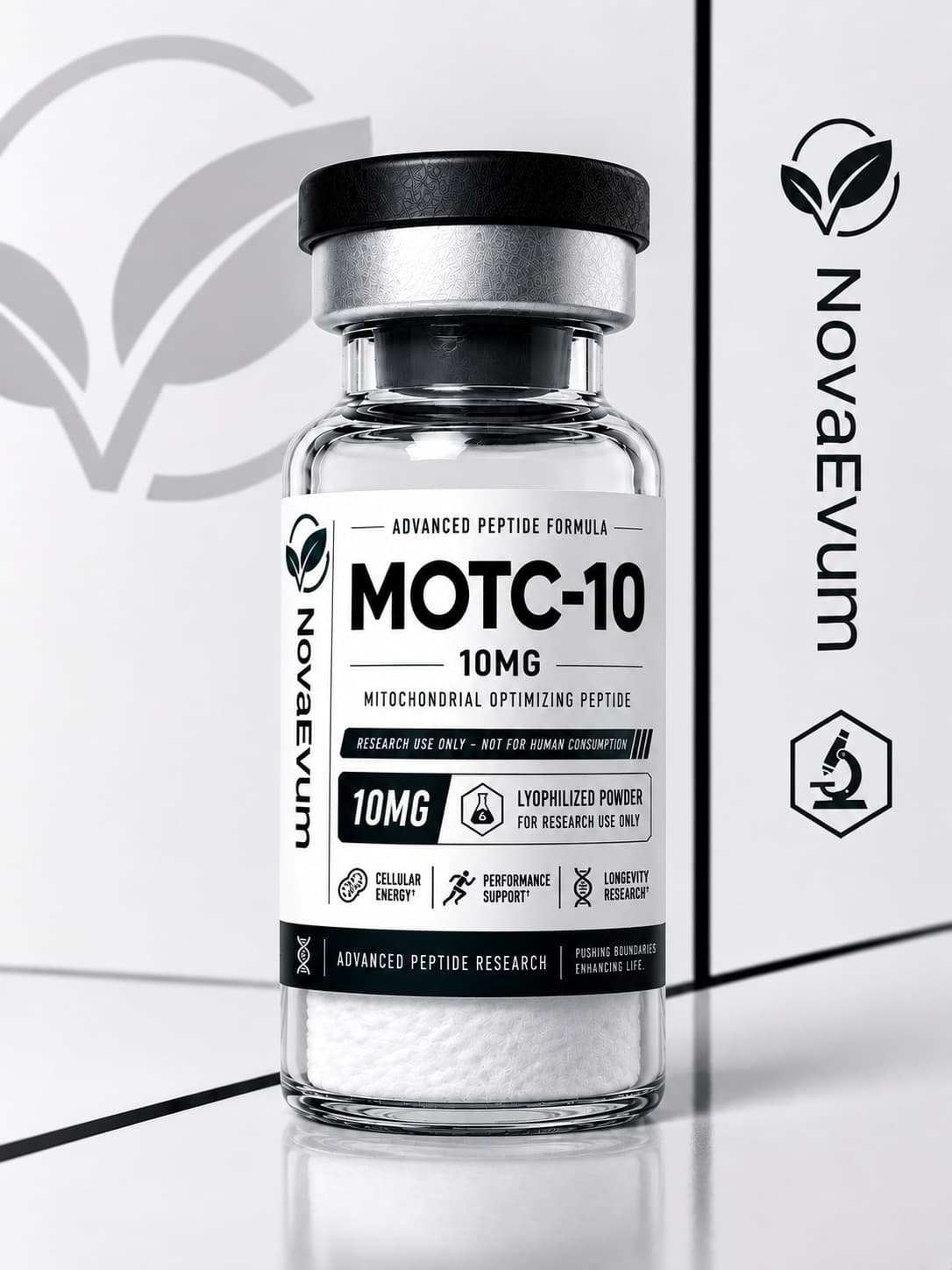
Each vial contains 10 mg of MOTS-c.
MOTS-c is a mitochondrial-derived peptide, encoded in mitochondrial DNA rather than in the nucleus, and one of the few known. Cell and rodent work covers mitochondrial-to-nuclear signalling, AMPK, and glucose and fatty-acid handling, including diet-induced obesity and exercise models. Human studies have measured it as a circulating marker in ageing and around exercise, without testing it as an intervention.
- Peptide, 16 amino acids
- Lyophilized powder, requires reconstitution
Price
$60.00 CAD
In stock
Produced & shipped in Canada
Specification
- CAS number
- 1627580-64-6
- Molecular formula
- C101H152N28O22S2
- Molecular weight
- 2,174.6 g/mol
- Sequence
- MRWQEMGYIFYPRKLR
- Purity
- ≥ 98.6% by RP-HPLC
- Form
- Lyophilized powder
- Third-party assay
- Purity, fill and endotoxin
- Origin
- Canada
- Storage
- -20 °C, protected from light
- Lot
- NVE-2429-A
How it works
Where the peptide is encoded is what sets the research question. A sequence written in mitochondrial DNA is studied as a signal travelling outwards to the nucleus, and what cell and rodent work measured while that signal was present is the subject of everything below — not energy in a person.
Mitochondrial-to-nuclear signalling
Where it was characterised
Encoded in the mitochondrial 12S rRNA region and studied as a retrograde signal from the mitochondrion to nuclear gene expression. That origin is why it is studied on its own terms rather than as another nuclear-encoded peptide.
AMPK and nutrient handling
Pathways in the cell work
Cell and rodent studies of AMPK signalling and of glucose and fatty-acid metabolism. This is the bulk of the metabolic literature, and it is work in models, not a finding about anybody’s energy use.
Metabolic stress models
What the animal work used
Diet-induced obesity and exercise models in rodents, measuring how those metabolic insults were handled when the peptide was present. Adaptation in a mouse is not adaptation in a person.
Circulating marker in humans
What the human work actually is
Human studies have measured MOTS-c in blood in ageing and around exercise, as a marker. They have not tested the peptide as an intervention, so exercise capacity and recovery are not findings this page can carry.
Where the evidence stands
Preclinical. No controlled human efficacy trials have been published. Not approved as a medicine.
Laboratory results
- Endotoxin2.651 EU/VialJanoshik · Aug 2026 · 10 mgOpen
- Purity+Fill99.329%Janoshik · Aug 2026 · 10 mgOpen
- Purity+Fill98.78%Uzorak · May 2026 · 10 mgOpen
Opened as the laboratory issued them, unedited. Every certificate we publish
Research use only
Supplied as a laboratory research chemical. Not a drug, food or cosmetic, and not for human or veterinary use. No application guidance is provided or implied.