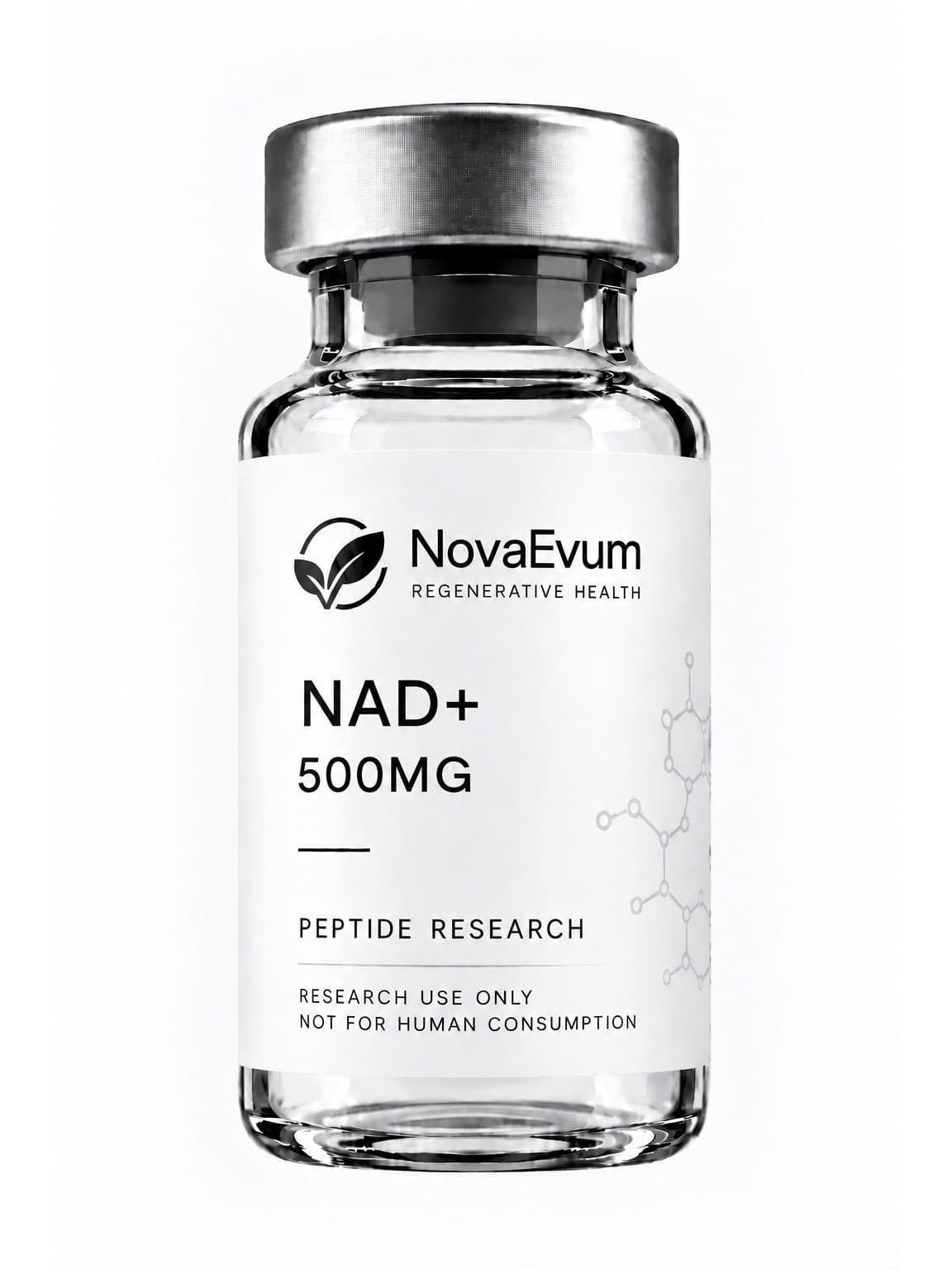
NAD+
Nicotinamide adenine dinucleotide
Supplied in 500 mg and 1000 mg vials.
NAD+ is nicotinamide adenine dinucleotide, a coenzyme present in every living cell, and not a synthetic peptide at all. It is among the most studied molecules in biochemistry: a cofactor in redox reactions that generate ATP, in sirtuin and PARP activity, and in a very large literature on cellular metabolism and ageing. Nearly all of that work concerns the coenzyme inside a cell, which is a different question from a vial of it.
- Lyophilized powder, requires reconstitution
Price
$60.00 CAD
In stock
Produced & shipped in Canada
Specification
- CAS number
- 53-84-9
- Molecular formula
- C21H27N7O14P2
- Molecular weight
- 663.43 g/mol
- Purity
- ≥ 99.0% by RP-HPLC
- Form
- Lyophilized powder
- Third-party assay
- Purity, fill and endotoxin
- Origin
- Canada
- Storage
- Refrigerated, 2-8 °C
- Lot
- NVE-2412-D
How it works
Two separate bodies of work carry this molecule’s name, and they are nowhere near the same size. The first is basic biochemistry about a coenzyme at work inside a cell — redox chemistry, sirtuins, PARP — and it is where every target below but the last one sits. The second is about material supplied in a vial, and the last target is there to say how much thinner it is.
Redox and ATP
What the biochemistry is
A cofactor in hydride-transfer reactions across metabolism, including the reactions that generate ATP. That is among the most established facts in biochemistry, and it is a fact about the coenzyme at work inside a cell.
Sirtuins
NAD-dependent deacetylases
Sirtuin activity is NAD-dependent, so a large ageing literature takes cellular NAD pools as a variable in that pathway. Findings about sirtuins are findings about that pathway, not about a vial.
PARP
DNA-damage signalling
PARP enzymes consume NAD at sites of DNA damage. The cell-biology literature on that consumption is large; it is not a finding about material supplied as a lyophilised powder.
The vial
A different question
Energy, clarity and recovery are claims about a person. Evidence that the coenzyme does what it does inside a cell is not evidence about a vial of it, and the second literature is far thinner than the first.
Where the evidence stands
Enormous basic-science literature on the coenzyme inside a cell. Evidence about a vial of it is far thinner. Not approved as a medicine; sold as a supplement elsewhere, in other forms.
Laboratory results
Opened as the laboratory issued them, unedited. Every certificate we publish
Research use only
Supplied as a laboratory research chemical. Not a drug, food or cosmetic, and not for human or veterinary use. No application guidance is provided or implied.