
SS-31
What Is SS-31 (Elamipretide)? Structure, Mechanism and the Trial Record
JH
· 11 min read
A summary of published research, with citations. It states no amount, schedule or route, and makes no claim about what this compound does in a person. Supplied for laboratory research use only.
On this page · 8 sections
SS-31 is a synthetic four-residue peptide, D-Arg-Dmt-Lys-Phe-NH2, that concentrates in the inner mitochondrial membrane and binds cardiolipin. It is the lead compound of the Szeto-Schiller peptide family. In clinical development it is called elamipretide. It has been through controlled trials in mitochondrial myopathy, heart failure, heart attack and eye disease, and most missed their primary endpoints. In September 2025 the US FDA granted it accelerated approval for one ultra-rare disorder, Barth syndrome. It has no Health Canada authorization that we could find.
Where the name comes from
"SS" stands for Szeto-Schiller, after Hazel Szeto and Peter Schiller, whose groups built the series together. The 2004 paper that first described these compounds as mitochondria-targeted lists both as authors (PMID 15178689). The family did not start as a mitochondrial project. Cho and colleagues describe an earlier opioid peptide, 2',6'-dimethyltyrosine-D-Arg-Phe-Lys-NH2, that protected the heart from stunning in vivo and turned out to target mitochondria and scavenge reactive oxygen species. SS-31 and a sister compound, SS-20, were analogues built without opioid activity so the two effects could be pulled apart (PMID 17429296). Szeto's own review of the series is titled, fairly, as a story of serendipity (PMID 25188726).
The compound has had several names, and all of them refer to the same molecule:
| Name | Where you see it |
|---|---|
| SS-31 | Original laboratory code; most preclinical papers; research-chemical catalogues |
| MTP-131 | Early clinical papers and trial registrations, such as EMBRACE STEMI |
| Bendavia | An early trade name on ClinicalTrials.gov entries |
| Elamipretide | International nonproprietary name used in later trials |
| Forzinity | Brand name of the US-approved product for Barth syndrome |
What is the structure of SS-31?
Four residues, with two deliberate oddities. The sequence is D-arginine, 2',6'-dimethyltyrosine (Dmt), lysine, phenylalanine, with an amidated C-terminus (PMID 16216225). The D-arginine is the mirror-image form of the amino acid. Dmt is a tyrosine with two extra methyl groups on its ring. Neither occurs in ordinary proteins, which makes SS-31 a designed molecule rather than a fragment of anything the body makes.
The pattern matters more than the individual residues. Zhao and colleagues described the motif as alternating aromatic and basic residues. Dmt supplies the radical-scavenging chemistry, and analogues without it did not suppress mitochondrial oxidant production or swelling (PMID 15178689). The peptide carries a net positive charge at physiological pH and still crosses cell membranes. In isolated mitochondria, radiolabelled SS-31 was concentrated about 5,000-fold in the mitochondrial pellet (PMID 16216225).
How is SS-31 thought to work?
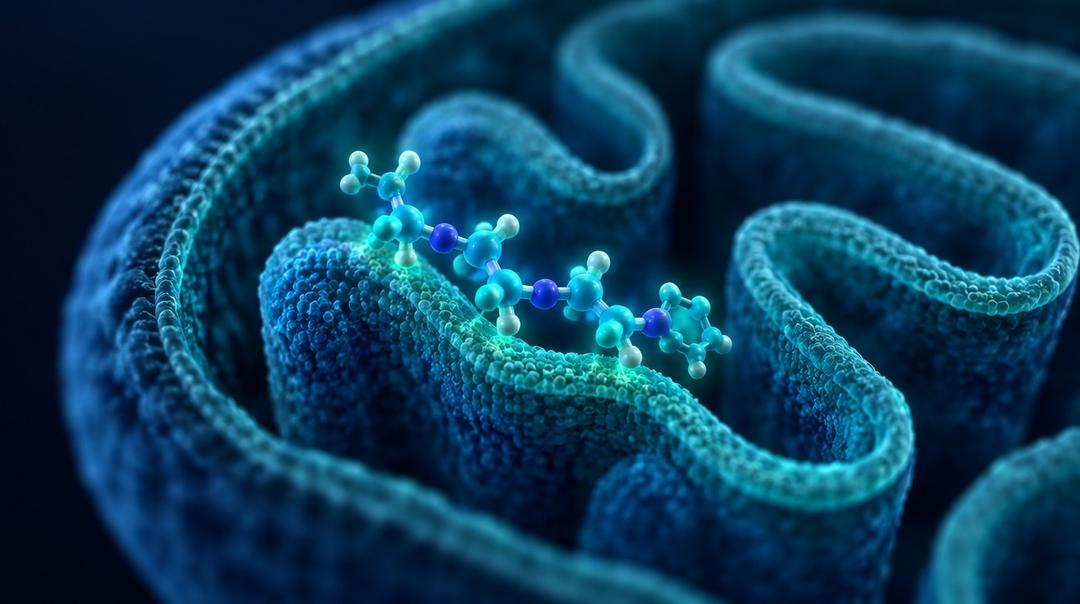
The leading account is that it binds a lipid, not a receptor. Cardiolipin is a phospholipid found almost only in the inner mitochondrial membrane. It shapes the folded cristae and anchors the respiratory-chain complexes. Birk and colleagues used a fluorescent analogue to show that SS-31 binds cardiolipin with high affinity. They also showed that the complex inhibits the peroxidase activity of cytochrome c, which otherwise oxidises cardiolipin during ischaemia. In rat kidney, pretreatment protected cristae and sped up ATP recovery on reperfusion (PMID 23813215).
That account has been refined since. Biophysical work from Mitchell and colleagues found that SS-31 sits in the interfacial region of membranes in proportion to their surface charge. They found it does not destabilise bilayers, and that it changes membrane surface electrostatics, including where calcium ions sit at the interface. They propose that charge-tuning is a key part of how it acts (PMID 32273339). A follow-up comparing SS-31 with three analogues found that all of them bound cardiolipin-containing membranes but differed in how they changed surface charge and in how well they protected cells (PMID 35913044). So "cardiolipin binder" is a fair label. It is not a complete mechanism, and the field itself is still revising it.
What SS-31 is not: a general antioxidant like glutathione, or a signalling peptide like MOTS-c. The contrast with MOTS-c is set out in MOTS-c vs SS-31.
What has elamipretide been tested for in humans?
More than most research peptides, and with mostly negative primary results. That is unusual and useful: the human evidence here was actually generated, and it can be read.
| Indication | Key trial | Design | Primary result |
|---|---|---|---|
| Primary mitochondrial myopathy | MMPOWER | Phase 1/2, 36 patients, 5 days | Highest-dose group walked 64.5 m further vs 20.4 m on placebo (p = 0.053); dose-response significant |
| Primary mitochondrial myopathy | MMPOWER-2 | Crossover, 30 patients, 4 weeks per period | 19.8 m difference on the walk test, not significant (p = 0.083) |
| Primary mitochondrial myopathy | MMPOWER-3 | Phase 3, 218 patients, 24 weeks | Both primary endpoints missed; walk difference −3.2 m (p = 0.69) |
| Heart failure, reduced ejection fraction | Daubert et al. | Single administration, 36 patients | Lower left-ventricular volumes within hours in the highest cohort |
| Heart failure, reduced ejection fraction | PROGRESS-HF | Phase 2, 71 patients, 4 weeks | No change in end-systolic volume vs placebo |
| Heart attack (anterior STEMI) | EMBRACE STEMI | Phase 2a | No reduction in infarct size |
| Barth syndrome | TAZPOWER | Crossover, 12 patients, then open-label | Primary endpoints missed in the crossover; improvements in the extension |
| Dry macular degeneration | ReCLAIM-2 | Phase 2, 176 patients | Both primary endpoints missed |
Mitochondrial myopathy is the clearest arc. The small dose-escalation study reported a borderline result on the six-minute walk and a significant dose-response (PMID 29500292). The crossover trial missed its primary endpoint but reported nominally significant improvements in patient-reported fatigue (PMID 32096613). The phase 3 trial, MMPOWER-3, randomised 218 adults and missed both primary endpoints. Its authors classify it as Class I evidence that elamipretide does not improve the walk test or fatigue at 24 weeks in that population (PMID 37268435). A later post hoc analysis found a signal in the subgroup whose disease comes from nuclear genes that maintain mitochondrial DNA, the "replisome" disorders such as POLG and TWNK (PMID 39574155). That generated a new phase 3 trial, NuPower (NCT05162768). The registry lists it as completed in December 2024, with no results posted. A post hoc subgroup is a hypothesis, and NuPower is the test of it.
Heart. A single-administration study in heart failure reported lower left-ventricular volumes within hours in the highest-dose cohort, with the drug undetectable in plasma by 24 hours (PMID 29217757). The four-week phase 2 trial that followed, PROGRESS-HF, found no difference from placebo in end-systolic volume or ejection fraction (PMID 32068002). In EMBRACE STEMI, giving the compound around reperfusion in first anterior heart attacks did not reduce infarct size by enzyme release, and no prespecified imaging or clinical outcome improved (PMID 26586786). Rat infarct models had looked promising (PMID 17429296). The human trials did not reproduce that.
Eye. Mouse vision studies, two uncontrolled phase 1 cohorts, a phase 2 trial that missed both primaries and a phase 3 trial still running. The full account is in SS-31 eye research and is not repeated here.
Is SS-31 approved anywhere?
Yes, in one country for one disorder. In September 2025 the US FDA granted elamipretide accelerated approval to improve muscle strength in patients with Barth syndrome weighing at least 30 kg. That made it the first disease-specific treatment for that ultra-rare X-linked disorder (PMID 41335372). Barth syndrome is a disorder of cardiolipin itself, so a cardiolipin-binding drug is a tidy mechanistic fit.
Two qualifications. Accelerated approval rests on evidence judged reasonably likely to predict benefit, and the evidence was thin. The randomised crossover part of TAZPOWER missed its primary endpoints, and the improvements came in the open-label extension. The same review states that elamipretide remains in phase 3 for dry macular degeneration and mitochondrial myopathies. In other words, it is not approved for either.
What is its status in Canada?
We found no Health Canada market authorization for elamipretide, for Barth syndrome or anything else. The Drugs first-approval profile describes the US decision as its first anywhere. Current status can be checked in Health Canada's Drug Product Database. A vial sold as SS-31 for laboratory research is not the approved drug product. A foreign approval of a regulated medicine does not attach to research material. The Canadian framework is covered in peptides and Canadian law.
How to read this record
SS-31 is a rare research peptide with a real clinical programme: hundreds of patients randomised, prespecified endpoints, results published whether positive or not. Read straight, that record says the mechanism is coherent and the preclinical signal was consistent. Translation into measurable benefit has failed more often than it has succeeded. The one success came in the disease whose defect most directly matches the mechanism, and it rests on open-label data. For why a missed primary endpoint outweighs a positive secondary one, see how to read a peptide study. For another way of targeting mitochondrial energy metabolism, see NAD+ and mitochondrial research. Nothing here is medical, dosing, or therapeutic guidance.
Supplied here for laboratory use: SS-31. The laboratory's certificate for each lot is linked from its product page. For laboratory research use only.
Frequently asked questions
What does "Szeto-Schiller peptide" mean? It names a family of short synthetic peptides from the laboratories of Hazel Szeto and Peter Schiller. They share a motif of alternating aromatic and positively charged residues, cross cell membranes, and concentrate in mitochondria. SS-31 is the best-studied member. SS-20, which lacks the dimethyltyrosine and so does not scavenge radicals, was used in early work as a comparison.
Is SS-31 an antioxidant? Partly, and that is not the whole story. Its dimethyltyrosine scavenges radicals, and early papers called it a mitochondria-targeted antioxidant. Later work puts the emphasis on binding cardiolipin and changing membrane surface charge. That is a structural effect on the membrane the respiratory chain sits in, not general neutralisation of oxidants throughout the cell.
Why did so many elamipretide trials fail if the mechanism is sound? A coherent mechanism and a measurable clinical effect are different things. Some trials were short, patient groups were genetically mixed, and endpoints like walking distance are noisy. Effects seen in rat infarct and kidney models may not scale to people. The mitochondrial myopathy programme has narrowed to a genetic subgroup for exactly this reason.
Is the US approval for Barth syndrome a full approval? No. It is an accelerated approval, which in the United States rests on evidence judged reasonably likely to predict clinical benefit. Further confirmation is generally required. The randomised part of the pivotal Barth trial missed its primary endpoints. The supportive improvements came from an open-label extension with a small number of patients.
Is research-grade SS-31 the same thing as Forzinity? The molecule is the same, but the product is not. Forzinity is a manufactured drug made under pharmaceutical quality controls and approved for a defined indication in the United States. A vial labelled SS-31 for laboratory use is a research chemical. It carries no approval, in Canada or anywhere else, and is not for human use.
Selected Research References
- Zhao K, Zhao GM, Wu D, et al. Cell-permeable peptide antioxidants targeted to inner mitochondrial membrane inhibit mitochondrial swelling, oxidative cell death, and reperfusion injury. J Biol Chem. 2004;279(33):34682-34690. pubmed.ncbi.nlm.nih.gov/15178689
- Zhao K, Luo G, Giannelli S, Szeto HH. Mitochondria-targeted peptide prevents mitochondrial depolarization and apoptosis induced by tert-butyl hydroperoxide in neuronal cell lines. Biochem Pharmacol. 2005;70(12):1796-1806. pubmed.ncbi.nlm.nih.gov/16216225
- Birk AV, Liu S, Soong Y, et al. The mitochondrial-targeted compound SS-31 re-energizes ischemic mitochondria by interacting with cardiolipin. J Am Soc Nephrol. 2013;24(8):1250-1261. pubmed.ncbi.nlm.nih.gov/23813215
- Mitchell W, Ng EA, Tamucci JD, et al. The mitochondria-targeted peptide SS-31 binds lipid bilayers and modulates surface electrostatics as a key component of its mechanism of action. J Biol Chem. 2020;295(21):7452-7469. pubmed.ncbi.nlm.nih.gov/32273339
- Karaa A, Haas R, Goldstein A, et al. Randomized dose-escalation trial of elamipretide in adults with primary mitochondrial myopathy. Neurology. 2018;90(14):e1212-e1221. pubmed.ncbi.nlm.nih.gov/29500292
- Karaa A, Bertini E, Carelli V, et al. Efficacy and safety of elamipretide in individuals with primary mitochondrial myopathy: the MMPOWER-3 randomized clinical trial. Neurology. 2023;101(3):e238-e252. pubmed.ncbi.nlm.nih.gov/37268435
- Karaa A, Bertini E, Carelli V, et al. Genotype-specific effects of elamipretide in patients with primary mitochondrial myopathy: a post hoc analysis of the MMPOWER-3 trial. Orphanet J Rare Dis. 2024;19(1):431. pubmed.ncbi.nlm.nih.gov/39574155
- Butler J, Khan MS, Anker SD, et al. Effects of elamipretide on left ventricular function in patients with heart failure with reduced ejection fraction: the PROGRESS-HF phase 2 trial. J Card Fail. 2020;26(5):429-437. pubmed.ncbi.nlm.nih.gov/32068002
- Gibson CM, Giugliano RP, Kloner RA, et al. EMBRACE STEMI study: a Phase 2a trial to evaluate the safety, tolerability, and efficacy of intravenous MTP-131 on reperfusion injury in patients undergoing primary percutaneous coronary intervention. Eur Heart J. 2016;37(16):1296-1303. pubmed.ncbi.nlm.nih.gov/26586786
- Shirley M. Elamipretide: first approval. Drugs. 2026;86(3):377-383. pubmed.ncbi.nlm.nih.gov/41335372
All products sold by NovaEvum are for research and laboratory use only. They are not intended for human or animal consumption, diagnosis, treatment, cure, or prevention of any disease.