
SS-31
Cardiolipin explained: the mitochondrial lipid behind cristae, Barth syndrome and SS-31 research
JH
· 9 min read
A summary of published research, with citations. It states no amount, schedule or route, and makes no claim about what this compound does in a person. Supplied for laboratory research use only.
On this page · 8 sections
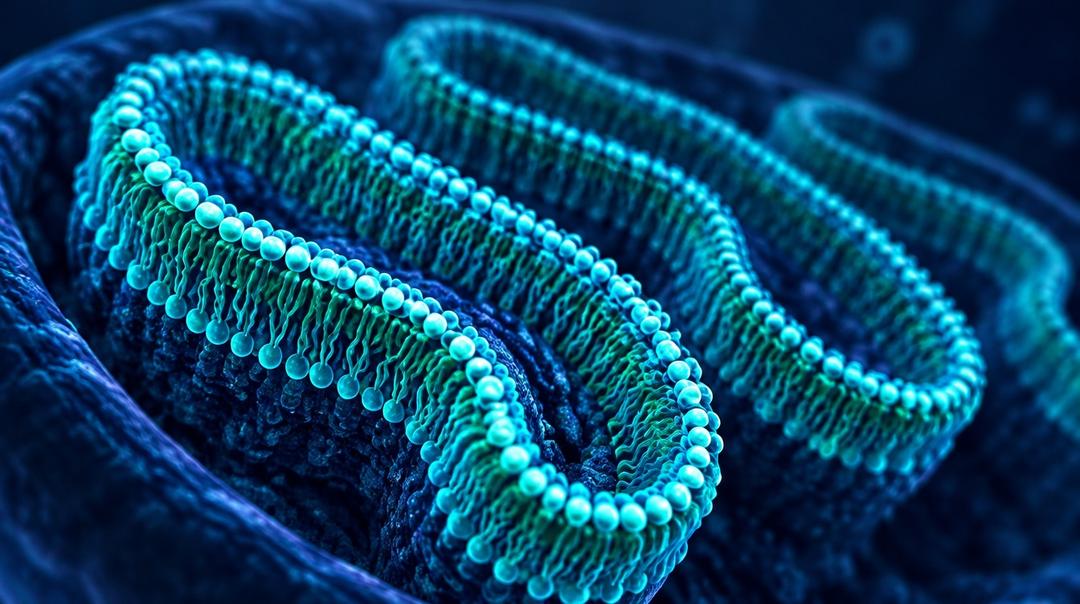
Cardiolipin is a phospholipid found almost only in the inner mitochondrial membrane. It is unusual in carrying four fatty-acid tails instead of two. It helps shape the folded cristae where ATP is made, holds respiratory-chain complexes together in supercomplexes, and binds cytochrome c. Faulty remodelling of cardiolipin, caused by mutations in the tafazzin gene, underlies Barth syndrome. SS-31 (elamipretide) was developed as a peptide that binds cardiolipin, which is why so much of its research literature is really about this lipid.
What is cardiolipin?
Most membrane phospholipids are built on one glycerol backbone with two fatty-acid tails and one phosphate head group. Cardiolipin is effectively two of these joined through a central glycerol, giving two phosphates and four tails. The result is a small head on a wide, cone-shaped base, and that shape is the source of most of what makes the lipid interesting.
Paradies and colleagues describe cardiolipin as a unique phospholipid "localized and synthesized in the inner mitochondrial membrane," required for the best activity of the electron transport chain complexes and of ATP production (PMID 31315173). It sits where it is made. That is part of why it acts as a marker of mitochondrial inner membranes, and why a compound that concentrates there is reaching a very specific address.
Where is cardiolipin found, and how much is there?
Ikon and Ryan put cardiolipin at roughly 18% of the inner membrane's phospholipid mass, against about 34% for phosphatidylethanolamine (PMID 28336315). The two are not spread evenly. Both gather in the leaflet of the membrane that faces the inside of each crista and curves sharply inward. Phosphatidylcholine dominates the opposite, matrix-facing leaflet.
That asymmetry follows from shape. A cone-shaped lipid relieves the strain of a tightly curved membrane. Cristae are, in Ikon and Ryan's description, tube-like extensions of the inner membrane capped by a dome, with a great deal of curvature to accommodate. The cristae are where the proton gradient is built that drives ATP synthesis, so the lipid that helps hold that shape is closely tied to the cell's energy output.
What does cardiolipin do?
| Role | What the research showed |
|---|---|
| Cristae shape | Concentrates in the sharply curved, lumen-facing leaflet of crista membranes (PMID 28336315) |
| Respiratory supercomplexes | In yeast, cardiolipin stabilised supercomplexes of complexes III and IV, though they could still form without it (PMID 14561769) |
| Cytochrome c oxidase activity | A cardiolipin-deficient yeast strain carried almost inactive resting cytochrome c oxidase (PMID 14561769) |
| Apoptosis signalling | Cardiolipin was the only mitochondrial phospholipid oxidised early in apoptosis, by a peroxidase activity of cytochrome c bound to it (PMID 16408039) |
Supercomplexes. Pfeiffer and colleagues found that cardiolipin "stabilized" supercomplexes of complexes III and IV in yeast, but was "not essential for their formation" (PMID 14561769). That is a careful distinction worth keeping. The lipid makes the assemblies hold together better. It is not the only thing assembling them.
Cytochrome c and cell death. Cytochrome c is normally an electron carrier between complexes III and IV. When it binds cardiolipin it can act as a peroxidase instead. Kagan and colleagues showed that this cardiolipin-bound cytochrome c oxidises cardiolipin early in apoptosis, and that the oxidised lipid was required for proapoptotic factors to be released from mitochondria (PMID 16408039). The same protein-lipid pair therefore sits at a switch point between energy production and the start of programmed cell death.
How is cardiolipin remodelled?
Newly made cardiolipin does not yet carry its final fatty acids. They are swapped afterwards in a remodelling step, and in heart and skeletal muscle the mature end product is dominated by one species, tetralinoleoyl-cardiolipin, with four linoleic acid tails.
Xu and colleagues identified the reaction that does this: a transfer of fatty acids from other phospholipids onto cardiolipin. It was reduced in cells from people with Barth syndrome, and the authors concluded that tafazzin is an acyltransferase involved in it (PMID 14551214). Remodelling passes through an intermediate called monolysocardiolipin, which is cardiolipin missing one tail.
What is Barth syndrome?
Barth and colleagues described the condition in 1983 in a large family. It was an X-linked disease of boys with dilated cardiomyopathy, neutropenia and skeletal myopathy, and with abnormal mitochondria seen by electron microscopy in heart muscle and bone marrow (PMID 6142097). Untreated affected boys in that pedigree died in infancy or early childhood.
The gene came in 1996. Bione and colleagues found mutations in a gene on Xq28, then called G4.5, that is highly expressed in heart and skeletal muscle. They named its protein products tafazzins (PMID 8630491). The lipid link followed. Schlame and colleagues found that one molecular species, tetralinoleoyl-cardiolipin, was missing from skeletal muscle, heart and platelets of eight children with Barth syndrome (PMID 12112112).
Barth syndrome is therefore a disease of cardiolipin remodelling. Mature cardiolipin falls and monolysocardiolipin builds up, and diagnostic testing uses exactly that. Vaz and colleagues describe a blood-spot test based on the monolysocardiolipin-to-cardiolipin ratio. Over 2006 to 2021 they diagnosed 93 individuals, which they estimate at about 40% of all reported cases worldwide (PMID 34382226). It is a very rare disease, and that affects how much any trial in it can show.
Why does SS-31 research target cardiolipin?
SS-31, later named elamipretide, is a synthetic tetrapeptide from the Szeto-Schiller series. Its proposed mechanism starts with this lipid. Szeto's review describes it binding cardiolipin selectively through electrostatic and hydrophobic interactions, and in doing so stopping cardiolipin from converting cytochrome c into a peroxidase while leaving its electron-carrying role intact (PMID 24117165).
The experimental anchor is a rat kidney ischaemia study. Birk and colleagues used a fluorescent analogue of SS-31 to show high-affinity binding to cardiolipin. They found that the peptide-cardiolipin complex inhibited cytochrome c peroxidase activity, and reported that pretreated rats kept their cristae membranes intact during renal ischaemia (PMID 23813215). That is a mechanism shown in vitro and in an animal model. It explains why the compound was developed. It does not show what the compound does in a person.
The human test of the idea came in the disease defined by cardiolipin. In a randomised crossover trial in 12 people with Barth syndrome, neither primary endpoint was met in the controlled part. Improvements were then reported in the open-label extension that followed (PMID 33077895). A later report on the long-term extension, with 10 entrants and 8 reaching week 168, described improvements in walking distance and in the monolysocardiolipin-to-cardiolipin ratio (PMID 38602181). Open-label extensions have no placebo arm, so they cannot separate a drug effect from expectation, practice and selection.
Elamipretide received accelerated approval in the United States in 2025 for Barth syndrome (PMID 42359884). That approval rests on evidence judged reasonably likely to predict benefit, and it covers one formulation for one rare disease. A Canadian authorisation could not be confirmed for this page; the Drug Product Database is the place to check. SS-31 sold for research is not that medicine. The fuller trial record is in what is SS-31 (elamipretide), and the eye trials, where a mechanism met a clinical endpoint, are in SS-31 and vision research.
What cardiolipin does not explain
Binding is not rescue. Showing that a peptide binds cardiolipin, or reduces cytochrome c peroxidase activity in a tube, establishes an interaction. The steps from there to cristae in an animal, and from an animal to a patient, each need their own evidence. The general argument is in how to read a peptide study.
Not every mitochondrial peptide works this way. MOTS-c is also discussed as a "mitochondrial peptide," but its literature describes quite different signalling, not cardiolipin binding. MOTS-c vs SS-31 sets the two side by side.
A biomarker is not an outcome. In Barth syndrome the monolysocardiolipin-to-cardiolipin ratio is a precise diagnostic marker. A change in it during treatment is a change in a lipid ratio, and whether it predicts how a patient fares is a separate question.
Nothing here is medical, dosing, or therapeutic guidance. For another explainer in this series, see BDNF explained.
Supplied here for laboratory use: SS-31. The laboratory's certificate for each lot is linked from its product page. For laboratory research use only.
Frequently asked questions
Why is it called cardiolipin? The name joins the Greek root for heart to the word lipid, and the lipid has long been associated with heart tissue, whose mitochondria are densely packed with cristae. Across the inner mitochondrial membrane generally, it makes up roughly 18% of phospholipid mass. In heart and skeletal muscle, the mature form is dominated by tetralinoleoyl-cardiolipin, the species found missing in Barth syndrome.
What makes cardiolipin different from other phospholipids? It has two phosphate groups and four fatty-acid tails on a linked glycerol backbone, where most phospholipids have one phosphate and two tails. That gives it a cone shape suited to sharply curved membranes, and it is made and kept almost entirely in the inner mitochondrial membrane, where it binds respiratory complexes and cytochrome c.
How does tafazzin relate to cardiolipin? Tafazzin is the enzyme involved in remodelling cardiolipin's fatty-acid tails into their mature pattern. When the TAZ gene is mutated, as in Barth syndrome, mature cardiolipin falls and the intermediate monolysocardiolipin builds up. The ratio between the two is used as a diagnostic test, including from a dried blood spot.
Does SS-31 restore normal cardiolipin? That is not what the research shows. SS-31 was characterised as binding cardiolipin and reducing cytochrome c's peroxidase activity in laboratory and rat studies. In Barth syndrome, the controlled part of the human trial missed its primary endpoints, and the later improvements come from open-label extensions. Mechanism and clinical effect are separate claims.
Selected Research References
- Paradies G, Paradies V, Ruggiero FM, Petrosillo G. Role of Cardiolipin in Mitochondrial Function and Dynamics in Health and Disease: Molecular and Pharmacological Aspects. Cells. 2019;8. pubmed.ncbi.nlm.nih.gov/31315173
- Ikon N, Ryan RO. Cardiolipin and mitochondrial cristae organization. Biochimica et Biophysica Acta Biomembranes. 2017;1859:1156-1163. pubmed.ncbi.nlm.nih.gov/28336315
- Pfeiffer K, Gohil V, Stuart RA, et al. Cardiolipin stabilizes respiratory chain supercomplexes. Journal of Biological Chemistry. 2003;278:52873-52880. pubmed.ncbi.nlm.nih.gov/14561769
- Kagan VE, Tyurin VA, Jiang J, et al. Cytochrome c acts as a cardiolipin oxygenase required for release of proapoptotic factors. Nature Chemical Biology. 2005;1:223-232. pubmed.ncbi.nlm.nih.gov/16408039
- Barth PG, Scholte HR, Berden JA, et al. An X-linked mitochondrial disease affecting cardiac muscle, skeletal muscle and neutrophil leucocytes. Journal of the Neurological Sciences. 1983;62:327-355. pubmed.ncbi.nlm.nih.gov/6142097
- Bione S, D'Adamo P, Maestrini E, et al. A novel X-linked gene, G4.5. is responsible for Barth syndrome. Nature Genetics. 1996;12:385-389. pubmed.ncbi.nlm.nih.gov/8630491
- Schlame M, Towbin JA, Heerdt PM, et al. Deficiency of tetralinoleoyl-cardiolipin in Barth syndrome. Annals of Neurology. 2002;51:634-637. pubmed.ncbi.nlm.nih.gov/12112112
- Birk AV, Liu S, Soong Y, et al. The mitochondrial-targeted compound SS-31 re-energizes ischemic mitochondria by interacting with cardiolipin. Journal of the American Society of Nephrology. 2013;24:1250-1261. pubmed.ncbi.nlm.nih.gov/23813215
- Szeto HH. First-in-class cardiolipin-protective compound as a therapeutic agent to restore mitochondrial bioenergetics. British Journal of Pharmacology. 2014;171:2029-2050. pubmed.ncbi.nlm.nih.gov/24117165
- Reid Thompson W, Hornby B, Manuel R, et al. A phase 2/3 randomized clinical trial followed by an open-label extension to evaluate the effectiveness of elamipretide in Barth syndrome, a genetic disorder of mitochondrial cardiolipin metabolism. Genetics in Medicine. 2021;23:471-478. pubmed.ncbi.nlm.nih.gov/33077895
All products sold by NovaEvum are for research and laboratory use only. They are not intended for human or animal consumption, diagnosis, treatment, cure, or prevention of any disease.