
MOTS-c
What Is MOTS-c? Origin, Sequence, Evidence and Regulatory Status
JH
· 10 min read
A summary of published research, with citations. It states no amount, schedule or route, and makes no claim about what this compound does in a person. Supplied for laboratory research use only.
On this page · 6 sections
MOTS-c is a 16-amino-acid peptide, Met-Arg-Trp-Gln-Glu-Met-Gly-Tyr-Ile-Phe-Tyr-Pro-Arg-Lys-Leu-Arg, encoded by a short open reading frame inside the mitochondrial 12S ribosomal RNA gene. It was described in 2015 by a group at UCLA and the University of Southern California, and it is one of very few peptides known to be written into mitochondrial rather than nuclear DNA. Its research is cell and mouse work, plus human studies that measure it in blood and muscle or look at a variant in its gene. No controlled human trial of the peptide has published results. It is not approved as a medicine anywhere, including Canada.
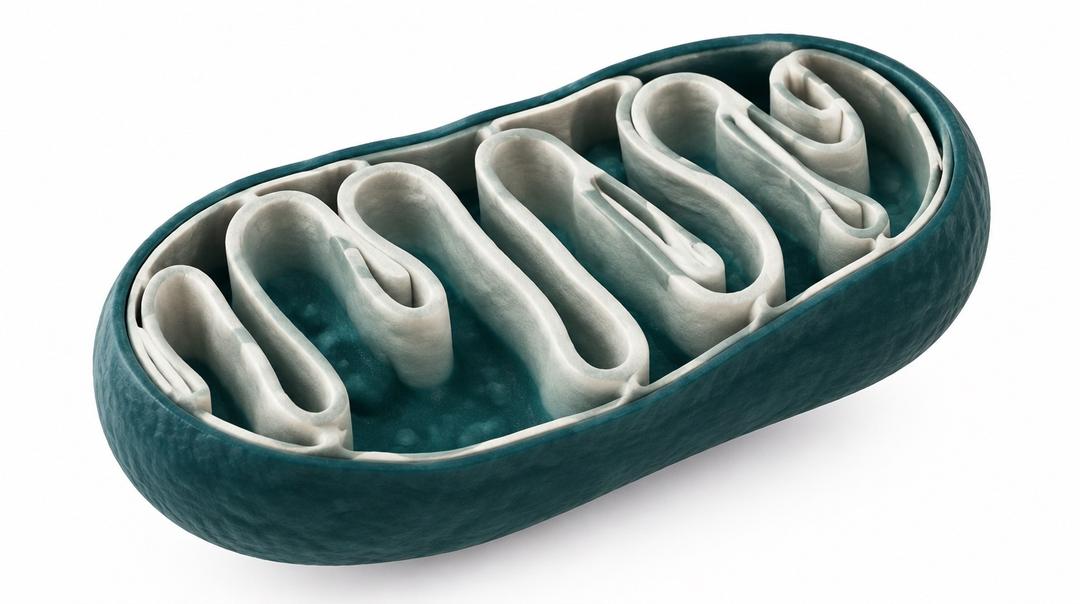
What is MOTS-c made of?
Sixteen ordinary L-amino acids, with nothing added. The name is an abbreviation of where it was found: mitochondrial open reading frame of the 12S rRNA, type c. Lee and colleagues reported the reading frame, showed that it encodes a 16-residue peptide, and proposed that mitochondria use it as a signal to the rest of the cell (PMID 25738459). Their starting point was humanin, an earlier peptide whose reading frame lies in the neighbouring 16S rRNA region of mitochondrial DNA (PMID 27070352); if there was one such peptide, there might be others.
A few features of the sequence matter for anyone reading the literature. It is strongly basic: three arginines and a lysine against one glutamate. It carries two methionines and a tryptophan, which can oxidise. Position 14 is the lysine affected by the East Asian m.1382A>C variant, which turns it into glutamine (K14Q), a change that comes up repeatedly below. What those residues mean for handling in solution is covered in MOTS-c stability after reconstitution.
| Property | MOTS-c |
|---|---|
| Sequence | Met-Arg-Trp-Gln-Glu-Met-Gly-Tyr-Ile-Phe-Tyr-Pro-Arg-Lys-Leu-Arg (MRWQEMGYIFYPRKLR) |
| Also called | Mitochondrial open reading frame of the 12S rRNA type-c |
| CAS number (PubChem) | 1627580-64-6 |
| Molecular formula (PubChem) | C101H152N28O22S2 |
| Molecular weight (PubChem) | About 2175 g/mol |
| Origin | Encoded in mitochondrial DNA, within the 12S rRNA gene; described 2015 (Cohen and Lee laboratories, UCLA and USC) |
| Evidence stage | Cell and rodent; human biomarker and genetic association studies |
| Regulatory status | Not approved anywhere; no Health Canada, FDA or EMA authorisation found |
How is MOTS-c thought to work?
The proposed mechanism has moved over a decade from an indirect metabolic account to a named binding partner. The main threads, all from cell and mouse work:
Folate cycle and AMPK. The 2015 paper reported that MOTS-c's cellular actions inhibit the folate cycle and the de novo purine synthesis tied to it, leading to activation of AMPK, the kinase that senses cellular energy status. It named skeletal muscle as the apparent primary target organ (PMID 25738459). AMPK as a research target in its own right is discussed in ATX-304 (O304) and AMPK research.
Movement to the nucleus. Kim and colleagues reported that in cultured cells under glucose restriction, MOTS-c moves into the nucleus in an AMPK-dependent manner, alters expression of a broad range of nuclear genes, including antioxidant-response genes, and interacts with the transcription factor NRF2 (PMID 29983246). This is the basis for describing MOTS-c as a mitochondrial signal that reaches nuclear gene expression. A later study in human muscle did not find the same link to antioxidant-response genes that had been seen in culture (PMID 32182209), so the cell finding has not simply carried over to tissue.
CK2. For years no direct binding target was known. In 2024 Kumagai and colleagues reported that MOTS-c binds and activates casein kinase 2 (CK2) in cell-free systems, that CK2 suppression blunted its effects on muscle in mice, and that the K14Q variant binds CK2 less and does not activate it (PMID 39559755). The same paper reported the opposite effect on CK2 activity in fat, which is a reminder that "activates CK2" is a tissue-specific statement.
These threads are not competing explanations so much as layers that have not yet been joined: how folate-cycle effects, nuclear movement and CK2 binding relate to each other has not been established. The narrative account of how the field developed is in MOTS-c: a peptide encoded by the mitochondrial genome.
What has MOTS-c been studied for?
| Area | Evidence stage | What exists |
|---|---|---|
| Insulin resistance and diet-induced obesity | Mouse; human genetic association | The 2015 mouse work; a variant associated with type 2 diabetes in men |
| Physical capacity and muscle in ageing | Mouse; human biomarker | Mouse performance studies; levels measured in muscle and plasma |
| Bone loss | Mouse and cell | Ovariectomy model; osteoclast culture |
| Longevity | Hypothesis from human genetics | A short commentary on a Japanese variant |
Metabolism is where the field started. The 2015 paper reported that treatment in mice prevented age-dependent and high-fat-diet-induced insulin resistance and diet-induced obesity (PMID 25738459). The human side is genetic. Zempo and colleagues meta-analysed three cohorts totalling 27,527 people and reported that men, but not women, carrying the K14Q variant had a higher prevalence of type 2 diabetes. In parallel mouse work, the native peptide was reported to affect weight and glucose tolerance in male mice on a high-fat diet where the K14Q form did not (PMID 33468709). An association between a lifelong variant and disease prevalence says the peptide may matter biologically. It says nothing about what giving the peptide would do.
Muscle and ageing. Reynolds and colleagues reported improved physical performance in young, middle-aged and old mice given MOTS-c, and, in humans, that exercise raises MOTS-c in skeletal muscle and in circulation (PMID 33473109). D'Souza and colleagues found plasma MOTS-c lower in older men but muscle MOTS-c about 1.5 times higher in middle-aged and older men than in young men, a pattern they linked to fibre-type composition (PMID 32182209). Both human findings are measurements of the body's own peptide, not results of giving it.
Bone. In ovariectomised mice, a model of oestrogen-loss bone loss, Ming and colleagues reported less bone loss on micro-CT with MOTS-c and inhibition of osteoclast formation in culture, partly reversed by an AMPK inhibitor (PMID 27237975). This is a single-laboratory rodent finding.
Longevity. Fuku and colleagues suggested, in a two-page commentary, that the K14Q variant, specific to Northeast Asian populations, might be among the mechanisms behind exceptional longevity in Japan (PMID 26289118). They framed it as a hypothesis, and it remains one.
A practical problem runs under all of the measurement studies. When an anti-doping laboratory built a mass spectrometry assay for MOTS-c in plasma, it could not confirm the endogenous levels a commercial immunoassay reported in 20 healthy people, and the two methods differed considerably (PMID 30394592). Circulating "MOTS-c levels" from different studies may not be measuring the same thing. How to weigh studies like these is set out in how to read a peptide study.
Most of this literature comes from one network of laboratories. The published disclosures state that UCLA licensed the MOTS-c intellectual property to CohBar, Inc., on which a senior author is listed as an inventor (PMID 39559755), and that senior authors are consultants to and shareholders in that company (PMID 29983246). Disclosure is not error, but it makes independent replication the thing to look for.
Is MOTS-c approved anywhere?
No. We found no authorisation as a medicine from Health Canada, the FDA or the EMA, and no other jurisdiction lists it as a registered drug. Status in Canada can be checked in the Drug Product Database, and the general framework is set out in peptides and Canadian law.
The closest thing to clinical development is CB4211, a compound from CohBar. ClinicalTrials.gov lists a randomised, placebo-controlled phase 1a/1b safety and pharmacokinetic study of CB4211 in healthy volunteers and people with non-alcoholic fatty liver disease (NCT03998514), completed in April 2021, with no results posted on the registry. CB4211 is widely described as a MOTS-c analogue, but the registry entry does not give its structure, and we found no peer-reviewed paper reporting the trial. It is a different molecule from MOTS-c in any case, and its record would not describe the native peptide.
What is MOTS-c commonly confused with?
SS-31 (elamipretide). Both get called "mitochondrial peptides". MOTS-c is made from mitochondrial DNA; SS-31 is a synthetic four-residue peptide aimed at the inner mitochondrial membrane, with randomised human trials and one narrow US approval. See MOTS-c vs SS-31 and what is SS-31.
Humanin and the small humanin-like peptides. Also mitochondrial-derived, but encoded in the 16S rRNA region, with different sequences and a separate literature (PMID 27070352). Findings for one family do not transfer to the other.
AICAR and other AMPK activators. MOTS-c's proposed route to AMPK runs through the accumulation of AICAR, a purine-synthesis intermediate that also activates AMPK. That link is why an anti-doping laboratory set out to detect synthetic MOTS-c (PMID 30394592). The peptide and the intermediate are still different molecules with different evidence.
An "exercise mimetic" proven in people. The phrase comes from mouse work and from the observation that exercise raises the body's own MOTS-c. No study has tested whether giving the peptide reproduces exercise in a person.
NAD+ precursors. A different strategy, raising a cofactor pool rather than sending a signal, with a much larger human literature; see NAD+ and mitochondrial research.
Supplied here for laboratory use: MOTS-c. The laboratory's certificate for each lot is linked from its product page. For laboratory research use only.
The findings above describe the compound in the animals and people studied, not any laboratory reagent. Nothing here is medical, dosing, or therapeutic guidance.
Frequently asked questions
Why is a mitochondrial peptide surprising? Mitochondrial DNA was long understood to encode only 13 proteins, all parts of the energy-producing machinery, plus the RNAs needed to make them. A peptide hidden inside a ribosomal RNA gene, apparently acting as a signal elsewhere in the cell, did not fit that picture. Humanin was the first such peptide reported; MOTS-c was the second to attract a sizeable literature.
Is MOTS-c made in the human body? Yes. Its reading frame is in human mitochondrial DNA, and it has been measured in human plasma and skeletal muscle. Measured levels depend on the assay, and immunoassay and mass spectrometry results have disagreed.
What is the K14Q variant? A single-letter change in mitochondrial DNA, m.1382A>C, found in East Asian populations, that replaces lysine 14 with glutamine. In cell and mouse work the variant form was less active, and in human cohorts it has been associated with type 2 diabetes in men and with muscle-fibre composition. It is the strongest human evidence that MOTS-c matters biologically, and it is still association, not intervention.
Has MOTS-c been tested in a human trial? Not with published results. The human literature measures the body's own peptide or studies a genetic variant. A related company compound, CB4211, completed an early safety study in 2021, with no results posted on ClinicalTrials.gov.
Is MOTS-c legal in Canada? It has no Canadian authorisation as a drug. It is sold here as a laboratory research chemical, not for human use, and Health Canada states that peptides are generally regulated as prescription drugs.
Selected Research References
- Lee C, Zeng J, Drew BG, et al. The mitochondrial-derived peptide MOTS-c promotes metabolic homeostasis and reduces obesity and insulin resistance. Cell Metabolism. 2015;21(3):443-454. pubmed.ncbi.nlm.nih.gov/25738459
- Kim KH, Son JM, Benayoun BA, Lee C. The mitochondrial-encoded peptide MOTS-c translocates to the nucleus to regulate nuclear gene expression in response to metabolic stress. Cell Metabolism. 2018;28(3):516-524.e7. pubmed.ncbi.nlm.nih.gov/29983246
- Kumagai H, Kim SJ, Miller B, et al. MOTS-c modulates skeletal muscle function by directly binding and activating CK2. iScience. 2024;27(11):111212. pubmed.ncbi.nlm.nih.gov/39559755
- Zempo H, Kim SJ, Fuku N, et al. A pro-diabetogenic mtDNA polymorphism in the mitochondrial-derived peptide, MOTS-c. Aging (Albany NY). 2021;13(2):1692-1717. pubmed.ncbi.nlm.nih.gov/33468709
- Reynolds JC, Lai RW, Woodhead JST, et al. MOTS-c is an exercise-induced mitochondrial-encoded regulator of age-dependent physical decline and muscle homeostasis. Nature Communications. 2021;12(1):470. pubmed.ncbi.nlm.nih.gov/33473109
- D'Souza RF, Woodhead JST, Hedges CP, et al. Increased expression of the mitochondrial derived peptide, MOTS-c, in skeletal muscle of healthy aging men is associated with myofiber composition. Aging (Albany NY). 2020;12(6):5244-5258. pubmed.ncbi.nlm.nih.gov/32182209
- Ming W, Lu G, Xin S, et al. Mitochondria related peptide MOTS-c suppresses ovariectomy-induced bone loss via AMPK activation. Biochemical and Biophysical Research Communications. 2016;476(4):412-419. pubmed.ncbi.nlm.nih.gov/27237975
- Fuku N, Pareja-Galeano H, Zempo H, et al. The mitochondrial-derived peptide MOTS-c: a player in exceptional longevity? Aging Cell. 2015;14(6):921-923. pubmed.ncbi.nlm.nih.gov/26289118
- Knoop A, Thomas A, Thevis M. Development of a mass spectrometry based detection method for the mitochondrion-derived peptide MOTS-c in plasma samples for doping control purposes. Rapid Communications in Mass Spectrometry. 2019;33(4):371-380. pubmed.ncbi.nlm.nih.gov/30394592
- Cobb LJ, Lee C, Xiao J, et al. Naturally occurring mitochondrial-derived peptides are age-dependent regulators of apoptosis, insulin sensitivity, and inflammatory markers. Aging (Albany NY). 2016;8(4):796-809. pubmed.ncbi.nlm.nih.gov/27070352
All products sold by NovaEvum are for research and laboratory use only. They are not intended for human or animal consumption, diagnosis, treatment, cure, or prevention of any disease.