MOTS-c mitochondrial research peptide, Canada
Mitochondrial ORF of the 12S rRNA type-c · Shipped across Canada
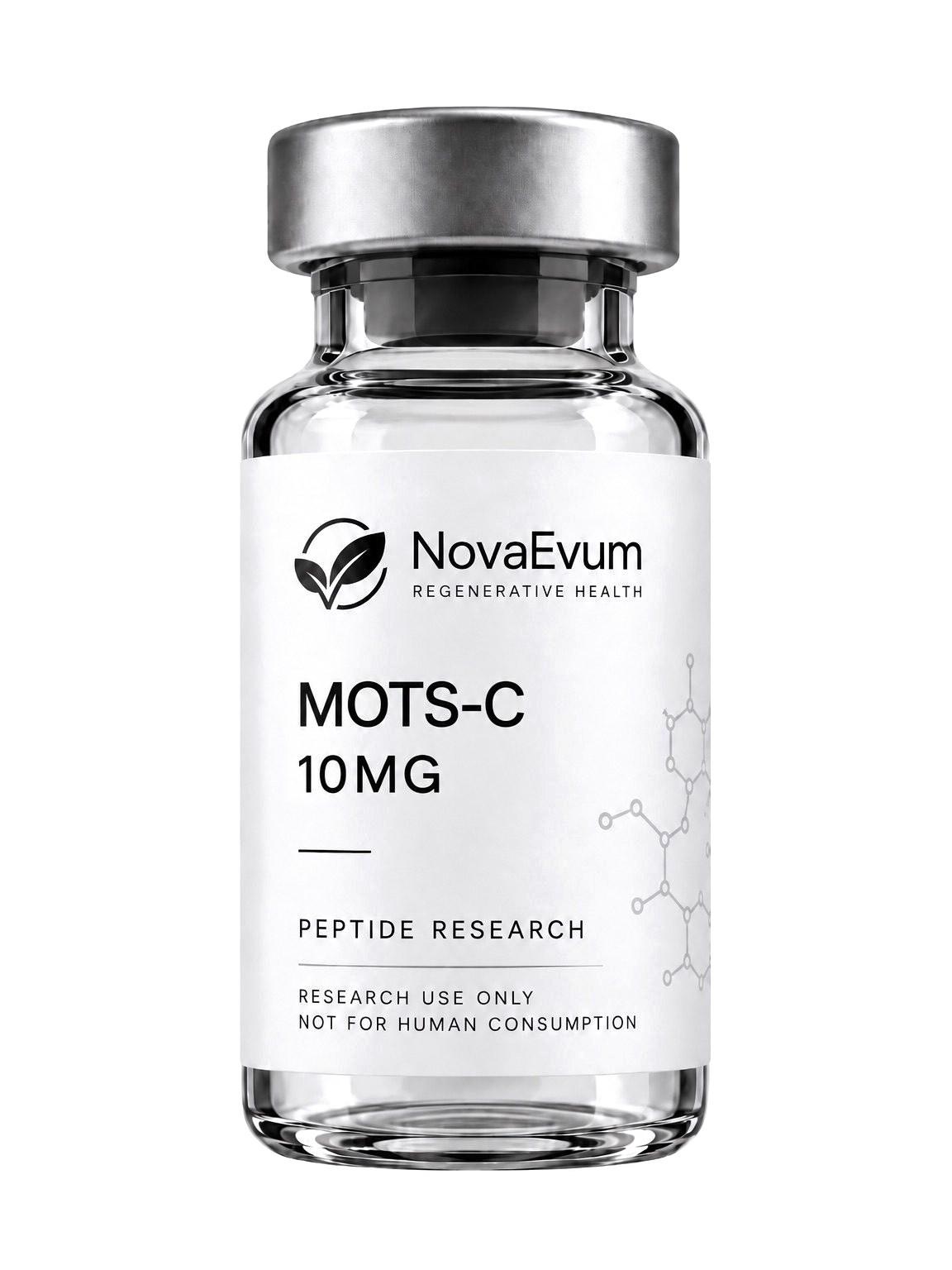
Supplied in 10 mg and 40 mg vials.
MOTS-c is a mitochondrial-derived peptide, encoded in mitochondrial DNA rather than in the nucleus, and one of the few known. Cell and rodent work covers mitochondrial-to-nuclear signalling, AMPK, and glucose and fatty-acid handling, including diet-induced obesity and exercise models. Human studies have measured it as a circulating marker in ageing and around exercise, without testing it as an intervention.
- Peptide, 16 amino acids
- Lyophilized powder, requires reconstitution
Price
$60.00 CAD
$6.00 / mg
In stock
- 24/7 customer support
- Lab tested purity & quality
- Free shipping on all orders




MOTS-c in Canada
Ships from Toronto to anywhere in Canada, priced in Canadian dollars, payable by Interac e-Transfer or card.
Specification
- CAS number
- 1627580-64-6
- Molecular formula
- C101H152N28O22S2
- Molecular weight
- 2,174.6 g/mol
- Sequence
- MRWQEMGYIFYPRKLR
- Purity
- ≥ 99.41% by RP-HPLC
- Form
- Lyophilized powder
- Third-party assay
- Purity and fill
- Storage
- -20 °C, protected from light
- Lot
- NVE-2429-A
How it works
Where the peptide is encoded is what sets the research question. A sequence written in mitochondrial DNA is studied as a signal travelling outwards to the nucleus, and what cell and rodent work measured while that signal was present is the subject of everything below — not energy in a person.
Mitochondrial-to-nuclear signalling
Where it was characterised
Encoded in the mitochondrial 12S rRNA region and studied as a retrograde signal from the mitochondrion to nuclear gene expression. That origin is why it is studied on its own terms rather than as another nuclear-encoded peptide.
AMPK and nutrient handling
Pathways in the cell work
Cell and rodent studies of AMPK signalling and of glucose and fatty-acid metabolism. This is the bulk of the metabolic literature, and it is work in models, not a finding about anybody’s energy use.
Metabolic stress models
What the animal work used
Diet-induced obesity and exercise models in rodents, measuring how those metabolic insults were handled when the peptide was present. Adaptation in a mouse is not adaptation in a person.
Circulating marker in humans
What the human work actually is
Human studies have measured MOTS-c in blood in ageing and around exercise, as a marker. They have not tested the peptide as an intervention, so exercise capacity and recovery are not findings this page can carry.
Where the evidence stands
Preclinical. No controlled human efficacy trials have been published. Not approved as a medicine.
Laboratory results
Opened as the laboratory issued them, unedited. Every certificate we publish
Research reading
New MOTS-c research
- Week of 9 November 2026Associations of Serum MOTS-c with Exercise Capacity and Antioxidant Markers in Young Males: A Cross-Sectional StudyAntioxidants (Basel) · 2026 Oct
- Week of 2 November 2026Integrative transcriptomic and computational analysis associates Ms4a6c+ macrophages with fibrosis in radiation proctitis and computationally nominates MOTS-c as a candidate modulatorFront Immunol · 2026
Research use only
Supplied as a laboratory research chemical. Not a drug, food or cosmetic, and not for human or veterinary use. No application guidance is provided or implied.
What MOTS-c is
Almost every peptide in a research catalogue is a fragment of something the cell nucleus encodes. MOTS-c is not. It is written into mitochondrial DNA, inside the 12S ribosomal RNA gene, in a short open reading frame. Lee and colleagues reported it in 2015, after humanin had shown that the mitochondrial genome could encode peptides at all.
That origin is the genuinely unusual thing about MOTS-c, and it is a fact about genetics rather than a claim about anything it does.
| Property | MOTS-c |
|---|---|
| Length | 16 amino acids |
| Encoded in | Mitochondrial DNA, within the 12S rRNA gene |
| First reported | 2015 |
| Name | Mitochondrial open reading frame of the 12S rRNA type-c |
References
- Lee et al., Cell Metabolism, 2015. PMID 25738459
MOTS-c research: what has been studied
The 2015 paper placed its cellular action in folate metabolism and the purine synthesis tied to it, with AMPK, the enzyme that reads a cell’s energy status, downstream. Later mouse work, including a 2021 study by Reynolds and colleagues, examined it alongside exercise and age.
In people, the record is observational: circulating MOTS-c measured across ageing and around exercise, and a gene variant within its reading frame found in East Asian populations. No controlled human trial of the peptide exists, and much of the literature traces to one research group.
| Research area | What was examined | Evidence stage |
|---|---|---|
| Cellular metabolism | Folate pathway and AMPK in cells | Cell |
| Metabolism in mice | Diet and ageing models | Animal |
| Exercise | Mouse studies; human levels measured | Animal and observational |
| People | Blood levels and a gene variant | Observational only |
MOTS-c research: published studies
The papers below are the backbone of the MOTS-c literature, in the order they appeared. Most of the mechanistic work comes from one laboratory, the group that reported the peptide, and none of it is a trial of the research material sold here.
We do not quote study figures on this page. A result belongs to the study that produced it, and the papers, linked below, are the place to read it.
| Study | What it examined | Journal |
|---|---|---|
| Lee et al., 2015 | Discovery: the reading frame in 12S rRNA, with cell and mouse work | Cell Metab |
| Fuku et al., 2015 | An East Asian variant in its reading frame, and longevity | Aging Cell |
| Ming et al., 2016 | A mouse model of bone loss after ovariectomy | Biochem Biophys Res Commun |
| Kim et al., 2018 | Movement to the nucleus under metabolic stress | Cell Metab |
| Knoop et al., 2019 | A mass spectrometry method to detect it in plasma, for doping control | Rapid Commun Mass Spectrom |
| D’Souza et al., 2020 | Levels in the skeletal muscle of healthy older men | Aging |
| Reynolds et al., 2021 | Exercise and age in mice; levels measured around exercise in people | Nat Commun |
| Zempo et al., 2021 | The East Asian variant and type 2 diabetes in three cohorts | Aging |
| Kumagai et al., 2024 | Binding to the enzyme CK2 in skeletal muscle | iScience |
References
- Lee et al., Cell Metabolism, 2015. PMID 25738459
- Fuku et al., Aging Cell, 2015. PMID 26289118
- Ming et al., Biochemical and Biophysical Research Communications, 2016. PMID 27237975
- Kim et al., Cell Metabolism, 2018. PMID 29983246
- Knoop et al., Rapid Communications in Mass Spectrometry, 2019. PMID 30394592
- D’Souza et al., Aging, 2020. PMID 32182209
- Reynolds et al., Nature Communications, 2021. PMID 33473109
- Zempo et al., Aging, 2021. PMID 33468709
- Kumagai et al., iScience, 2024. PMID 39559755
MOTS-c vs SS-31
Both are called mitochondrial peptides, and that is where the resemblance ends. One is made by mitochondria; the other is a synthetic molecule designed to reach them.
| MOTS-c | SS-31 | |
|---|---|---|
| Origin | Encoded in mitochondrial DNA | Designed in a laboratory |
| Length | 16 amino acids | 4 amino acids |
| What it is studied at | Folate pathway and AMPK | Cardiolipin in the inner membrane |
| Furthest evidence | Animal; human levels observed | Clinical trials, as elamipretide |
How this MOTS-c is tested
Two questions matter about any vial of research peptide: is it the molecule on the label, and what else is in it. They are answered by different tests, and a certificate is only as useful as knowing which of the two it covers.
High-performance liquid chromatography (HPLC) answers the second. It separates the contents of a sample and reports how much of what it detects is the main component. That figure belongs to the lot that was tested, which is why it is stated on each certificate and not here.
Mass spectrometry answers the first. It measures the mass of the molecule, which for MOTS-c should match a molecular weight of about 2,174.6. HPLC alone does not establish identity; a certificate that reports a mass result does.
Every certificate published for this compound is linked under Laboratory results above, with the laboratory, the test date and the vial size it covers. Read each for which tests it reports.
Buying MOTS-c in Canada
NovaEvum ships MOTS-c from Toronto to every province and territory, in 10 mg and 40 mg sizes, priced in Canadian dollars.
Orders placed before 2:00 PM ET on a working day are dispatched the same day by tracked express parcel, which reaches most of Canada in one to two working days and remote areas a little later. In the Greater Toronto Area, larger orders placed before the cutoff can be couriered the same evening; the threshold is on our shipping page. Shipping is free on every order.
Pay by Interac e-Transfer, which takes 10% off the goods, or by card. Because the order ships from inside Canada, it never crosses a border: there is no customs declaration and no import hold.
Storage and laboratory handling
The specification for MOTS-c is -20 °C, protected from light. Keep sealed vials frozen and away from light.
Lyophilised material tolerates ambient temperature in transit; put it back into cold storage on arrival. Let a cold vial reach room temperature before opening it, so moisture does not condense on the powder.
MOTS-c FAQ
What is MOTS-c?
A 16-amino-acid peptide encoded in the mitochondrial genome, within the 12S rRNA gene. Its name abbreviates mitochondrial open reading frame of the 12S rRNA type-c.
Where does MOTS-c come from?
It is encoded in mitochondrial DNA, in a short open reading frame inside the 12S ribosomal RNA gene. Lee and colleagues reported it in 2015; it is one of only a handful of known peptides encoded by the mitochondrial genome.
Has MOTS-c been tested in human trials?
No controlled human trial of the peptide has been published. The human literature is observational: blood levels measured across ageing and exercise, and a gene variant in its reading frame found in East Asian populations.
What is the m.1382A>C variant?
A mitochondrial DNA variant found in Northeast Asian populations that changes one amino acid of MOTS-c, written K14Q. It has been studied for associations with longevity and with type 2 diabetes in population cohorts.
Can MOTS-c be detected in a doping test?
A mass spectrometry method for detecting it in plasma, developed for doping control, was published in 2019 (Knoop and colleagues, Rapid Communications in Mass Spectrometry).
Is MOTS-c the same as humanin?
No. Both are peptides encoded by mitochondrial DNA, which is why they are discussed together, but they come from different genes and have different sequences and literatures. Humanin was reported first.
Which MOTS-c sizes are available?
10 mg and 40 mg, as lyophilised powder. The size selector above shows the current price and stock for each.
How is MOTS-c shipped within Canada?
From Toronto by tracked express parcel, dispatched the same working day for orders before 2:00 PM ET. Most of Canada receives it in one to two working days. Shipping is free on every order.
How should MOTS-c be stored?
At -20 °C, protected from light, sealed and away from light. Return it to cold storage on arrival.
Can I see a certificate of analysis before ordering?
Yes. Every certificate published for this compound is linked under Laboratory results on this page, stating the laboratory, the date and the vial size it covers. For the certificate covering a specific lot, contact us before ordering.
Is MOTS-c for human use?
No. It is supplied as a laboratory research chemical: not a drug, food or cosmetic, and not for human or veterinary use. No application guidance is provided or implied.