
Blends
What Is MitoPrime? NAD+, MOTS-c and 5-Amino-1MQ in One Vial, Explained
JH
· 6 min read
A summary of published research, with citations. It states no amount, schedule or route, and makes no claim about what this compound does in a person. Supplied for laboratory research use only.
On this page · 9 sections
MitoPrime is a research blend of three compounds studied in cellular energy research, supplied together in one vial: NAD+ (100 mg), MOTS-c (10 mg) and 5-Amino-1MQ (10 mg), 120 mg in total. Only one of the three, MOTS-c, is a peptide; NAD+ is a coenzyme and 5-Amino-1MQ is a small molecule. They were chosen because their literatures meet at the same place: the mitochondrion, and the NAD+ that cells depend on to turn food into usable energy. The combination itself has never been studied. This article explains what each component is, how far its evidence goes, and why a blend can carry no more evidence than its parts.
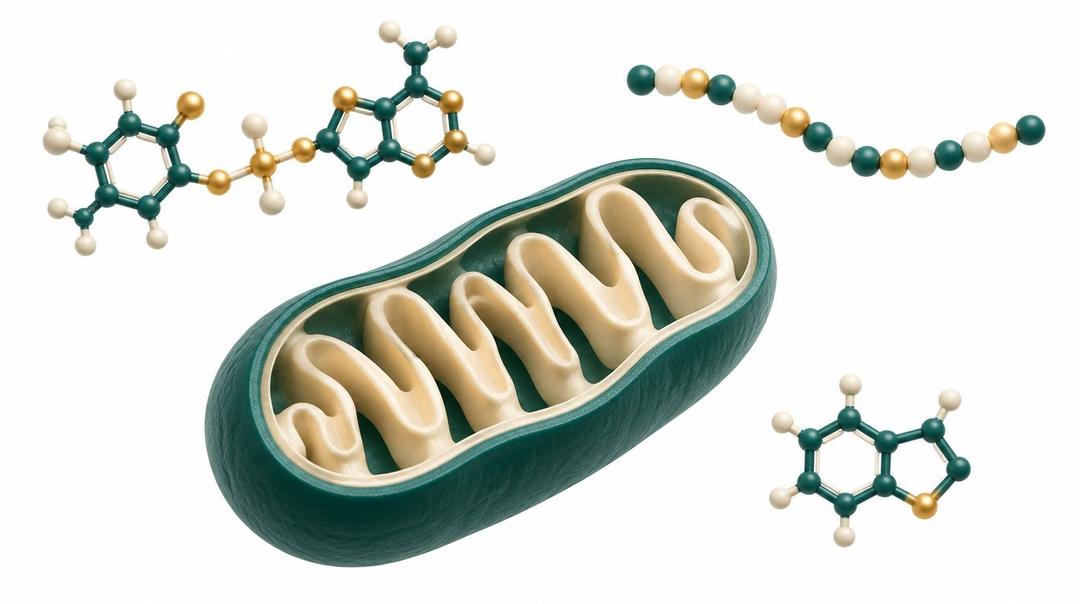
What is in MitoPrime?
| Component | Amount per vial | What it is | Evidence stage |
|---|---|---|---|
| NAD+ | 100 mg | A coenzyme present in every living cell | Basic science; little on NAD+ supplied from outside |
| MOTS-c | 10 mg | A 16-amino-acid peptide encoded in mitochondrial DNA | Mostly animal; small human association studies |
| 5-Amino-1MQ | 10 mg | A small-molecule inhibitor of the enzyme NNMT | Animal and cell work |
The amounts are what the vial contains, not a ratio anyone has tested: no study has examined these three compounds together, in this or any proportion.
The common thread: NAD+ and the mitochondrion
The three compounds are linked by biology rather than by any shared trial.
NAD+ (nicotinamide adenine dinucleotide) carries electrons in the reactions that generate ATP, and is consumed by enzymes such as sirtuins and PARPs. Cells keep their supply topped up by recycling nicotinamide through what is called the salvage pathway.
5-Amino-1MQ acts on that recycling. It inhibits nicotinamide N-methyltransferase (NNMT), an enzyme that tags nicotinamide for disposal instead of reuse. The hypothesis in its literature is that blocking NNMT leaves more nicotinamide available to rebuild NAD+.
MOTS-c comes at energy metabolism from another direction: it is a signalling peptide encoded in the mitochondrion's own DNA, studied for its effects on metabolic pathways in muscle.
So two of the three bear on the size of the NAD+ pool, and the third on mitochondrial signalling. That is a reasonable rationale for studying them side by side. It is not evidence that they do anything together.
NAD+: a coenzyme, not a peptide
NAD+ is among the most studied molecules in biochemistry, and its levels have been reported to fall with age in some tissues. The difficulty is getting from that to a vial. Most of the encouraging animal work on "raising NAD+" used precursors, nicotinamide mononucleotide (NMN) and nicotinamide riboside (NR), rather than NAD+ itself, as Rajman, Chwalek and Sinclair set out in their review of the in vivo evidence (PMID 29514064). Whether NAD+ supplied from outside a cell gets in intact is itself an open question. The full picture is in what NAD+ is.
MOTS-c: a peptide from the mitochondrial genome
MOTS-c is a 16-amino-acid peptide encoded within the mitochondrial gene for 12S ribosomal RNA. Lee and colleagues described it in 2015, reporting that in mice it acted on skeletal muscle through the energy-sensing enzyme AMPK and altered how the animals handled a high-fat diet (PMID 25738459). Human work so far measures how much MOTS-c people naturally carry: a 2026 cross-sectional study of 30 young men found circulating levels rose with fitness, from sedentary men to elite athletes, though a snapshot cannot show which causes which (PMID 42939841). More in what MOTS-c is.
5-Amino-1MQ: an NNMT inhibitor
The NNMT story began genetically. Kraus and colleagues reduced NNMT in mice with an antisense oligonucleotide and reported that the animals were protected from diet-induced weight gain (PMID 24717514). Neelakantan and colleagues then developed small, membrane-permeable NNMT inhibitors of the class 5-Amino-1MQ belongs to and reported reduced fat mass in obese mice (PMID 29155147). It is all preclinical, and much of it uses other members of the same chemical class. See what 5-Amino-1MQ is.
Why a blend has no evidence of its own
A mixture is not a studied compound. Every statement about MitoPrime's components comes from separate studies of each one, in different models, at different amounts, often by different routes. Combining them raises questions none of those studies answer: whether the three are stable together in one vial, whether one affects how another behaves, and whether any effect of one is changed by the others. Combining compounds multiplies unknowns rather than evidence.
The practical case for a blend is convenience and consistency: one vial, one set of documentation and the same ratio every time. That is a reason a laboratory might choose it; it is not a finding about what it does.
Is MitoPrime approved anywhere?
No. None of the three components is an approved drug in Canada for any use, and the combination has never been reviewed by any regulator. NAD+ precursors are sold as supplements in some markets, which does not extend to a research blend. The general framework is set out in peptides and Canadian law.
Supplied here for laboratory use: MitoPrime. For laboratory research use only.
The findings above describe each compound in the cells, animals and people studied, not any laboratory reagent. Nothing here is medical, dosing, or therapeutic guidance.
Frequently asked questions
What is in MitoPrime? NAD+, MOTS-c and 5-Amino-1MQ: 100 mg, 10 mg and 10 mg, 120 mg in total.
Has MitoPrime itself been studied? No. There is no published study of these three compounds together. What is known comes from each one's separate literature.
Is MitoPrime a peptide? Partly. MOTS-c is a peptide; NAD+ is a coenzyme and 5-Amino-1MQ is a small molecule.
Why are these three combined? Their literatures meet in mitochondrial and NAD+ biology: NAD+ itself, an inhibitor of an enzyme that drains the NAD+ salvage pathway, and a mitochondrial signalling peptide. That is a rationale for studying them, not a demonstrated effect.
Selected Research References
- Rajman L, Chwalek K, Sinclair DA. Therapeutic Potential of NAD-Boosting Molecules: The In Vivo Evidence. Cell Metabolism. 2018;27(3):529-547. pubmed.ncbi.nlm.nih.gov/29514064
- Lee C, Zeng J, Drew BG, et al. The mitochondrial-derived peptide MOTS-c promotes metabolic homeostasis and reduces obesity and insulin resistance. Cell Metabolism. 2015;21(3):443-454. pubmed.ncbi.nlm.nih.gov/25738459
- Zhang Z, Zhang X, Wang C, et al. Associations of Serum MOTS-c with Exercise Capacity and Antioxidant Markers in Young Males: A Cross-Sectional Study. Antioxidants. 2026;15(10). pubmed.ncbi.nlm.nih.gov/42939841
- Kraus D, Yang Q, Kong D, et al. Nicotinamide N-methyltransferase knockdown protects against diet-induced obesity. Nature. 2014;508(7495):258-262. pubmed.ncbi.nlm.nih.gov/24717514
- Neelakantan H, Vance V, Wetzel MD, et al. Selective and membrane-permeable small molecule inhibitors of nicotinamide N-methyltransferase reverse high fat diet-induced obesity in mice. Biochemical Pharmacology. 2018;147:141-152. pubmed.ncbi.nlm.nih.gov/29155147
Further reading
All products sold by NovaEvum are for research and laboratory use only. They are not intended for human or animal consumption, diagnosis, treatment, cure, or prevention of any disease.