
Testing, quality and handling
D-Amino Acids in Peptides: Chirality, Protease Resistance and Racemisation
NB
· 10 min read
A summary of published research, with citations. It states no amount, schedule or route, and makes no claim about what this compound does in a person. Supplied for laboratory research use only.
On this page · 6 sections
A D-amino acid is the mirror image of the L-form that ribosomes use. The atoms and the mass are identical; only the arrangement around the alpha carbon differs. That difference is invisible to a mass spectrometer and often to a chromatogram, but it is decisive for enzymes, which recognise shape. Peptide chemists install D-residues deliberately to slow proteolysis, and the same residues appear accidentally, as racemisation impurities, when synthesis or analysis inverts a centre that should have stayed put.
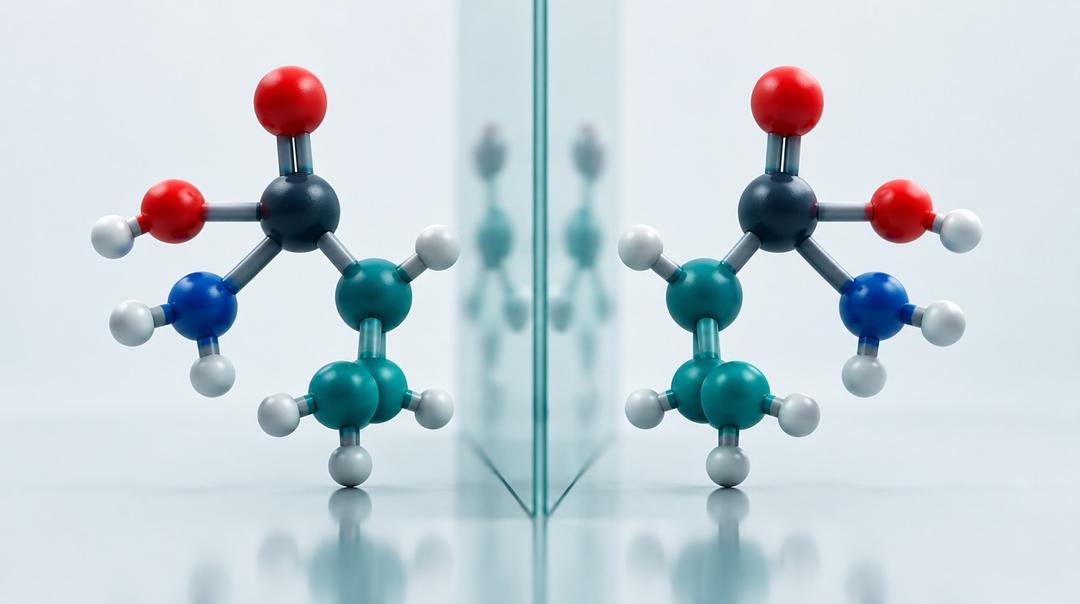
What makes an amino acid D or L?
Nineteen of the twenty proteinogenic amino acids have a chiral alpha carbon carrying four different groups: an amine, a carboxyl, a hydrogen and a side chain. Two arrangements are possible and they are not superimposable, like a left and a right hand. Glycine is the exception, its side chain being a second hydrogen.
Biology picked one hand. Ribosomal protein synthesis uses L-amino acids throughout, so every enzyme that acts on peptides evolved against L-substrates. A D-residue in a chain is therefore chemically ordinary and biologically foreign — the same bonds, presented the wrong way round.
D-residues do occur in nature, by post-translational conversion rather than by translation. Jilek and colleagues isolated an enzyme from the skin secretions of frogs of the genus Bombina that isomerises an L-isoleucine at the second position of a model peptide to D-allo-isoleucine, with no cofactor required, and found related polypeptides in several vertebrate species including humans (PMID 15758070). The amphibian opioid peptide dermorphin, which carries a D-alanine, was characterised from frog skin in the early 1980s.
Why do D-residues resist proteases?
Because a protease active site is a chiral pocket. It holds the backbone in a particular geometry so that the catalytic machinery meets the scissile bond; invert one alpha carbon and the side chain points the wrong way, the backbone cannot adopt the required conformation, and the bond is not cleaved. The effect is local, which is why a single well-placed substitution can protect a peptide without rebuilding it.
Tugyi and colleagues quantified this on an epitope from the MUC2 mucin. They substituted up to three D-amino acids into the flanking regions on each side of the recognised core, left the core itself untouched, and measured both antibody binding and stability in diluted human serum and a lysosomal preparation. The partly D-substituted peptide retained its epitope function and showed high resistance to proteolytic degradation (PMID 15630090). The design principle is general: protect the ends, where exopeptidases attack, and leave the recognition surface alone.
The strategy is widespread in antimicrobial peptide design, where Li and colleagues reviewed the consistent improvements D-substitution brings to host-defence peptides (PMID 27376281). It also sits alongside the other half-life extension strategies — lipidation, albumin binding, backbone modification — collected in peptide half-life explained.
Which designed peptides contain D-residues?
Several well-studied molecules, including two carried in this catalogue.
| Peptide | D-residues reported | Evidence stage and status |
|---|---|---|
| Octreotide (SMS 201-995) | D-phenylalanine at the N-terminus and D-tryptophan within the ring (PMID 6128648) | A licensed somatostatin analogue in many jurisdictions; reviewed in the clinical literature since the 1980s |
| SS-31 / elamipretide | D-arginine at position one (PMID 17429296) | Cell, animal and human trial work; granted accelerated approval in the United States for one ultra-rare disorder, and not authorised in Canada |
| Ipamorelin | D-2-naphthylalanine and D-phenylalanine within a pentapeptide (PMID 9849822) | Preclinical pharmacology in rat and swine; not an approved medicine in any jurisdiction |
Bauer and colleagues described octreotide as a stepwise-modified somatostatin analogue that was highly resistant to degradation by pure enzymes and tissue homogenates and much longer acting than the native hormone (PMID 6128648). The D-residues are part of why. Native somatostatin is cleared within minutes; the analogue is not.
SS-31's first residue is D-arginine, in the sequence D-Arg-Dmt-Lys-Phe-NH2, where Dmt is 2',6'-dimethyltyrosine — a residue that does not occur in proteins either. Cho and colleagues state the structure explicitly in comparing it against a related analogue lacking the scavenging group (PMID 17429296). The compound's trial record, which is mixed, is set out in what SS-31 is.
Supplied here for laboratory use: SS-31. The laboratory's certificate for each lot is linked from its product page. For laboratory research use only.
Ipamorelin, which Raun and colleagues reported as a pentapeptide with the composition Aib-His-D-2-Nal-D-Phe-Lys-NH2, releases growth hormone from rat pituitary cells with potency comparable to GHRP-6 and, unusually for that class, did not raise ACTH or cortisol in swine at amounts far above its effective range (PMID 9849822). That paper is preclinical; the selectivity claim belongs to those animal experiments. The compound is discussed further in ipamorelin's half-life and selectivity.
When is a D-residue an impurity?
Whenever it was not intended — and synthesis produces them.
Activating an amino acid's carboxyl group for coupling makes its alpha proton more acidic, and an abstracted proton can return to the opposite face, inverting the centre. Palasek and colleagues measured this in microwave-accelerated Fmoc synthesis of a model 20-residue peptide containing all twenty natural amino acids, and found cysteine, histidine and aspartic acid the susceptible residues. Lowering the coupling temperature limited histidine and cysteine racemisation; a hindered base reduced D-cysteine formation; and additives in the deprotection solution reduced aspartimide formation and the aspartate racemisation that follows it (PMID 17121420). The surrounding synthesis chemistry is covered in solid-phase peptide synthesis.
Strege and colleagues describe the three origins compactly: D-isomers enter as impurities in the amino acid starting materials, form during synthesis, and in some cases appear over a product's shelf life (PMID 36857849). The last of those connects to degradation chemistry — the succinimide intermediate that drives asparagine deamidation and aspartate isomerisation also racemises, which is why peptide degradation pathways ends up producing the same species that bad synthesis does.
A racemised impurity is the hardest kind to catch. It has exactly the intended mass, so an intact mass measurement sees nothing, and tandem mass spectrometry sees nothing either, since fragmentation does not distinguish the two forms. On reverse-phase HPLC a diastereomer may or may not separate: Hartmann and colleagues separated diastereomeric amphipathic helices by both reverse-phase and mixed-mode chromatography, but their peptides were designed so the substitution sat in a structurally sensitive position (PMID 13677645). For a short, unstructured peptide the two forms can co-elute and report as one peak, which is the blind spot named in HPLC and LC-MS testing.
How is chirality measured?
Three approaches, and all of them have to solve the same contamination problem first.
Marfey's method. The peptide is hydrolysed to free amino acids, which are then reacted with a chiral derivatising reagent — 1-fluoro-2,4-dinitrophenyl-5-L-alanine amide. D- and L-amino acids become diastereomers rather than enantiomers, and diastereomers separate on an ordinary reverse-phase column. Bhushan and Brückner's review covers the reagent, its analogues and the precautions (PMID 15503232), and a later assessment by Sethi and colleagues surveys a further decade of enantioseparation work with it (PMID 32959901).
Chiral chromatography. A chiral stationary phase separates the enantiomers directly, without derivatisation. Strege and colleagues validated a direct chiral HPLC method with tandem mass spectrometric detection across all nineteen chiral proteinogenic amino acids, and recovered deliberately introduced D-substitutions at every residue of an octapeptide across the 0.1 to 1.0% range (PMID 36857849).
The deuterated-acid trick, which both need. Hydrolysis itself racemises some of what it releases, so a measured D-content is partly an artefact of the measurement. Goodlett and colleagues solved this by hydrolysing in deuterated hydrochloric and acetic acid: any amino acid that racemises in the tube picks up one deuterium at its alpha carbon and is one mass unit heavier, so mass spectrometry separates the artefact from the real thing. They used it to determine the chiral purity of every residue in a hexapeptide by-product found in a kilogram batch of thymopentin (PMID 7633594). Weiss and colleagues' finding that microwave-accelerated hydrolysis racemises more than conventional heating is the same problem seen from the other side (PMID 9528102).
None of this appears on an ordinary research-chemical certificate. The general composition check that shares the hydrolysis step is amino acid analysis, and what a certificate covers in general is in what a certificate of analysis establishes. Nothing here is medical, dosing, or therapeutic guidance.
Frequently asked questions
Does a D-amino acid change a peptide's molecular weight? No. The two forms are enantiomers with identical atoms and identical mass, so a mass spectrometer cannot distinguish them at any resolution. This is why chiral purity needs its own method and why an intact-mass identity check on a certificate is silent about stereochemistry entirely.
Are all D-containing peptides more stable? Not automatically. Protection depends on where the substitution sits relative to the bonds proteases attack, and a substitution inside a binding surface can destroy activity while protecting the backbone. The Tugyi work succeeded because the D-residues went into the flanking regions and the recognised core was left as L.
Do D-amino acids occur naturally in animals? Yes, in a small number of peptides, produced by enzymatic isomerisation after translation rather than by the ribosome. The isomerase from Bombina skin secretions converts a specific L-isoleucine to D-allo-isoleucine, and related sequences exist in other vertebrates. Free D-amino acids such as D-serine also occur and have their own biology.
Can HPLC detect a racemised impurity? Sometimes. A peptide containing one D-residue is a diastereomer of the intended one, not an enantiomer, so it can separate on an achiral column — but whether it does depends on the sequence, the position and the method. Short, flexible peptides frequently give one unresolved peak, which is why the dedicated chiral methods exist.
What is the specification for chiral purity in peptide manufacturing? It varies by product and by regulator, but the analytical work is written around the sub-percent range: the chiral HPLC method cited here was demonstrated recovering D-substitutions between about a tenth of a percent and one percent at each residue. No general number applies across compounds, and research-grade material is typically not tested for this at all.
Selected Research References
- Tugyi R, Uray K, Iván D, et al. Partial D-amino acid substitution: improved enzymatic stability and preserved Ab recognition of a MUC2 epitope peptide. Proceedings of the National Academy of Sciences. 2005;102(2):413-418. pubmed.ncbi.nlm.nih.gov/15630090
- Bauer W, Briner U, Doepfner W, et al. SMS 201-995: a very potent and selective octapeptide analogue of somatostatin with prolonged action. Life Sciences. 1982;31(11):1133-1140. pubmed.ncbi.nlm.nih.gov/6128648
- Cho J, Won K, Wu D, et al. Potent mitochondria-targeted peptides reduce myocardial infarction in rats. Coronary Artery Disease. 2007;18(3):215-220. pubmed.ncbi.nlm.nih.gov/17429296
- Raun K, Hansen BS, Johansen NL, et al. Ipamorelin, the first selective growth hormone secretagogue. European Journal of Endocrinology. 1998;139(5):552-561. pubmed.ncbi.nlm.nih.gov/9849822
- Palasek SA, Cox ZJ, Collins JM. Limiting racemization and aspartimide formation in microwave-enhanced Fmoc solid phase peptide synthesis. Journal of Peptide Science. 2007;13(3):143-148. pubmed.ncbi.nlm.nih.gov/17121420
- Strege MA, Oman TJ, Risley DS, et al. Enantiomeric purity analysis of synthetic peptide therapeutics by direct chiral high-performance liquid chromatography-electrospray ionization tandem mass spectrometry. Journal of Chromatography B. 2023;1219:123638. pubmed.ncbi.nlm.nih.gov/36857849
- Goodlett DR, Abuaf PA, Savage PA, et al. Peptide chiral purity determination: hydrolysis in deuterated acid, derivatization with Marfey's reagent and analysis using high-performance liquid chromatography-electrospray ionization-mass spectrometry. Journal of Chromatography A. 1995;707(2):233-244. pubmed.ncbi.nlm.nih.gov/7633594
- Bhushan R, Brückner H. Marfey's reagent for chiral amino acid analysis: a review. Amino Acids. 2004;27(3-4):231-247. pubmed.ncbi.nlm.nih.gov/15503232
- Jilek A, Mollay C, Tippelt C, et al. Biosynthesis of a D-amino acid in peptide linkage by an enzyme from frog skin secretions. Proceedings of the National Academy of Sciences. 2005;102(12):4235-4239. pubmed.ncbi.nlm.nih.gov/15758070
- Li H, Anuwongcharoen N, Malik AA, et al. Roles of D-amino acids on the bioactivity of host defense peptides. International Journal of Molecular Sciences. 2016;17(7):1023. pubmed.ncbi.nlm.nih.gov/27376281
All products sold by NovaEvum are for research and laboratory use only. They are not intended for human or animal consumption, diagnosis, treatment, cure, or prevention of any disease.