
Foundations
Peptide Half-Life Explained: Plasma Clearance, Shelf Stability and Extension Strategies
EW
· 9 min read
A summary of published research, with citations. It states no amount, schedule or route, and makes no claim about what this compound does in a person. Supplied for laboratory research use only.
On this page · 6 sections
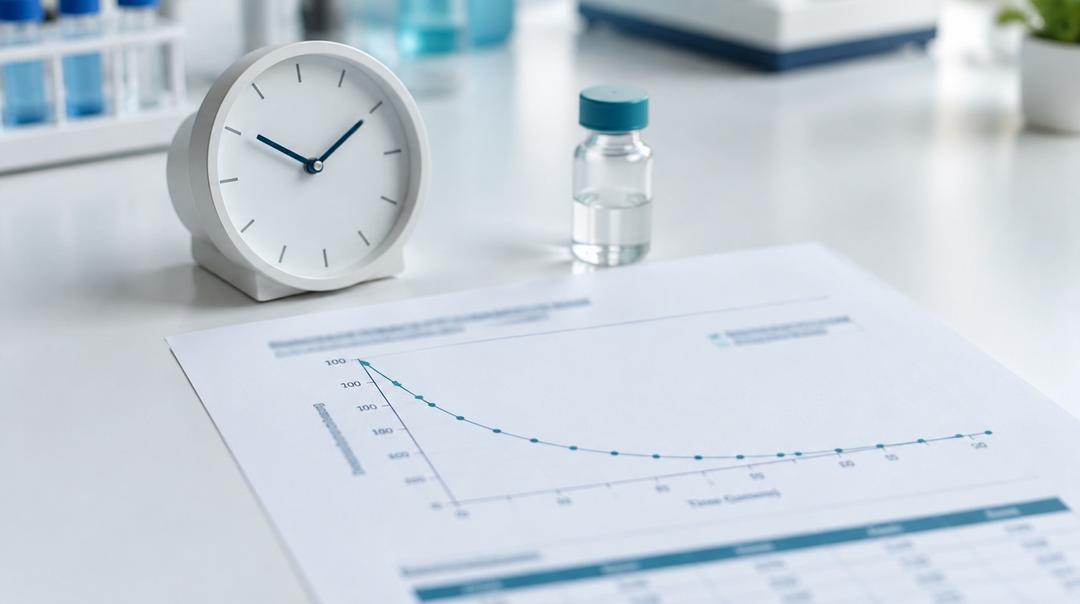
A peptide's half-life usually means its plasma half-life: the time for its concentration in blood to fall by half, measured in a defined population with a defined assay. It is not shelf stability, how long material stays intact in a vial, nor the duration of a biological effect, which can outlast the drug or fall short of it. Native peptides clear fast because proteases cleave them and the kidneys filter them. Lipidation, albumin binding, PEGylation, Fc fusion and D-amino acid substitution extend it in approved medicines.
What does "half-life" mean for a peptide?
Three different quantities share the word, and most confusion online comes from mixing them.
| Quantity | What it describes | How it is measured | What it does not tell you |
|---|---|---|---|
| Plasma (elimination) half-life | How quickly circulating concentration falls once distribution is complete | Serial blood sampling and a validated assay, analysed by a pharmacokinetic model | How long any effect lasts, or how long the vial keeps |
| Chemical or shelf stability | How quickly the material degrades in storage, as powder or solution | Stability-indicating HPLC and LC-MS over time under defined conditions | Anything about behaviour in a living system |
| Duration of biological effect | How long a measured response stays changed | Biomarker or outcome sampling over time | The drug's own concentration, which may already be gone |
A half-life is also tied to the molecule, the species, the population, the assay and the model. A figure quoted without those is close to meaningless, a point made in this site's ipamorelin half-life and selectivity article. Shelf stability is a separate chemistry question, covered in peptide degradation pathways and lyophilised peptides; a long plasma half-life does not make a peptide more stable in a vial, and vice versa.
Why do natural peptides have such short half-lives?
Two mechanisms dominate, and they act together.
Proteolysis. Peptidases are everywhere: in blood, on cell surfaces, in the liver and kidney. Diao and Meibohm note that unmodified peptides usually undergo extensive proteolytic cleavage, resulting in short plasma half-lives, and that because proteases are ubiquitous, degradation is not limited to the classic elimination organs (PMID 23719681). Some enzymes are highly specific. Dipeptidyl peptidase-4 removes the first two residues from peptides with alanine or proline in position two; Deacon describes it as the key enzyme regulating the biological activity of the incretin hormone GLP-1 (PMID 30828317). Growth-hormone-releasing hormone is a substrate too, which matters below.
Renal filtration. Peptides are small. Diao and Meibohm define therapeutic peptides as chains under 50 amino acids and under 10 kDa, and note that they are generally freely filtered by the kidneys, with glomerular filtration and renal proteolysis contributing to elimination (PMID 23719681). Werle and Bernkop-Schnürch likewise name fast renal clearance and enzymatic degradation in circulation as the common causes of short half-lives (PMID 16622600).
Somatostatin shows the scale. Werle and Bernkop-Schnürch report its plasma half-life as only a few minutes (PMID 16622600).
How do drug developers extend peptide half-life?
Every strategy attacks one or both clearance routes: make the molecule resist proteases, make it too large to filter, or make it bind something that is too large to filter.
Amino acid substitution, including D-amino acids. Proteases recognise L-amino acid sequences. Replacing vulnerable residues, or using D-amino acids that proteases handle poorly, slows cleavage. Octreotide is the textbook case: by shortening somatostatin and substituting D-amino acids, its plasma half-life became 1.5 hours against a few minutes for the parent (PMID 16622600). Octreotide is an approved medicine in Canada and elsewhere. Terminal modifications, such as amidation of the carboxyl end or acetylation of the amino end, block exopeptidases in the same spirit.
Lipidation and reversible albumin binding. Attaching a fatty acid lets the peptide bind serum albumin, a large, abundant protein that is not filtered and recycles with a long life of its own. While bound, the peptide is protected from filtration and partly from proteases. Knudsen and Lau describe how liraglutide and semaglutide were protracted by reversible binding to albumin, with fatty acid and linker combinations chosen to maximise albumin binding while keeping GLP-1 receptor potency (PMID 31031702). Both are approved medicines in Canada, for defined indications.
Covalent albumin attachment (DAC). Instead of reversible binding, a reactive group can be built into the peptide to bond covalently to albumin after it enters circulation. Jetté and colleagues attached a maleimide-bearing lysine to a tetrasubstituted growth-hormone-releasing factor(1–29) analogue so that it would bond to the free cysteine on serum albumin; the conjugates resisted dipeptidyl peptidase-4 in vitro, and the selected compound, CJC-1295, remained in rat plasma beyond 72 hours (PMID 15817669). In healthy adults, Teichman and colleagues estimated its half-life at 5.8 to 8.1 days (PMID 16352683). CJC-1295 has never been approved as a medicine anywhere. The difference between that DAC-bearing molecule and products sold as CJC-1295 without DAC is the subject of sermorelin vs CJC-1295; half-life findings for one do not transfer to the other.
PEGylation. Attaching polyethylene glycol chains increases a molecule's size and shields it from proteases. Harris and Chess describe how this reduces renal clearance and proteolysis and can reduce immunogenicity (PMID 12612647). Werle and Bernkop-Schnürch cite a PEG conjugate of interferon alfa-2b with a 330-fold longer plasma half-life than the native protein (PMID 16622600). Strohl names pegfilgrastim, a PEGylated form of filgrastim, as an established example (PMID 26177629). Several PEGylated medicines are approved in Canada.
Fusion to an Fc domain or to albumin. The peptide is expressed as part of a larger protein: the Fc region of an antibody, or albumin itself. Both are large enough to escape filtration and are rescued from degradation by the neonatal Fc receptor, which recycles them. Strohl reviews Fc fusion, albumin fusion and other polypeptide fusion approaches as ways to improve pharmacokinetic profiles (PMID 26177629). Approved GLP-1 receptor agonists include an Fc fusion, dulaglutide.
| Strategy | Clearance route addressed | Approved example |
|---|---|---|
| D-amino acids, truncation, terminal capping | Proteolysis | Octreotide |
| Fatty-acid lipidation, reversible albumin binding | Filtration and proteolysis | Liraglutide, semaglutide |
| Covalent albumin attachment (DAC) | Filtration and proteolysis | None; CJC-1295 was investigational |
| PEGylation | Filtration and proteolysis | Pegfilgrastim, peginterferons |
| Fc or albumin fusion | Filtration and proteolysis, with receptor recycling | Dulaglutide |
Current approval status for any medicine in Canada is in Health Canada's Drug Product Database.
Does a short half-life mean a short effect?
Not necessarily, and the reverse is also true. Gobburu and colleagues modelled ipamorelin in healthy male volunteers and reported a short terminal half-life of 2 hours, with growth hormone peaking at 0.67 hours and then declining exponentially; the relationship between concentration and response needed an indirect-response model, and variability between people was larger in the response than in the pharmacokinetics (PMID 10496658). The drug's concentration and the hormone's concentration are different curves.
Teichman and colleagues saw the opposite shape with CJC-1295: growth hormone stayed raised for six days or more and IGF-1 for 9 to 11 days after a single administration (PMID 16352683). A hormone response can outlast a drug whose half-life is shorter, if it triggers a downstream process with its own kinetics, and can fall short of a long-lived drug if receptors desensitise. Neither tells you anything about outcomes in a person, which require trials designed to measure them. Ipamorelin is not an approved medicine in any jurisdiction.
The general caution is set out in how to read a peptide study: a biomarker is not an outcome, and a pharmacokinetic figure is not a schedule. No interpretation of any half-life as a guide to amounts or timing is offered here. Nothing here is medical, dosing, or therapeutic guidance.
Why do published half-lives for the same peptide disagree?
Because they measure different things. Some report terminal elimination half-life, some an initial distribution phase. Some use immunoassays that may also detect fragments, others LC-MS that detects only the intact molecule. Free and albumin-bound fractions behave differently. And when absorption from the site of administration is slower than elimination, the apparent terminal half-life reflects absorption rather than clearance. Each figure is valid for its study and should travel with it.
Supplied here for laboratory use: Ipamorelin and CJC-1295 / Ipamorelin Blend. The laboratory's certificate for each lot is linked from its product page. For laboratory research use only.
Frequently asked questions
Is plasma half-life the same as how long a peptide lasts in the vial? No. Plasma half-life describes clearance from blood by proteases and kidneys. Shelf stability describes chemical degradation in storage, driven by water, pH, oxygen and temperature. A peptide engineered to circulate for days can degrade in solution as readily as any other, and a very stable powder can clear from blood in minutes.
Why does attaching a fatty acid lengthen half-life? The fatty acid lets the peptide bind serum albumin reversibly. Albumin is too large to pass the kidney's filter and is recycled rather than degraded, so the bound peptide is shielded from filtration and partly from proteases. Liraglutide and semaglutide were designed this way, with the linker and fatty acid tuned to keep receptor potency.
Does CJC-1295 without DAC have the same half-life as CJC-1295 with DAC? No published human data supports transferring the figure. The 5.8 to 8.1 day estimate from Teichman and colleagues belongs to the DAC-bearing molecule, whose covalent albumin attachment is what extends it. A version without the reactive group lacks that mechanism, so the DAC result says nothing about its half-life.
What is the half-life of a natural peptide hormone? Often minutes. Werle and Bernkop-Schnürch give somatostatin's plasma half-life as a few minutes, and GLP-1 is rapidly inactivated by dipeptidyl peptidase-4. Short half-lives suit hormones whose signals must switch off quickly, which is exactly why unmodified versions make poor long-acting drugs.
Selected Research References
- Diao L, Meibohm B. Pharmacokinetics and Pharmacokinetic-Pharmacodynamic Correlations of Therapeutic Peptides. Clinical Pharmacokinetics. 2013;52(10):855-868. pubmed.ncbi.nlm.nih.gov/23719681
- Werle M, Bernkop-Schnürch A. Strategies to Improve Plasma Half Life Time of Peptide and Protein Drugs. Amino Acids. 2006;30(4):351-367. pubmed.ncbi.nlm.nih.gov/16622600
- Deacon CF. Physiology and Pharmacology of DPP-4 in Glucose Homeostasis and the Treatment of Type 2 Diabetes. Frontiers in Endocrinology. 2019;10:80. pubmed.ncbi.nlm.nih.gov/30828317
- Knudsen LB, Lau J. The Discovery and Development of Liraglutide and Semaglutide. Frontiers in Endocrinology. 2019;10:155. pubmed.ncbi.nlm.nih.gov/31031702
- Jetté L, Léger R, Thibaudeau K, et al. Human Growth Hormone-Releasing Factor (hGRF)1-29-Albumin Bioconjugates Activate the GRF Receptor on the Anterior Pituitary in Rats: Identification of CJC-1295 as a Long-Lasting GRF Analog. Endocrinology. 2005;146(7):3052-3058. pubmed.ncbi.nlm.nih.gov/15817669
- Teichman SL, Neale A, Lawrence B, et al. Prolonged Stimulation of Growth Hormone (GH) and Insulin-Like Growth Factor I Secretion by CJC-1295, a Long-Acting Analog of GH-Releasing Hormone, in Healthy Adults. Journal of Clinical Endocrinology and Metabolism. 2006;91(3):799-805. pubmed.ncbi.nlm.nih.gov/16352683
- Harris JM, Chess RB. Effect of Pegylation on Pharmaceuticals. Nature Reviews Drug Discovery. 2003;2(3):214-221. pubmed.ncbi.nlm.nih.gov/12612647
- Strohl WR. Fusion Proteins for Half-Life Extension of Biologics as a Strategy to Make Biobetters. BioDrugs. 2015;29(4):215-239. pubmed.ncbi.nlm.nih.gov/26177629
- Gobburu JV, Agersø H, Jusko WJ, et al. Pharmacokinetic-Pharmacodynamic Modeling of Ipamorelin, a Growth Hormone Releasing Peptide, in Human Volunteers. Pharmaceutical Research. 1999;16(9):1412-1416. pubmed.ncbi.nlm.nih.gov/10496658
All products sold by NovaEvum are for research and laboratory use only. They are not intended for human or animal consumption, diagnosis, treatment, cure, or prevention of any disease.