
Testing, quality and handling
Solid-Phase Peptide Synthesis Explained: Fmoc, Boc and the Impurities Each Step Leaves
NB
· 10 min read
A summary of published research, with citations. It states no amount, schedule or route, and makes no claim about what this compound does in a person. Supplied for laboratory research use only.
On this page · 7 sections
- How does solid-phase peptide synthesis work?
- What is the difference between Fmoc and Boc chemistry?
- Why does every coupling step matter so much?
- Which impurities does each step create?
- What can a certificate of analysis show about synthesis quality?
- Does synthesis method say anything about a peptide's research evidence?
- Frequently asked questions
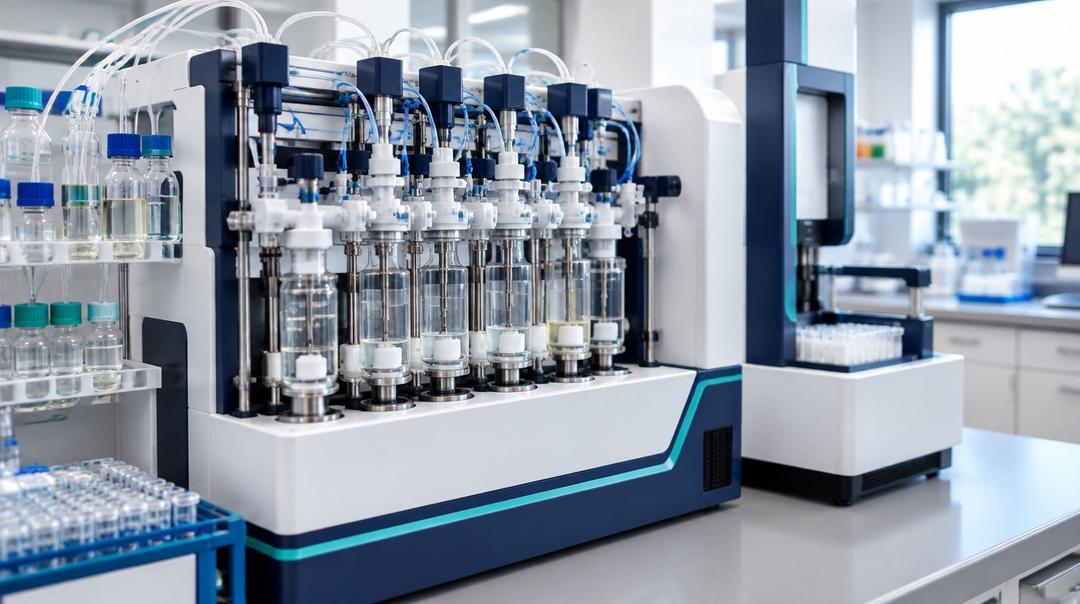
Solid-phase peptide synthesis (SPPS) builds a peptide one amino acid at a time on an insoluble resin bead, so excess reagents can be washed away after every step. Each cycle removes a temporary protecting group from the chain's end (deprotection) and attaches the next protected amino acid (coupling). A final acid treatment cuts the peptide from the resin and strips its side-chain protection (cleavage). Invented by R. Bruce Merrifield, it is how nearly all research peptides are made, mostly by Fmoc chemistry, and each step leaves signature impurities.
How does solid-phase peptide synthesis work?
Merrifield's insight, set out in his review of the method in Science (PMID 3961484), was to attach the first amino acid by its carboxyl end to a polymer bead and build the chain outward from it. Because the peptide is bound to something insoluble, every reaction can be driven with a large excess of reagent and then finished by filtration and washing. No intermediate needs to be isolated or purified. That is what made long chains, and later automation, practical.
A synthesis runs as a repeated cycle from the carboxyl terminus to the amino terminus:
- Deprotection. The temporary protecting group on the free end of the resin-bound chain is removed, exposing an amine.
- Washing. The deprotection reagent and by-products are washed off.
- Coupling. The next amino acid, with its own amine protected and its carboxyl group chemically activated, is added in excess and forms a peptide bond with the exposed amine.
- Washing. Excess amino acid and activating reagents are washed off.
The side chains of reactive residues, lysine's amine, aspartate's carboxyl, serine's hydroxyl, cysteine's thiol, arginine's guanidine and others, carry permanent protecting groups throughout. They come off only at the end, in the same step that releases the peptide from the resin.
What is the difference between Fmoc and Boc chemistry?
The two strategies are named for the temporary protecting group on the amine, and they differ in which conditions remove what.
| Boc strategy | Fmoc strategy | |
|---|---|---|
| Temporary amine protection | tert-butyloxycarbonyl (Boc) | 9-fluorenylmethoxycarbonyl (Fmoc) |
| Removed each cycle by | Moderate acid (trifluoroacetic acid) | Base (typically piperidine) |
| Side-chain protection | Benzyl-type groups | tert-butyl-type and trityl groups |
| Final cleavage | Very strong acid, classically anhydrous hydrogen fluoride | Concentrated trifluoroacetic acid with scavengers |
| Selectivity | Graded acid lability | Orthogonal: base for temporary groups, acid for permanent ones |
| Current role | Specialist uses | The dominant method |
Merrifield's original chemistry was Boc-based. Fmoc chemistry is orthogonal: the base that removes Fmoc leaves acid-labile side-chain protection untouched, and the acid that removes side-chain protection at the end never had to be used during chain assembly. It also avoids hydrogen fluoride. Behrendt, White and Offer describe Fmoc SPPS as the method of choice today, with high-quality building blocks available cheaply because therapeutic peptides are now produced by it at multi-tonne scale (PMID 26785684). Isidro-Llobet and colleagues' review catalogues the protecting groups on which both strategies depend (PMID 19364121).
A practical consequence of either route is that the peptide meets trifluoroacetic acid at cleavage and usually again in HPLC purification, which is why it is typically isolated as a trifluoroacetate salt. That story continues in TFA vs acetate peptide salts.
Why does every coupling step matter so much?
Because yield compounds. If each coupling and deprotection goes to 99% completion, the fraction of chains that are full-length after 29 couplings (a 30-residue peptide) is 0.99 raised to the 29th power, about 75%. At 99.5% per step it is about 86%. The remaining chains are not lost; they are still on the resin, and they come off with the product at cleavage as a family of closely related impurities.
Merrifield and colleagues measured this directly. Using mass spectrometry to quantify the by-products of model alanine peptides synthesised under different protocols, they found that some coupling conditions produced significant levels of both deletion and insertion peptides, while their best protocol, a double coupling, gave an average deletion of only 0.036% per step and insertion of 0.029% per step (PMID 3239745). The model sequence was chosen to avoid the aggregation that caused incomplete reactions in an all-L version, which is itself instructive: difficult sequences fail differently from easy ones.
Which impurities does each step create?
D'Hondt and colleagues' review of impurities in peptide medicines organises them by origin, and the synthesis-related group maps onto the steps above (PMID 25044089).
Deletion sequences. If a deprotection is incomplete, that chain cannot couple in the next cycle but may resume afterwards, producing a peptide missing one residue internally. D'Hondt and colleagues attribute deletions mainly to inefficient Fmoc removal. Incomplete coupling has the same effect. A one-residue deletion is very similar to the target in hydrophobicity and may co-elute.
Truncated sequences. Chains that stop growing entirely, often because unreacted amines were deliberately capped by acetylation to prevent later deletions. Capping trades a hard-to-separate deletion for an easier-to-separate truncation.
Insertions. An extra copy of a residue, linked by D'Hondt and colleagues to excess amino acid reagent, for instance when a small amount of the activated amino acid loses its protection and couples twice.
Racemisation. Activation of an amino acid's carboxyl group can let its alpha carbon invert, producing a D-residue in an L-peptide. Palasek and colleagues found cysteine, histidine and aspartic acid the most susceptible in a model 20-residue peptide made by microwave-assisted synthesis, and that lowering the coupling temperature from 80 °C to 50 °C limited histidine and cysteine racemisation (PMID 17121420). The resulting diastereomer has exactly the target's mass.
Aspartimide formation. Under the repeated base treatments of Fmoc removal, an aspartate's side chain can cyclise onto the backbone, forming a succinimide ring that reopens to the normal aspartate, the rearranged isoaspartate, or, with piperidine, piperidide adducts, and can racemise along the way. Palasek and colleagues reduced it by adding HOBt to the deprotection solution or replacing piperidine with piperazine (PMID 17121420); Kong and colleagues review the protecting-group strategies developed to suppress it (PMID 40857621). The same ring chemistry drives aspartate degradation in storage, covered in peptide degradation pathways.
Incomplete side-chain deprotection. If a permanent protecting group survives cleavage, the product carries it as an adduct of characteristic mass, for example about +56 Da for a residual tert-butyl group or about +252 Da for a residual Pbf group on arginine. D'Hondt and colleagues list these peptide-protection adducts as a distinct impurity class.
Cleavage side reactions. The protecting groups released by trifluoroacetic acid are reactive cations that will attach to electron-rich residues if not intercepted. King, Fields and Fields found that most cleavage side reactions modify tryptophan, tyrosine, methionine and cysteine with liberated protecting groups and linker fragments, and compared scavenger mixtures for suppressing them (PMID 2279849). Methionine oxidation during or after cleavage is another common product.
Counter-ions and residual reagents. Trifluoroacetate from cleavage and purification, and traces of scavengers and solvents, are present in the isolated solid. D'Hondt and colleagues also report contamination of peptide products by unrelated peptides, which they attribute to inadequate good-manufacturing practice.
What can a certificate of analysis show about synthesis quality?
The impurity profile is a record of how the synthesis and purification went, and different methods read different parts of it.
| Impurity | Mass difference from target | Seen by HPLC? | What identifies it |
|---|---|---|---|
| Deletion of one residue | Minus that residue's mass | Often, but may co-elute | LC-MS on each peak |
| Truncation (capped) | Large loss plus acetyl | Usually well separated | LC-MS |
| Insertion | Plus a residue's mass | Often close to main peak | LC-MS |
| Racemised residue | None | Only if the method resolves diastereomers | Chiral amino acid analysis or a resolving HPLC method |
| Aspartimide | About −18 Da | Sometimes | LC-MS |
| Isoaspartate | None | Only with a resolving method | Resolving HPLC, enzymatic or MS fragmentation methods |
| Protecting-group adduct | Plus the group's mass | Usually | LC-MS |
| Oxidised methionine | About +16 Da | Usually elutes earlier | LC-MS |
| Trifluoroacetate | Not a peptide | No | Ion chromatography or fluorine-19 NMR |
The table makes the limits of an HPLC-only certificate concrete. A purity figure reports the main peak's share of UV area and cannot say which impurities make up the rest. LC-MS, with a mass for each peak, can distinguish a synthesis problem (a missing residue) from a storage problem (an added oxygen), as described in HPLC vs LC-MS peptide testing. Mass-silent impurities, racemised and isoaspartyl forms, need a method validated to resolve them, and a routine certificate seldom states that it was. Counter-ion and water content sit outside the chromatogram altogether and determine how much of the powder is peptide, the subject of peptide net content vs purity.
The broader point about what a single document can establish, and what it cannot, is made in what a certificate of analysis establishes. For contaminants that synthesis chemistry does not predict, endotoxin above all, see endotoxin testing for peptides. Which of these tests a vendor's programme actually commissions is the subject of third-party peptide testing in Canada.
Does synthesis method say anything about a peptide's research evidence?
No. How a peptide was made governs what is in the vial, not what the molecule does. The research catalogued on this site, from cell and animal work on BPC-157, a compound approved nowhere as a medicine, to the human trials of licensed medicines, stands or falls on its own study designs. Nothing here is medical, dosing, or therapeutic guidance.
Frequently asked questions
Why is it called solid-phase synthesis if the chemistry happens in solution? The reagents are dissolved, but the growing peptide is chemically attached to insoluble resin beads. That is the solid phase. It means the peptide stays in the reaction vessel while excess reagents and by-products are simply washed away after each step, which is what makes repeated cycles fast and automatable.
Is Fmoc chemistry better than Boc chemistry? For most sequences Fmoc is now preferred: its mild base deprotection is orthogonal to acid-labile side-chain protection, and it avoids hydrogen fluoride. Boc chemistry remains useful for some difficult or base-sensitive sequences. Neither is free of side reactions; aspartimide formation is characteristic of Fmoc conditions, for example.
Why are longer peptides harder to make pure? Because small per-step losses compound. At 99% completion per coupling, about a quarter of 30-residue chains are incomplete; longer chains fare worse, and aggregating sequences couple less efficiently. The failed chains are structurally close to the product, so purification must separate many near-identical species.
Can mass spectrometry detect every synthesis impurity? No. It identifies deletions, insertions, adducts and oxidation by their mass differences, ideally peak by peak in LC-MS. Racemised residues and isoaspartate have exactly the target's mass and need a chromatographic method validated to resolve them, or chiral or enzymatic analysis.
Selected Research References
- Merrifield B. Solid Phase Synthesis. Science. 1986;232(4748):341-347. pubmed.ncbi.nlm.nih.gov/3961484
- Merrifield RB, Singer J, Chait BT. Mass Spectrometric Evaluation of Synthetic Peptides for Deletions and Insertions. Analytical Biochemistry. 1988;174(2):399-414. pubmed.ncbi.nlm.nih.gov/3239745
- Behrendt R, White P, Offer J. Advances in Fmoc Solid-Phase Peptide Synthesis. Journal of Peptide Science. 2016;22(1):4-27. pubmed.ncbi.nlm.nih.gov/26785684
- Isidro-Llobet A, Alvarez M, Albericio F. Amino Acid-Protecting Groups. Chemical Reviews. 2009;109(6):2455-2504. pubmed.ncbi.nlm.nih.gov/19364121
- D'Hondt M, Bracke N, Taevernier L, et al. Related Impurities in Peptide Medicines. Journal of Pharmaceutical and Biomedical Analysis. 2014;101:2-30. pubmed.ncbi.nlm.nih.gov/25044089
- Palasek SA, Cox ZJ, Collins JM. Limiting Racemization and Aspartimide Formation in Microwave-Enhanced Fmoc Solid Phase Peptide Synthesis. Journal of Peptide Science. 2007;13(3):143-148. pubmed.ncbi.nlm.nih.gov/17121420
- Kong MJW, van den Braak TJHP, Neumann K. Aspartimide Formation and Its Prevention in Fmoc Chemistry Solid Phase Peptide Synthesis. ChemBioChem. 2025;26(18):e202500490. pubmed.ncbi.nlm.nih.gov/40857621
- King DS, Fields CG, Fields GB. A Cleavage Method Which Minimizes Side Reactions Following Fmoc Solid Phase Peptide Synthesis. International Journal of Peptide and Protein Research. 1990;36(3):255-266. pubmed.ncbi.nlm.nih.gov/2279849
All products sold by NovaEvum are for research and laboratory use only. They are not intended for human or animal consumption, diagnosis, treatment, cure, or prevention of any disease.