
Testing, quality and handling
Peptide Net Content vs Purity: Why a Vial Holds Less Peptide Than Its Label
NB
· 9 min read
A summary of published research, with citations. It states no amount, schedule or route, and makes no claim about what this compound does in a person. Supplied for laboratory research use only.
On this page · 8 sections
- What is the difference between peptide purity and net peptide content?
- Why does a peptide vial contain less peptide than its labelled weight?
- Does it matter for a research result?
- How is net peptide content measured?
- Why do purity and net content get confused?
- How does net content enter concentration arithmetic?
- What should a certificate report?
- Frequently asked questions
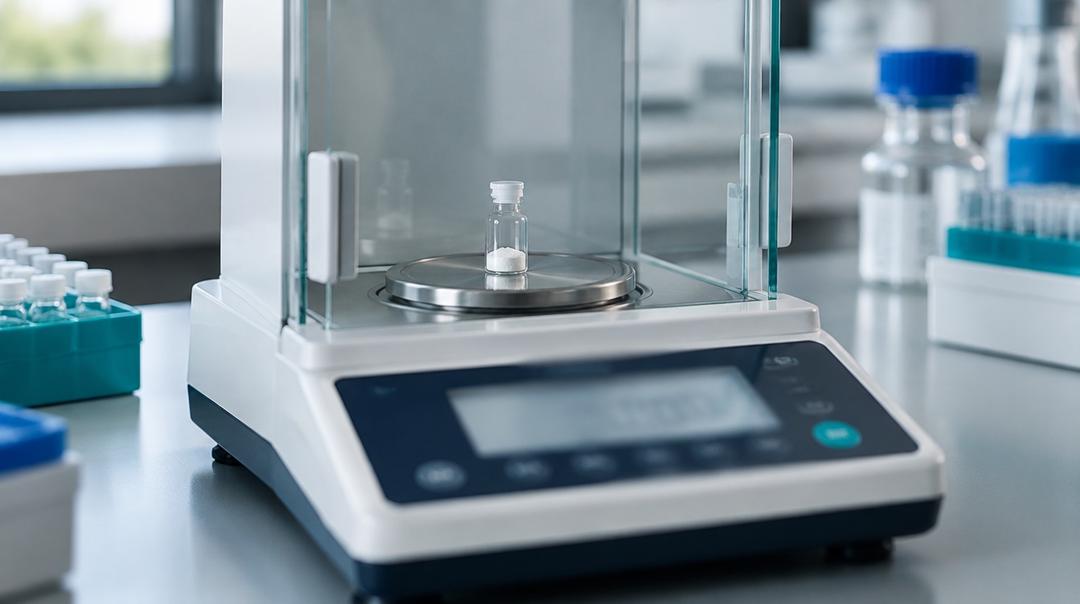
Peptide net content is the fraction of a powder's mass that is actually peptide, rather than counter-ions such as trifluoroacetate, residual water or other material. Purity is something else: the share of the HPLC-detected material that is the target sequence. A peptide can be highly pure yet only part peptide by weight, because salt and water are invisible to purity measurement. Net content is measured by amino acid analysis, nitrogen determination, quantitative NMR or UV absorbance. A vial labelled by gross weight therefore holds less peptide than its label number.
What is the difference between peptide purity and net peptide content?
They answer two different questions about the same powder.
| Purity | Net peptide content | |
|---|---|---|
| Question answered | Of the peptide-like material present, how much is the intended sequence? | Of the total mass weighed, how much is peptide of any kind? |
| Usual method | Reverse-phase HPLC with UV detection, as main-peak area percentage | Amino acid analysis, nitrogen determination, quantitative NMR, or UV absorbance against a computed coefficient |
| Blind to | Counter-ions, water, inorganic salts, anything without a chromophore | Whether the peptide is the right sequence or a mixture of related sequences |
| What lowers it | Deletion sequences, oxidised or deamidated forms, synthesis by-products | Counter-ions, residual moisture, excess salts, excipients |
The two are independent. A lot can be high in both, high in one and low in the other, or low in both. Neither substitutes for identity, which is a mass spectrometry question: see HPLC vs LC-MS peptide testing.
Why does a peptide vial contain less peptide than its labelled weight?
Because a lyophilised peptide is a salt with water in it, and a gross-weight label counts all of it.
Counter-ions. Every positively charged group on a peptide, the amino terminus and each lysine, arginine and histidine, is paired in the solid with an anion from purification, most often trifluoroacetate, sometimes exchanged to acetate or chloride. On a small, basic peptide the counter-ion can be a fifth or more of the mass. How that happens, and why trifluoroacetate is heavier than the alternatives, is in TFA vs acetate peptide salts.
Residual water. Freeze-dried solids are hygroscopic and retain bound water after drying, and they take up more each time they are opened in humid air. Karl Fischer titration measures it.
Everything else. Excess free acid, inorganic salts from buffers, and any added excipient or bulking agent. D'Hondt and colleagues' review of impurities in peptide medicines lists unwanted counter-ions such as trifluoroacetate alongside synthesis by-products (PMID 25044089), and Sikora and colleagues' review shows that approved peptide medicines are formulated with a deliberately chosen counter-ion rather than whatever purification left behind (PMID 33287352).
The result is easy to state. An illustrative vial labelled 10 mg of powder, at 75% net peptide content, holds about 7.5 mg of peptide; at 60%, about 6 mg. The purity figure on the same certificate could be identical in both cases.
This is not a small or theoretical gap. When Canada's National Research Council assigned a purity value to an angiotensin II candidate certified reference material, the trifluoroacetate counter-ion alone came to nearly 25% of the mass, and the final assigned peptide purity was 691 ± 9 mg per gram (Melanson and colleagues, PMID 30143839). That was a carefully prepared reference material; ordinary research lots have no reason to do better.
Does it matter for a research result?
It can matter more than purity does. Boullerne and colleagues compared two commercial preparations of the same immunising peptide used to induce experimental autoimmune encephalomyelitis in mice. Their purities were similar, but their peptide fractions were 45% and 72%. The two preparations produced different disease courses, and the authors noted that peptide fraction in this material can range from under 50% to over 90%, the remainder being mainly counter-ion (PMID 24471474). Their conclusion was that knowing peptide fraction is as critical as knowing purity when peptides come from different sources.
The general lesson for any comparison between lots or suppliers is that equal weights of powder are not equal amounts of peptide. Two experiments run at "the same" weighed amount from two lots may be running at different peptide amounts, and a difference in outcome may come from that rather than from the biology. Study-design pitfalls of this kind are covered in how to read a peptide study.
How is net peptide content measured?
Four approaches are in use, each with its own blind spots.
Amino acid analysis. The peptide is hydrolysed in strong acid into its constituent amino acids, which are separated and quantified, conventionally against standards and in reference work by isotope-dilution LC-MS/MS (PMID 30143839). Because the sequence is known, the moles of each stable amino acid give the moles of peptide, and from that the peptide mass in the weighed sample. Some residues are unreliable after acid hydrolysis: tryptophan is largely destroyed, asparagine and glutamine are converted to aspartate and glutamate, and cysteine and methionine are partly oxidised. A good analysis quantifies the robust residues and reports which ones it used. Amino acid analysis also counts amino acids from any related peptide impurity as if they were the target, which is why Melanson and colleagues corrected for related impurities explicitly.
Nitrogen determination. Combustion (CHN) analysis or Kjeldahl digestion measures total nitrogen; dividing by the peptide's known nitrogen fraction estimates peptide mass. It is simple and needs no reference standard. It is also blind to the source of the nitrogen: an ammonium counter-ion, an arginine counter-ion, or a nitrogen-containing impurity all read as peptide. Trifluoroacetate and acetate contain no nitrogen and do not interfere.
Quantitative NMR. Proton NMR against an internal standard of certified purity quantifies the intact peptide without hydrolysis, which removes hydrolysis bias. Melanson and colleagues combined proton qNMR with amino acid analysis and a mass-balance approach, and found good agreement among the three (PMID 30143839). Fluorine-19 NMR in the same work quantified the trifluoroacetate directly.
UV absorbance. For peptides containing tryptophan or tyrosine, absorbance at 280 nm with a molar absorption coefficient computed from the sequence is a standard method, and Pace and colleagues set out how to measure and predict that coefficient (PMID 8563639). Many research peptides contain neither residue. For those, Anthis and Clore validated a method for predicting the absorptivity at 205 nm directly from sequence, without calibration (PMID 23526461). UV methods are quick but sensitive to anything else that absorbs at the chosen wavelength, including some preservatives and buffers.
Why do purity and net content get confused?
Partly language. Both are reported as percentages, and both are loosely called "purity". The certificate article on this site separates the three numbers that share the word, chromatographic purity, content and identity, and the distinction there is the one that matters here.
Partly omission. Most certificates in this market report HPLC purity and nothing else, so purity becomes the only number in circulation. Net content requires a separate analysis that has to be commissioned on purpose; third-party peptide testing in Canada lists it with the other tests a programme can include.
And partly label convention. A vial described by milligrams of powder is making a claim about gross weight. A vial described by milligrams of peptide is making a stronger claim, one that only a content measurement on that lot can support.
How does net content enter concentration arithmetic?
Conceptually, it is a correction factor on the mass. A concentration computed from label weight and diluent volume describes powder per millilitre; multiplying by the net content fraction converts it to peptide per millilitre. Without a measured content figure, a concentration calculated from gross weight is an upper bound on the peptide concentration, not the value. The concentration calculator does the arithmetic from whatever mass is entered; the net content question is about which mass that should be.
Two practical consequences for laboratory work follow. Lots should be compared on peptide mass, not powder mass. And where an experiment's interpretation depends on the absolute amount of peptide, the content figure belongs in the methods section alongside the purity figure, as Boullerne and colleagues urged.
What should a certificate report?
Ideally: identity by mass spectrometry; purity by HPLC, with the chromatogram; net peptide content, with its method; counter-ion content by ion chromatography or fluorine-19 NMR; and water content by Karl Fischer. Together, content, counter-ion and water should account for most of the weighed mass. A certificate whose numbers add up to far less than the whole, or that reports only purity, is leaving the mass question open. The general limits of any certificate, including who chose the sample, are covered in what a certificate of analysis establishes. Nothing here is medical, dosing, or therapeutic guidance.
Frequently asked questions
If my certificate shows high purity, is the vial mostly peptide? Not necessarily. Purity describes the composition of the peptide-like material the detector saw. Counter-ions and water do not appear in that measurement at all. A lot can show high chromatographic purity and still be only two-thirds peptide by mass. Only a net content measurement answers the mass question.
What net peptide content is typical? It varies with sequence and salt form, so a single typical figure would mislead. Basic peptides carry more counter-ion than neutral ones, and trifluoroacetate salts weigh more than acetate or chloride salts. Boullerne and colleagues found two commercial lots of one peptide at 45% and 72%, and cited a range from under half to over ninety percent.
Is amino acid analysis or nitrogen determination better? Amino acid analysis is more specific because it quantifies individual residues of the known sequence, but some residues are lost in hydrolysis and related impurities still count as peptide. Nitrogen determination is simpler but counts every nitrogen source, including nitrogen-containing counter-ions. Reference laboratories combine methods and check that they agree.
Does net content change after the vial is opened? The peptide does not multiply or vanish on opening, but a hygroscopic solid takes up atmospheric water, which raises the gross weight without adding peptide. Weighing out portions from a repeatedly opened vial can therefore deliver progressively less peptide per milligram. Degradation over time can also convert peptide into related impurities.
Selected Research References
- Melanson JE, Thibeault MP, Stocks BB, et al. Purity Assignment for Peptide Certified Reference Materials by Combining qNMR and LC-MS/MS Amino Acid Analysis Results: Application to Angiotensin II. Analytical and Bioanalytical Chemistry. 2018;410(26):6719-6731. pubmed.ncbi.nlm.nih.gov/30143839
- Boullerne AI, Polak PE, Braun D, et al. Effects of Peptide Fraction and Counter Ion on the Development of Clinical Signs in Experimental Autoimmune Encephalomyelitis. Journal of Neurochemistry. 2014;129(4):696-703. pubmed.ncbi.nlm.nih.gov/24471474
- Anthis NJ, Clore GM. Sequence-Specific Determination of Protein and Peptide Concentrations by Absorbance at 205 nm. Protein Science. 2013;22(6):851-858. pubmed.ncbi.nlm.nih.gov/23526461
- Pace CN, Vajdos F, Fee L, et al. How to Measure and Predict the Molar Absorption Coefficient of a Protein. Protein Science. 1995;4(11):2411-2423. pubmed.ncbi.nlm.nih.gov/8563639
- Sikora K, Jaśkiewicz M, Neubauer D, et al. The Role of Counter-Ions in Peptides: An Overview. Pharmaceuticals (Basel). 2020;13(12):442. pubmed.ncbi.nlm.nih.gov/33287352
- D'Hondt M, Bracke N, Taevernier L, et al. Related Impurities in Peptide Medicines. Journal of Pharmaceutical and Biomedical Analysis. 2014;101:2-30. pubmed.ncbi.nlm.nih.gov/25044089
All products sold by NovaEvum are for research and laboratory use only. They are not intended for human or animal consumption, diagnosis, treatment, cure, or prevention of any disease.