
GLP-1 and metabolic
What Is Tirzepatide? Structure, Mechanism, Trials and Approvals
AM
· 9 min read
A summary of published research, with citations. It states no amount, schedule or route, and makes no claim about what this compound does in a person. Supplied for laboratory research use only.
On this page · 6 sections
Tirzepatide is a synthetic 39-amino-acid peptide, developed by Eli Lilly under the code LY3298176, that activates two incretin receptors: the GIP receptor and the GLP-1 receptor. Its backbone is based on the native GIP sequence, and a C20 fatty diacid attached through a linker lets it bind albumin, giving a half-life of about five days. It is an approved medicine, sold as Mounjaro and, in the United States, also as Zepbound. Research-grade tirzepatide is a laboratory reagent, not either product.
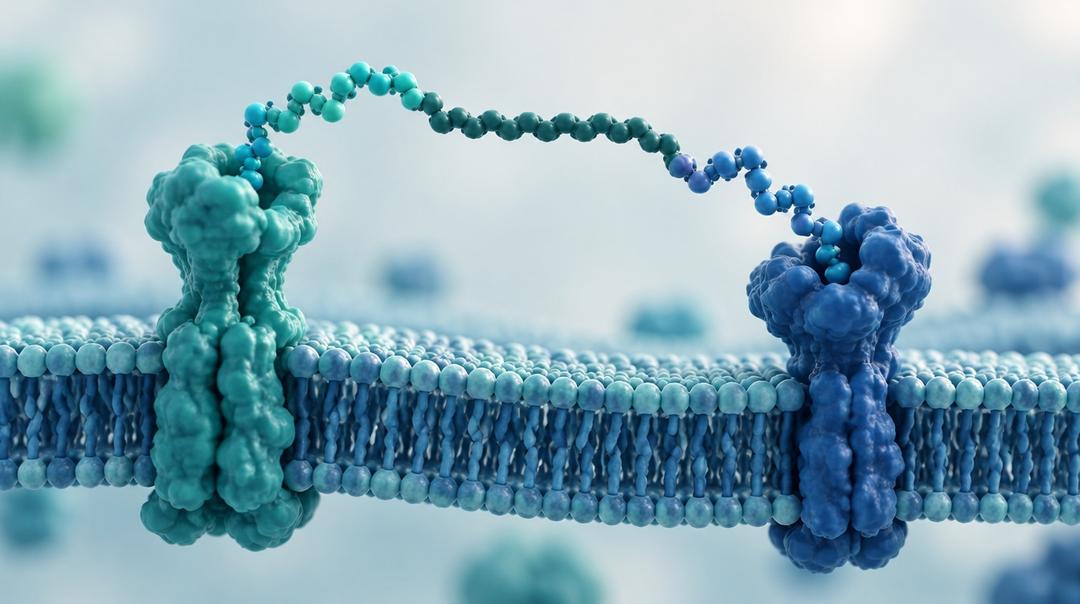
What kind of molecule is tirzepatide?
One peptide, not two. It is easy to read "dual agonist" as a mixture of a GIP drug and a GLP-1 drug in one vial. Tirzepatide is a single engineered chain that both receptors recognise.
| Property | Tirzepatide |
|---|---|
| Class | Dual GIP and GLP-1 receptor agonist, sometimes called a "twincretin" |
| Length | 39 amino acids |
| Backbone | Based on the native GIP sequence |
| Modification | C20 fatty diacid on a linker, for albumin binding |
| Half-life | About five days |
| Developer | Eli Lilly (development code LY3298176) |
| Brand names | Mounjaro; Zepbound (United States) |
| Elimination | Broken down by protease cleavage, β-oxidation of the diacid and amide hydrolysis; no intact drug found in urine or faeces |
The 39-residue, GIP-based design is described in Min and Bain's review of the early programme (PMID 33325008). Chavda and colleagues describe the C20 fatty diacid, its albumin binding and the roughly five-day half-life (PMID 35807558). Martin and colleagues traced radiolabelled tirzepatide in people, rats and monkeys. The parent drug was the main circulating component; about two thirds of the radioactivity left in urine and about a third in faeces, all as metabolites (PMID 39243911).
The albumin-binding strategy is the same general idea used for semaglutide: a fatty acid that hitches the peptide to the most abundant protein in blood, slowing its clearance. What differs is the sequence the fatty acid is attached to.
How does tirzepatide work?
GIP (glucose-dependent insulinotropic polypeptide) and GLP-1 (glucagon-like peptide-1) are the two main incretin hormones. Both are released from the gut after a meal and both increase insulin secretion when glucose is high. For years GIP looked like a poor drug target, because infusing it into people with type 2 diabetes produced little insulin response. Min and Bain describe how co-infusion experiments, showing a larger combined effect, revived the idea of targeting both (PMID 33325008). How the two receptors and the glucagon receptor differ is set out in GLP-1, GIP and glucagon receptors.
Tirzepatide's pharmacology turned out to be more specific than "activates both". In the discovery paper, Coskun and colleagues showed it activated both receptors in cell assays and in mice, and that body-weight and food-intake reductions in mice were greater than with a selective GLP-1 receptor agonist (PMID 30473097). Willard and colleagues then calculated receptor occupancy at clinical exposures and found tirzepatide engages the GIP receptor more than the GLP-1 receptor, an "imbalanced" profile. At the GLP-1 receptor it is "biased": it favours cAMP signalling over β-arrestin recruitment and drives less receptor internalisation than GLP-1 itself (PMID 32730231). The authors proposed that this combination may account for its effects. That is a hypothesis from cell, islet and occupancy work, not a demonstrated cause of the clinical results.
What has tirzepatide been tested in?
Unlike nearly every compound on this site, tirzepatide has a large phase 3 record. The programmes are named, and the names tell you the population.
| Programme | Population | Comparator | What it reported | Deep-dive |
|---|---|---|---|---|
| SURPASS (phase 3) | Type 2 diabetes | Placebo, semaglutide, insulin and others | SURPASS-1: 478 adults over 40 weeks; HbA1c fell by 1.87 to 2.07 percentage points across the doses studied, against a rise of 0.04 with placebo | vs semaglutide |
| SURMOUNT (phase 3) | Obesity or overweight | Placebo, semaglutide | SURMOUNT-1: 2,539 adults without diabetes over 72 weeks; mean weight change of −15.0% to −20.9% across the doses studied, against −3.1% with placebo | side effects |
| SURMOUNT-OSA (phase 3) | Obstructive sleep apnoea with obesity | Placebo | Two 52-week trials; apnoea-hypopnoea index fell by 20.0 and 23.8 events per hour more than with placebo | sleep apnoea |
| SUMMIT | Heart failure with preserved ejection fraction and obesity | Placebo | 731 patients; cardiovascular death or worsening heart failure in 9.9% against 15.3% (hazard ratio 0.62) | cardiovascular outcomes |
| SURPASS-CVOT | Type 2 diabetes with atherosclerotic disease | Dulaglutide | 13,299 randomised; major cardiovascular events 12.2% against 13.1%, hazard ratio 0.92; noninferior, not shown superior | cardiovascular outcomes |
| SYNERGY-NASH (phase 2) | Biopsy-confirmed MASH with moderate or severe fibrosis | Placebo | 190 participants; MASH resolution without worsening fibrosis in 44% to 62% across the doses studied, against 10% | This page |
Sources for each row: SURPASS-1 (PMID 34186022), SURMOUNT-1 (PMID 35658024), SURMOUNT-OSA (PMID 38912654), SUMMIT (PMID 39555826), SURPASS-CVOT (PMID 41406444) and SYNERGY-NASH (PMID 38856224).
Three cautions apply to that table. Each result belongs to the licensed drug, in the trial's screened population, under the trial's monitoring. Percentages from different trials cannot be lined up against each other, because the populations and durations differ; why is covered in tirzepatide vs retatrutide. And SYNERGY-NASH was a phase 2 trial whose authors called for larger, longer studies.
The most common adverse events across these trials were gastrointestinal, mostly mild to moderate. In SURMOUNT-1, adverse events led to stopping treatment in 4.3% to 7.1% of tirzepatide participants, against 2.6% with placebo (PMID 35658024). The full safety picture, including gallbladder events and the pancreatitis question, is in tirzepatide side effects. Related questions about hair and lean mass are covered in GLP-1 hair loss trials and GLP-1 muscle loss.
Where is tirzepatide approved?
United States. The FDA approved tirzepatide as Mounjaro for type 2 diabetes in May 2022 (PMID 35807558). It approved it under the brand name Zepbound for chronic weight management on 8 November 2023 (PMID 37966831). In December 2024 it approved tirzepatide for moderate-to-severe obstructive sleep apnoea in adults with obesity, the first drug approved for that condition (PMID 42897716).
Canada. Tirzepatide is authorised as Mounjaro, for type 2 diabetes and for chronic weight management. Authorised indications, warnings and conditions are set out in the Canadian product monograph and change over time. Check the product's entry in Health Canada's Drug Product Database rather than any summary, this one included. A US label change, such as the sleep apnoea indication, does not by itself apply in Canada.
Approval attaches to a manufactured product, released against a filed specification and dispensed on prescription. It does not attach to the molecule wherever it appears. Research-grade tirzepatide has no status as a medicine in Canada or anywhere else; the Canadian peptide rules article explains the distinction.
What is tirzepatide commonly confused with?
Semaglutide. A GLP-1 receptor agonist only. The two were compared directly in SURPASS-2 and SURMOUNT-5; see tirzepatide vs semaglutide.
Retatrutide. Adds glucagon receptor activity and is not approved anywhere. See tirzepatide vs retatrutide.
Mazdutide and eloralintide. Different receptor strategies again, covered in tirzepatide vs eloralintide vs mazdutide.
"Two peptides combined". Tirzepatide is one chain. A vial containing a GIP agonist and a GLP-1 agonist side by side would be a different product with no trial record.
Mounjaro. The same active ingredient, but a licensed medicine is the molecule plus a manufacturing licence, a specification, a prescriber and a pharmacist. A research reagent has none of those.
Nothing here is medical, dosing, or therapeutic guidance.
Supplied here for laboratory use: Tirzepatide. The laboratory's certificate for each lot is linked from its product page. For laboratory research use only.
Frequently asked questions
Is tirzepatide a GLP-1? Partly. It is a dual agonist that activates both the GLP-1 receptor and the GIP receptor, and its backbone is based on GIP rather than GLP-1. Receptor-occupancy work by Willard and colleagues suggests it engages the GIP receptor more than the GLP-1 receptor at clinical exposures, so calling it simply a GLP-1 drug understates its design.
Why does tirzepatide last so long in the body? A C20 fatty diacid attached to the peptide binds albumin, the most abundant protein in blood, which slows clearance and gives a half-life of about five days. It is eventually broken down into metabolites, which leave the body mostly in urine; in a radiolabel study no intact tirzepatide was found in urine or faeces in people, rats or monkeys.
What does SURPASS mean, and what is SURMOUNT? They are Lilly's phase 3 trial programme names. SURPASS trials enrolled people with type 2 diabetes; SURMOUNT trials enrolled people with obesity or overweight; SURMOUNT-1 excluded people with diabetes. SURMOUNT-OSA studied sleep apnoea, SUMMIT studied heart failure with preserved ejection fraction, and SURPASS-CVOT measured cardiovascular events against dulaglutide.
Is tirzepatide approved in Canada? Yes, as Mounjaro, for type 2 diabetes and for chronic weight management. Zepbound is the US brand name for weight management. Indications differ between countries and change, so the Canadian product monograph and Health Canada's Drug Product Database are the sources to check. Research-grade tirzepatide is not Mounjaro and is not sold for human use.
Is research tirzepatide the same as Mounjaro? It may share the molecular formula, but it is not the medicine. Mounjaro is manufactured under licence, released against a regulator-reviewed specification, prescribed and dispensed. The trial results on this page describe that product in trial participants. A laboratory reagent carries none of that evidence or accountability.
Selected Research References
- Coskun T, Sloop KW, Loghin C, et al. LY3298176, a novel dual GIP and GLP-1 receptor agonist for the treatment of type 2 diabetes mellitus: From discovery to clinical proof of concept. Molecular Metabolism. 2018;18:3-14. pubmed.ncbi.nlm.nih.gov/30473097
- Willard FS, Douros JD, Gabe MB, et al. Tirzepatide is an imbalanced and biased dual GIP and GLP-1 receptor agonist. JCI Insight. 2020;5(17):e140532. pubmed.ncbi.nlm.nih.gov/32730231
- Min T, Bain SC. The Role of Tirzepatide, Dual GIP and GLP-1 Receptor Agonist, in the Management of Type 2 Diabetes: The SURPASS Clinical Trials. Diabetes Therapy. 2021;12(1):143-157. pubmed.ncbi.nlm.nih.gov/33325008
- Chavda VP, Ajabiya J, Teli D, et al. Tirzepatide, a New Era of Dual-Targeted Treatment for Diabetes and Obesity: A Mini-Review. Molecules. 2022;27(13):4315. pubmed.ncbi.nlm.nih.gov/35807558
- Martin JA, Czeskis B, Urva S, et al. Absorption, distribution, metabolism, and excretion of tirzepatide in humans, rats, and monkeys. European Journal of Pharmaceutical Sciences. 2024;202:106895. pubmed.ncbi.nlm.nih.gov/39243911
- Rosenstock J, Wysham C, Frías JP, et al. Efficacy and safety of a novel dual GIP and GLP-1 receptor agonist tirzepatide in patients with type 2 diabetes (SURPASS-1): a double-blind, randomised, phase 3 trial. The Lancet. 2021;398(10295):143-155. pubmed.ncbi.nlm.nih.gov/34186022
- Jastreboff AM, Aronne LJ, Ahmad NN, et al. Tirzepatide Once Weekly for the Treatment of Obesity. New England Journal of Medicine. 2022;387(3):205-216. pubmed.ncbi.nlm.nih.gov/35658024
- Malhotra A, Grunstein RR, Fietze I, et al. Tirzepatide for the Treatment of Obstructive Sleep Apnea and Obesity. New England Journal of Medicine. 2024;391(13):1193-1205. pubmed.ncbi.nlm.nih.gov/38912654
- Packer M, Zile MR, Kramer CM, et al. Tirzepatide for Heart Failure with Preserved Ejection Fraction and Obesity. New England Journal of Medicine. 2025;392(5):427-437. pubmed.ncbi.nlm.nih.gov/39555826
- Nicholls SJ, Pavo I, Bhatt DL, et al. Cardiovascular Outcomes with Tirzepatide versus Dulaglutide in Type 2 Diabetes. New England Journal of Medicine. 2025;393:2409-2420. pubmed.ncbi.nlm.nih.gov/41406444
All products sold by NovaEvum are for research and laboratory use only. They are not intended for human or animal consumption, diagnosis, treatment, cure, or prevention of any disease.