
Reading the evidence
In Vitro vs In Vivo: What Cell and Animal Studies Can Show
AR
· 9 min read
A summary of published research, with citations. It states no amount, schedule or route, and makes no claim about what this compound does in a person. Supplied for laboratory research use only.
On this page · 8 sections
- What do in vitro, ex vivo and in vivo mean?
- What can a cell study show?
- Why does the cell type matter so much?
- Why does concentration realism matter?
- What does an ex vivo tissue study add?
- What can an animal study show, and where does it stop?
- How do you judge whether a preclinical finding might translate?
- Frequently asked questions
In vitro ("in glass") means an experiment on cells, tissue or molecules outside a living organism. In vivo ("in the living") means an experiment in a whole animal or person. In vitro work can show that a molecule is able to act on a target, and at what concentration. Only in vivo work shows whether it reaches that target at that concentration in a body that absorbs, distributes, breaks down and clears it. Most published work on research peptides sits on the in vitro side, or in rodents.
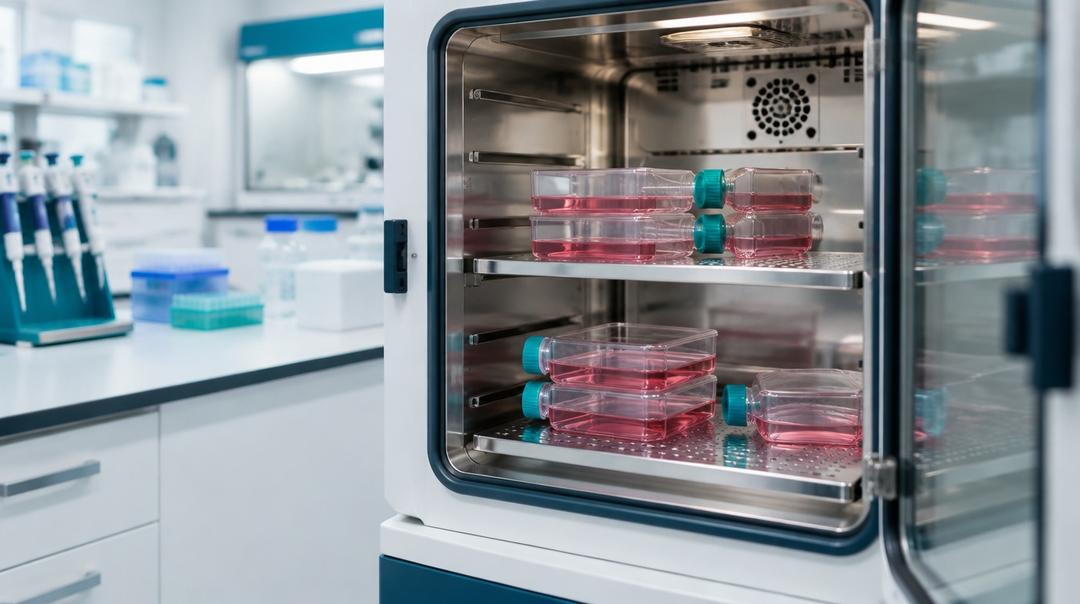
What do in vitro, ex vivo and in vivo mean?
The terms describe how much of a living system is still attached to the experiment.
| Term | What is studied | Example from this site's literature | What it can show | What it cannot |
|---|---|---|---|---|
| In vitro | Cultured cells or purified molecules | GHK-Cu on fibroblast cultures; KPV on intestinal cell lines | Mechanism, target, concentration-response | Whether the concentration is reached in a body |
| Ex vivo | Tissue removed from an organism and kept alive briefly | BPC-157 on rat tendon explants | Response in real tissue architecture | Effects of blood supply, immunity, metabolism |
| In vivo, animal | A whole animal, usually a rodent with an induced injury or disease | BPC-157 after rat Achilles detachment; KPV in chemically induced mouse colitis | Effect in an organism, on a measurable outcome | Whether the model matches human disease |
| In vivo, human | People, in a trial or observational study | Not yet done in a controlled way for these three compounds | Effect in the population studied | Effect in anyone else |
How to read a peptide study sets out this hierarchy in general terms. This page is about the specific traps at each step, using three compounds whose evidence is mostly preclinical.
What can a cell study show?
A well-designed cell experiment answers precise questions. Does the molecule act on this cell type? Through which receptor or pathway? At what concentration does the effect begin, peak and level off?
GHK-Cu and fibroblasts. Maquart and colleagues, working with Loren Pickart, reported that the copper complex of the tripeptide glycyl-histidyl-lysine stimulated collagen synthesis in fibroblast cultures. The effect began between 10⁻¹² and 10⁻¹¹ molar, peaked at 10⁻⁹ molar, and did not depend on any change in cell number. That last point matters: more collagen per dish could otherwise just mean more cells. The paper also noted that the GHK sequence occurs within type I collagen, suggesting it might be released at wound sites. That is a hypothesis about physiology, offered from a dish. GHK-Cu is not approved as a drug anywhere; it appears in cosmetics as an ingredient. Its wound literature is reviewed in GHK-Cu wound-healing research.
KPV and intestinal cells. Dalmasso and colleagues stimulated human intestinal epithelial cell lines and a human T-cell line with inflammatory cytokines. Nanomolar concentrations of KPV reduced activation of the NF-κB and MAP kinase pathways and cut pro-inflammatory cytokine secretion. Uptake experiments indicated that KPV enters cells through PepT1, a di- and tripeptide transporter. That is good mechanistic work: it identifies a route into the cell and a pathway affected. It does not show what happens in a human gut. KPV is an unapproved research chemical with no human trial; see KPV and inflammatory bowel disease research.
Why does the cell type matter so much?
Cell lines are convenient because they grow indefinitely and behave consistently. Many are derived from cancers, which is why they grow indefinitely, and they do not always behave like the normal cells of the tissue they came from.
An independent study of Epitalon shows how much the choice can change the answer. Al-Dulaimi and colleagues treated breast cancer cell lines and normal epithelial cells and fibroblasts. In normal cells, telomeres lengthened through telomerase upregulation. In the cancer cells, lengthening came mainly through a different mechanism, alternative lengthening of telomeres. The same peptide, in the same paper, acted through different machinery depending on the cell. Epitalon is not approved anywhere, and is sold here only as laboratory research material; why longer telomeres are not automatically desirable is covered in correlation vs causation.
Why does concentration realism matter?
In a dish, a cell sits in a fixed concentration of a compound for as long as the experimenter chooses. In a body, the concentration at any tissue rises and falls. It depends on how much is absorbed, where it distributes, how fast enzymes break it down and how fast the kidneys and liver clear it. A cell result is only relevant to a living system if that system can deliver a similar concentration, to the same cells, for a similar time.
BPC-157 is a useful illustration. He and colleagues studied its pharmacokinetics in rats and dogs. The elimination half-life of the intact peptide was under 30 minutes, and radiolabelled BPC-157 was rapidly broken down into small peptide fragments and then single amino acids. A cell culture bathed in intact peptide for a day is a very different exposure. Half-life in general is covered in peptide half-life explained.
Questions to ask of any cell study:
- What concentration was used, and has anyone measured what tissue concentrations are achieved in vivo?
- Was the effect concentration-dependent, and over what range?
- For how long were cells exposed, compared with how long the compound survives in a body?
- Were the cells normal, primary cells or a transformed line?
- Was there a vehicle control, and a positive control showing the assay could detect an effect?
Very low effective concentrations in vitro, such as GHK-Cu's picomolar to nanomolar range, can make a compound look potent. Potency at the target is not the same as exposure at the target. Neither can be inferred from the other.
What does an ex vivo tissue study add?
Ex vivo work keeps the tissue's structure, extracellular matrix and mixture of cell types, which cultured cells lose. Chang and colleagues, in Taiwan, cultured rat Achilles tendon explants with and without BPC-157 and reported faster outgrowth of tendon fibroblasts. In isolated fibroblasts, BPC-157 did not change proliferation. It did increase survival under oxidative stress and migration across a filter, both concentration-dependently, with activation of the FAK-paxillin signalling pathway.
That paper is valuable partly because it comes from outside the Zagreb group that produced most BPC-157 work. It is also careful about what it measured: cell behaviour, not healing. "Did not affect proliferation" is the kind of negative detail that tends to vanish from secondary summaries.
What can an animal study show, and where does it stop?
Animal models add everything the dish lacks: circulation, immunity, metabolism, and outcomes that can be measured functionally. Krivic and colleagues surgically detached the Achilles tendon from bone in rats. They reported better functional, biomechanical and microscopic healing with BPC-157, and less of the impairment caused by a corticosteroid. Biomechanical testing, load to failure and stiffness, is a stronger endpoint than histology alone. Dalmasso's group likewise tested KPV in two chemically induced mouse colitis models and reported less colitis and lower inflammatory cytokine expression.
What such studies cannot show is that the model behaves like the human condition. A surgically detached rat tendon is an acute, clean injury in a young animal. A chemically induced colitis is not Crohn's disease or ulcerative colitis. Seok and colleagues compared genomic responses in people with acute inflammatory stresses of several different causes with responses in the corresponding mouse models. The human responses resembled one another closely; the mouse responses correlated poorly with the human ones and with each other. Among genes changed significantly in humans, the mouse equivalents were close to random in matching them, with R² between 0.0 and 0.1.
BPC-157 is approved nowhere and has no controlled human trial of the peptide as an intervention; its rodent work is reviewed in BPC-157 musculoskeletal research.
How do you judge whether a preclinical finding might translate?
No single study answers it. Confidence grows when several conditions are met together:
- The effect appears across more than one cell type, and in primary cells as well as lines.
- The effective concentration has been compared with measured tissue exposure in vivo.
- More than one animal model, ideally in more than one species, shows it, with blinded outcome assessment.
- The endpoints are functional, not only markers.
- Laboratories other than the originating one have reproduced it; see conflicts of interest in research.
- Negative results have been published, not just positive ones; see publication bias explained.
For the assays that sit underneath cell work, see how peptide receptor signalling is studied. Nothing here is medical, dosing, or therapeutic guidance.
Frequently asked questions
Is in vitro evidence useless? No. It is how mechanisms are discovered and how compounds are screened before any animal is used. Its limits are specific: it shows what a molecule can do to cells under controlled conditions, not what it does in a body. The error is quoting a dish result as if it described an organism.
What does "physiologically relevant concentration" mean? A concentration that the compound actually reaches at the relevant tissue in a living organism, delivered in a realistic way, for a realistic time. Establishing it requires pharmacokinetic measurements. Without them, a cell result at any concentration, however low, cannot be assumed to apply in vivo.
Why do so many animal results fail in humans? Species differ in metabolism, immune responses, lifespan and scale. Induced injuries differ from chronic disease. Many animal studies are small, unblinded and unreplicated. Mouse genomic responses to inflammation, for example, correlate poorly with human ones. A consistent rodent literature is real evidence, but evidence about rodents.
Does ex vivo mean the same as in vitro? Not quite. Ex vivo work uses tissue taken from an organism and studied outside it, usually for a short time, keeping its structure. In vitro usually means isolated cells or molecules. Ex vivo is a step closer to a living system but still lacks circulation, immunity and clearance.
Selected Research References
- Maquart FX, Pickart L, Laurent M, et al. Stimulation of collagen synthesis in fibroblast cultures by the tripeptide-copper complex glycyl-L-histidyl-L-lysine-Cu2+. FEBS Letters. 1988;238(2):343-346. pubmed.ncbi.nlm.nih.gov/3169264
- Dalmasso G, Charrier-Hisamuddin L, Nguyen HT, et al. PepT1-mediated tripeptide KPV uptake reduces intestinal inflammation. Gastroenterology. 2008;134(1):166-178. pubmed.ncbi.nlm.nih.gov/18061177
- Al-Dulaimi S, Thomas R, Matta S, Roberts T. Epitalon increases telomere length in human cell lines through telomerase upregulation or ALT activity. Biogerontology. 2025;26(5):178. pubmed.ncbi.nlm.nih.gov/40908429
- He L, Feng D, Guo H, et al. Pharmacokinetics, distribution, metabolism, and excretion of body-protective compound 157, a potential drug for treating various wounds, in rats and dogs. Frontiers in Pharmacology. 2022;13:1026182. pubmed.ncbi.nlm.nih.gov/36588717
- Chang CH, Tsai WC, Lin MS, et al. The promoting effect of pentadecapeptide BPC 157 on tendon healing involves tendon outgrowth, cell survival, and cell migration. Journal of Applied Physiology. 2011;110(3):774-780. pubmed.ncbi.nlm.nih.gov/21030672
- Krivic A, Anic T, Seiwerth S, et al. Achilles detachment in rat and stable gastric pentadecapeptide BPC 157: Promoted tendon-to-bone healing and opposed corticosteroid aggravation. Journal of Orthopaedic Research. 2006;24(5):982-989. pubmed.ncbi.nlm.nih.gov/16583442
- Seok J, Warren HS, Cuenca AG, et al. Genomic responses in mouse models poorly mimic human inflammatory diseases. Proceedings of the National Academy of Sciences of the United States of America. 2013;110(9):3507-3512. pubmed.ncbi.nlm.nih.gov/23401516
All products sold by NovaEvum are for research and laboratory use only. They are not intended for human or animal consumption, diagnosis, treatment, cure, or prevention of any disease.