
ARA-290
What Is ARA-290 (Cibinetide)? Structure, Receptor, Trials and Status
EW
· 8 min read
A summary of published research, with citations. It states no amount, schedule or route, and makes no claim about what this compound does in a person. Supplied for laboratory research use only.
On this page · 8 sections
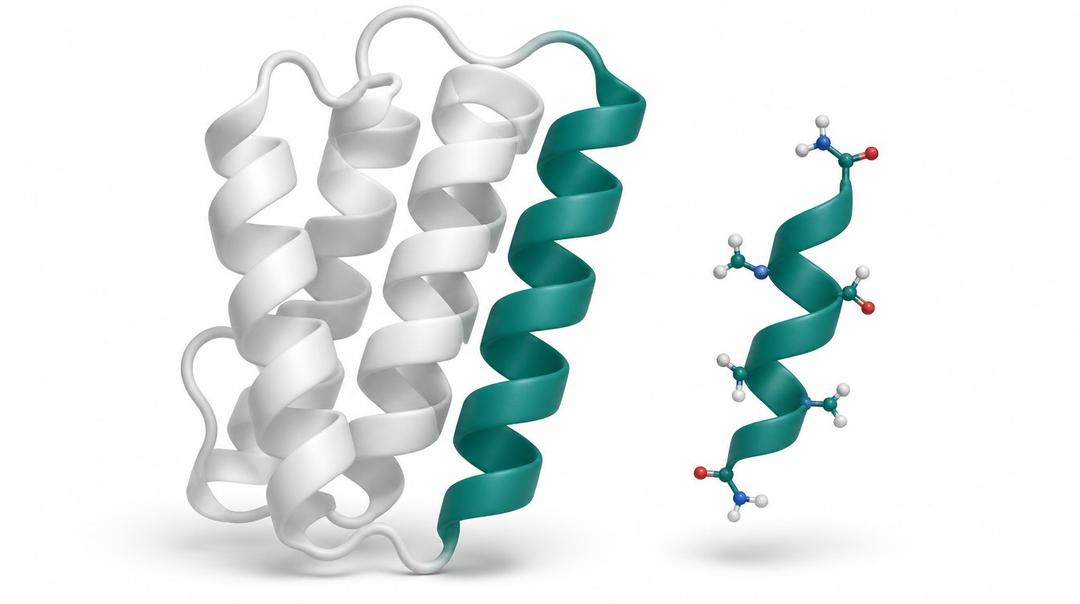
ARA-290, given the international name cibinetide, is an 11-amino-acid peptide designed from the structure of erythropoietin (EPO), the hormone that drives red blood cell production. It copies one surface of EPO, the outward-facing side of a helix called helix B, and was built to keep the tissue-protective signalling attributed to EPO while leaving out its effect on red cells. Its literature runs from rodent injury models to a handful of small phase 2 trials in neuropathy, almost all of them run by the company developing it and its academic collaborators. It is not approved as a medicine anywhere.
Where did ARA-290 come from?
From a puzzle about erythropoietin. EPO is best known for its hormonal job: produced by the kidney, it binds a pair of EPO receptors on bone-marrow cells and raises red cell production. But many tissues also make EPO locally after injury, and in animal models EPO protects nerve, kidney and heart tissue. Giving EPO itself for that purpose is a problem, because it also raises red cell mass and the risk of clotting.
In 2008, Brines and colleagues reported that the two jobs run through different receptors, and that the tissue-protective one could be engaged by fragments of EPO. They showed that helix B, the part of EPO that faces outward when the hormone sits on its blood-forming receptor, was protective in models of stroke, retinal injury and nerve trauma. They then showed that an 11-amino-acid peptide reproducing just the water-facing surface of that helix was also protective in rodent models, and did not stimulate red cell production (PMID 18676614). That peptide became ARA-290. Several of the authors worked for the company developing it, a point the paper discloses.
What is ARA-290 made of?
Eleven amino acids, starting with pyroglutamate, a ring-closed form of glutamate that blocks the start of the chain from being trimmed by enzymes.
| Property | ARA-290 |
|---|---|
| Sequence | pGlu-Glu-Gln-Leu-Glu-Arg-Ala-Leu-Asn-Ser-Ser |
| Also called | Cibinetide; pyroglutamate helix B surface peptide (pHBSP) |
| CAS number (PubChem) | 1208243-50-8 |
| Molecular formula (PubChem) | C51H84N16O21 |
| Molecular weight (PubChem) | About 1,257 g/mol |
| Origin | Designed from the structure of erythropoietin, 2008 |
| Evidence stage | Animal work; small phase 2 trials, largely sponsor-linked |
| Regulatory status | Not approved as a medicine anywhere |
How is ARA-290 thought to work?
Through what its developers call the innate repair receptor: a pairing of one EPO receptor with CD131, the beta common receptor shared with several immune signalling molecules. This is a different receptor from the pair of EPO receptors that drives red cell production, which is why a peptide can engage one without the other.
The strongest piece of evidence that the receptor matters comes from knockout mice. Swartjes and colleagues gave ARA-290 to rats and mice after a peripheral nerve injury and measured sensitivity to touch and cold. The peptide reduced that sensitivity in rats and in normal mice, but had no effect in mice lacking the beta common receptor (PMID 21873879). An effect that disappears when the receptor is removed is better evidence of mechanism than an effect alone. Why that matters is set out in how peptide receptors work.
What has ARA-290 been studied for?
| Area | Evidence stage | What exists |
|---|---|---|
| Neuropathic pain after nerve injury | Animal | Rat and mouse nerve-injury models, including receptor knockouts |
| Small fibre neuropathy in sarcoidosis | Small phase 2 trials | Three placebo-controlled trials, 22 to 64 patients, about four weeks each |
| Type 2 diabetes with neuropathy | Small phase 2 trial | Blood sugar markers, symptom scores and corneal nerves |
| Diabetic macular oedema | Small open trial | Nine patients; no change in the main eye measures |
| Mood and emotional processing | Single study in healthy volunteers | 36 people; no effect on mood |
| Kidney, heart and wound models | Animal | Injury and inflammation models from several groups |
Neuropathy is where the human work concentrates. Small fibre neuropathy is damage to the thinnest nerve fibres, which carry pain and temperature and control functions such as sweating. It is common in sarcoidosis and diabetes and hard to measure, so the trials leaned on corneal confocal microscopy, a scan of the nerve fibres in the cornea, alongside symptom questionnaires. The trials, and what their results do and do not show, are covered in detail in ARA-290 and the small fibre neuropathy trials.
Type 2 diabetes. Brines and colleagues ran a phase 2 trial in people with type 2 diabetes and painful neuropathy, comparing ARA-290 with placebo for 28 days and following them for another month. They reported changes in HbA1c, blood lipids and a neuropathic-symptom questionnaire, and an increase in corneal nerve fibre density in the subgroup that started furthest below normal (PMID 25387363).
The eye. Lois and colleagues gave cibinetide to nine people with diabetic macular oedema for 12 weeks. Visual acuity, retinal thickness and retinal sensitivity did not change on average; a quality-of-life questionnaire did (PMID 32674280). It was an open study without a control group.
Mood. Cerit and colleagues gave ARA-290 or placebo to 36 healthy volunteers and measured how they processed emotional faces and words a week later. There were some differences in emotional processing, no effect on mood, and the authors concluded the results did not clearly support an antidepressant-like profile (PMID 26431906).
Where the evidence stops
Small and short. The human trials enrolled between nine and 64 people and lasted about four to twelve weeks. Nothing of that size can establish a lasting effect on a chronic condition.
Surrogate endpoints. The most consistent finding is a change in corneal nerve fibre measures, which is a marker rather than how a person feels or functions. Why a moved marker is not the same as a demonstrated outcome is explained in surrogate endpoints explained.
One developer. Most of the clinical work involves the company developing cibinetide and its collaborators, several of whom disclose holding stock. That does not make the results wrong, but it is the reason independent replication matters; see conflicts of interest in research.
No phase 3. We found no published phase 3 trial.
Is ARA-290 approved anywhere?
Not that we could find. Cibinetide has no marketing authorisation from Health Canada, the FDA or the EMA, for any indication. Status in Canada can be checked in the Drug Product Database, and the general framework is set out in peptides and Canadian law.
What is ARA-290 commonly confused with?
Erythropoietin. ARA-290 is derived from EPO's structure but is a different molecule, a tenth of its size, designed not to act on the receptor that raises red cell production. Results for EPO do not transfer to ARA-290, or the reverse.
EPO-stimulating drugs. Epoetin, darbepoetin and similar drugs are made to raise red cell counts. ARA-290 was designed to do the opposite of that one job.
Other "repair" peptides. BPC-157 and TB-500 are often grouped with ARA-290 online. They have unrelated structures, receptors and literatures.
Supplied here for laboratory use: ARA-290. For laboratory research use only.
The findings above describe the compound in the cells, animals and people studied, not any laboratory reagent. Nothing here is medical, dosing, or therapeutic guidance.
Frequently asked questions
Is ARA-290 the same as cibinetide? Yes. ARA-290 was its development code; cibinetide is its international non-proprietary name.
Does ARA-290 raise red blood cell counts? It was designed not to, and the original rodent work reported no effect on red cell production. That is the point of the molecule: it copies a part of EPO that does not bind the receptor responsible.
Has ARA-290 been tested in people? Yes, in a small number of short phase 2 trials, mainly in small fibre neuropathy linked to sarcoidosis or diabetes. There is no phase 3 trial.
Is ARA-290 legal in Canada? It has no Canadian authorisation as a drug. It is sold here as a laboratory research chemical, not for human use.
Selected Research References
- Brines M, Patel NS, Villa P, et al. Nonerythropoietic, tissue-protective peptides derived from the tertiary structure of erythropoietin. Proceedings of the National Academy of Sciences of the United States of America. 2008;105(31):10925-10930. pubmed.ncbi.nlm.nih.gov/18676614
- Swartjes M, Morariu A, Niesters M, et al. ARA290, a peptide derived from the tertiary structure of erythropoietin, produces long-term relief of neuropathic pain: an experimental study in rats and β-common receptor knockout mice. Anesthesiology. 2011;115(5):1084-1092. pubmed.ncbi.nlm.nih.gov/21873879
- Brines M, Dunne AN, van Velzen M, et al. ARA 290, a nonerythropoietic peptide engineered from erythropoietin, improves metabolic control and neuropathic symptoms in patients with type 2 diabetes. Molecular Medicine. 2015;20(1):658-666. pubmed.ncbi.nlm.nih.gov/25387363
- Lois N, Gardner E, McFarland M, et al. A Phase 2 Clinical Trial on the Use of Cibinetide for the Treatment of Diabetic Macular Edema. Journal of Clinical Medicine. 2020;9(7):2225. pubmed.ncbi.nlm.nih.gov/32674280
- Cerit H, Veer IM, Dahan A, et al. Testing the antidepressant properties of the peptide ARA290 in a human neuropsychological model of drug action. European Neuropsychopharmacology. 2015;25(12):2289-2299. pubmed.ncbi.nlm.nih.gov/26431906
All products sold by NovaEvum are for research and laboratory use only. They are not intended for human or animal consumption, diagnosis, treatment, cure, or prevention of any disease.