
ARA-290
ARA-290 and the Small Fibre Neuropathy Trials: What Was Measured and What It Shows
EW
· 7 min read
A summary of published research, with citations. It states no amount, schedule or route, and makes no claim about what this compound does in a person. Supplied for laboratory research use only.
On this page · 5 sections
Most of the human research on ARA-290 (cibinetide) is in one condition: small fibre neuropathy in people with sarcoidosis. Three placebo-controlled trials, enrolling 22, 22 and 64 patients for about four weeks each, are the core of that record, with a fourth in type 2 diabetes. Each reported a change in at least one measure, most consistently in the nerve fibres of the cornea. This article sets out what each trial measured, why researchers looked at the eye to study nerves in the legs, and what the results can and cannot support. For the compound itself, see what ARA-290 is.
What is small fibre neuropathy?
Damage to the thinnest nerve fibres in the body, the lightly insulated and uninsulated fibres that carry pain and temperature and help control sweating, heart rate and blood pressure. Damage to them can cause burning pain, abnormal sensitivity and autonomic problems, while the standard nerve conduction test, which measures the larger fibres, comes back normal.
That last point is the research problem. If the usual test cannot see the damage, it is hard to diagnose and harder to measure change. The options are a skin biopsy, which counts nerve fibres in a small piece of skin, symptom questionnaires, which are subjective, and corneal confocal microscopy.
Sarcoidosis is an inflammatory disease that forms small clusters of immune cells, granulomas, in the lungs and other organs. Small fibre neuropathy is a common and often disabling complication of it, which is why the developers of ARA-290, a peptide studied for its anti-inflammatory signalling, chose it as a test condition.
Why measure nerves in the cornea?
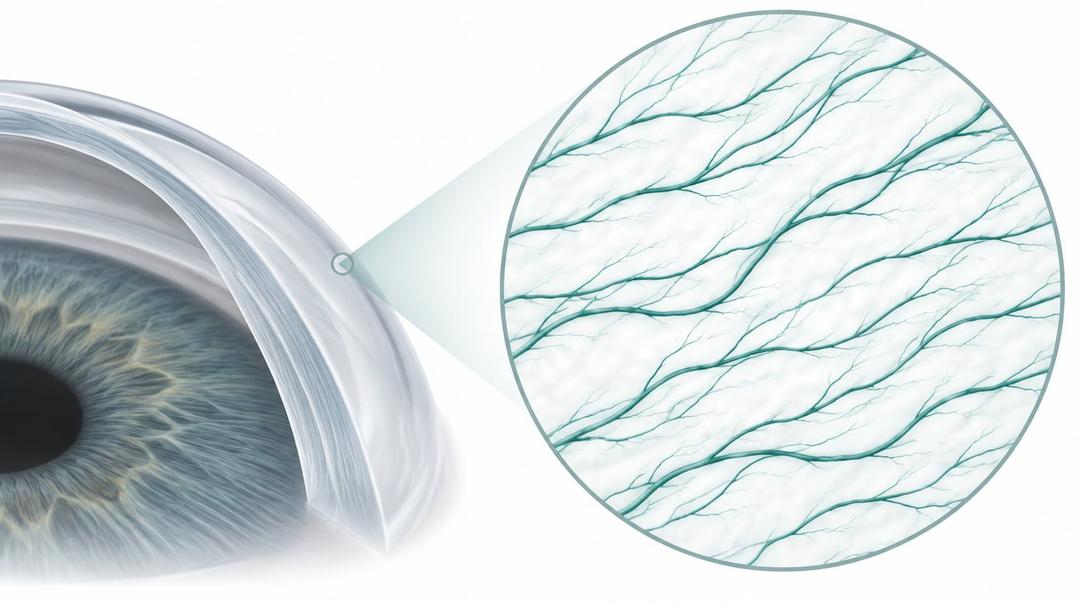
The cornea, the clear front of the eye, is one of the most densely innervated tissues in the body, and its nerve fibres are small fibres of the same kind affected in the legs. Corneal confocal microscopy photographs those fibres in a living person in a few minutes, without a needle. Researchers can count the fibres, measure their length or the area they cover, and repeat the scan weeks later.
That makes it attractive for a short trial. But a corneal nerve count is a surrogate endpoint: a measurable marker that is hoped to track the outcome people care about, here pain and function. A marker can move without the outcome following, which is why these trials are best read as early, exploratory work. The general problem is set out in surrogate endpoints explained.
The trials, one by one
| Trial | Patients | Length | Main measure | What was reported |
|---|---|---|---|---|
| Heij 2012 | 22, sarcoidosis | 4 weeks | Small fibre neuropathy symptom score | Symptom score changed more than placebo; pain and fatigue scores changed equally in both groups |
| Dahan 2013 | 22, sarcoidosis | 4 weeks | Symptoms, corneal nerve density, walking test | Changes in symptoms, corneal nerve fibre density and 6-minute walk |
| Culver 2017 | 64, sarcoidosis | 4 weeks | Corneal nerve fibre area | Significant at one of three strengths only; pain fell in all groups, placebo included |
| Brines 2015 | Type 2 diabetes | 4 weeks, plus 4 of follow-up | Blood sugar markers, symptoms, corneal nerves | Changes in HbA1c, lipids and symptoms; nerve change in a subgroup |
Heij and colleagues, 2012. The first trial was a double-blind pilot in 22 people with sarcoidosis and symptoms of small fibre neuropathy, 12 on ARA-290 and 10 on placebo, for four weeks. The small fibre neuropathy screening score changed significantly more with ARA-290 than with placebo. The pain score and the fatigue score, however, changed by similar amounts in both groups, which is a reminder of how large placebo responses are in pain research (PMID 23168581).
Dahan and colleagues, 2013. A second placebo-controlled trial in sarcoidosis added objective measures. The authors reported changes in neuropathic symptoms, in corneal small nerve fibre density, in skin temperature sensitivity and in distance on the 6-minute walk test (PMID 24136731).
Culver and colleagues, 2017. The largest, a phase 2b trial, randomised 64 patients to placebo or one of three strengths of cibinetide for 28 days, with a change in corneal nerve fibre area as the primary endpoint. The difference from placebo was statistically significant in the middle strength group only; the lowest and highest were not. Skin biopsies showed more regenerating fibres in the same group, and the change in corneal nerves correlated with changes in skin fibres and walking distance. Pain fell significantly in every group, placebo included (PMID 28475703).
Brines and colleagues, 2015. In type 2 diabetes with painful neuropathy, the developers reported changes in HbA1c, lipids and a neuropathic-symptom questionnaire over 28 days of ARA-290 and a month of follow-up. Corneal nerve fibre density rose only in the subgroup that started furthest below normal (PMID 25387363).
What the results can and cannot support
A consistent signal in one marker. Across the trials, corneal nerve measures moved in the ARA-290 groups more than in the placebo groups. That is the most repeatable finding in this literature, and it is a reason the developers proposed corneal nerve fibre area as an endpoint for future trials.
A weak picture for symptoms. Pain improved in placebo groups as well, sometimes by the same amount. With 22 to 64 patients and four weeks of follow-up, the trials could not show whether any symptom change would last or matter.
A dose pattern that is hard to read. In the largest trial, the middle strength reached significance and the highest did not. That can happen by chance in a small trial, and it is one reason a single phase 2b result is not a basis for conclusions.
One sponsor. All four trials were run by or with the company developing cibinetide, and several authors disclose holding stock in it. No independent group has published a trial. Why that matters, separately from whether the results are right, is covered in conflicts of interest in research, and how to weigh small trials in how to read a peptide study.
No phase 3. We found no published phase 3 trial, and cibinetide is not approved as a medicine anywhere.
Supplied here for laboratory use: ARA-290. For laboratory research use only.
The findings above describe the compound in the people studied, not any laboratory reagent. Nothing here is medical, dosing, or therapeutic guidance.
Frequently asked questions
Did ARA-290 work for small fibre neuropathy? The trials reported changes in corneal nerve measures and some symptom scores, but they were small, short and run by the developer, and pain also improved on placebo. They are early, exploratory results, not proof of an effect.
What is corneal confocal microscopy? A scan that photographs the nerve fibres in the cornea, the clear front of the eye, in a few minutes without a needle. Because those fibres are the same small type affected in neuropathy, the scan is used to track nerve loss and regrowth.
Why sarcoidosis? Small fibre neuropathy is a common and hard-to-manage complication of sarcoidosis, an inflammatory disease, and ARA-290 was designed around anti-inflammatory and tissue-protective signalling.
Has anyone else repeated these trials? Not that we could find. Every published trial involves the developer and its collaborators.
Selected Research References
- Heij L, Niesters M, Swartjes M, et al. Safety and efficacy of ARA 290 in sarcoidosis patients with symptoms of small fiber neuropathy: a randomized, double-blind pilot study. Molecular Medicine. 2012;18(1):1430-1436. pubmed.ncbi.nlm.nih.gov/23168581
- Dahan A, Dunne A, Swartjes M, et al. ARA 290 improves symptoms in patients with sarcoidosis-associated small nerve fiber loss and increases corneal nerve fiber density. Molecular Medicine. 2013;19(1):334-345. pubmed.ncbi.nlm.nih.gov/24136731
- Culver DA, Dahan A, Bajorunas D, et al. Cibinetide Improves Corneal Nerve Fiber Abundance in Patients With Sarcoidosis-Associated Small Nerve Fiber Loss and Neuropathic Pain. Investigative Ophthalmology and Visual Science. 2017;58(6):BIO52-BIO60. pubmed.ncbi.nlm.nih.gov/28475703
- Brines M, Dunne AN, van Velzen M, et al. ARA 290, a nonerythropoietic peptide engineered from erythropoietin, improves metabolic control and neuropathic symptoms in patients with type 2 diabetes. Molecular Medicine. 2015;20(1):658-666. pubmed.ncbi.nlm.nih.gov/25387363
All products sold by NovaEvum are for research and laboratory use only. They are not intended for human or animal consumption, diagnosis, treatment, cure, or prevention of any disease.