
A summary of published research, with citations. It states no amount, schedule or route, and makes no claim about what this compound does in a person. Supplied for laboratory research use only.
On this page · 6 sections
Quick answer: Thymosin beta-4 is a 43-amino-acid peptide. “TB-500” is used inconsistently in commerce, often for a short fragment; a name on a vial does not verify which molecule is present.
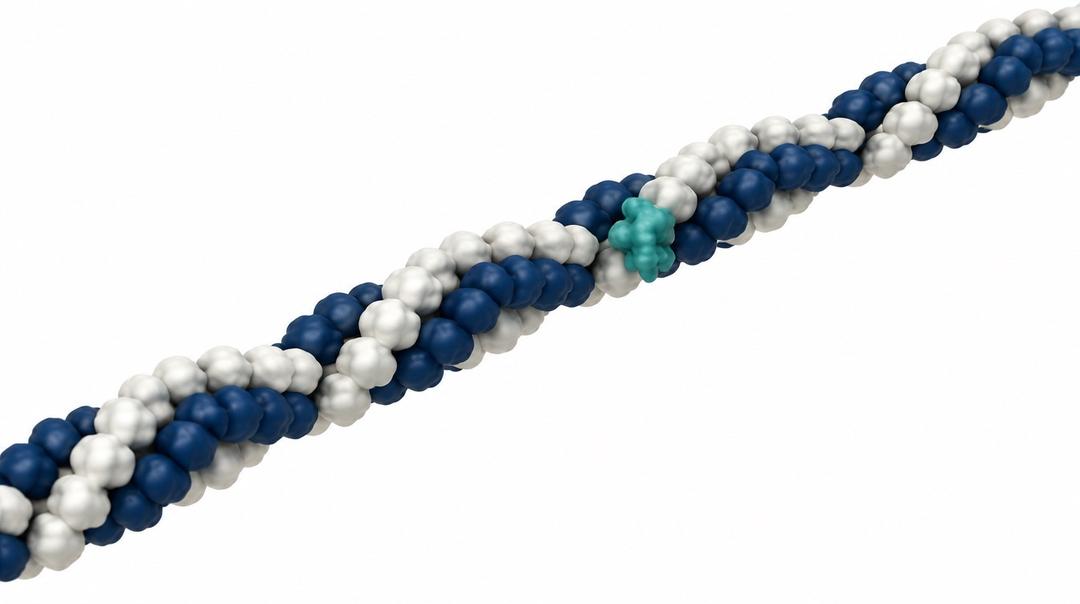
Full-length and fragment are not equivalent
Changing peptide length changes molecular mass, proteolytic behaviour and possibly biological activity. Researchers should distinguish studies on thymosin beta-4 from those specifically using an identified TB-500 fragment. Even a fragment taken from the same sequence cannot be assumed to reproduce every effect of the full molecule.
Why this matters in research reviews
Cardiac, repair and actin-related studies often concern full-length thymosin beta-4. A blog that cites them to support a commercial TB-500 formulation may be switching compounds halfway through its argument. The source article’s methods section—not its popular summary—settles the question.
What a batch document should identify
An informative analytical report names the intended sequence or molecular formula, measured molecular mass, test method and corresponding lot. Purity by HPLC alone cannot distinguish every closely related species, and a stated milligram amount does not resolve fragment identity.
What has not been established
A preclinical response to thymosin beta-4 does not demonstrate a clinical benefit from an unapproved research fragment. Statements about speed of recovery or safety in people need direct clinical testing of the exact formulation.
Frequently asked questions
Are TB-500 and thymosin beta-4 identical? Not necessarily; the TB-500 label is used inconsistently and must be tied to a sequence.
Can the two research literatures be combined? Only with explicit molecular identification and carefully stated limits.
Supplied here for laboratory use: TB-500. The laboratory's certificate for each lot is linked from its product page. For laboratory research use only.
Further reading
All products sold by NovaEvum are for research and laboratory use only. They are not intended for human or animal consumption, diagnosis, treatment, cure, or prevention of any disease.