
Research
Peptide Research in Canada: New Developments Shaping Quality Standards in 2026
NB
· 8 min read
A summary of published research, with citations. It states no amount, schedule or route, and makes no claim about what this compound does in a person. Supplied for laboratory research use only.
On this page · 12 sections
- The next chapter of peptide research in Canada
- Why peptide science continues to attract attention
- November 2026: a significant Canadian regulatory development
- What constitutes meaningful peptide quality?
- HPLC and the science of peptide characterization
- Mass spectrometry and molecular identification
- Batch traceability and research reproducibility
- The role of Canadian regulations
- The NovaEvum perspective: research quality as a scientific foundation
- What comes next for peptide research in Canada?
- Frequently asked questions
- Further reading
Peptide science has emerged as an important area of modern biotechnology, connecting developments in molecular biology, metabolic research, analytical chemistry and pharmaceutical innovation. As interest in peptide research continues to expand, an equally important conversation is developing around research quality: how peptides are identified, how purity is measured, what makes laboratory documentation scientifically meaningful, and how Canada's regulations distinguish investigational materials from authorized medicines. A Health Canada advisory in November 2026 made those questions especially relevant.
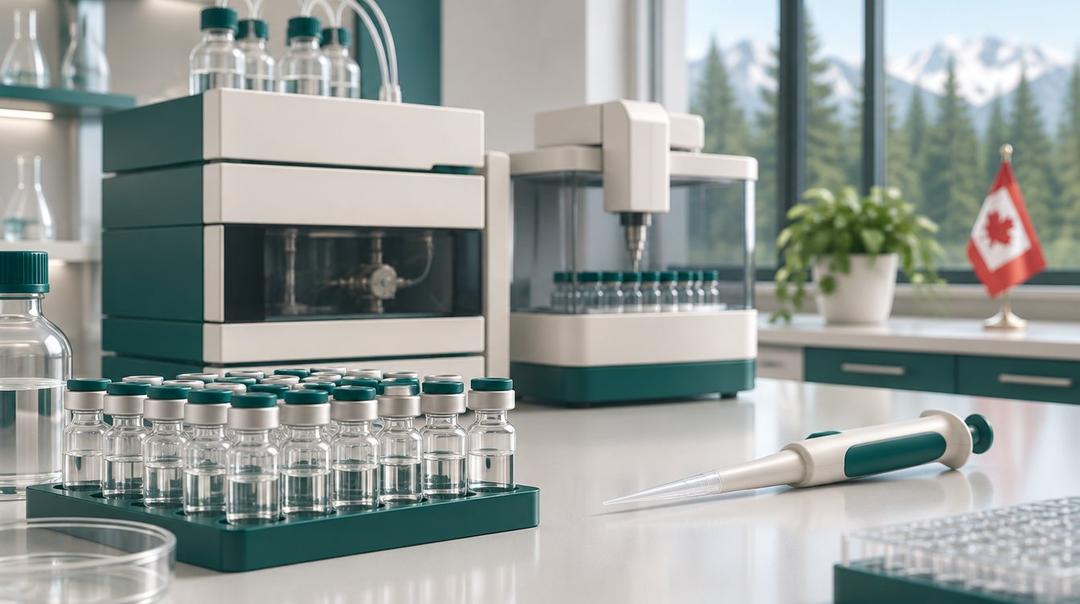
The next chapter of peptide research in Canada
Across research institutions worldwide, scientists are investigating how short chains of amino acids interact with biological pathways responsible for cellular communication, hormone signalling, metabolic regulation and tissue responses.
Canada is part of this evolving scientific landscape. Canadian researchers contribute to pharmaceutical development, molecular characterization, clinical investigation, and the analytical techniques that support reliable scientific experimentation.
For NovaEvum, understanding this intersection of emerging science, analytical precision and responsible research is central to meaningful scientific education.
Why peptide science continues to attract attention
Peptides are composed of amino acids connected through peptide bonds. Their amino acid sequences determine many aspects of their structure, stability and biological interactions. Some peptides occur naturally as hormones or signalling molecules; others are designed or synthesized to investigate particular molecular targets. That diversity makes peptide research relevant to several distinct scientific fields. The basics are covered in what peptides are.
Metabolic and endocrine research. Researchers are investigating how peptide-based receptor agonists influence metabolic signalling. Developments involving GLP-1, GIP and glucagon receptors have generated scientific interest in approaches that target multiple hormonal pathways; see retatrutide and triple-receptor research.
Cellular and tissue biology. Experimental compounds are being studied in relation to cellular migration, extracellular matrix regulation, inflammation and tissue organization. These investigations help scientists explore the complex mechanisms involved in biological repair processes.
Mitochondrial research. Mitochondria are increasingly understood as signalling organelles in addition to their established roles in energy metabolism. Peptides associated with mitochondrial biology, including MOTS-c and SS-31, are subjects of ongoing investigation.
Analytical chemistry. Advances in chromatography and mass spectrometry allow researchers to investigate peptide identity, chemical composition and molecular characteristics with increasing precision.
These fields show why peptide research cannot be reduced to a single application or biological effect.
November 2026: a significant Canadian regulatory development
On November 6, 2026, Health Canada issued a public advisory concerning contaminated, unauthorized injectable peptide and non-peptide products.
The agency reported detecting bacterial contamination in products from Shanghai ERP Peptide Biotechnology Co., Ltd. Its investigation also involved two Canadian online retailers selling products from that supplier, and the enforcement actions resulted in the seizure of more than 11,400 vials. According to Health Canada, the bacteria identified included Acinetobacter seifertii, Acinetobacter nosocomialis and Propionibacterium (Cutibacterium) acnes.
The advisory named examples of unauthorized products sold by that supplier, including human chorionic gonadotropin, MOTS-c, NAD+, retatrutide, tesamorelin and tirzepatide. Health Canada has asked the supplier to stop selling into Canada and is working with the Canada Border Services Agency to stop shipments at the border.
The significance of the advisory extends beyond the particular molecules involved. It highlights the importance of distinguishing chemical characterization from microbiological quality and from regulatory authorization. The findings concerned the investigated products, and should not be presented as showing that every material containing those compounds shares the same contamination profile. At the same time, contamination of injectable products is a serious safety concern: Health Canada advises against buying or using unauthorized injectable drugs, and recommends seeking medical care right away if signs of infection develop after exposure.
What constitutes meaningful peptide quality?
In molecular research, quality is not a single measurement. A research material can be evaluated on several characteristics, each answering a different scientific question.
| Dimension | The question it answers | How it is examined |
|---|---|---|
| Molecular identity | Is this the intended molecule? | Mass spectrometry, often with chromatography |
| Chemical purity | What share of what is detected is the main component? | HPLC, under a stated method |
| Net content | How much of the compound is actually in the vial? | Quantitative assay against a reference |
| Sterility and endotoxins | Is it free of microorganisms and bacterial toxins? | Sterility testing and endotoxin (LAL) assays |
| Regulatory status | Is this product authorized for a particular use? | A regulator's decision, not a laboratory test |
These categories are not interchangeable. A material may show high chromatographic purity without establishing the absence of bacteria or endotoxins. Likewise, successful analytical identification does not mean that a compound has been clinically evaluated for human use. Endotoxin testing is covered in endotoxin testing and the LAL assay.
HPLC and the science of peptide characterization
High-performance liquid chromatography, or HPLC, is one of the main analytical methods used in peptide research. It separates chemical components according to how they interact with a mobile phase and a stationary phase. As a sample moves through a chromatographic column, different compounds emerge at different retention times, and a detector records them as peaks on a chromatogram.
Researchers can examine that pattern to assess relative chemical composition and the presence of certain impurities. But chromatographic purity depends on the analytical method, the detector's response and how the result is calculated. A purity percentage is not a universal measure of every possible contaminant. HPLC is valuable precisely because it answers a defined analytical question.
Mass spectrometry and molecular identification
Mass spectrometry offers complementary information by measuring the mass-to-charge ratio of ions. In peptide analysis it can confirm molecular mass and help distinguish the intended compound from related structures or impurities. Combined with chromatography, it gives information about both separation behaviour and molecular identity, which is particularly useful for synthetic peptides with closely related structures.
The principle underneath both methods is the same: different analytical methods contribute different forms of evidence, and no single test should be read as showing something it was not designed to measure. How to read the documents these tests produce is set out in how to read a certificate of analysis.
Batch traceability and research reproducibility
Scientific reproducibility depends partly on knowing what material was used in an experiment. Batch traceability connects a particular sample to its analytical documentation. A useful record includes a batch identifier, a testing date, the laboratory method, the measured results and information about sample handling.
These details matter most when different laboratories try to reproduce published findings. If two experiments use materials with different identities, concentrations or impurity profiles, their results may not be directly comparable. Reliable documentation is therefore not simply an administrative feature; it is part of how molecular research is interpreted. How study design affects what a result can show is covered in how to read a peptide study.
The role of Canadian regulations
In Canada, authorization depends on a product's characteristics, its intended use and the applicable regulatory requirements. Health Canada generally regulates injectable peptides intended for medical use as prescription drugs, and authorized drug products ordinarily carry an eight-digit Drug Identification Number, or DIN.
A research-use label does not automatically exempt a product from Canadian drug legislation. Scientific research and regulatory authorization are separate matters: a compound can be scientifically interesting while remaining unauthorized for human therapeutic use. The framework is set out in more detail in peptides and Canadian law.
The NovaEvum perspective: research quality as a scientific foundation
Peptide research is advancing because scientists are asking increasingly precise questions about molecular structure and biological activity. Our editorial approach is to understand those questions and the evidence used to investigate them. Analytical testing, molecular characterization and the published literature provide a framework for separating promising hypotheses from demonstrated findings.
The November advisory reinforces why technical transparency and careful scientific interpretation matter. The future of peptide research will depend not only on discovering new biological interactions, but on reliable methods for studying them.
What comes next for peptide research in Canada?
Several developments are likely to shape future research. Improved mass spectrometry may support more sophisticated molecular characterization. Advances in peptide engineering may let researchers investigate receptor interactions with greater specificity. Clinical studies will continue to determine which investigational molecules have meaningful therapeutic applications. And Canadian regulators will continue to evaluate product authorization, manufacturing quality and public safety.
Together these point to one principle: scientific innovation and rigorous evidence are complementary, not competing, objectives.
This article is scientific education, not medical advice. Investigational research findings do not establish clinical safety, efficacy or authorization for human use.
Frequently asked questions
Are peptides legal in Canada? Legal status depends on the particular product, its intended use and the applicable laws. Authorized prescription peptide medicines are available for specific indications, while unauthorized drug products cannot lawfully be sold as medicines.
What is peptide purity testing? Purity testing examines chemical composition through methods such as HPLC. Results have to be interpreted according to the specific method used.
Does a 99% purity result establish sterility? No. Chemical purity and sterility are different characteristics and require different tests.
What is a peptide certificate of analysis? A certificate of analysis summarizes specified analytical results for a sample or batch. Its usefulness depends on the testing methods, its authenticity and its traceability to the material in question.
What did Health Canada find in November 2026? Bacterial contamination in unauthorized injectable products from one overseas supplier, sold through two Canadian online retailers, with more than 11,400 vials seized.
Selected Research References
- Health Canada. Health Canada warns about contaminated unauthorized injectable peptides and non-peptide drugs. Public advisory, November 6, 2026. recalls-rappels.canada.ca/en/alert-recall/health-canada-warns-about-contaminated-unauthorized-injectable-peptides-and-non
- Health Canada. Peptides: regulations and enforcement. canada.ca/en/health-canada/services/drugs-health-products/peptides/regulations-enforcement.html
Further reading
All products sold by NovaEvum are for research and laboratory use only. They are not intended for human or animal consumption, diagnosis, treatment, cure, or prevention of any disease.