
GLP-1 and metabolic
MariTide (Maridebart Cafraglutide): Phase 2 Results and the GIPR Antagonist Idea
AM
· 9 min read
A summary of published research, with citations. It states no amount, schedule or route, and makes no claim about what this compound does in a person. Supplied for laboratory research use only.
On this page · 7 sections
MariTide (maridebart cafraglutide, AMG 133) is Amgen's investigational antibody-peptide conjugate. It blocks the GIP receptor with an antibody and activates the GLP-1 receptor with two attached peptides. In its 52-week phase 2 trial, adults with obesity had mean weight change of −12.3% to −16.2% against −2.5% on placebo; those with obesity and type 2 diabetes had −8.4% to −12.3% against −1.7%. The MARITIME phase 3 programme has not reported. MariTide is approved nowhere.
What is MariTide?
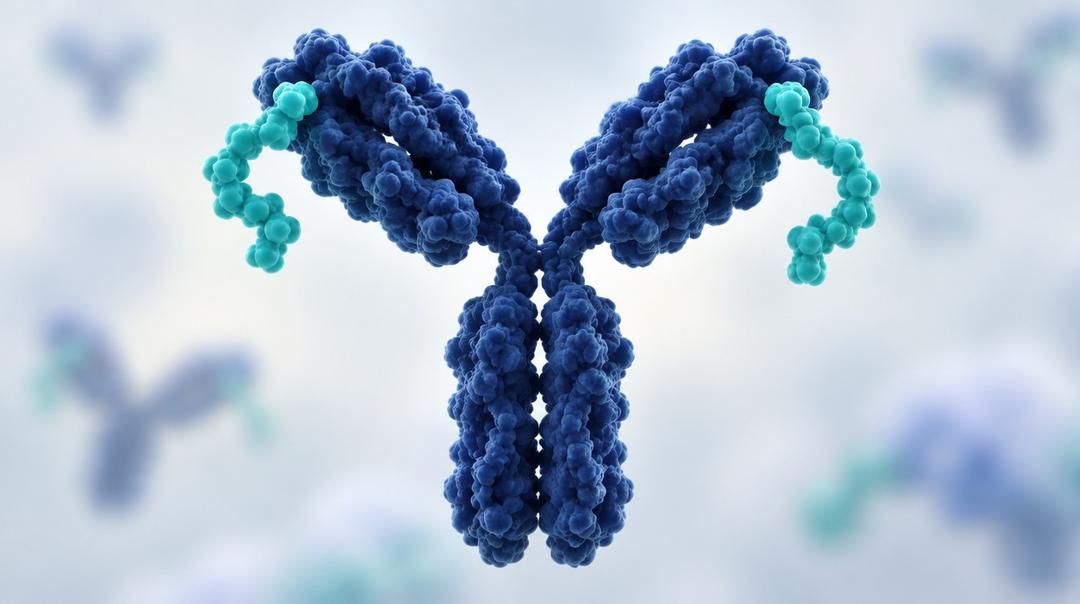
Most incretin drugs are peptides: chains of amino acids, often with a fatty acid attached to slow their clearance. MariTide is built differently. Véniant and colleagues at Amgen describe it as a fully human monoclonal antibody against the human GIP receptor, conjugated through amino acid linkers to two GLP-1 analogue peptides. The antibody part blocks the GIP receptor; the peptide parts activate the GLP-1 receptor. In cell-based systems both activities were confirmed, and the molecule reduced body weight in obese male mice and in cynomolgus monkeys.
A 2026 review by Yie and colleagues uses MariTide as the central example of antibody-peptide conjugates. The rationale they set out is pharmacokinetic as much as pharmacological: peptides are cleared quickly by proteolysis and the kidneys, while antibodies circulate for a long time. Joining the two gives the peptide an antibody's exposure profile. That long exposure is the main practical difference between MariTide and the peptide incretins.
How the GIP, GLP-1 and glucagon receptors differ is covered in the receptor guide.
Why block the GIP receptor when tirzepatide activates it?
This is the question everyone asks about MariTide, and the honest answer is that the field does not fully know. Tirzepatide activates the GIP receptor. MariTide blocks it. Both, combined with GLP-1 agonism, produce substantial weight loss in trials. Reviewers call this the GIPR paradox.
The case for antagonism started with genetics and mice. Killion and colleagues at Amgen wrote in 2018 that the GIP receptor gene had appeared in several genome-wide association studies as a contributor to obesity, and that mice lacking the receptor are protected from diet-induced obesity. On that basis they built antagonist antibodies. A mouse antibody against the mouse receptor protected obese mice from weight gain, and an antibody against the human receptor produced weight loss in obese monkeys. Weight loss was greater when the antibodies were combined with GLP-1 agonists, in both species.
Agonism may end up looking like antagonism. In 2020 the same group reported that chronic GIP receptor agonism desensitised receptor activity in fat cells, so that a long-acting agonist behaved, in adipocytes, like an antagonist. If that is what happens in people, the two strategies may converge on the same tissue-level effect. It is a hypothesis drawn from cell and mouse work.
The brain is involved either way. Liu and colleagues showed in mice that the full weight effect of a GIP-receptor-antibody/GLP-1 conjugate required GIP and GLP-1 receptors in the central nervous system. The conjugate was detected in the brain's circumventricular organs and activated neurons in regions involved in appetite.
Direct comparisons in mice show different metabolic profiles. Davies and colleagues compared a GIP receptor agonist with an antagonist in male mice. In obese mice both reduced food intake and body weight, and the weight loss matched pair-fed controls, meaning energy expenditure did not change. But the agonist improved glucose tolerance independently of weight loss, while the antagonist reduced insulin sensitivity compared with pair-fed controls. The two routes to the same weight change were not metabolically identical.
The current reading. A 2026 review by Gao and Borner proposes that agonism may work partly through anorectic brain circuits, thermogenesis and by dampening the nausea that GLP-1 drugs cause, while antagonism may amplify GLP-1 receptor signalling and counter fat-storing effects of endogenous GIP. A 2025 review by Douros and colleagues traces how the same human genetics and animal data were read to justify both programmes. Neither mechanism has been settled in people.
| Tirzepatide | MariTide | |
|---|---|---|
| GLP-1 receptor | Agonist | Agonist |
| GIP receptor | Agonist | Antagonist |
| Molecule type | Lipidated peptide | Antibody conjugated to two peptides |
| Status | Approved in the United States since 2022 and in Canada | Phase 3; approved nowhere |
Tirzepatide's own trial record is covered in tirzepatide vs semaglutide and its side-effect data.
What did the phase 1 trial show?
The phase 1 trial (NCT04478708), reported in the same paper as the animal work, was randomised, double-blind and placebo-controlled in people with obesity. The authors reported an acceptable safety and tolerability profile with pronounced, dose-dependent weight loss. In the multiple-dose cohorts, weight loss was maintained for up to 150 days after the last administration, consistent with the long exposure an antibody backbone provides.
What did the phase 2 trial find?
Jastreboff and colleagues published the phase 2 dose-ranging trial in the New England Journal of Medicine in 2025 (NCT05669599). It enrolled 592 participants in two cohorts across 11 randomised groups, testing several dose levels, intervals and escalation schemes against placebo. The primary endpoint was percent change in body weight at 52 weeks.
Obesity cohort. 465 participants, 63% female, mean BMI 37.9. With the treatment-policy estimand, which counts everyone randomised, mean weight change ranged from −12.3% to −16.2% across the MariTide groups, against −2.5% on placebo.
Obesity with type 2 diabetes cohort. 127 participants, mean BMI 36.5. Weight change ranged from −8.4% to −12.3% against −1.7%. HbA1c fell by 1.2 to 1.6 percentage points against a rise of 0.1 on placebo.
Tolerability. Gastrointestinal adverse events were common. They were less frequent in groups that escalated gradually rather than beginning at the full level, which is the main design lesson the trial offered for phase 3. The authors reported no unexpected safety signals.
As with every incretin drug, weight change in people with diabetes was smaller than in people without. The abstract does not report body composition; how other incretin trials measured lean mass is covered in GLP-1 muscle loss and lean mass.
What is in the MARITIME phase 3 programme?
ClinicalTrials.gov lists a phase 3 programme named MARITIME, all sponsored by Amgen. None had reported by late October 2026.
| Trial | Population | Registry | Listed status |
|---|---|---|---|
| MARITIME-1 | Obesity or overweight without type 2 diabetes; about 3,850 | NCT06858839 | Active, not recruiting |
| MARITIME-2 | Type 2 diabetes with obesity or overweight; about 1,100 | NCT06858878 | Active, not recruiting |
| MARITIME-CV | Atherosclerotic cardiovascular disease with overweight or obesity; 12,800 | NCT07037433 | Recruiting |
| MARITIME-HF | Heart failure with preserved or mildly reduced ejection fraction and obesity | NCT07037459 | Recruiting |
| MARITIME-OSA-1 and -2 | Obstructive sleep apnoea, with and without airway pressure therapy | NCT07225686, NCT07226765 | Active, not recruiting |
| MARITIME-T2D-3 | Type 2 diabetes, against semaglutide | NCT07866066 | Not yet recruiting |
There is also a phase 2 trial in elevated liver fat (NCT07441252) and a completed phase 1 study of the drug's effect on the heart's electrical activity (NCT07229157). MARITIME-CV, at 12,800 participants, is the trial that will say whether the GIP receptor antagonist approach is safe and beneficial for the heart. Its registry primary completion date is 2028.
Is MariTide approved?
No. No regulator has authorised maridebart cafraglutide for any use. Its evidence base is one phase 1 trial and one phase 2 trial; the confirmatory phase 3 trials are under way. Health Canada's Drug Product Database is where any Canadian authorisation would appear.
Its place beside the approved incretins and other late-stage candidates is in the 2026 incretin pipeline overview. Other designs that add a second mechanism to GLP-1 agonism are covered in glucagon receptor agonists explained, survodutide, mazdutide and amycretin.
NovaEvum does not carry MariTide. The comparator molecule, tirzepatide, is supplied here as a laboratory reagent only; it is not the licensed medicine, and no trial result above describes it. Nothing here is medical, dosing, or therapeutic guidance.
Frequently asked questions
How much weight did people lose on MariTide? In the 52-week phase 2 trial, adults with obesity had mean weight change of −12.3% to −16.2% across the MariTide groups, against −2.5% on placebo, counting everyone randomised. In people with obesity and type 2 diabetes it was −8.4% to −12.3% against −1.7%. Phase 3 results have not been published.
Why does MariTide block GIP when tirzepatide activates it? Both approaches reduced weight in animals and people when combined with GLP-1 agonism. Proposed explanations include chronic agonism desensitising the receptor so that it behaves like antagonism, and different actions in the brain and fat tissue. Mouse studies show the two are not metabolically identical. The question remains open.
What makes MariTide different from other GLP-1 drugs? Its structure. It is a monoclonal antibody against the GIP receptor with two GLP-1 peptides attached, rather than a single peptide. The antibody gives it a much longer exposure in the body. In the phase 1 trial, weight loss persisted for up to 150 days after the last administration.
What are MariTide's side effects? In phase 2, gastrointestinal adverse events were the most common, and they were less frequent in groups that started at a lower dose and escalated. The authors reported no unexpected safety signals. Cardiovascular outcomes are being tested in MARITIME-CV, a 12,800-participant trial that has not reported.
Selected Research References
- Killion EA, Wang J, Yie J, et al. Anti-obesity effects of GIPR antagonists alone and in combination with GLP-1R agonists in preclinical models. Science Translational Medicine. 2018;10:eaat3392. pubmed.ncbi.nlm.nih.gov/30567927
- Killion EA, Chen M, Falsey JR, et al. Chronic glucose-dependent insulinotropic polypeptide receptor (GIPR) agonism desensitizes adipocyte GIPR activity mimicking functional GIPR antagonism. Nature Communications. 2020;11:4981. pubmed.ncbi.nlm.nih.gov/33020469
- Véniant MM, Lu SC, Atangan L, et al. A GIPR antagonist conjugated to GLP-1 analogues promotes weight loss with improved metabolic parameters in preclinical and phase 1 settings. Nature Metabolism. 2024;6:290-303. pubmed.ncbi.nlm.nih.gov/38316982
- Liu CM, Killion EA, Hammoud R, et al. GIPR-Ab/GLP-1 peptide-antibody conjugate requires brain GIPR and GLP-1R for additive weight loss in obese mice. Nature Metabolism. 2025;7:1266-1281. pubmed.ncbi.nlm.nih.gov/40301582
- Jastreboff AM, Ryan DH, Bays HE, et al. Once-Monthly Maridebart Cafraglutide for the Treatment of Obesity - A Phase 2 Trial. New England Journal of Medicine. 2025;393:843-857. pubmed.ncbi.nlm.nih.gov/40549887
- Douros JD, Mowery SA, Knerr PJ. The Premise of the Paradox: Examining the Evidence That Motivated GIPR Agonist and Antagonist Drug Development Programs. Journal of Clinical Medicine. 2025;14:3812. pubmed.ncbi.nlm.nih.gov/40507574
- Davies I, Turland A, Tran HD, et al. A metabolic comparison of GIPR agonism versus GIPR antagonism in male mice. Diabetes, Obesity and Metabolism. 2026;28:1160-1167. pubmed.ncbi.nlm.nih.gov/41287212
- Gao SX, Borner T. One receptor, two opposite approaches: efficacy and tolerability of GIPR agonism and antagonism in obesity pharmacotherapy. Appetite. 2026;227:108723. pubmed.ncbi.nlm.nih.gov/42492687
- Yie J, Mou Z, Liu X, et al. Design and therapeutic rationale of antibody-peptide conjugates: insights from maridebart cafraglutide (AMG133) and emerging applications. Antibody Therapeutics. 2026;9:367-380. pubmed.ncbi.nlm.nih.gov/42592044
All products sold by NovaEvum are for research and laboratory use only. They are not intended for human or animal consumption, diagnosis, treatment, cure, or prevention of any disease.