
Testing, quality and handling
How to verify a peptide COA: is this certificate real, and is it about your vial?
NB
· 10 min read
A summary of published research, with citations. It states no amount, schedule or route, and makes no claim about what this compound does in a person. Supplied for laboratory research use only.
On this page · 7 sections
To verify a peptide certificate of analysis, confirm it with the laboratory that issued it, not the seller who sent it. Retrieve the report through the laboratory's own verification page or by writing to the laboratory, check that your copy matches the original in every field, then check that the certificate's lot number is the one printed on your vial. A certificate that fails any of those steps tells you nothing about the material in your hand, however good its numbers look.
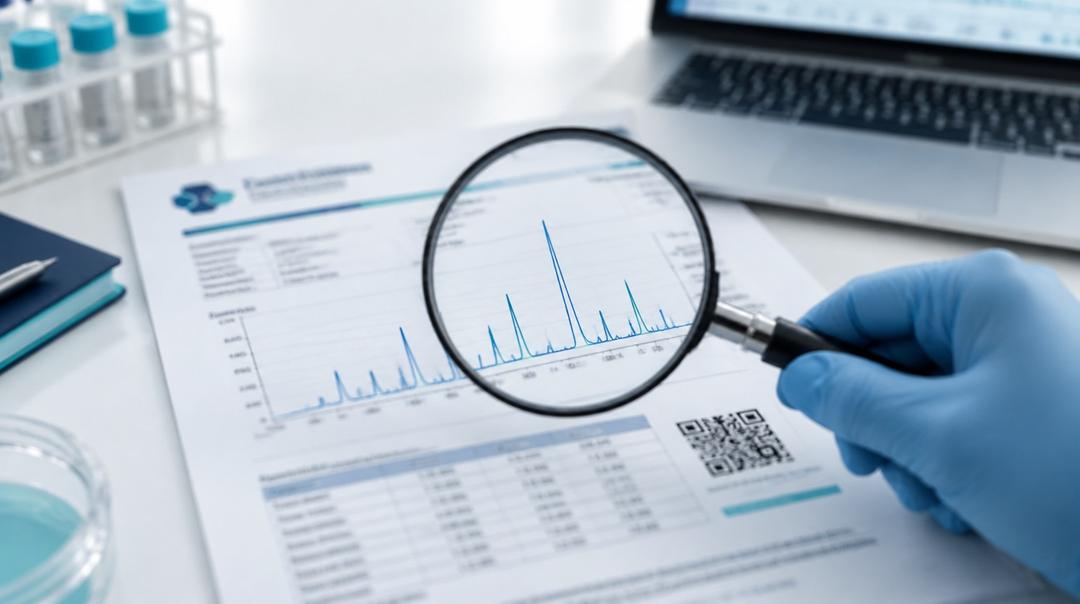
This page is about authenticity: whether a report exists, whether it is the report it claims to be, and whether it describes what you bought. What the figures on a genuine report mean is a separate question, covered in what a certificate of analysis establishes, and what no certificate can. Read the numbers only once the document has earned it.
Why a certificate needs verifying at all
A certificate usually reaches a buyer as a PDF or an image, both trivially editable and neither carrying proof of where it came from. A laboratory logo is a picture. A signature is a picture. A purity figure is a few characters in a text box.
The incentive to edit runs one way. Testing costs money for every lot, and a report showing a weak result costs a sale. The cheapest certificate is one somebody else paid for, and a report issued for one batch, or to one company, can be re-labelled for another in minutes.
This is not a hypothetical concern confined to fraud. Researchers at Ghent University ordered a set of synthetic peptides with a requested purity of at least 95.0% and ran their own quality control on arrival. They reported a large discrepancy between the purity on the suppliers' certificates and their own measurements: only 44.0% of the peptides met the requested purity, and in one sample the main compound had a different structure from the peptide ordered (Verbeke and colleagues, PMID 29403929). Those were supplier certificates in an ordinary research-reagent market. Their conclusion was that relying on the supplier's certificate alone could have serious consequences for the research built on it.
The gap is wider where nobody is accountable for the label. A 2024 study made test purchases of semaglutide vials from online sellers operating without a prescription and analysed what arrived by liquid chromatography with mass spectrometry. Measured purity fell far below what the labels stated, peptide content did not match the labelled amount, and endotoxin was detected in every sample (Ashraf and colleagues, PMID 39509151). A printed claim and a measurement are different kinds of evidence.
Step one: retrieve the original from the laboratory
The strongest single check is to get the report from its source rather than from the seller.
Verification portals and report keys. Several analytical laboratories that serve this market issue each report with a unique key, a QR code or a link that retrieves the original from the laboratory's own website. Use it, but type the laboratory's address yourself or reach it by search, rather than following a link or scanning a code printed on the seller's copy. A QR code on a forged document can point at a forged page, and a look-alike domain one letter away from the real one costs very little to register.
Writing to the laboratory. Where there is no portal, email the laboratory at an address taken from its own website and ask whether it issued a report with that number, on that date, for that sample. Many will confirm or deny the existence of a report even if they will not send a copy without the client's consent. A laboratory that has never heard of the report number has answered the question.
Comparing field by field. When you have the original, compare it with the copy you were given. Not just the purity figure: the sample description, the stated mass or fill, the lot number, the client name, the test date, the method and the chromatogram. Edits are usually made to the fields that sell — the figure, the compound name, the lot — and the rest is left untouched, which is exactly why a full comparison catches them.
| What you can check | How | What a failure means |
|---|---|---|
| The report exists | Laboratory portal, or email to the laboratory | Fabricated, or the number was invented |
| The copy matches the original | Field-by-field comparison | Edited after issue |
| The client is the seller, or its stated supplier | Client field on the original | Borrowed from another company's testing |
| The lot matches your vial | Certificate lot against vial label | A report about different material |
| The test date makes sense | Date against when the lot was offered | Recycled from an earlier batch |
| The sample matches the product | Compound, stated mass, blend components | A report for a different product |
Step two: match the lot to the vial
A genuine certificate for the wrong lot is a genuine certificate about someone else's material. The lot number, or batch number, is the only link between a document and a physical vial, and it has to appear in both places.
Check the label on the vial you received, not the lot named on the product page. If a seller publishes one certificate per product rather than per lot, the certificate cannot be about your vial except by coincidence, and you have no way to know which. If the vial carries no lot number at all, no certificate can be matched to it, and that is a fact about the seller's traceability rather than about the paperwork.
Two smaller checks belong here. The stated sample mass should match the vial size: a report on a 10 mg sample tells you little about a 5 mg product made separately. And a report on a blend should name every component it measured; a certificate that quantifies one ingredient of a multi-component vial is a certificate about one ingredient.
Signs a report has been edited or recycled
None of these proves forgery on its own. Each is a reason to verify with the laboratory before trusting the document.
- Identical chromatograms across lots. Two separate injections never produce identical baseline noise. Overlay the traces from two "different" lots; if every small wiggle matches, it is the same file.
- The same report under several sellers' names. A certificate image found on more than one storefront, with only the logo or client name changed, was issued to at most one of them. A reverse image search takes seconds.
- A client name that is not the seller. Laboratories report who submitted the sample. If that is a different company and the seller has not explained its supply chain, the report was not commissioned for this product.
- Typography that does not match. A figure in a slightly different font, weight or alignment from the surrounding text, or a field that sits off the grid the rest of the template follows.
- Document metadata. A PDF records its creating software and modification date. A laboratory report modified with an image editor weeks after its stated issue date deserves a question.
- Numbers that do not agree with each other. An observed molecular mass that does not match the compound's theoretical mass, a purity figure that does not agree with the peak table printed beside it, or peak areas that do not sum to the total.
- Dates out of order. A test date before the lot could have existed, or a single test date attached to a lot sold continuously for two years.
The question a genuine certificate still cannot answer: who chose the sample
A verified, unedited, lot-matched certificate establishes that a laboratory measured a sample labelled with that lot and recorded the result. It does not establish that the sample was representative.
In most of this market the seller chooses what goes to the laboratory. That leaves room for an unrepresentative sample — the best vial from a run, or material from a cleaner batch labelled with the lot number that needs a certificate. Even with no bad faith, one vial from a poorly mixed or unevenly filled lot may not resemble the next.
The stronger arrangements reduce the seller's control over the sample. Testing of vials bought anonymously off the shelf, testing of several vials from one lot, and repeat testing of the same lot later in its shelf life each answer a question that a single seller-submitted sample cannot. When you read a certificate, look for any statement of how the sample was obtained. Silence usually means the seller sent it.
The companion guide to evaluating a vendor's testing programme covers sample selection, accreditation and per-lot testing in more depth. For a structured way to record what you have checked, see the peptide COA grading checklist.
What verification does not do
Verifying a certificate confirms the document. It does not confirm that the methods were adequate, that the right tests were run, or that the material survived shipping. A verified report of HPLC purity alone is still silent about identity, peptide content and endotoxin; the HPLC and LC-MS explainer sets out what each method can and cannot see. And a certificate dated before your vial left the warehouse cannot describe what heat or time did to it afterwards.
This site hosts the certificates it holds, as the laboratories issued them, on its lab results page; the steps above apply to those documents exactly as they apply to anyone else's.
Frequently asked questions
How can I tell if a peptide COA is fake? Retrieve the report from the issuing laboratory, through its own verification page or by email, and compare every field with the copy you were given. Then look for identical chromatograms across lots, a client name that is not the seller, mismatched fonts, and numbers that contradict each other. No visual check replaces confirmation from the laboratory.
What if the laboratory has no verification portal? Email the laboratory at an address taken from its own website and ask whether it issued that report number, on that date, for that sample. Many laboratories will confirm whether a report exists even without releasing a copy. If you cannot find any independent contact for the laboratory at all, treat that as a finding in itself.
Does a QR code on the certificate prove it is genuine? No. A QR code is only a link, and a forged document can carry a code that points at a forged page. Reach the laboratory's site independently, by typing its address or searching for it, and enter the report key there. Check the domain carefully, since look-alike addresses are cheap to register and easy to miss.
Is one certificate per product enough? It is enough to show that some lot was tested once. It cannot describe your vial unless the lot number on the certificate matches the lot number on your label. Peptide batches differ, so a single product-level certificate reused across successive lots is a statement about history, not about the material you received.
Can a genuine certificate still be misleading? Yes. A real report can cover a sample the seller hand-picked, test only chromatographic purity, or predate months of storage and shipping. Authenticity is the first question, not the last. Once a report is verified, read what it actually measured and what it left out before relying on it.
Selected Research References
- Verbeke F, Wynendaele E, Braet S, et al. Quality evaluation of synthetic quorum sensing peptides used in R&D. J Pharm Anal. 2015;5(3):169-181. pubmed.ncbi.nlm.nih.gov/29403929
- Ashraf AR, Mackey TK, Vida RG, et al. Multifactor Quality and Safety Analysis of Semaglutide Products Sold by Online Sellers Without a Prescription: Market Surveillance, Content Analysis, and Product Purchase Evaluation Study. J Med Internet Res. 2024;26:e65440. pubmed.ncbi.nlm.nih.gov/39509151
All products sold by NovaEvum are for research and laboratory use only. They are not intended for human or animal consumption, diagnosis, treatment, cure, or prevention of any disease.