
Testing, quality and handling
Do Peptides Need to Be Refrigerated During Shipping? What Stability Data Shows
AR
· 10 min read
A summary of published research, with citations. It states no amount, schedule or route, and makes no claim about what this compound does in a person. Supplied for laboratory research use only.
On this page · 6 sections
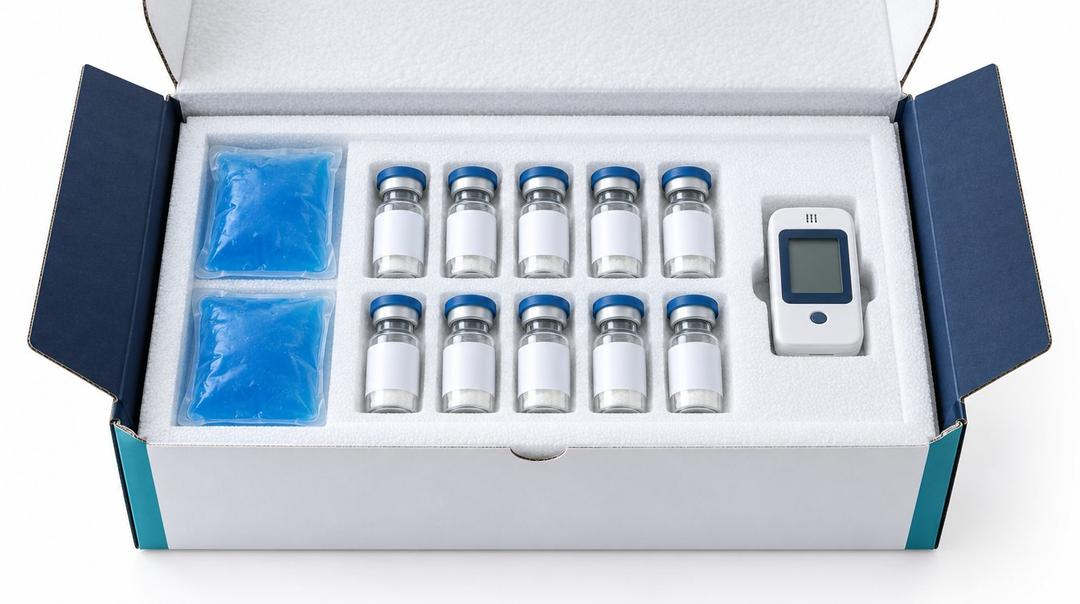
Usually not, if the peptide is lyophilised. A dry, sealed, low-moisture peptide degrades far more slowly than the same peptide in solution, and a few days at ambient temperature in transit is generally within what dried peptides tolerate. Peptides shipped in solution are different, and often do need cold-chain shipping. The rule is not universal: stability depends on the sequence and the formulation, and some dried peptides do lose material at room temperature over weeks. Only data for that specific peptide settles the question.
Why does being dry matter so much?
Most of the chemistry that damages a peptide needs water. Deamidation, hydrolysis of the backbone and many oxidation reactions run in solution, or in the mobile, water-rich parts of a solid. Lyophilisation removes most of the water and leaves the peptide in a glassy solid where molecules move very little. Reactions still happen in the solid state, and solid-state chemistry has been reviewed in detail: deamidation, peptide bond cleavage, oxidation, the Maillard reaction, beta-elimination and aggregation all occur. Their rates depend on temperature, residual moisture, excipients and whether the solid is amorphous or crystalline (PMID 10229638).
The size of the effect has been measured directly. In a study of asparagine deamidation, two model peptides held at 50 °C degraded between 2 and 80 times more slowly as lyophilised solids than in solution. Even at that temperature, far above anything a parcel should see, the solid state slowed the reaction substantially (PMID 15986465). The same study found that the ratio between the two peptides' rates depended on the matrix they were dried in. That is an early sign that stability belongs to the peptide and its formulation together, not to "peptides" in general.
Lyophilised peptides explains what the cake is and what degrades it during storage. This page is about the few days a sealed vial spends in transit.
What happens to a lyophilised peptide during a short warm excursion?
For most sealed, dry peptides, the honest answer is very little that anyone could measure. That is not the same as nothing. Three things decide whether an excursion matters:
- How long and how warm. Reaction rates rise with temperature, so a few days at room temperature is a very different exposure from weeks at room temperature, or a day in a hot vehicle.
- How much water is in the cake. Residual moisture makes the solid more mobile and speeds up degradation. A seal that lets in humid air turns a minor excursion into a real one. Recent formulation work treats water activity, together with the glass transition temperature, as the main predictor of how stable a lyophilised product will be (PMID 39809457).
- What the sequence is. Methionine and cysteine oxidise, asparagine next to glycine deamidates quickly, and some sequences aggregate. Peptide degradation pathways explains which residues are the weak points.
A study by FDA scientists of lyophilised human secretin, a 27-residue peptide hormone, shows why "dry" is not the same as "stable". Samples were stored at −20 °C, 4 °C, 25 °C, and 25 °C at 60 percent relative humidity, and tested over eight weeks. By week 8, HPLC showed a 20 to 27 percent loss of secretin. Particles appeared and the time to dissolve increased, at 25 °C with humidity as early as the first week. The excipient also changed during storage, with mannitol shifting between crystal forms (PMID 25636302). Secretin's labelled storage was −20 °C, and the study was designed to test excursions above it. Weeks of warm, humid storage harmed it. The data does not show that a few days in transit would.
Work on freeze-dried human growth hormone, a protein rather than a short peptide, found the same pattern. Very little changed during freeze-drying itself, but methionine oxidation, deamidation and aggregation built up during storage of the dried solid at 25 °C and 40 °C. The formulation decided how much (PMID 1871037).
Is a peptide in solution different?
Yes, and by a large margin. In water, a peptide is exposed to every hydrolytic and oxidative pathway at full speed. It can also aggregate, stick to surfaces and grow microbes if the solution is not sterile. Freezing and thawing add their own stress. In a study of glucagon, repeated freeze-thaw cycles triggered aggregation, and the excipient and the excipient-to-peptide ratio changed how quickly it began (PMID 39489188).
A 2026 study from an anti-doping laboratory shows how much the dry-versus-wet difference depends on the peptide. It is about biological samples, not vials. The study tracked 54 prohibited compounds in serum, plasma and dried blood spots. At 4 °C and 22 °C, several peptides, including kisspeptin-10 and LHRH, were extensively degraded within a week in both serum and plasma. BPC-157, TB-500 and vasopressin degraded completely in serum but not in plasma. In dried blood spots every compound stayed detectable for the whole study, and the authors concluded that dried samples could be shipped without refrigeration (PMID 42328738). Serum contains enzymes that a vial does not, so these numbers do not apply to a reagent. What carries over is the pattern: drying protects, and peptides differ widely once they are wet.
| Form in transit | Main risks | Cold chain usually needed? |
|---|---|---|
| Lyophilised, sealed, low moisture | Slow solid-state chemistry; moisture getting in through a damaged seal | Generally not for short transit; check the supplier's data for that peptide |
| Lyophilised, seal compromised | Water uptake, then faster chemistry and a collapsed cake | Cold does not fix a broken seal |
| Solution | Hydrolysis, oxidation, aggregation, microbial growth | Often yes; depends on the peptide and formulation |
| Frozen solution | Freeze-thaw stress if it thaws and refreezes | Yes, kept frozen without breaks |
Why can't there be one rule for every peptide?
Because stability belongs to a particular sequence in a particular formulation. Two peptides of the same length can differ by orders of magnitude in how fast they deamidate or oxidise. The same peptide can behave differently as an acetate or a trifluoroacetate salt, with or without a bulking agent, at different residual moisture. A review of protein stability makes the point at length: chemical and physical instability are linked, and formulation choices change both (PMID 20143256). Pharmaceutical manufacturers deal with this by running transport-specific stability studies. One methods paper notes that there were no official guidelines for testing products to define transport conditions, and proposes how to design such studies (PMID 21948319).
So "lyophilised peptides are stable at room temperature" is a reasonable general expectation. It is not a fact about any specific vial. Where a supplier, a monograph or a published study gives data for a specific peptide, that data overrides the general expectation.
What should a receiving laboratory check?
Receipt is the only moment when the shipment can be inspected, so record it then. Handling research peptides covers receipt and storage in full. For temperature specifically:
- Note the parcel's condition and how long it was in transit. Write down the ship and receipt dates, and whether cold packs were present and still cold. If they had warmed, record that. You cannot recover the temperature history later.
- Inspect the vials before opening them. Check that seals and caps are intact and that no liquid has appeared where there should be a solid. Note any discolouration, and whether the cake has collapsed or melted back. A cake that has moved or cracked is usually cosmetic. A cake that has liquefied points to moisture.
- Let the vial reach room temperature before opening it. Opening a cold vial draws condensation onto a hygroscopic solid, which adds the water that drying removed.
- Match the lot to its certificate. The certificate describes the material at the time it was tested. It says nothing about transit. What a certificate of analysis establishes explains that gap.
- Store it as the label says, straight away. Most lyophilised peptides are labelled for frozen storage, and some for refrigeration. Follow the label for that lot.
- If an excursion matters to the experiment, test it. An HPLC run against the certificate's chromatogram, or a mass check, will show whether degradation products have appeared. Without that, record the excursion and interpret the results with it in mind.
If a lot arrives with an unknown temperature history and the experiment depends on exact content, the cautious course is to analyse it before use. Research use only: what the label means covers how to document reagents so that a later reader can judge them. Whatever the transit, these materials are for laboratory research only.
Nothing here is medical, dosing, or therapeutic guidance.
Frequently asked questions
Do lyophilised peptides need ice packs when shipped? For short domestic transit, sealed and dry, most do not need them to stay within what their solid-state stability allows. Ice packs reduce heat exposure, which helps in hot weather or with long delays. They do not replace a good seal or low moisture, and they can cause condensation if the vial is opened cold.
How long can a lyophilised peptide stay at room temperature? It depends on the peptide and the formulation. Short excursions of a few days are generally well tolerated by dry, sealed material. But published data on lyophilised secretin showed measurable loss and particle formation over weeks at 25 °C, so weeks at room temperature can matter. Use data for that peptide where it exists.
My parcel arrived warm. Is the peptide ruined? Probably not, if the vials are sealed and the cake is dry and intact. Record the condition and the transit time, store the vials as labelled, and judge the risk by how sensitive your experiment is. If exact content matters, check the material by HPLC against the certificate before relying on it.
Why do peptide solutions need to stay cold? In water, hydrolysis, deamidation, oxidation and aggregation all run much faster than in a dry solid. Measured deamidation rates in model peptides were up to 80-fold higher in solution than in the lyophilised state at the same temperature. Microbial growth is a further risk in non-sterile solutions.
Selected Research References
- Lai MC, Topp EM. Solid-state chemical stability of proteins and peptides. Journal of Pharmaceutical Sciences. 1999;88(5):489-500. pubmed.ncbi.nlm.nih.gov/10229638
- Li B, O'Meara MH, Lubach JW, et al. Effects of sucrose and mannitol on asparagine deamidation rates of model peptides in solution and in the solid state. Journal of Pharmaceutical Sciences. 2005;94(8):1723-1735. pubmed.ncbi.nlm.nih.gov/15986465
- Srinivasan C, Siddiqui A, Korang-Yeboah M, Khan MA. Stability characterization and appearance of particulates in a lyophilized formulation of a model peptide hormone-human secretin. International Journal of Pharmaceutics. 2015;481(1-2):104-113. pubmed.ncbi.nlm.nih.gov/25636302
- Pikal MJ, Dellerman KM, Roy ML, Riggin RM. The effects of formulation variables on the stability of freeze-dried human growth hormone. Pharmaceutical Research. 1991;8(4):427-436. pubmed.ncbi.nlm.nih.gov/1871037
- Zäh M, Brandenbusch C, Groël S, et al. Water Activity as an Indicator for Antibody Storage Stability in Lyophilized Formulations. Molecular Pharmaceutics. 2025;22(2):918-926. pubmed.ncbi.nlm.nih.gov/39809457
- Zäh M, Brandenbusch C, Artusio F, et al. DSC reveals the excipient impact on aggregation propensity of pharmaceutical peptides during freezing. European Journal of Pharmaceutical Sciences. 2025;204:106954. pubmed.ncbi.nlm.nih.gov/39489188
- Mazzarino M, Colpaert T, Deventer K, Van Eenoo P. Rapid and harmonized analytical workflow for the determination of peptidic and non-peptidic doping agents in dried and liquid blood matrices. Analyst. 2026;151(15):4398-4413. pubmed.ncbi.nlm.nih.gov/42328738
- Manning MC, Chou DK, Murphy BM, et al. Stability of protein pharmaceuticals: an update. Pharmaceutical Research. 2010;27(4):544-575. pubmed.ncbi.nlm.nih.gov/20143256
- Ammann C. Stability studies needed to define the handling and transport conditions of sensitive pharmaceutical or biotechnological products. AAPS PharmSciTech. 2011;12(4):1264-1275. pubmed.ncbi.nlm.nih.gov/21948319
All products sold by NovaEvum are for research and laboratory use only. They are not intended for human or animal consumption, diagnosis, treatment, cure, or prevention of any disease.