A summary of published research, with citations. It states no amount, schedule or route, and makes no claim about what this compound does in a person. Supplied for laboratory research use only.
On this page · 9 sections
Quick answer: NAD+ is the coenzyme itself. NMN (nicotinamide mononucleotide) and NR (nicotinamide riboside) are smaller molecules that cells convert into NAD+, which is why they are called precursors. The human trials of NMN and NR are small and short, and what they mostly show is that blood NAD+ levels go up. Whether that changes anything a person would notice is a separate question, and the trials that measured function report mixed results.
The three are sold, discussed and argued about as if they were interchangeable ways of reaching the same place. They are not the same molecule, they do not enter the cell the same way, and the evidence for each was gathered differently.
What NAD+ does
Nicotinamide adenine dinucleotide carries electrons. In its oxidised form, NAD+, it accepts them from food-derived fuels; in its reduced form, NADH, it hands them to the mitochondrial electron transport chain. That role is textbook biochemistry and is not in dispute.
NAD+ is also consumed. Enzymes including the sirtuins, the PARPs and CD38 break it down as part of their own signalling, so the cell has to keep remaking it. Reviews by Verdin (PMID 26785480) and by Covarrubias and colleagues (PMID 33353981) describe how NAD+ levels decline with age in several tissues and why that decline became a research target. NAD+ and the mitochondrion covers the coenzyme's role in more depth.
Three molecules, three entry points
| NAD+ | NMN | NR | |
|---|---|---|---|
| What it is | The coenzyme | Nicotinamide mononucleotide, one step before NAD+ | Nicotinamide riboside, two steps before NAD+ |
| How cells use it | Made inside the cell, not generally taken up intact | Converted to NAD+ by NMNAT enzymes | Phosphorylated to NMN by NRK enzymes, then to NAD+ |
| Main human evidence | Little for the molecule given from outside | Small randomised trials since 2021 | Several randomised trials since 2016 |
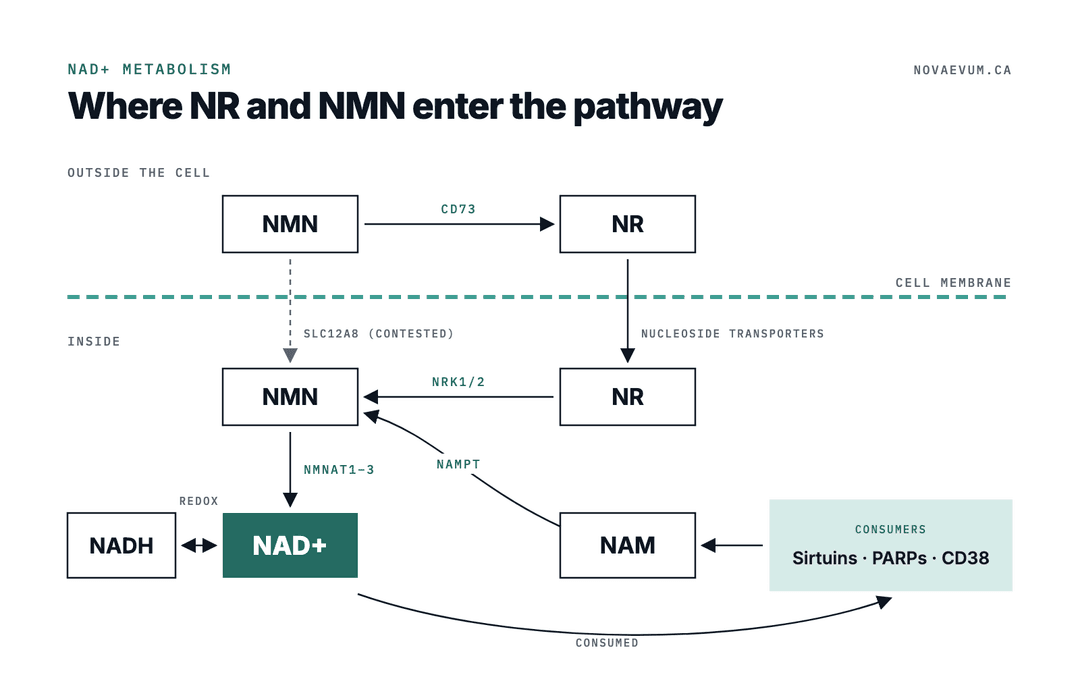
The order matters. NR was shown to be a route to NAD+ through dedicated kinases in 2004 (PMID 15137942); NR becomes NMN, and NMN becomes NAD+. Because NAD+ itself is large and charged, extracellular NAD+ is generally thought to be broken down to smaller precursors before cells take it in, which is part of why research attention moved to the precursors.
Even how NMN gets into cells is contested. Grozio and colleagues reported in 2019 that a protein called Slc12a8 transports NMN directly (PMID 31131364). Schmidt and Brenner replied in the same journal that the evidence did not support that conclusion (PMID 32694648), and the original authors answered (PMID 32694650). The exchange is worth reading as an example of how unsettled basic mechanism still is.
What the NR trials measured
NR has the longer human record. Trammell and colleagues showed it is orally bioavailable in mice and humans and raises NAD+ metabolites (PMID 27721479). Martens and colleagues ran a randomised crossover trial in healthy middle-aged and older adults and found NR well tolerated and blood NAD+ raised (PMID 29599478).
Function is where the picture gets mixed. Dollerup and colleagues gave NR or placebo to obese, insulin-resistant men for twelve weeks and found no change in insulin sensitivity (PMID 29992272). Elhassan and colleagues found NR raised the NAD+ metabolome in aged human muscle and altered gene-expression signatures there (PMID 31412242). The NADPARK study, a phase 1 trial in Parkinson's disease, reported that NR raised NAD+ levels measured in the brain and was well tolerated (PMID 35235774). Raised levels are a consistent finding; changes in clinical endpoints are not.
What the NMN trials measured
NMN's case began in animals. Mills and colleagues gave NMN to mice over twelve months and reported that it mitigated several age-associated physiological changes (PMID 28068222).
The human trials are newer and small. Yoshino and colleagues studied 25 prediabetic postmenopausal women and reported an increase in muscle insulin sensitivity after ten weeks (PMID 33888596). Igarashi and colleagues reported raised blood NAD+ and some changes in muscle function measures in healthy older men (PMID 35927255). Yi and colleagues ran a randomised, double-blind, multicentre trial in healthy middle-aged adults and reported raised blood NAD+ (PMID 36482258). Each is a short trial with a modest number of participants.
Why a raised level is not an outcome
Every trial above measured something real. Most of what they measured is a biomarker: NAD+ or its metabolites in blood or tissue. A biomarker is useful because it shows a compound reached its target. It does not show that anything a person cares about changed.
The gap between the two is the whole question. The review by Rajman, Chwalek and Sinclair (PMID 29514064) and the one by Yoshino, Baur and Imai (PMID 29249689) both set out the animal evidence and the open questions for people. Long trials with clinical endpoints, in defined populations, are what would settle it, and they have not been published. How to read a research study explains why the endpoint is the first thing to check.
Why the evidence does not transfer between them
A trial of NR is not a trial of NMN. They enter metabolism at different steps, through different enzymes, and the trials used different populations and durations.
A capsule trial is not evidence about a vial. The human NR and NMN data concerns oral supplements. It says nothing about lyophilised NAD+ research material, a different molecule in a different form.
Mouse lifespan is not human lifespan. Mouse studies are where the ageing hypothesis comes from, and they are the reason the human trials exist, not a substitute for them.
Frequently asked questions
Is NMN the same as NAD+? No. NMN is a precursor that cells convert into NAD+ in one enzymatic step.
Is NR the same as NMN? No. NR is one step further back: cells phosphorylate NR to make NMN, then convert NMN to NAD+.
Do NMN and NR raise NAD+ levels in people? Several randomised trials report raised NAD+ in blood, and some in muscle or brain. That is the most consistent finding in the literature.
Does raising NAD+ prove a longevity effect? No. Raised levels are a biomarker. No published human trial has shown an effect on lifespan, and trials of functional endpoints report mixed results.
Supplied here for laboratory use: NAD+. The laboratory's certificate for each lot is linked from its product page. For laboratory research use only.
Further reading
References
- Verdin E. NAD+ in Aging, Metabolism, and Neurodegeneration. Science. 2015;350(6265):1208-1213. pubmed.ncbi.nlm.nih.gov/26785480
- Covarrubias AJ, Perrone R, Grozio A, Verdin E. NAD+ Metabolism and Its Roles in Cellular Processes during Ageing. Nature Reviews Molecular Cell Biology. 2021;22(2):119-141. pubmed.ncbi.nlm.nih.gov/33353981
- Bieganowski P, Brenner C. Discoveries of Nicotinamide Riboside as a Nutrient and Conserved NRK Genes Establish a Preiss-Handler Independent Route to NAD+ in Fungi and Humans. Cell. 2004;117(4):495-502. pubmed.ncbi.nlm.nih.gov/15137942
- Grozio A, Mills KF, Yoshino J, et al. Slc12a8 Is a Nicotinamide Mononucleotide Transporter. Nature Metabolism. 2019;1(1):47-57. pubmed.ncbi.nlm.nih.gov/31131364
- Schmidt MS, Brenner C. Absence of Evidence That Slc12a8 Encodes a Nicotinamide Mononucleotide Transporter. Nature Metabolism. 2019;1(7):660-661. pubmed.ncbi.nlm.nih.gov/32694648
- Grozio A, Mills K, Yoshino J, et al. Reply to: Absence of Evidence That Slc12a8 Encodes a Nicotinamide Mononucleotide Transporter. Nature Metabolism. 2019;1(7):662-665. pubmed.ncbi.nlm.nih.gov/32694650
- Trammell SA, Schmidt MS, Weidemann BJ, et al. Nicotinamide Riboside Is Uniquely and Orally Bioavailable in Mice and Humans. Nature Communications. 2016;7:12948. pubmed.ncbi.nlm.nih.gov/27721479
- Martens CR, Denman BA, Mazzo MR, et al. Chronic Nicotinamide Riboside Supplementation Is Well-Tolerated and Elevates NAD+ in Healthy Middle-Aged and Older Adults. Nature Communications. 2018;9(1):1286. pubmed.ncbi.nlm.nih.gov/29599478
- Dollerup OL, Christensen B, Svart M, et al. A Randomized Placebo-Controlled Clinical Trial of Nicotinamide Riboside in Obese Men: Safety, Insulin-Sensitivity, and Lipid-Mobilizing Effects. American Journal of Clinical Nutrition. 2018;108(2):343-353. pubmed.ncbi.nlm.nih.gov/29992272
- Elhassan YS, Kluckova K, Fletcher RS, et al. Nicotinamide Riboside Augments the Aged Human Skeletal Muscle NAD+ Metabolome and Induces Transcriptomic and Anti-inflammatory Signatures. Cell Reports. 2019;28(7):1717-1728. pubmed.ncbi.nlm.nih.gov/31412242
- Brakedal B, Dölle C, Riemer F, et al. The NADPARK Study: A Randomized Phase I Trial of Nicotinamide Riboside Supplementation in Parkinson's Disease. Cell Metabolism. 2022;34(3):396-407. pubmed.ncbi.nlm.nih.gov/35235774
- Mills KF, Yoshida S, Stein LR, et al. Long-Term Administration of Nicotinamide Mononucleotide Mitigates Age-Associated Physiological Decline in Mice. Cell Metabolism. 2016;24(6):795-806. pubmed.ncbi.nlm.nih.gov/28068222
- Yoshino M, Yoshino J, Kayser BD, et al. Nicotinamide Mononucleotide Increases Muscle Insulin Sensitivity in Prediabetic Women. Science. 2021;372(6547):1224-1229. pubmed.ncbi.nlm.nih.gov/33888596
- Igarashi M, Nakagawa-Nagahama Y, Miura M, et al. Chronic Nicotinamide Mononucleotide Supplementation Elevates Blood Nicotinamide Adenine Dinucleotide Levels and Alters Muscle Function in Healthy Older Men. NPJ Aging. 2022;8(1):5. pubmed.ncbi.nlm.nih.gov/35927255
- Yi L, Maier AB, Tao R, et al. The Efficacy and Safety of β-Nicotinamide Mononucleotide (NMN) Supplementation in Healthy Middle-Aged Adults: A Randomized, Multicenter, Double-Blind, Placebo-Controlled, Parallel-Group, Dose-Dependent Clinical Trial. GeroScience. 2023;45(1):29-43. pubmed.ncbi.nlm.nih.gov/36482258
- Rajman L, Chwalek K, Sinclair DA. Therapeutic Potential of NAD-Boosting Molecules: The In Vivo Evidence. Cell Metabolism. 2018;27(3):529-547. pubmed.ncbi.nlm.nih.gov/29514064
- Yoshino J, Baur JA, Imai SI. NAD+ Intermediates: The Biology and Therapeutic Potential of NMN and NR. Cell Metabolism. 2018;27(3):513-528. pubmed.ncbi.nlm.nih.gov/29249689
All products sold by NovaEvum are for research and laboratory use only. They are not intended for human or animal consumption, diagnosis, treatment, cure, or prevention of any disease.